I'll probably get bashed all to crap on my opinion.Piebald bloodreds to me aren't the same thing as the w/c genetic forms of ball pythons found in nature!I have never seen a corn with the complete white banding that you see in these.I have some bloodreds corns in my collection that exhibit some white coloration on theirflanks but,they are just that,bloodreds! Jeff
Reptile & Amphibian Forums
Welcome to kingsnake.com's message board system. Here you may share and discuss information with others about your favorite reptile and amphibian related topics such as care and feeding, caging requirements, permits and licenses, and more. Launched in 1997, the kingsnake.com message board system is one of the oldest and largest systems on the internet.



pied bloodreds
cochran
Dec 26, 2008 09:48 PM
Replies (20)
DonSoderberg
Dec 26, 2008 11:15 PM
Hence, the reason I didn't call these piebald or pied bloodreds. Since the white on these is relegated to the sides, I named this mutation pied-sided bloodreds. Also, whatever genetic function(s) cause the p/s bloods, it seems to be linked only to bloodreds. We'll know for sure this year, but they'll still only be p/s corns, if in fact non bloodreds can have it. I didn't want to ruin things for the person that comes up with the first TRUE piebald corn.
SO, the reason they don't look alike is beacause we don't yet have a pied (piebald corn).
Tom_AF_Guy
Dec 27, 2008 03:43 AM
what about that wildcaghut corn fond a while back, lucy? i think it was. cant remember, if that was it, what ever happened to it...hope its not a dead end.
-----
2.1.1 leopard geckos
1.1 golden thread turtles
1.0 reticulated python
2.1 firebelly toads
0.0.1 pacman frog
0.1 creamsicle corn
tspuckler
Dec 27, 2008 07:47 AM
That snake wasn't a piebald and has yet to be proven as having genetically inheritable features.
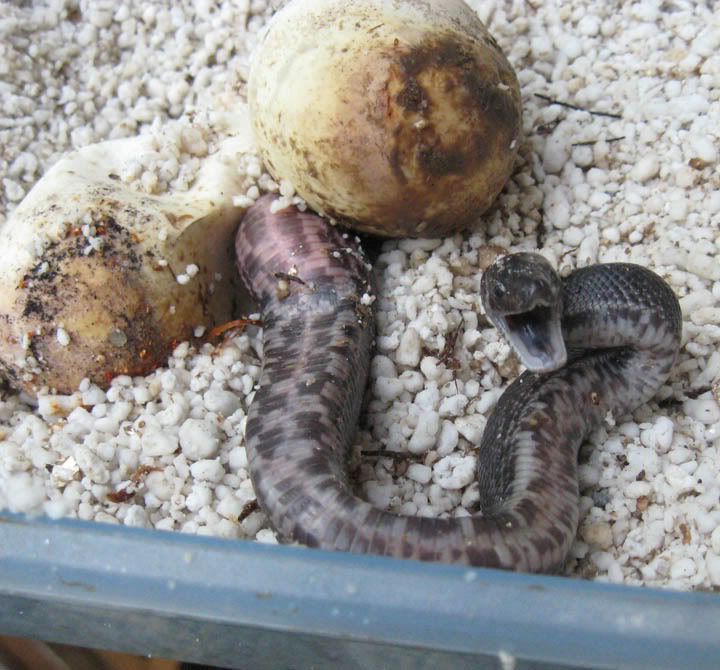
To answer Jeff's question, there are no colubrid snakes that I know of that are piebald in the same manner as ball pythons. There's a piebald black pine which has more white than piedsided bloodred corns, but that white tends to mainly occur on the head and sides of the snake.
Tim
Non-piebald black pine that I hatched this summer:
Third Eye
HerpZillA
Dec 27, 2008 08:31 AM
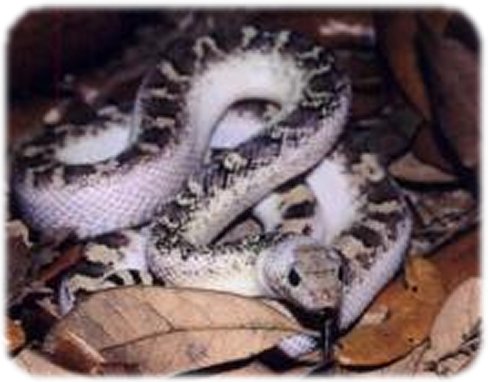
I'm not even sure how i got this? I think from a youth guy in Texas. he breeeds a lot of gophers. I'm not even sure it is real? but you post got me to remember the image and I went hunting for it.
Real or not is the 1st question I guess.
I hope it's real, its rather cool. If real i may? be able to get info on where he got it.
-----
Thanks for reading.
Big Tom
xblackheart
Dec 27, 2008 01:08 PM
isnt that just called licorice? I have seen snakes looking like that. I think they are rat snakes though, not gophers.
-----
****Misty****
www.sneakyserpents.com
"The more things change, the more they remain Insane"
HerpZillA
Dec 27, 2008 01:24 PM
Sounds right. Something I don't really follow. but I have seen pics.
-----
Thanks for reading.
Big Tom
sean1976
Dec 28, 2008 02:02 AM
... A white-side bullsnake to me.
The white-sided gene is a common gene in the bullsnakes. I know I have seen it in other species but if memory serves me it is more prevalent in the pituophis group(bulls, gophers, pines). Also many people confuse or lump bullsnakes and gophersnakes as the same thing. I am no expert on bulls as I've only kept gophers myself(of the pituophis species) but the pic does remind me of some.
Sean.
-----
1.1 BRB
0.1 Pacific Gophersnake(unproven Hypo)
1.0 Amel Pacific Gophersnake
0.1 Striped Anery Pacific Gophersnake
1.1 Triple Het TPRS's
0.1 Silver TPRS
1.1 Amel Bloodred Corns
0.1 Abbott Okeetee Corn
0.1 Blizzard Bloodred Corn
1.1 Thayeri Kingsnakes
0.1 Reeve's Turtle
0.2 Amstaff's
1.0 Pudytat
crocman6594
Dec 28, 2008 06:28 PM
it looks like a white sided bull snake to me.
HerpZillA
Dec 27, 2008 08:07 AM
Don I posted this earlier. My apoligizes if you did not want to respond? but I figured you may have nissed it? this is just a copy and paste so it may read a bit odd. It was in reference to the image of the PS richie rich bought for $30.
Don I was at a show several months back in Cleveland. A guy had a "pied sided" bloodred baby in deli cup for $200. After I screwed my neck back on, I gathered myself to check this out in a casual manner, using my rather large frame to stop anyone else near the area. (It has to be good for something lol).
Well, it was a little bloodred male and as I was looking for those long white sides, then little white sides. I honestly saw nothing. I asked casually is this mis marked? The guy said no let me show ya. OK, it had a few scales, or portion of scales, with specs of white. Maybe 2-3 connected at most. I play coy as I'm not sure where pied begins and ends with white. But I'm going to be 50 yo soon, and grew up in Cleveland, so I smelt a scam?
So I asked is it a genetic pied or the other type? This is now a test of people that can BS. He was at a loss for words. Before he could answer I asked if the parents were pieds or known het for pieds? He knew I'd ask to see pics so he was honest and said no on the parents. I showed a lot of interest and passed. Maybe I screwed up? But he told me pieds are now popping up all over out of regular blood reds. At this point I bit my tongue and left quickly.
I am sure I see a spec of white here and there on a couple of my bloods. I figured this is just the chance of having a white belly and a bit of the white making its way around the corner up the side a tiny bit. Am I right?
And is pied sided a simple recessive trait? or more a trait of white and you line breed to make it as white as possible? Or both of those?
The spec of white bloodred at the show reminded me of the leucistic beardies. Line bred to be light in color was not a leucistic beardie to me.
Don I know you love your corns and you of anyone would know that is a pied. But for us lay persons, how will we be able to discern a pied from a guy breeding line bred stuff with a little white?
Sorry so long.
-----
Thanks for reading.
Big Tom
DonSoderberg
Dec 27, 2008 08:48 AM
I pecked out a huge response to that, back when it was posted. I know this sounds selfish of me, but when I was just finishing it, the electricity went out from a storm we had, and I discovered the power back up I had on that computer has a bad battery. Fixed that, but in all the time from beginning to end of that disappointment, I opted to get back to it later. About that time, I decided to sequester myself for working on the book and have been somewhat incommunicado ever since. I went to your web site, and sent you a letter explaining that I was not ignoring you, but it came back undeliverable. Last night was the first time I’ve been to the forum in over a week, and as soon as I saw that thread, I sent a message to your KS mailbox. It should be there now.
I don’t have a lot of time right now, but here’s the nuts and bolts of the A to your Q :
We’ve been seeing white on the sides of bloodreds for over 15 years. This is why I thought Walter was crazy when he wanted to borrow one of my breeder females that had little bits and pieces of white on the sides. Turns out, I was the crazy one. After seeing the sensational babies from those two animals, I was tongue-tied. Point one: there are still bloods out there with bits of white on their sides that will not send that trait to their progeny. I’m sure some of them will, but there’s only one way to find out, so I recommend folks don’t open their wallets when they see one at a show. As you point out, if they can show you the adults with lots of white on them, go for it. Point two: not unlike piebaldism in ball pythons, no two p/s bloods have the same volume of white. As I said yesterday, the white is always relegated to the sides and is virtually always conjunct with the belly (exception some white on the faces of some), BUT you never know how much white you’re going to get. This is not an all-or-nuthin mutation like white-sided. Hence the reason I couldn’t call them white-sided. We’ll surely have that in corns someday, and I didn’t want someone cursing me for misusing that term (like piebaldism) for this line. Conclusion: the jury’s still out about this “gene”. Is it actually polygenetics, modifying the interactions of genes OR is it actually a gene? We should know this year, but no matter what is discovered, I suspect it will be linked only to bloodreds. BTW, you referred to the scant amount of white on the sides of the one you saw at a show. For every good p/s blood I hatch (over 75 in the past three years), I get six that have just a few white scales on the sides. Unfortunately, in variable traits like this (like candy canes), they're not all worthy of the morph title. Many of the "regular" bloods I sold this year were actually siblings of good p/s bloods, but they showed little or no white. Naturally, I didn't tell those customers what they have. They just think they got killer bloods from me, since they all have the amazing patternless red sides. Rob and Louise Stevens at Bayou have some of my stock, and have made some killer p/s bloods. I know this year, I’ll see some F2 outcrosses (and so will they). I think by the end of this coming summer, we’ll be able to make a declaration about the mechanics of this “trait”.
Don

cochran
Dec 27, 2008 09:09 AM
Wow Don! That's a beauty!! That all makes sense! You're right,I've never seen one listed as piebald,it's always "pied sided."
Jeremy Pierce
Dec 27, 2008 09:12 AM
Hello Don! That is one beautiful animal. Hope you and yours had a great christmas and that you and the mrs. were able to relax and rest some! Take care my friend and happy new year!
Jeremy
-----
Jeremy Pierce
Shade Tree Exotics
shade-tree-exotics@att.net

HerpZillA
Dec 27, 2008 09:34 AM
The only thing I'll add is I can't see the pied sided only staying in bloodreds. It may take some time, but I would think if you have a killer pied sides bloodred and bred him to a, lets say okeetee, those genes have/should be in those okeetee babies. Just breeding the babies to find some of that pied sided, and of course bring the okeetee look back. Ya know it's coming. Then someone will think "what if" I make a pied sided blizzard?
Or a pied sided lucy! What would that bring at Daytona? lol
Cool stuff for sure.
Thanks
Don
-----
Thanks for reading.
Big Tom
DonSoderberg
Dec 27, 2008 11:23 AM
There is preliminary evidence to suggest that the p/s trait is simply a variation, exaggeration, or extension of diffusion. Diffusion is a prominent trait of bloodreds, so there is a likelihood that what we are seeing in p/s bloods is actually the first stages of the final product of THE ULTIMATE BLOODRED, derived from selective breeding refinement. Early in the history of the bloodred morph (and still today), we see individuals that show almost no diffusion. It is now believed that what we call a bloodred is actually an aggregate of the basic physiology of the mutation, AND polygenic enhancements. In other words, the extreme diffusion exhibited in the best examples of bloodreds is only possible in bloodreds. We have not been able to infuse that diffusion attribute into the genes of other corn morphs (indicating that diffusion is gene linked to bloodreds). Hence, whether the pied-sided effect IS or is NOT genetically recessive, this particular random and variable trait is likely unique to bloodreds. IF p/s proves to be a recessive gene, there’s a good chance it can be promoted in other corns. Fingers crossed.
South Mountain Reptiles
ekestam
Dec 29, 2008 04:49 AM
I trust and believe your suggestion that the pied is a polygenic enhancement of the bloodred strains, but...
In time it is likely that new selectively bred bloodred morfs are produced with combinations of genes or multiple gene traits from other morfs.
One good prospect morf to ad more white colour should be the High-White Reverse Okeetee. Those okeetees have genes (probably not simple recessive) for lots of white.
High-White Reverse Okeetee
http://www.vmsherp.com/ImagePages/Corns/HWReverseOkeetee.htm
http://www.vmsherp.com/images/Corns/HWReverseOkeetee.JPG
/Niklas

DonSoderberg
Dec 29, 2008 08:49 AM
Many genes are involved in the rendering of ground coloration in snakes. In the common form of corns, the ground color we see is the result of many genes controlling many different aspects of color, shade, hue, ect. (all aspects of those color zones). Those genes are raw materials of the final phenotype. Quantatitively speaking, polygenetics modify interactions between genes, which essentially changes the aggregate physiology (form AND appearance). This is what makes no two organisms identical (except for genetic clones, of course). If there was only one gene that dictated ground coloration, virtually all corns would have the same ground color, and only mutations of that gene would be different. Again, without polygenetics, that would amount to just a few ground colors in snakes, with no middle "tweeners". Instead, we have thousands of different ground colors in corns. Your nose; it's shape, size, color, etc. are not the result of one gene. Many different genes makes your nose different from your friends, neighbors, and even your brothers and sisters. Then, trait modifications between those genes causes it to be distinct.
Therefore, high whites are selectively bred products of many generations. We're still not done with those. I'm on my third generation of high whites now, and some are incredible, but their looks are not from a gene mutation that I can isolate, and breed into other snakes. Same with candy canes. One reason they're so annoyingly frustrating is because good ones are NOT the product of one gene. If they were, all candy canes would be equal. Polygenetic traits are heritable. That's how we get more than one of any desired feature. We can duplicate results of polygenetics, but not predictably (like we can with gene mutations).
Finally:
Look at albino corns. No two are alike. They're all albinos, but all have distinctions that make them unique. Polygenetics changed the degree of interactions between genes that work together to render color, pattern, and relationships between them. Hence, we see hundreds of different looks in albinos.
boxienuts
Dec 31, 2008 04:21 PM
Don,
That is without a doubt the best explination of genetics beyond Mendel's punnet square as it relates to snakes that I have read on kingsnake yet to date, it reaffirmed why I enjoyed reading your book so much, but clearly you could expand on your genetics chapter, and I hope you will in your next book. I can't wait to read it!
Jeff
-----
Jeff Benfer
1.0 cinnamon pastel Python regius
1.1 pastel Python regius
1.1 mojave Python regius
0.3 normal Python regius
1.3 Terrapene carolina thriunguis
2.3 Terrapene carolina carolina
4.1 Kinosternon baurii
1.1 Malaclemys terrapin terrapin
2.2 double het albino and anerythristicThamnophis sirtalis parietalis
1.0 anerythristic Thamnophis sirtalis parietalis
2.3 Iowa snow Thamnophis radix
0.2 het Christmas albino Thamnophis radix
1.1 double het cherry erythristic, albino Thamnophis sirtalis sirtalis
1.1 melanistic Thamnophis sirtalis sirtalis
2.0 66% het snow Thamnophis sirtalis sirtalis
1.1 triple heterozygous for amelanistic,carmel, and stripe Pantherophis guttatus
0.1 anerythristic motley Pantherophis guttatus
0.1 butter p.h. stripe Pantherophis guttatus
0.1 carmel stripe p.h. amel Pantherophis guttatus
0.1 amelanistic p.h. carmel,stripe Pantherophis guttatus
DonSoderberg
Dec 31, 2008 04:40 PM
The first book was written for entry-level corn snake owners, but the next one will be much larger. It have much greater depth, since it's written for breeding-level corn snake keepers.
boxienuts
Dec 31, 2008 06:57 PM
Excellent, do you have an estimated time of publish? Mainly, I want to know if I can put it on next years Xmas wish list?  This summer I hope to buy a pair of your outstanding amel bloodreds, they are at the very top of my cornsnake want list. I was planning to get a pair this year but I ended up keeping too many holdbacks for the space I have allowed. The pied-sided bloods are very interesting too, just visually not my cup of tea....yet, but they may grow on me in time. Any plans to produce an amel pied-sided bloodred or ideas of what effect on the pied-sided the amel would have?
-----
Jeff Benfer
1.0 cinnamon pastel Python regius
1.1 pastel Python regius
1.1 mojave Python regius
0.3 normal Python regius
1.3 Terrapene carolina thriunguis
2.3 Terrapene carolina carolina
4.1 Kinosternon baurii
1.1 Malaclemys terrapin terrapin
2.2 double het albino and anerythristicThamnophis sirtalis parietalis
1.0 anerythristic Thamnophis sirtalis parietalis
2.3 Iowa snow Thamnophis radix
0.2 het Christmas albino Thamnophis radix
1.1 double het cherry erythristic, albino Thamnophis sirtalis sirtalis
1.1 melanistic Thamnophis sirtalis sirtalis
2.0 66% het snow Thamnophis sirtalis sirtalis
1.1 triple heterozygous for amelanistic,carmel, and stripe Pantherophis guttatus
0.1 anerythristic motley Pantherophis guttatus
0.1 butter p.h. stripe Pantherophis guttatus
0.1 carmel stripe p.h. amel Pantherophis guttatus
0.1 amelanistic p.h. carmel,stripe Pantherophis guttatus
DonSoderberg
Dec 31, 2008 07:11 PM
What is it with you guys. You must know my publisher. He keeps asking the same question, "when will the book be done?". lol. I wish I could answer that, but I hope it's this summer. Fingers crossed. Like my eyes are now, from working on the books for eight straight days this week. Uuuugghhh.
I have one amel p/s blood that may be breedable this year. Fingers crossed.
