is this required to get kings ready for breeding or does it just improve the odds have having eggs.
Reptile & Amphibian Forums
Welcome to kingsnake.com's message board system. Here you may share and discuss information with others about your favorite reptile and amphibian related topics such as care and feeding, caging requirements, permits and licenses, and more. Launched in 1997, the kingsnake.com message board system is one of the oldest and largest systems on the internet.



hybernation/cool down
insane_racing618
Jan 03, 2009 11:47 AM
Replies (39)
FR
Jan 03, 2009 01:42 PM
They hibernate/brumate to avoid harsh conditions, as in, the winter cold or the summer heat. As in, to avoid conditions unsuitable to acquire normal support.
People hibernate them because they do not know any better, in some cases. As in, taking others advice. Or to avoid working on your snakes over the winter, you know, as rest period for the keepers. Which is really good when you have lots of snakes.
Back to your question, its not needed in any way for colubrid snakes to reproduce. Cheers
RickD
Jan 03, 2009 03:33 PM
wouldnt hibernation cycle them so we know ,like a recipe, when they will breed....if we dont do this how do we know when they are ready
thanks
rick
FR
Jan 03, 2009 06:28 PM
Why do you need a recipe? When a female snake cycles, its VERY obvious, you can tell twenty feet away, if your good. If your not that good, all you have to do is get closer. If you have to, you can easily and simply palpate them.
Before a female cycles, she builds internal fat, which is very easy to notice. Then she converts that fat to ovum, which is VERY easy to feel. To palpate, is what that is called and its a key tool in captive husbandry and field work. Cheers
RickD
Jan 03, 2009 11:15 PM
no im not that good but im sure going to watch the females and try to recognize when they are cycling
thanks
FR
Jan 04, 2009 08:40 AM
How you become good at this, Is to know it exsists and then learn how. Its very very easy to learn. heck, learning to wash dishes is much harder or working a mp3 player. Heck, learning to this computer stuff is a million times harder.
The first pattern you look for is how they hold their weight. In the spring a female will feed and have a mid body lump. Then as she digests that bolus, she becomes thicker farther down her body, above her vent. When she passes her food(deficates) she is back to normal. But, if she passes her fecal matter and does not slim down, that is an indication she is building up pre ovulation fat.
Once she does that, she will then drop ovum and they will form a "string of pearls". If you let her crawl between two fingers, do not squeeze, just let her crawl. You will feel these "pearls". Place your fingers slightly less then her diameter apart. You can practice this with males. If its too tight, they will simply stop crawling thru and try to back out. Warning, do not increase your pressure. There is no need to do that.
As the ovum develop there will be less space between them. In no time, you will be able to not only tell when she is ready to copulate, but how many eggs there are and even if they are fertile.
Of course there are other signs(ways they talk to you) If a female is gravid and fairly far along, all you have to do is place one finger under her mid-body and lift. If she tightens and curls her lower body, she is gravid and most likely with fertile eggs. U do not have to lift her all the way off the ground.
Once you learn this, you are no longer confined to time of year, or captive snakes. You can apply you knowledge to other keepers snakes and wild snakes too. You will be surprise how many people, HAVE NO CLUE what their snakes are doing.
Again, these are only a few SIMPLE things you can learn, then you do not have to depend on LUCK or a recipe. You will actually have "working knowledge" You are now becoming an educated keeper/herper. Cheers
RickD
Jan 04, 2009 03:24 PM
thanks for taking the time to share this
Rick
BobS
Jan 03, 2009 03:34 PM
Frank, I'm trying to explore your ideas on several things a little at a time and am having some mixed results. Most likely I figure I may not be doing something quite right.
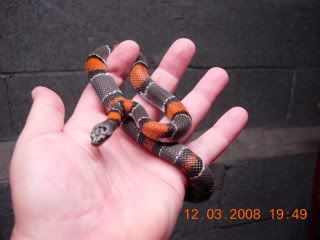
An example is I have two beautiful 08' Harris county Texas Lemon yellow speckled Kings from Jim Seargent over at Split Rock. Both were eating well in an enclosed AP rack up until a few weeks ago(moist Sphangnum hides provided). The female is still eating up a storm,shedding,pooping even mellowing out noticably. The male on the other hand has stopped eating and despite raising the heat to try to support him (cellar background temp 65 unless raised shot term when I do laundry etc.)he refuses food. Both are being kept in identical conditions different shoeboxes same level. I put the male in a cooler part of the cellar to let him nap for a while rather than let him deplete his reserves. Any thoughts? Thanks. Bob.
-----
 Sometimes I think the kid with two pet snakes has something that those of us with 50 to 200 lost a long time ago.
Patton
Jan 03, 2009 04:56 PM
Beautiful Holbrooki Bob!! Do you have any locale info on it?
It looks to be from the Mississippi low lands. I haven't seen
many with a nice even speckling like yours in the hobby.
Great looker!
-Phil
-----
Work is the curse
of the drinking class!
BobS
Jan 03, 2009 11:32 PM
Thanks Phil. I was just told it was collected in E. Texas. I love that even speckling.That's why I went for Jim Seargents Harris County locales. His adults are very evenly speckled and bright yellow rather than cream. I'm hoping they look like his adult pics eventually. I think Thomas said they look like this around Houston? I'm east coast, not a clue. lol
-----
Sometimes I think the kid with two pet snakes has something that those of us with 50 to 200 lost a long time ago.
FR
Jan 03, 2009 05:42 PM
Please keep this in mind. I breed lizards, a lot of which I was told I had to hibernate, colubrid snakes, pythons etc, turtles, and torts. And I do not hibernate any of them.
The key in captivity and in nature to allow reptiles to produce is the ability to conserve energy and the ability to use energy. Which is this simple, they need cool and hot/warm. Cool to conserve energy, heat to use it.
If you think about it, that sounds very much like SPRINGTIME.
Hot all the time(summer) causes to much energy to be used and females cannot gain the energy to reproduce. Cold (hibernation) does not allow metabolic processes to be achieved.
Many of the above species reproduce year around. If I can maintain cool and warm. Once it gets hot all the time, end of that story. Again its not all that complicated.
I do not worry about which feeds and which do not. If they have choices and are healthy, I trust they know what they are doing. I only make sure they are healthy and not sick. If sick, they may not make suitable choices.
So when given suitable choices, I do not have much to do other then feed and do a check every now and again.
So females have no need for food, so they do not feed, same for males. Others feed, because they have a need. Cheers
BobS
Jan 03, 2009 11:27 PM
Thanks Frank. I'll keep pluggin away and see what I can work out.
-----
Sometimes I think the kid with two pet snakes has something that those of us with 50 to 200 lost a long time ago.
BobS
Jan 03, 2009 11:49 PM
Frank. Trying to let this percolate....
I am using nice enclosed pvc racks ( I like that they are dark like a little crevice/cave) but I seem to remember that you might have mentioned that enlclosed wooden racks are too well insulated(they heat too evenly?) Am I right in taking that maybe a rack like Freedom Breeder or ARS would allow a better choice of Temps?
What about simulating night time drops? Over the years I have done both (steady temps and off at night) Any thoughts on how this fits into the choices thing good or bad? Thanks.
-----
Sometimes I think the kid with two pet snakes has something that those of us with 50 to 200 lost a long time ago.
FR
Jan 04, 2009 08:49 AM
heres the problem, its a concept, whats you learn it, you can apply where needed.
You see, in areas there are cold all the time, a base of cool is easy and you really do not have to worry about heating the whole cage. But here and in other hot areas of the world, that is not so. We do have to consider ways to achieve a wide temperature range with such restrictive caging as show boxes(plastic box rack systems)
So a heat gun and an idea of what your looking for is all you need. You do not have to ask anyone else. Besides, they are not where you are.
In the old days, I use to tell people, I used a different setup in different rooms of my own house. That is, I had to adjust to different rooms, muchless different parts of the country. And sir, that is true. of course back then I was new and still learning. Cheers
BobS
Jan 04, 2009 06:58 PM
nm
-----
Sometimes I think the kid with two pet snakes has something that those of us with 50 to 200 lost a long time ago.
JKruse
Jan 04, 2009 02:48 PM
that is one gorgeous holbrooki Bob. Can we get a pic of the other as well?
-----
Jerry Kruse
"Yesterday is history.....tomorrow is a mystery.........but today is a gift -- that is why it is called the present". - Master Oogway
BobS
Jan 04, 2009 07:01 PM
Got a new Camera for Christmas Jerry. I'll try to take pics of the babies. They are not as impressive yet and still have banding. I'll give it a shot. Thanks.
-----
Sometimes I think the kid with two pet snakes has something that those of us with 50 to 200 lost a long time ago.
Patton
Jan 03, 2009 04:51 PM
Frank,
Have you personally had any luck breeding Zonata, Pyros,
or Greeri while "offering" their normal broad temprature
range, that you have mentioned before, i.e., 50-100 degrees,
through out the entire year? Just curious.
-Phil
-----
Work is the curse
of the drinking class!
Tony D
Jan 03, 2009 04:53 PM
add temporalis to that group
-----
That is a a completely narcistocanibolizistic thing to say!
Patton
Jan 03, 2009 04:58 PM
Hey Tony,
I hope you and your family have an awesome New Year!
-Phil
-----
Work is the curse
of the drinking class!
Tony D
Jan 04, 2009 04:43 PM
Thanks P. We did! Hope you did as well.
-----
That is a a completely narcistocanibolizistic thing to say!
FR
Jan 03, 2009 06:38 PM
Sir, you can breed all types, all you have to do is change your thought pattern. With the colder loving snakes, all you have to do is give them a tiny bit cooler, cool side. It really is not very complicated, in fact, its simple. Let them do what they know how.
When I am working with a new species, I do not tell them what I think they need. I offer cooler and warmer then what they need and let them pick. Consider, wild snakes never live wheres its exactly the temps they need. They live in a world that always has colder and hotter. Just think about that.
Thats how I bred many world firsts. I did not need to know much. In otherwords, I made a simple thing simple, instead of making a simple thing complicated, which is what most do.
Tony D
Jan 04, 2009 04:43 PM
No change in thought patterns needed. I have about 20 years experience with temporalis with several dedicated to the non-hibernating method. It doesn't work. Its fine for corns, bairds, brooks, goini and such but not temporalis.
-----
That is a a completely narcistocanibolizistic thing to say!
FR
Jan 04, 2009 06:25 PM
You say, non hibernation method. Hmmmmm is there one. Are you doing what I do. Do you know what I do. Heck, do I know what I do.
Let me explain my method, keep working at it until it works. So I am not set on a particular set of parameters. I am set on adding or changing until something does work.
As I mentioned, I bred so many species that folks said, they HAVE to be hibernated. Hmmmmmmmmmmm
Do you have any logical reason temporalis would be different? Do they only occur in cold areas? Canada perhaps(joke) High elevation??? Hmmmmmm I have produced many kings that only occur at elevation. And without hibernating.
Which brings up another point, what is hibernation? unless we set some sort of standard, we may be talking apples to cactus fruit. Cheers
Tony D
Jan 04, 2009 07:47 PM
As a matter of fact they do have a behavior that tends to cause failure. Its called going off feed in August. If they don't get pretty darn cool they loose weight and come spring are not in condition to produce.
Now I could manipulate the light cycle and trick them into staying up to feed and breed more heavily but that would be about what the breeder wants not what the animal is biologically programed to do.
-----
That is a a completely narcistocanibolizistic thing to say!
FR
Jan 04, 2009 08:45 PM
do you know what they are biologically programed to do? That amazes me.
I would think you cannot get them to do anything they are not programed to do. As long as you do not gene splice or something. or maybe adding high doses of steriods. I am not sure that could get them to do something they are not programed to do.
You do understand, the enviornment predicts(supports) their genetic potential. You do understand, they have been programed over tens of thousands of years, so their abilities can be much greater then present conditions support.
You do understand, they can genetically multiclutch. Its supporting conditions that control IF they do.
Do you really thing doing something they do not physically understand, will benefit them?
As in, too hot will cause them to fail, to cold, etc etc, to little food will cause them to fail, as will to much, etc.
Are you assuming all snakes cycle like the ones around your area. So your saying central american kings or south american kings cycle exactly like yours. Hmmmmmmmmm odd I say. You do understand folks here hibernate them in our winter, don't you? Hmmmmmmmmmmm
I don't know Tony, but I have not had problems breeding kings any time of year or multiclutching them. After all, If I want to see such things, its my responsibility to support those things.
I Have a monitor I hatched 9 years ago, that has had 68 clutches and is still going, hmmmmmmmmmmm They too are suppose to only have one clutch. I don't know how you think what you do, but I do have real support for thinking like I do. I have results, not lack of results, there is a difference. And please do not get mad, just think about the difference between results and lack of results.
You see, you failing to support something is Lack of results. As in, you simply may not be doing it right. AND please, I am not saying your bad or anything. Your most likely very good, but you fail to consider, you are not doing something right. And that is only comparing that to others who are doing what you say cannot be done. Please consider these thoughts. Cheers
Jeff Schofield
Jan 05, 2009 01:27 AM
FR-I gotta pipe in on this. You say you do what needs to be done. One has to ASSUME you have failed and have learned from your failures. One can also assume that someone else will do the same. I KNOW you dont always produce good results, its impossible if you try as many things as you say. You would not have changed things if they were working to try something else. Why preach if you cant be SPECIFIC and help? Brumation WORKS.
If I read your "theory" correctly given "proper" conditions, kingsnakes(this forum) would not hibernate and would feed and breed year round? Are you saying that given the "complete" range of choices the INSTINCT to brumate would go away? Have you tested this on snakes that dont live in the wild wild west of Texas? Are you saying that its because of captive conditions that they go off feed? Are you saying given "complete" range of choices of habitat picky feeders would change their diet to eat any available prey(mice)?? Now I admit to using more of a "recipe" approach than you, but I have also brumated Hondos at temps they likely could never be exposed to without incident. I have tried different things, as many for MY benefit as the snakes admittedly.
Truth is you can do something WRONG and it will work, and you can do something RIGHT and it wont. ALL your facts are anecdotal, and we are back to our last argument. You admit to not knowing what you do....but it "works". A broken clock is right twice a day. By saying this I am not saying you are wrong either, but you cant tell me that a kingsnake from the north-genetically trained to deal with harsh winters, can shut all its genetic switches off because YOU suddenly are providing "perfect" conditions for it in every way. Tens of thousands of years of genetic potential will fight against most of what you are saying....but not everything. That is why you will find kings up and moving in VERY low temps once in a while. One warm day, a king will try and take advantage,sure. But what you dont see is all the ramifications of those that do and arent successful. I suggest that they are built to adapt to a wide variety of conditions, but do best kept under the same conditions that their habitat has trained its genes to adapt to...not some crazy nirvana.
Tony D
Jan 05, 2009 06:39 AM
"I don't know Tony, but I have not had problems breeding kings any time of year or multiclutching them. After all, If I want to see such things, its my responsibility to support those things."
Who is talking about the keeper now?
-----
That is a a completely narcistocanibolizistic thing to say!
JKruse
Jan 04, 2009 10:36 PM
I have YET to have someone be able to tell me how to get my precious zonatas to NOT go off feed come mid/end of summer or in the fall. I've tried to manipulate it as best i can. But this whole new thread about reptilian programming should be a monster jam of an event -- So can someone tell me how to reverse this seemingly innate response? Anyone? Bueller? Bueller??
-----
Jerry Kruse
"Yesterday is history.....tomorrow is a mystery.........but today is a gift -- that is why it is called the present". - Master Oogway
MikeRusso
Jan 04, 2009 10:50 PM
Im still trying to figure out what's so bad about hibernation?? 
~ Mike Russo
JKruse
Jan 04, 2009 11:38 PM
I dunno Mike but I'm about to start writing a proposal to fund a rehab group for chronic hibernators . . . the first step is admitting you have a problem and then sitting in a cold room for three days with nothing more than water after you have enema'd out. The rest? Well, maybe others can give suggestions about this therapy for chronic hibernators.
I have to go now Mike -- I'm trying to fit one end of a 55 gallon filled with various kingsnakes into the fridge while the other end is in the oven. I hope hey don't FEEL happy about the whole effort.

" alt="Image">
-----
Jerry Kruse
"One often meets his destiny on the path he takes to avoid it". - Master Oogway
JKruse
Jan 04, 2009 11:45 PM
that i hope the snakes do feel happy after the effort -- I could use a hug from them as a result. Then publish the whole thing. And be popular in some obscure country -- maybe Mehico . . . I can see it now . . . "El Whisperador de Las Serpientes". Kinda like Zorro but with snakes, and with a Three Amigos twist. I already got an e-mail from Howie, Patton, and Shannon for auditions try-outs. I can see the millions! (in pesos, of course...)
-----
Jerry Kruse
"One often meets his destiny on the path he takes to avoid it". - Master Oogway
shannon brown
Jan 05, 2009 12:52 AM
its easy man, just build your snake room into a side of a big hill.They all have cages that go wayyyyyy back underground yet you have four to six feet of cage hanging out into the snake house and have the sun hitting them.Its so easy why do you keep asking these silly questions.
L8r
JKruse
Jan 05, 2009 01:11 AM
I now get to revive that old back-hoe (easy fellas, I'm talkin' 'bout a tractor with a digger ya hear!?) after all these years. YES!!! Glad you're around to shed some light on these things and clean up house.
Auditions are this Saturday at 2.
-----
Jerry Kruse
"One often meets his destiny on the path he takes to avoid it". - Master Oogway
FR
Jan 03, 2009 06:30 PM
Yes for decades. Cheers
insane_racing618
Jan 03, 2009 06:10 PM
thanx frank i appreciate all the help
rickd
Jan 04, 2009 02:58 PM
I beg to differ. How do you explain that many colubrid snakes cooled down to the 50's to 60's for ~2.5 months or so, (The way I have been doing it for 25 years) will breed and produce fertile eggs year after year. Maybe a clutch of 20 eggs or so might have 2 or 3 that don't hatch. I've seen many people breed their snakes with no cooling and IF they get eggs many of them are infertile?
Also, I'm a different Rick D that has been posting on this thread.
Thanks,
FR
Jan 04, 2009 06:11 PM
hey, I did not say, brumation/hibernation cannot work. Its just not everything. What is infered here is, only hibernation works and that is plain WRONG. hibernation has nothing to do with reproduction other then delaying it.
Also, in most colubrids natural range, there is no need to hibernate.
For instance, I was out yesterday and there were snakes out crawling. So whats it like south of here? Why aren't they hibernating? cheers
rickd
Jan 05, 2009 09:42 PM
As far as snakes being out in the warm winter days, sure, it happens all the time. It's in the 70's here in central AL and I'm sure some of them are out but in two days when the temp is in the 30's at night they won't be.
My way seems to have worked fine for 25 years so I think I'll keep doing it the same way.
FRoberts
Jan 04, 2009 03:35 PM
I bred Texas rat snakes this year without any cool down and she triple clutched. The third clutch was from stored sperm with no breeding, totaling 28 hatchlings.
First clutch was nine eggs, second was 12 eggs, 10 fertile. Third was 14 eggs, nine fertile.
I stopped feeding her to AVOID a fourth clutch. (I was getting scared)
These snakes have bred on other occasions ALL without any hibernation. They never stop feeding and generally do not go under 70 degrees EVER.
All my colubrids eat year round, I have used hibernation (no feeding) and had same success as well. (other Colubrid types)
I do believe the cooler temp kings need the cooler temps to breed, but not the EVEN temps we use. I see snakes when there is snow on the ground if you are at the right place at the right time, basking next to their hibernaculums. But they would die if they couldn't remove themselves from the bitter cold.
The "cooler loving" kings need exactly that cooler temps, but the access to higher temps should be provided, take a temp gun outside in the winter, find a spot in the sunshine, you would be surprised at the temps one can measure in the sun. Obviously if there is snow involved a snake wouldn't bask. But if given the choice they very well if they can do so continue to thermoregulate and seek their preferred temps.
I also believe you don't have to offer the higher temps, sometimes I would imagine they will have no access to higher temps and are able to survive, but that may be just what they are doing surviving, not thriving. But as long as they have the reserves I believe this does the animal little to NO harm. Matter of preference and what you have the means of providing.
So if your snake is healthy and of proper body weight I see nothing wrong with hibernating them. And if letting them rest works for you to get them to resume feeding then do so, no sense in killing your snake cause it's making choices from what you are offering it.
I do believe most animals need some form of cycling to reproduce.
I also believe we don't know what they REALY need.
BUT if you are keeping them healthy, breeding, etc...
It's much better then... the only good snake... is a dead snake mentality.
I have never bred ANY type of kingsnake, although I do have a Chain King and think they are magnificent animals.
I have bred a few types of Boa, Pythons, and colubrids.
Most times I have used some type of thermo cycling.
I used none ( a certain amount obviously occurred )with a few colubrids ( I usually hibernate them to make breeding attempts because of reading they couldn't form sperm or egg without doing so, but never thought about how much experimenting the science department did to conclude what they consider fact )
None with Burmese Pythons.
70 - 90 with ball pythons.
75 - 90 with retics
70 - 84 Dumeril's and rainbow boas.
temps are also available to avoid the two extremes offered, but otherwise it's a pretty narrow range.
I am not sure what cycling is actually necessary
But have bred snakes in a few different ways but have not experimented much on WHAT would happen if I didn't cycle the ball pythons etc...
The female and male texas rats ATE almost the entire time, male ate entire time.
I have seen a few other people breed without hibernation, but to so say no cycling took place would be idiotic.
What they need to reproduce is obviously being provided by some means or they would not do so, to say concretely you have all figured out is simply INGNORANT, that applies to any party that posts to these boards. Both parties will always think they have merit and try to discredit the other, but yet, both methods yield results of some form or another with both claiming to be better.
I am open to info from all methods and parties and used to locked into the science book text, which is not fact in MANY cases in regards to reptiles and amphibian husbandry/physiology etc...
I do believe cooler temps may put them off feed if they can't get to a warmer area. Why cause themselves to regurge and waste valuable energies they are programmed to conserve.
All of this is a matter of opinion on my part...not fact.
We claim fact about things we don't know much about. (me included) But we all know what we know!!!
If a snake "feels" the need to hibernate it's because you are making it try to make that choice and may have it stuck in between somewhere not being able to do either. It also may very well be some snakes need to hibernate and some don't. Saying one knows a snakes needs is funny, are you a snake, I understand the "choices argument" and the other "method" argument, it's a argument, I do not mean as in a fight, which is what sadly usually turns into.
Ain't having testes GREAT!!!!
-----
Thanks,
Frank Roberts
