

Reptile & Amphibian Forums

Welcome to kingsnake.com's message board system. Here you may share and discuss information with others about your favorite reptile and amphibian related topics such as care and feeding, caging requirements, permits and licenses, and more. Launched in 1997, the kingsnake.com message board system is one of the oldest and largest systems on the internet.

Click for 65% off Shipping with Reptiles 2 You

Newer to corns...? about "morphs"

jsschrei Jan 06, 2009 04:59 PM

Hello everyone,
About a month ago I got a couple of corns from a friend of ours that we buy our feeders from. I started as a ball python gal, but am really liking these little corns! I have read some literature (like Love's corn book), websites, etc. and have some questions.

First, are the different types called "phases"? I am used to "morphs" with the ball pyhtons and would like to know the right term to use for corns.

Second, if I am learning correctly, most of the "types" are recessive, correct? Also, is the term "double het" used in the corn world to describe a corn that is het for two traits, like snows? Or do most just say " het for...AND het for..."?

I've been reading about the "Ultramels". Most descriptions I've found say "co-dom with amel = ultramel". Is the "ultra" gene a visible gene? Is there an Ultra corn...or does it only influence the amel gene carried by the individual? Does an individual that carries Ultra, but NO OTHER GENE for color/pattern look normal? I have seen a pic of ultramel bloodred. Is this a bloodred x ultra, or bloodred x ultramel, thus has ultra, amel and bloodred genes? If someone could explain this gene I'd be deeply thankful!

Ok, another- Amber. Most descriptions I've read say "the hypomelanistic FORM of caramel". Is that one gene, or hypo x caramel, you get "double hets", breed those and get Ambers???

Thanks Bunches to all that reply!I teach Bio and understand genetics very well, just trying to grasp how it is being applied to the names and combos of corns. Sorry about the long post.

Jessica
-----
Cheers,
Jessica
10.15 Ball Pythons
3.3 Corn Snakes
0.0.1 Green Tree Python
2.2 Jungle Carpet Pythons
0.0.1 Boa Constrictor
3.0 Crazy Dogs
2.0 Cats
Some Tropical Fish
...........and growing!

Replies (14)

HerpZillA Jan 06, 2009 05:21 PM

I could answer a few those. but I'd rather just welcome you to the forum. I'll let the pros answer tehm so not to confuse you with to many answers. At times people say teh same thing in different ways.

And if you like balls you'll like corns for sure.
-----
Thanks for reading.
Big Tom

www.HerpZillA.com

jsschrei Jan 06, 2009 05:38 PM

Thanks for the welcome!
-----
Cheers,
Jessica
10.15 Ball Pythons
3.3 Corn Snakes
0.0.1 Green Tree Python
2.2 Jungle Carpet Pythons
0.0.1 Boa Constrictor
3.0 Crazy Dogs
2.0 Cats
Some Tropical Fish
...........and growing!

tspuckler Jan 06, 2009 05:27 PM

Alright Jessica, I'll give this a shot:

I've bred Ball Pythons, so I know where you're coming from. There are no co-dom traits in corns like you have for mojave, spider, etc. Ball Pythons. If a morph of a corn is bred to a normal corn the all babies will appear normal.

All corn morphs are simple recessive genetic traits. "Ultra" is a morph that can be expressed when an Ultra is bred to another morph (but not a normal). I'm going to steer clear of any additional Ultramel talk, as I don't work with them, but a number of other people on this forum can answer those questions.

There are "locality types" of corns like Miami Phase and Okeetee, but these might either be referring to the locality of the snake, what the snake looks like (irregardless of its locality), or both.

I'd say "morphs" and "phases" are used interchangably.

You are right on your "double het" thought. A normal looking snake that is het for anery and amel is double het for snow. What makes corns different from Ball Pythons is that "double het" is rarely used. Most people don't know what their snakes are het for, since corns have large clutches and their lineage isn't very well kept in many situations. You will see "multi-hets" advertised, which means that there's a number of colors and patterns that the snake could be carrying genes for.

Carmel is one gene and so is hypo. Though I've never seen a double het for amber ever, which is weird. But I understand amber to be a snake homozygous for both hypo and carmel.

Tim

Third Eye
Third Eye

jsschrei Jan 06, 2009 05:40 PM

Thanks! Very helpful.
-----
Cheers,
Jessica
10.15 Ball Pythons
3.3 Corn Snakes
0.0.1 Green Tree Python
2.2 Jungle Carpet Pythons
0.0.1 Boa Constrictor
3.0 Crazy Dogs
2.0 Cats
Some Tropical Fish
...........and growing!

DonSoderberg Jan 07, 2009 05:08 PM

AS STATED PREVIOUSLY, PHASES ARE USUALLY RESERVED FOR LOCALITY VERSIONS OF WILD-TYPE CORNS.

WE HAVE AT LEAST ONE THAT APPEARS NOT TO BE RECESSIVE. THE ULTRA GENE APPEARS TO BE CO-DOM WITH AMEL. IF YOU BREED ONE TO A SNAKE NOT AN AMEL GENOTYPE, NO AMELS OR ULTRA TYPES WILL BE PRODUCE IN THE F1 FAMILY.
IN THE ORIGINAL BREEDINGS OF THE TESSERA CORNS, THEY HAVE PROVEN TO BE A FORM OF DOMINANT. THIS YEAR, WE SHOULD KNOW WHAT PARTICULAR VARIATON OF DOMINANT INHERITANCE IS ASSOCIATED WITH THIS NEW MORPH.

YES. DOUBLE HOMO FOR A CORN GENOTYPICALLY POSSESSING TWO MUTATIONS, AND DOUBLE HETS FOR ANIMALS CARRYING TWO GENES, BUT VISUALLY EXHIBITING NEITHER. EXCEPTION WOULD BE AN ULTRAMEL.

NEONATALLY, ULTRA CORNS HAVE A PHENOTYPE LIKE SOME RECESSIVE HYPO CORNS. THEY’RE USUALLY JUST SLIGHTLY DARKER THAN ULTRAMELS. SOME ULTRAMELS VERY NEARLY LOOK LIKE AMELS, WHILE OTHERS RESEMBLE HYPO TYPES. AS ADULTS, ULTRAS CAN EASILY BE VISUALLY CONFUSED WITH HYPO TYPES, AND SOME ULTRAMEL ADULTS, THE SAME. EXTREME VERSIONS OF THE ULTRAMELS ARE CLOSER TO AMELS THAN HYPOS, BUT CERTAINLY NOTHING LIKE NORMALS. THE ULTRA GENE IS AN ALLELE TO ALBINO. EVEN THOUGH THEY RESEMBLE HYPO TYPES (and are practically the poster child for a hypo corn), WE DO NOT CALL THEM HYPOS, FOR FEAR OF PEOPLE THINKING THEY ARE ONE OF THE HYPO MUTATIONS IN CORNS.

AS PREVIOUSLY STATED IN THIS THREAD, BOTH CARAMEL AND AMEL ARE SIMPLE RECESSIVE MUTATIONS. AMBER IS THE NAME GIVEN TO THE DOUBLE HOMOZYGOUS EXPRESSION (genotype and phenotype) OF THOSE TWO RECESSIVE GENES.

South Mountain Reptiles

HerpZillA Jan 07, 2009 08:57 PM

I have to say I'm glad this came up as I did not understand the ultra gene. Not much interest personally as my corn taste is very narrow for what I want/collect. But still fun to learn whats going on.

It's just cool to have people you can really trust to explain. There are quite a few people in here I trust, more on other forums. I guess since I have a 26 year gap of no herps, I think of the 70s taking out 50 year old books. I'm sure we all had the same books too.

Just thought I'd say that's to ALL the people that help out.
-----
Thanks for reading.
Big Tom

www.HerpZillA.com

jsschrei Jan 08, 2009 12:11 AM

Don...So cool of you to reply to my questions! I can't wait for my new arrivals in the morning!

"THE ULTRA GENE APPEARS TO BE CO-DOM WITH AMEL....."

OK, still confused though. I am going to use "a" for "amel", "u" for "ultra" and "N" for wild type, just for typing and conversation's sake, even though I know allelic forms (multiple allele systems) are usually represented with a common letter with a superscript letter designating the allele, it's hard to type that in this response box.

Is there a "uu"? A "uN"?

I know that if a corn is "aN", its phenotype is wild type. "aa" the phenotype is amel. "au" the phenotype is ultramel (correct?).
So is there a "uu" and "uN"???????

If there is a "uu", are there any pictures of it? If there is a "uN" is its phenotype wildtype like in "aN"?

If you breed an ultramel to a wild type do you get "aN" and "uN" F1 or "aNuN" (which to me does not make Mendelian sense to me- that would be inherited from an "aauu" individual to a wild type)? Is there a "super" form (pardon the ball-speak)? Would it be "aauu", or no?

Comments, corrections, and explainations are really appreciated!
-----
Cheers,
Jessica
10.15 Ball Pythons
3.3 Corn Snakes
0.0.1 Green Tree Python
2.2 Jungle Carpet Pythons
0.0.1 Boa Constrictor
3.0 Crazy Dogs
2.0 Cats
Some Tropical Fish
...........and growing!

jsschrei Jan 08, 2009 12:21 AM

In the above reply I stated is there a "super"? But "super" usually refers to visual co-doms.

So, I'll change my question to, "is there a double homozygous form of ultra and amel possible? My guess is no, if it is alleles of the same single gene locus. So there would not be "aNuN" or an "aauu".

If you cross two versions of amelanistics, like a candy cane to a regular amel (I think referred to as a red amel?), are they allelic? I'll use "c" for candy cane. Would that cross get you "ca" F1 offspring?
-----
Cheers,
Jessica
10.15 Ball Pythons
3.3 Corn Snakes
0.0.1 Green Tree Python
2.2 Jungle Carpet Pythons
0.0.1 Boa Constrictor
3.0 Crazy Dogs
2.0 Cats
Some Tropical Fish
...........and growing!

STEVES_KIKI Jan 08, 2009 09:29 AM

ok as for the candy cane and amel cross...
candy cane is still an amel, but a line bred amel with a white background and red or orange saddles. if you breed a candy cane to an amel, you get 100% amels... only outcrossed candy canes.... heres the hard part:
if you breed 2 candy canes together, you will get 100% amels but only a few would be considered candy canes.
this also works with sunglows and other "types" of amels.. sunglows are just line bred amels with little to no white. and if you breed 2 sunglows, you may not get any sunglows, or you may get a few sunglows... but you will get 100% amels. regardless, they are amels or albinos... its hard to tell what the hatchling will look like as an adult...

i am still trying to understand the ultra gene myself... but i think you are asking if there is a difference between ultra and ultramel. There is technically no visual difference. the only way to find out if an ultramel is indeed ultramel and NOT just Ultra, you have to breed it to an amel. Ultra to amel will make plain amels as well as ultramels. ultramel to ultramel will not make "normal" amels... i hope that typed out the way i intended..
~kin
-----
~Sober Serpents~
www.freewebs.com/soberserpents
Tons of Corns, A Trio of Creamsicles, A Black Rat, A pair of Leucistic Black Rat X Leucistic Texas Rat Intergrades, Thayeri, Cal Kings, A Jungle Corn, Ball Pythons, A Pair of Albino Nelsons Milksnakes, A Rescue RTB, Leopard Geckos, Green Anoles, 2 Snapping Turtles, an Eastern Box Turtle, a Bearded Dragon, an Adult Rescue Iguana

jsschrei Jan 08, 2009 10:28 AM

Thanks for your reply!
Wow, the whole amel and it's "line specialties" is a PITA then, huh? LOL!
The genetics of the corns, and ball pythons, are so cool! Other than their temperments this is why I love it!
-----
Cheers,
Jessica
10.15 Ball Pythons
3.3 Corn Snakes
0.0.1 Green Tree Python
2.2 Jungle Carpet Pythons
0.0.1 Boa Constrictor
3.0 Crazy Dogs
2.0 Cats
Some Tropical Fish
...........and growing!
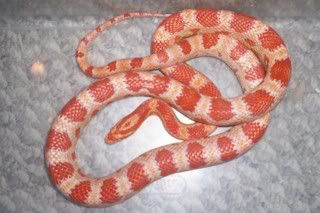
STEVES_KIKI Jan 08, 2009 10:49 AM

corn genetics are extremely easy compared to BP morphs... i'm trying to figure out BP and Boa morphs.. gosh i wish they were all the same... but once you know what 1 amel looks like... its easy...

sunglows:

Candy Canes:

Abbotts okeetee and a Reverse okeetee (AKA Albino Okeetee)

plain ole amel (this one is het for Charcoal)

and then there are the hybrid albinos which include
Jungle (cal king X Corn cross)

and then there are creamsicles (emoryi rat snake X Corn cross)

there are other kinds of hybrids... but thats just an example

~kin
-----
~Sober Serpents~
www.freewebs.com/soberserpents
Tons of Corns, A Trio of Creamsicles, A Black Rat, A pair of Leucistic Black Rat X Leucistic Texas Rat Intergrades, Thayeri, Cal Kings, A Jungle Corn, Ball Pythons, A Pair of Albino Nelsons Milksnakes, A Rescue RTB, Leopard Geckos, Green Anoles, 2 Snapping Turtles, an Eastern Box Turtle, a Bearded Dragon, an Adult Rescue Iguana

DonSoderberg Jan 08, 2009 02:07 PM

In the above reply I stated is there a "super"? But "super" usually refers to visual co-doms.

We have one of those now (tesseras), but as you point out, that gene type is common in boids, and rare (so far) in corns.

So, I'll change my question to, "is there a double homozygous form of ultra and amel possible?

Yes. Ultra(uu) amel(aa) = Ultramel(ua).

My guess is no, if it is alleles of the same single gene locus. So there would not be "aNuN" or an "aauu".

You're thinking RECESSIVE. This gene is not recessive.

If you cross two versions of amelanistics, like a candy cane to a regular amel (I think referred to as a red amel?), are they allelic?

Genetically, they're the same mutation (amel). They're just color/pattern variations of one single recessive gene (amel). Since the differences in them is of a polygenetic nature, there are no other gene mutations involved.

I'll use "c" for candy cane. Would that cross get you "ca" F1 offspring?
N/A. See above.
South Mountain Reptiles

DonSoderberg Jan 08, 2009 02:01 PM

Don...So cool of you to reply to my questions! I can't wait for my new arrivals in the morning!
~~First, sorry to seem like I was SHOUTING. As I told big Tom in an email today, I had copied and pasted all the questions into that email, and then responded to each one in CAPS, so a to distinguish where the questions left off and the answer began. The questions didn’t show, so it looked like I was shouting the responses. Sorry bout that misimpression.~~

"THE ULTRA GENE APPEARS TO BE CO-DOM WITH AMEL....."

OK, still confused though. I am going to use "a" for "amel", "u" for "ultra" and "N" for wild type, just for typing and conversation's sake, even though I know allelic forms (multiple allele systems) are usually represented with a common letter with a superscript letter designating the allele, it's hard to type that in this response box.

Is there a "uu"? A "uN"?
~~If you breed an ultra (uu) to a non albino(NN), you get all ‘uN’. (It genetically behaves recessively when bred to non albinos.) ‘uu’ is the ultra, and it is about half as dark as a normal. Ultramels ‘ua’ are half lighter than ultras (as a general rule).~~

I know that if a corn is "aN", its phenotype is wild type. "aa" the phenotype is amel. "au" the phenotype is ultramel (correct?). Correct.
So is there a "uu" and "uN"???????
~~See above. ‘uu’ is the ultra (resembling many hypos) and ‘uN’ are the normal-looking corns het for ultra.~~

If there is a "uu", are there any pictures of it? If there is a "uN" is its phenotype wildtype like in "aN"?
~~‘uN’ (like aN) is just a normal-looking corn. ‘uu’ could be more difficult to get pix of. I have ‘uuca’ and ‘uumo’, but no stand-alone ‘uu’ (ultras). Of course, like everyone else, I have lots of ‘ua’s laying around.~~

If you breed an ultramel to a wild type do you get "aN" and "uN" F1 or "aNuN" (which to me does not make Mendelian sense to me- that would be inherited from an "aauu" individual to a wild type)? Is there a "super" form (pardon the ball-speak)? Would it be "aauu", or no?
~~No super form.~~

Pecked at this email on and off for the past few hours, between other tasks, so forgive any nonsense. I'll read it again later to see if I left something out, or made any booboos. If I don't post now, it may not otherwise get posted today.
South Mountain Reptiles

jsschrei Jan 08, 2009 04:28 PM

Thanks Don!
-----
Cheers,
Jessica
10.15 Ball Pythons
3.3 Corn Snakes
0.0.1 Green Tree Python
2.2 Jungle Carpet Pythons
0.0.1 Boa Constrictor
3.0 Crazy Dogs
2.0 Cats
Some Tropical Fish
...........and growing!

Site Tools
