Can someone please tell me how to distinguish between an Axanthic boa and an Anery. My current understanding is that Axanthics lack the production of red and yellow melanin while the anery lacks only the red. Hence the yellow snows we currently see are the anery resulted breedings, whereas an axanthic to an albino would eventually produce a white snow.
Reptile & Amphibian Forums
Welcome to kingsnake.com's message board system. Here you may share and discuss information with others about your favorite reptile and amphibian related topics such as care and feeding, caging requirements, permits and licenses, and more. Launched in 1997, the kingsnake.com message board system is one of the oldest and largest systems on the internet.


AXANTHIC or ANERYTHRISTIC
albinorosy
Jan 09, 2009 05:51 PM
Replies (32)
maizeysdad
Jan 09, 2009 07:53 PM
Axanthic means lacking yellow. Anerythristic means lacking red.
LarM
Jan 09, 2009 08:14 PM
You are right Axanthic is lacking red & yellow pigment.
If you found a line of Axanthic Boas it would be huge.
I don't believe Axanthic Boas exist
certainly not in captive stock.
. . . . Lar M
-----
Boas By Klevitz

SpyderPB6
Jan 10, 2009 01:11 AM
Hey guys,
I was wondering, I would personally love to see an all white boa even once it hits adult hood. Any traits out there that even come close? I know snows look it when born but develop yellow.
Hmmmm would be quite interesting to see that.
PS...what is the closest to that right now? Moonglows?
Thanks,
Mike.
Slithering_Serpents
Jan 10, 2009 02:16 AM
The Leucistic would be much closer:
http://s3.photobucket.com/albums/y83/djspin959/?action=view¤t=MOV05299.flv
-----
Caden Chapman
slithering.serpents@gmail.com
http://slitheringserpents.com
Luke9815
Jan 11, 2009 06:27 PM
Or Jeremy Stone's Super Motley Albino....
-----
Luke Martin
Bronze Serpent Reptiles
ajfreptiles
Jan 10, 2009 09:22 AM
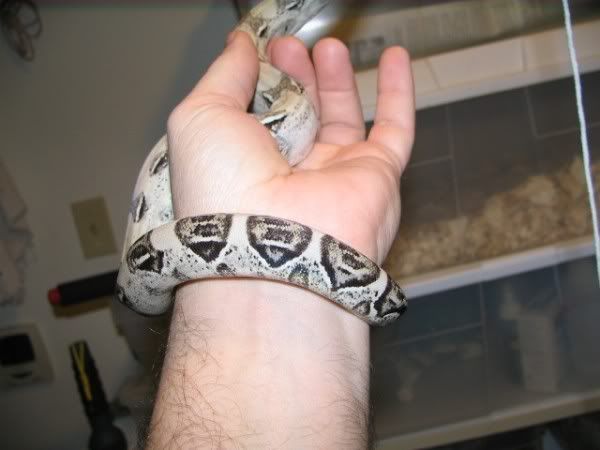
Here is a freak that I produced last summer...he is white and black...I hope he can reproduce himself...I would be thrilled if he proves Axanthic...but who knows....He was produced from my Gun Metal Blue Anery...you can check out my youtube videos to see dad...but so far he has produced 2 types of anerys ...black ones and this black and white version.
Andy
...
-----

mpollard
Jan 10, 2009 09:31 AM
Andy,
I think that's the first pic I've seen of that little fella (the black and white one), he looks pretty cool! How about some more pics!? 
Mark
-----
uncommonboa.com
boaphile
Jan 10, 2009 10:04 AM
ANERYTHRISTIC means lacking all red pigment. Proven to be a simple recessive trait that is easily reproducible in Boas.
AXANTHIC means lacking all yellow pigment. Not proven to exist in any Boa Constrictor. Some speculate they have something that is Axanthic simply becuase the animal is quite dark. However they fail to understand how the layering of color works in Reptiles. Of course an animal with tons of black may not reveal the underlying yellow, but strip away that black and those animals have always shown plenty of yellow. ie. all the Albinos and Snow Boas ever produced, regardless of how black the parents or grandparents, produce offspring with plenty of yellow.
I do think some day we will find an axanthic line, but the give away will not be the black that completely masks the underlying yellow. It will be a light colored animal that due to the total lack of yellow, will glow with the remaining primary color that is red. Blue is also a primary color but very limited in the vast majority of animals including Boas.
The yellow is what makes Hypos orangish vs. reddish. The less yellow influence, the more red is revealed without being polluted by the yellow. Selective breeding can reduce that yellow, but only a true mutation will make a true axanthic... Someday.

-----
Boaphile Home
All Original/Boaphile Plastics
Boaphile Photo Gallery
albinorosy
Jan 10, 2009 11:33 AM
Lets say i have two boas that both appear to be devoid of all color except greys silvers and blacks. And i breed them each to a seperate albino producing two lines of double hets. The double hets then produce snows. One of the (anery/axanthic) line produced a solid white snow boa and the other produced a snow that turned yellow. Would it be reasonable to assume that one of the "grey,silver black boas is an axanthic and the other an Anery?
boaphile
Jan 10, 2009 01:19 PM
In order to produce an all white snow Boa, that does not develop any yellow, that would actually be called a "Blizzard". Not the blizzards or het blizzards that people have been breeding and selling for years, because nobody has ever proven any Boa to be axanthic yet.
An all white snow, devoid of all yellow, if that yellow was the result of a single gene mutation would be Albino, Anerythristic and Axanthic.
My understanding is that the Ball Python Axanthics are actually not truly axanthic either. I could certainly be wrong about this because I know as much about Ball Pythons as I do Barbie dolls. But if there is any yellow, it does not truly meet with the definition of axanthic. Reduced yellow? Sure. Devoid of yellow? I don't know about that.
-----
Boaphile Home
All Original/Boaphile Plastics
Boaphile Photo Gallery
ExecutiveReptiles
Jan 10, 2009 04:08 PM

I have seen you post pics of your Ball Pythons in the Ball Forums...Don't be afraid to admit it...lol
I have to agree with your statement too, The "Axanthics" in the Ball Python world when used with Albinos to make "Snows" those snows just like the Boa snows eventually gain yellow pigmentation as well. Even though they are called "Axanthics" I don't see how they really could be true axanthics...but don't bring that up on the forum over there...lol
Anerytheristic

VPI Axanthic het Albino

I know you have one of these don't ya

-----
Executive Reptiles
Amanda Kingsbury & David Kendrick
www.executivereptiles.com
boaphile
Jan 10, 2009 04:23 PM
I said I didn't know any more about Ball Pythons than I do Barbies. I do know some things about Barbies. For instance, I know a woman who will not let her daughter play with a Barbie doll because "no woman is shaped like that". I seriously do. Maybe there is more than one woman that won't let her daughters play with them for that reason. That's about as much as I know about Ball Pythons... almost.
-----
Boaphile Home
All Original/Boaphile Plastics
Boaphile Photo Gallery
ExecutiveReptiles
Jan 10, 2009 04:53 PM
I personally think the "Axanthic" Ball Pythons are actually Anerytheristic. Why?....Several reasons, just like the Anerytheristic Boas, often times Axanthic Ball Pythons "Brown out" as they get older, to the point of almost looking normal, Many Anerytheristic Boas do the same, Both are most striking as youngsters.
The fact that both Snows in Balls and Boas have little to alot of yellow pigmentation as adults seems to point to them being Anerytheristic instead of Axanthic. I think the reason why they are labeled Axanthic is because unlike boas that have red pigmentation visible, the Ball Pythons don't (Ie they don't have red in thier tails, ect..)
Its one of those things that you'd be heavily critizied for saying amoungst Ball Python people, but I say if the shoe fits...right? I havn't heard a good reason as to why they are called Axanthics and not Anerytheristics?...have you?
Your a brave man...you should ask the question on the Ball Python forum...I dare ya.....lol
-----
Executive Reptiles
Amanda Kingsbury & David Kendrick
www.executivereptiles.com
ExecutiveReptiles
Jan 10, 2009 05:25 PM
Will say when asked about what makes an Axanthic an Axanthic....we will see...
-----
Executive Reptiles
Amanda Kingsbury & David Kendrick
www.executivereptiles.com
ExecutiveReptiles
Jan 12, 2009 10:26 AM
It seems not many people want to discuss the topic, but the one of two responses I got over there, this was the most detailed response.
Jeff Benfer Quote
"Part of the reason it is quiet, is that is a common question...for good reason, it is confusing, with the terms appearing to be used randomly or interchangably. Without knowing exactly what biochemical pathway and what chromophores specifically that a particular mutation is effecting, since there are many, many different ways to get the same visual end result, it is a bit of a guessing game based on what is visually seen of the mutant phenotype with reference to the wild type, with reference to the wild type being the key. Erythristic usually refers by definition more to reds, Xanthic to yellows. It seems that generally the refence of the wild type is what dictates the decision as to which term is used, i.e. corn snakes- wild types are mostly red-orange, hence the lack of predominant red results in calling anery, balls reds and yellow, wild types being mostly yellows and browns, leaning on mainly yellow being taken away, so hence called axanthic. If you look at the base colors of the wild type of most if not all snakes in question, the naming of the mutations are in line with what I have just written. How much pigment remains in a particular snow is probably more to do with the resulting visual effect of how much "pigment depletion power" the particular axanthic or anerythristic matation has, which is dependant on the "what and where" its effect is on a particular pathway or set of pathways. Just as you see differing "power" in the different BELs. This is just my personal educated view as a molecular biologist and reptile keeper, I am by no means claiming to be the "know it all" on the subject or even one of "seasoned herptoculturist" so I could be wrong, however some mornings when I try to get out of bed lately I feel quite "seasoned"
-----
Executive Reptiles
Amanda Kingsbury & David Kendrick
www.executivereptiles.com
ajfreptiles
Jan 10, 2009 01:10 PM
So Axanthic has red? I thought it was lacking red and yellow.
Do you think the Anerys that Pete Kahl is now working with are Axanthic?
If that little fella I posted stays black and white would he not be Axanthic? He would need Red to be Axanthic?
Thanks Andy
-----
boaphile
Jan 10, 2009 01:26 PM
xanthic means yellow.
http://www.medterms.com/script/main/art.asp?articlekey=14975
a-xanthic or axanthic means: No yellow.
eythristic means a condition marked by exceptional prevalence of red pigmentation.
http://www.merriam-webster.com/dictionary/erythristic
an-erythristic or anerythristic means no red.
-----
Boaphile Home
All Original/Boaphile Plastics
Boaphile Photo Gallery
LarM
Jan 10, 2009 03:38 PM
Thanks Jeff for the correction. I know Xanthic means yellow and
Axanthic means lack of yellow.
For some reason when referring to a Boa ,I was under impression
Axanthic was referring to devoid of both red and yellow.
My apologies maizeysdad,and albinorosy.
I do not want to disseminate bad information.
. . . . Lar M
-----
Boas By Klevitz
snakecandy
Jan 10, 2009 11:16 AM
Here is the thing that I don't understand... I have boas but I have been able to own an axanthic ball or two in my "crazy owning ball python days". Don't worry I am no longer on the dark side and have seen the light and I am using the force properly now. All joking aside though...
Both snow BP and snow boas have some degree of yellowing to them. In BP you even have 3 strains of axanthic and all of them have some yellowing to them. In BP it's not red it's yellow... or at least it appears that way to me because the snows are not totally white.
I am just wondering if they shouldn't all be called hypoaxanthic since the underlying colors when you remove the black leaves some residual yellow in the many layers of snakes and other reptiles.
At least in the boas you have removed ALL of the red in anerythristics but I have yet to see an animal besides a leucistic (and not all of those) that is solid white.
Just my rambling...
albinorosy
Jan 10, 2009 11:54 AM
It's interesting you bring up the ball axanthic/snow scenario.
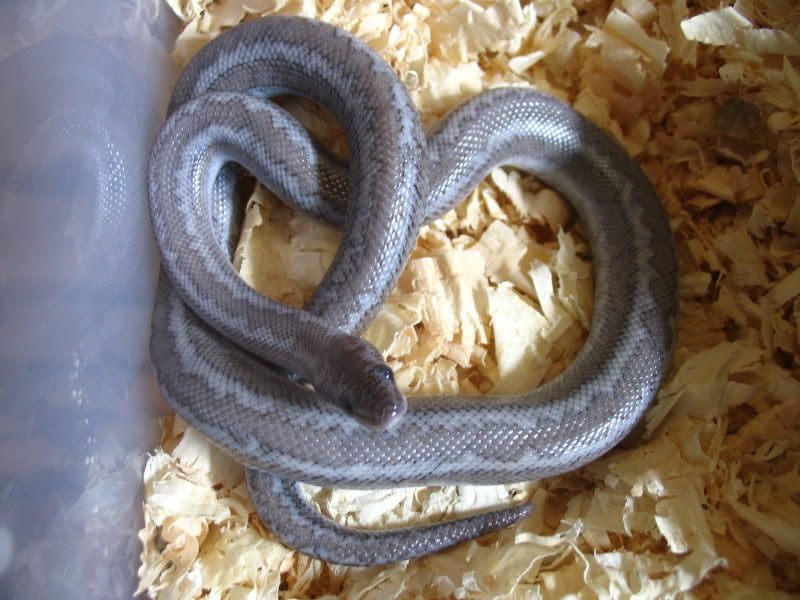
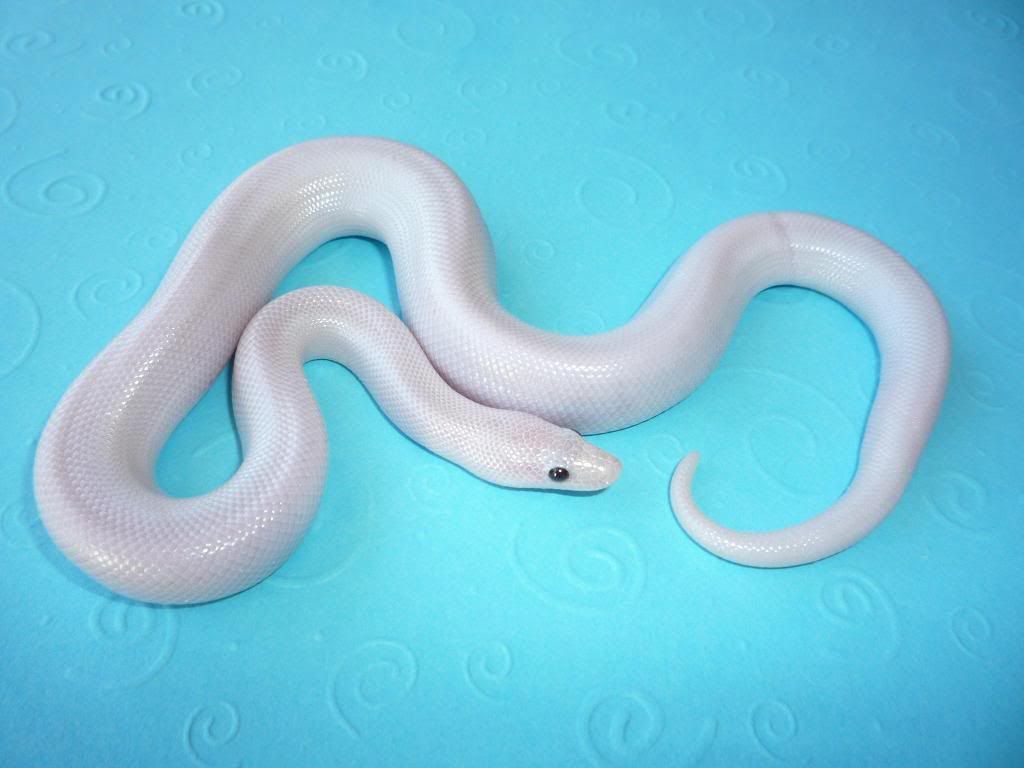
In addition to the "real" boas i am also involved with developing rosy boa morphs. Here are a couple of examples from the rosy's that illustrate my query.
#1 refered to as axanthic
#2 combined with an albino gene makes pure white
#3 refered to as an anery
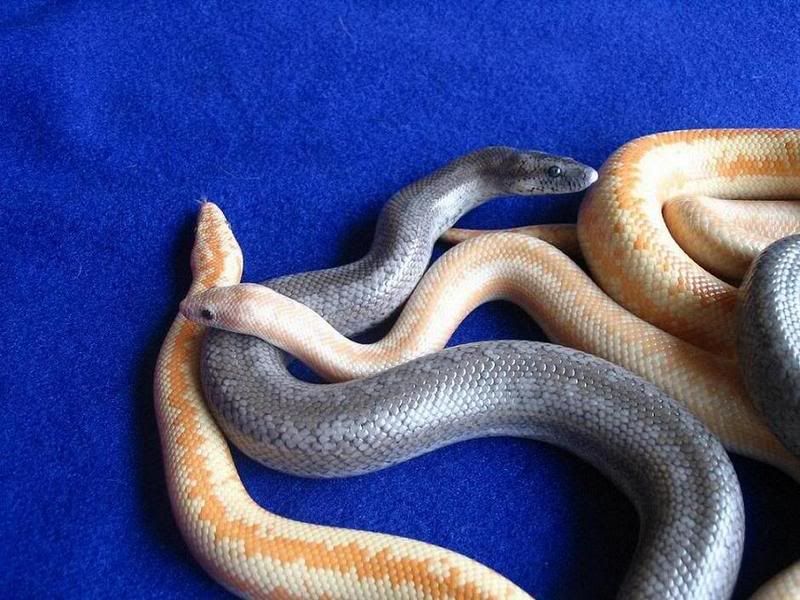
#4 the resulting snow with traces of orange
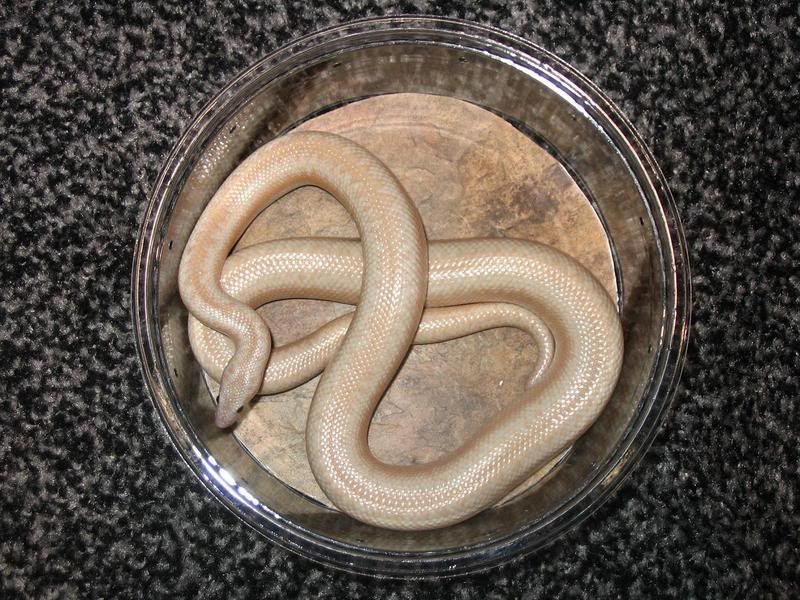
as you can see the two anery/axanthics look very similar in appearearence, but certainly do not produce the same snow when bred to an albino.
snakecandy
Jan 10, 2009 04:09 PM
That is interesting since picture #2 isn't even an albino... but a leucistic. At least from what I can tell in the pick the angle looks like it has dark colored eyes. Beautiful snake by the way. I would be interested in hearing some opinion on those genetics.
albinorosy
Jan 10, 2009 05:05 PM
It is not a leucistic. The eye color fron this line of "axanthic" is very very dark, and the eye color on the snow White is black with a red pupil.
kylefrost
Jan 10, 2009 04:12 PM
Very cool. I didn't know so much work had been done with Anery and Axanthic Rosy morphs. The two(Anery and Axanthic) genes are hard for me to distinguish alone but when they are Albino it plainly shows their underlying colors.
boaphile
Jan 10, 2009 04:27 PM
However, the axanthic trait is a simple recessive trait in Balls. At least I think it is. So there is no disputing that at least what seems to be the primary gene that causes most of the yellow pigmentation is interrupted by the homozygous form of this trait. So it does seem you could still call them axanthic without reservation. Still somehow some yellow is still able to be created. Just another example to prove that genetics is not as simple as we simple minded people would like to think.
-----
Boaphile Home
All Original/Boaphile Plastics
Boaphile Photo Gallery
albinorosy
Jan 10, 2009 05:15 PM
so is the snake hobbyist community simply using these terms, axanthic and anerythristic, out of convienence and marketing rather than scientifically based? And is our only choice for calling one an axanthic or an anery only measured by how the gene reponds to an albino in its degree of creating a white snake?
ExecutiveReptiles
Jan 10, 2009 05:38 PM
"so is the snake hobbyist community simply using these terms, axanthic and anerythristic, out of convienence and marketing rather than scientifically based? And is our only choice for calling one an axanthic or an anery only measured by how the gene reponds to an albino in its degree of creating a white snake?"
I asked this a simular question on the Ball Python Forum, I agree with the definition of Anerytheristic gene in Boas, it seems to fit the description, and is further proven when the Albino Gene is mixed in the equation, the snows fit what I would think it should produce.
Its the Axanthic Gene that I question, I think that term is used incorrectly...I am curious how Axanthics can gain yellow pigmentation? If ther term means lacking yellow...why do they gain yellow as they age like Anerytheristics do? Why do the Snows that are made up of Axanthics and Albinos look like the Snows that are made up of Anerytheristic and Albinos...why do they gain yellow pigmentation like the Anerytheristics do?....
I think Boas labeled as Anerytheristic, those are correctly labeled...but the Axanthics should not have any trace of yellow...just like the Anerytheristics shouldn't have any trace of red...but unlike Anerytheristics...the axanthics do tend to show yellow...to me thats not a true Axanthic...

-----
Executive Reptiles
Amanda Kingsbury & David Kendrick
www.executivereptiles.com
ExecutiveReptiles
Jan 10, 2009 08:01 PM
Say for example that when the Snow Boa was created (AnerytheristicAmelanistic) that for some reason as it aged it started getting red coloration in the pattern, I would ask the same question....How could it truely be an AnerytheristicAmelanistic specimen? How could it truely be Anerytheristic if its showing red pigment? Thats my question for the Axanthics, why do they gain yellow pigment? If axanthic means lacking yellow?
When looking at the Snow Ball (AxanthicAmelanistic) as it ages it does the same thing the Snow Boa does, it starts gaining yellow pigment....how? Why? if its a true Axanthic it should gain yellow pigment...just like a Snow Boa shouldn't have Red Pigment right? So how are Snow Ball Pythons truely Axanthic Amelanistic Homozygous specimens?
-----
Executive Reptiles
Amanda Kingsbury & David Kendrick
www.executivereptiles.com
ExecutiveReptiles
Jan 10, 2009 08:04 PM
"if its a true Axanthic it should gain yellow pigment...just like a Snow Boa shouldn't have Red Pigment right?"
That should read "If its a true Axanthic it shouldn't gain yellow pigment....just like the Snow Boa shouldn't have Red Pigment Right?
-----
Executive Reptiles
Amanda Kingsbury & David Kendrick
www.executivereptiles.com
EricIvins
Jan 10, 2009 07:58 PM
Thats how its always been. It has been dumbed down for public consumption. The majority of keepers have a hard time keeping the things alive, so understanding complex genetics is quite a stretch for the general reptile keeping public. Same thing goes for inheritance, which is still quite misunderstood. Simple Recessive stuff is easy, but the dom/co-dom/double & triple recessives can get complicated. Technically we shouldn't have a paradox Albino right?
-----
South Central Herpetological
micahdenton
Jan 11, 2009 01:08 AM
i start with sand boas when i was a kid and one of the things that happens in anery sand boas is they throw normals. what seems to happen is the more out crossing you do to strengthening the blood line, then more often anery to anery breedings throw normals. gene mutations like anery seem to be "bad" mutations so the genes try to fix themselves. when the gene "fixs" it's self in the single cell animal you get a normal het for nothing normal from a anery to anery breeding. what i think is happening in albino Colombians is that the gene is try to fix itself some time after the egg has already started to divide, so you get patches of normal cells mixed in to the albino cells causing the paradox condition. my guess is the the paradox albino might not always produce albinos if the "fix" cell happen in a sex cell you can get normals from those paradox albino to albino breeding. but i could be wrong.

EricIvins
Jan 11, 2009 05:28 AM
It's actually a whole more complicated than that. It deals with individual genes that are able to synthesize melanin while others can't. It's been labled "Partial Expression of Heterzygosity", and with Boa Constrictors and Ball Pythons they are Hets not the Homozygous mutation. Sand Boas have a different type of Paradox going on. Their's actually a few different Paradox mutations floating around
-----
South Central Herpetological
vcaruso15
Jan 11, 2009 10:25 AM
While I agree that alot of keepers have a fair amount of trouble grasping the genetic aspect of things, I think you are way out of line to say that a large portion of the people in our hobby have trouble keeping animals alive. To the contrary I believe that the people in our hobby have an astounding ability to not only keep their animals alive but to maintain them to the highest levels. I would also venture to that most take better care of their animals than alot of zoos or "reptile farms" out there.
To come on a public forum and say that the people in our hobby cannot keep animals alive is one of the worst things you can do. Every day we are fighting to keep our hobby alive and to have people within the hobby making comments like that will only make our struggle harder.
