what other people think about the possibilities of what might be going on with the Patternless Genetics? No attacks on each other for our thoughts or ideas, just an open discussion like has been done about other uknown morphs in the past. I know in the past some have been a little afraid to speak up because some like to think they know more or aren't interested in other's opinions. I would love to hear from those that have been doing this a while and understand many of the possible ways genes can pass based on the facts stated in the post below. The only additional info I can provide is that their were also 7 slugs. So:
4 patternless
5 normal sibs
7 slugs
And the pics of the parents are shown in the post below.
I would really appreciate it guys.
-----
Ty Hege
Rat Race Solutions
www.ratracesolutions.com
Reptile & Amphibian Forums
Welcome to kingsnake.com's message board system. Here you may share and discuss information with others about your favorite reptile and amphibian related topics such as care and feeding, caging requirements, permits and licenses, and more. Launched in 1997, the kingsnake.com message board system is one of the oldest and largest systems on the internet.



Can we have an open discussion about
Replies (23)
Kinda suprised no one else jumped in here, LOL...
My opinion, considering there were four patternless, sure seems to point to them being genetic...(if there were only one, it would be a different story...but four, all with that same appearance...very difficult for that to be random.)
One of the siblings to the patternless babies, that I've seen pictures of, had an awesome tail, that reminds me a lot of some of the connected pattern/laddertail siblings to my 50% Suriname Roswell boas, and their parents.
And the parents of the patterness babies, I believe had some BCC blood...(please correct me if I'm wrong about this)
So I'm sort of wondering if the patternless gene comes from the BCC side, and is a super form...?
I've got some further pairings to do for proof, but I'm pretty certain the Roswells are a super form of the connected pattern/laddertails...
I suspect something very similar may be going on with the patternless gene...
I look at the tail on the patternless, and it is almost like a fuzzy, blurred version of a Roswell...with that one, single spot at the end of the tail, too...
-----
Heather Martin
---------------------------
One other observation I wanted to add...
Something interesting I've noticed, looking at the physical appearance of three different morphs...
Motleys--having laddertails, connected patterns, and side striping, that result in a dark grey to black patternless super form, and one solid eye color.
Roswell siblings, having laddertails, connected patterns, and some degree of streched medallions and/or side striping, that were in litters alongside Roswell striped babies with patternless heads, and one solid eye color.
Siblings to the patternless boa, that had a strong laddertail, in a litter with four patternless babies...and the surviving patternless appearing to have one solid eye color.
Wonder if there might be something similar going on with all three?
-----
Heather Martin
---------------------------
very good points, the first being that it is suprising that no one jumps in on this discussion very readily. And you are correct about the BCC blood. I am not certain why everyone seems so afraid to weigh in with their opinions since on other potential morphs like your Roswells everyone seems to have an opinion. I don't know how long you have been around on this forum but for as long as I have been around(lurking from 2001 until I joined in 2003) their has always been some hesitation to discuss the Harlequin line and how it is passed and such. I have done some digging in the archives as well as on othe sites similar to this one and it appears that their has always been some defensiveness and heated conversations surrounding the line. I have also spoken to a couple of the "larger/top" breeders and the consensus seems to be that "open debate" hasn't been possible due to the unwillingness of some parties. I am not naming any names or pointing any fingers just letting you know what I have found in my effort to get input since I am invested in this project. Perhaps this time will be different and people will once again try to give their input and theories without feeling attacked. I really hope so because that is what this forum is all about. I wished I knew more people personally on here like it seems some do but until I was injure 20 months ago I didn't have a lot of time to spend posting and commenting on others posts but simply stopped by each evening to get my daily dose of boa pics. I do have more time now and hope to get more involved and get to know people better and hopefully they will get to know me better. I have done alot of business with people in the hobby but don't know how many of them come on the site since so many go by screen names and I don't read through all the posts normally. Well I will stop rambling. Thanks for chiming in and you make some good points. I hope we WILL hear from others throughout the day.
-----
Ty Hege
Rat Race Solutions
www.ratracesolutions.com
I think Heather made some good points also, but from the looks of the mother of the litter, keeping in mind I cant see her tail in the picure posted, doesnt appear to have a ladder tail. The father clearly doesnt have a ladder tail. I believe this means the laddertail does not play into the Harlequin Patternless genetics.
I do believe Heathers laddertails are the hetero form of the Roswell boa however.
My question is does the father of the Patternless have any BCC blood in him? If so, is he in any way related to the mother of the litter? I think the answers to this question will be very telling. If he has no BCC blood or relation to the mother of the litter I would have to say the Patternless genetics do not come from the BCC blood.
I think most would agree the patternless is the homo or "super" form of a mutuation regardless if it proves to be co-dom or simple recessive. This would tell me that the "Patternless" gene was in both parents. I would look for traits that both parents have in common and target them as possible "het patternless" markers.
I think this will prove to be a reproducable genetic mutuation. I also believe the genetics may ride the fine line between being co-dom and simple recessive. I feel there will prove to be subtle visual traits of "Het Harlequin Patternless" almost like the Yellow Belly Ball Python.
I have absolutely no facts to back up my theory so take it for what you will. I do have a small group of Harlequins and I am hoping to see if any of my animals carry the Patternless gene within the next few years.
her tail and you are right that their is no laddertail. I also do not believe that their is any BCC in them based on the history on Tim's website. I am including a link so that all can see the details as given by these brothers.Thanks for your input. I look forward to more ideas being shared.

History
-----
Ty Hege
Rat Race Solutions
www.ratracesolutions.com
Some more thoughts on lack of pattern in boas...but from the ball python world...
You have several very different morphs, such as Mojaves, Fires, and Yellowbellies...
All create similar, yet unique super forms of achromatic pythons, i.e. Blue eyed leucistics, Black eyed, Ivorys have some yellow, etc.
I don't know much about the genetics surrounding leucism in ball pythons, but I would venture to guess the genes responsible for achromatic phenotypes might be very close to each other, and simply produce different forms of leucistic ball pythons, depending which type of gene (Mojave, Fire, etc.) gets tossed into the mix with them...
So my thought is, in boas perhaps we have three different 'flavors' of patternless...Supermotleys that are very darkly pigmented, Roswells, which are basically devoid of pattern other than the stripes, and the Harlequin patternless, which is a light colored patternless morph...
Perhaps the gene responsible for creating a boa without pattern, is similar to the leucistic/achromatic gene in ball pythons...producing a different patternless appearance, depending on what other morph happens to be in there as well(Motley, laddertails/Roswell siblings, and Harlequin patternless siblings.)
-----
Heather Martin
---------------------------
a ball python if I saw one. LOL No seriously I don't know anything about their morphs genetic ways.
-----
Ty Hege
Rat Race Solutions
www.ratracesolutions.com
Don't forget about the Patternless Super Aztecs. Bob Potts
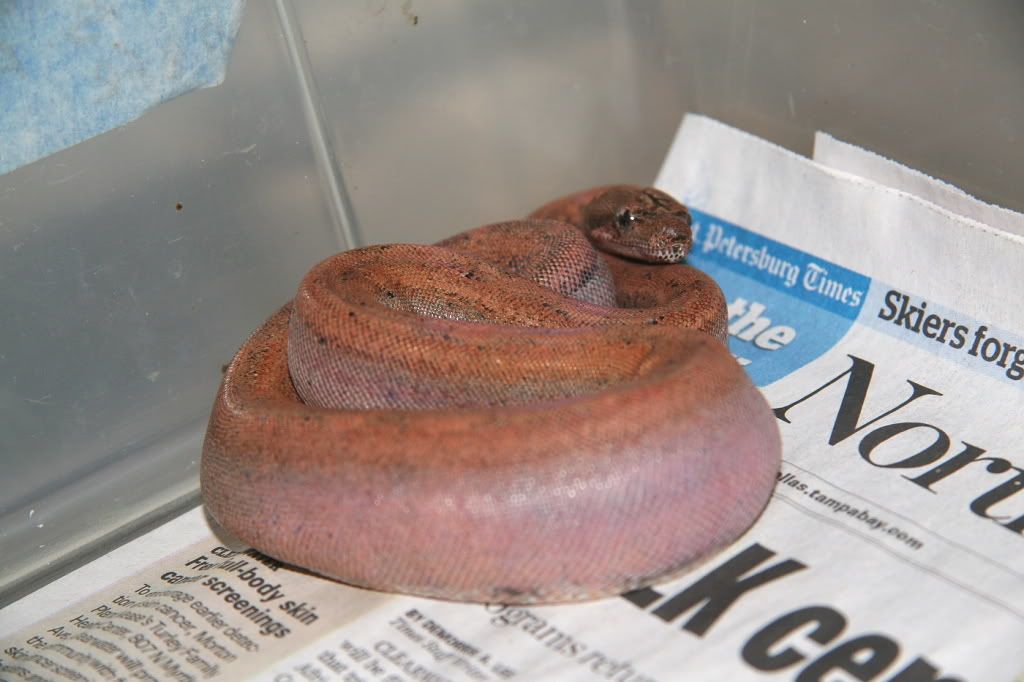
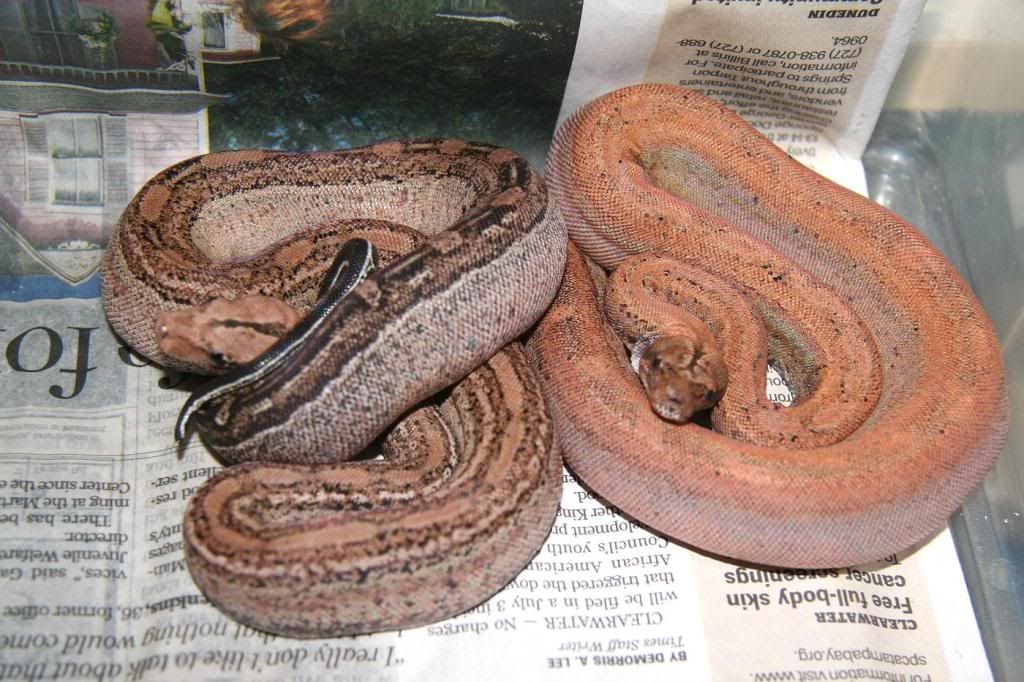
Those are insane I don't know why I forgot about those. Probably because I will NEVER be able to afford one so I was protecting myself. Blocking it out I suppose! Incredible animals Andrew!
-----
Ty Hege
Rat Race Solutions
www.ratracesolutions.com
I think it would be very helpful to see pictures of both of the parents of those babies to have a more intelligent discussion of this one. It' seems like the parentage of those puppies may have been shrouded in mystery. I say that because I can't remember seeing what they were for sure, and have no recollection of what exactly the parents were. Rumors abound. It seems most likely that it is a super form of some likely discernible single dose co-dominant mutation. That single dose mutation having not necessarily been identified as such. Sort of like the Roswells that were not identified as a mutation till we saw what a Super Roswell was. What a happy day that was.
All that being said, it is certainly within the right of Brandon not to tell anyone what the parents were that made those puppies, and not to have shown pictures of them. Even being the big mouth that I am, I probably would keep it a mystery as well, so kudos for the mystery. Ya gotta love a good mystery. Still it does drive me a little crazy not knowing...
-----
Boaphile Home
All Original/Boaphile Plastics
Boaphile Photo Gallery
that all of the info you are seeking are provided and now Tim has chimed in to further clarify. The entire history of the Harlequin line breedings (at least on Tim's side and the F3 father)are outlined and I provided 2 seperate pics of mom. You have pics of the four patternless as well. The only missing evidence in my opinion is a picture that includes the 5 siblings with the 4 patternless. I am sure it exists but even as much as Brendan and I used to hang out I have never seen that evidence. I hope this helps ease your "craziness".
-----
Ty Hege
Rat Race Solutions
www.ratracesolutions.com
This is something I ran across a couple years ago and Tim found it interesting enough to include on his site as a link. It really warped my mind. Maybe it will stimulate some new ideas.

-----
Ty Hege
Rat Race Solutions
www.ratracesolutions.com
Thanks for the link... that was a great read! Definitely food for thought...
My knowledge of genetics is very limited, but I am interested in learning more...that site presented some really good points about going beyond simple inheritance...
-----
Heather Martin
---------------------------
np
-----
Ty Hege
Rat Race Solutions
www.ratracesolutions.com
once you see these amazing animals in a ball of goo your hooked. Back in 07 Josh showed me his adults. I was inpressed but not blown away! Then i saw them produce a litter! The amazing color and pattern diversity in that litter was unreal! I was lucky enough to get a couple animals from this litter! As babies there unreal, but as they grow they only get better. I think they really start to show there color as yearlings! You will not trully love this morph untill you own one yourself IMO! They change so much! I can't wait till this gene is crossed into more morphs! They are underated. Buy far my favorite morph! Thats my two cents Ty. Not that it helped Bryan
my friend. You are exactly right about having to see it yourself. The colors come in for a couple years at least. I will post some of mine next.
-----
Ty Hege
Rat Race Solutions
www.ratracesolutions.com
From the first time Brendan sent me pics of the patternless babies I've been curious.
I've been a huge fan of the Harlequin Boas from early '03 I'd guess before I saw patternless pics.
What I find interesting is I've thought they had a peculiar similarity to those Purple patternless Motley boas.
These Harlequin Patternless seem to even have a Purple hue to there bodies I think anyway.
I certainly hope between Tim,Brendan,Ty,Josh, and others who are deeply involved in the Harlequin project.
Some interesting and conclusive results occur.
My '03 male Harlequin/Salmon

. . . Lar M
-----
Boas By Klevitz

to tail and it has browned/creamed up over time. I am sure we will know something if not this year then another couple years when some male offspring can be bred back to the mothers.
-----
Ty Hege
Rat Race Solutions
www.ratracesolutions.com
Very pretty boas and a very interesting project.
I didn't see any hard information about the patternless babies' mother on the web site. Is she out of the harlequin project, too? If so, how closely is she related to the father? She looked like a normal snake, to me. Not an orangetail, and not a harly. Is she a (presumed) het harly or an unrelated snake? The patternless were in 2005. The father died, but is the mother still around? Has she been bred to any other males???
From the HarlequinBoa web site, it looks to me as if harlequin is a recessive mutant gene. If patternless is at all related to harlequin, then patternless is likely to be a recessive mutant gene, too.
I thought that it was interesting that there were no harlequins in the patternless litter. Could this be just the luck of the draw? Or could it indicate something else?
I don't think there is enough information to draw any conclusions right now. So everything following this is brainstorming. The snakes will tell us eventually which of my ideas is right.
1. Patternless is a mutant gene that is dominant to the normal version of the gene totally unrelated to harlequin, though it masks the expression of the harlequin mutant. It was a spontaneous mutantion in either the father or the mother. If in the mother, has she been bred to any other snake? Objection: But if the mother was supposed to be het harlequin, why weren't there any harlequin babies?
2. Same as 1 except patternless is a codominant mutant. Same objection, too.
3. Same as 1 except patternless is a recessive mutant. Same objection. Also, both parents would have to be het patternless.
4. Patternless is a mutated version of the harlequin gene present in the mother only. That gene is dominant to the harlequin gene and recessive to the normal version of the gene. That would explain the no harlequin babies.
5. There is another explanation that I haven't written down or haven't thought of. I'm out of web surfing time now. 
Paul Hollander
of boas. I feel that they express themselves in almost a polygenic fashion under normal circumstances such as with most line bred animals except there do seem to be some subtle markers that are hard to discern unless you have looked at a lot of them. The thing I find is that they really start coloring up later so if their aren't many aberancies (which seems to be another trait that is passed along in some type of incomplete dominance or something)you have to wait to see the inordinant amount of color they pull up in their faces and sides, sort of like a jungle does(which is often another trait that co-exists). Paul, the Harlequins are simply a line of boas(line bred and then crossed out and then bred back into themselves like so many other lines) I often have thought that maybe they have a type of gene that actually "reflects" or matches up with certain genes in a sort of "universal" way like someone with O blood type can donate to all blood types(I think). So if a particular animal has the gene for a trait it can be duplicated without having to have a match as long as one is a Harlequin. The idea that none of them was Harlequin I think is a misconception because we have never seen the other three siblings. Only the two I have which are both DEFINITELY Harlequins. As far as the father he was an F3 that had NO relation to the mother who appeared to be a F1 bci X bcc cross and you will see the influence in my siblings. I think the one thing that would help the most is if the other three siblings were shown or a picture of all 9 babies together. ONLY so that we could look for the bcc influence or markers or whatever.


-----
Ty Hege
Rat Race Solutions
www.ratracesolutions.com
doesn't come across wrong. I value your opinions Paul I was just trying to explain what I know about them. I have much better pics but I haven't gotten them transferred off my old computor yet. They are interesting in how they work that is for sure. Some of the others that have bred them may have their own ideas. I have been up for over 20 hours now and am on pain killers. I have also been on this forum and updating photos for my site like 15 hours today so there is no telling how I come across. I hope not too bad.
-----
Ty Hege
Rat Race Solutions
www.ratracesolutions.com
Ty, thanks for correcting my misconceptions. The less garbage goes into the old mental mill, the less garbage comes out. And there was nothing offensive in your post.
The information about the mother of the patternless and your harlequins convinced me that harlequin is not a recessive mutant gene. Now harlequin is back in the "Wotinell is going on here?" category. 
As for patternless babies, having an unrelated mother and father lowers the probability that patternless is caused by a recessive mutant gene. But if patternless is caused by a recessive mutant gene, either the same mutation or two almost identical mutations occurred in both ancestral lines. Or there was a common ancestor in the unrecorded past. I really hope one of those is true.
Paul Hollander
about ALL the ways things happen in genetics, but I am still paying off my last student loans.LOL
I know that sometimes genes can kind of break and flip so that they match up differently or even split and end up with one parent contributing BOTH halves of the genetic code for a section of ther DNA if that makes sense. So it IS possible I believe in RARE circumstances that a trait can come from one parent and still be recessive. The offspring from them would then either be homozygous for that recessive trait or 100% hets but that happening in 5 babies without some type of predisposition for that by that parent to do that are very slim. The father being an F3 could possibly have developed some "weakness" for this type of thing due to inbreeding/line breeding but we will never know now. Like I mentioned before there are also a couple types of genes that "regulate or release other genes to exhibit themselves without a match from the other parent so to speak. So, ONLY time will tell I suppose. Thanks for your input and I am glad it didn't come across wrong because I really want an open-minded "meeting of the minds" so to speak. I KNOW we have some people in the field and/or the knowledge of many of the exceptions to the rules that could offer some "ideas" and I really hope this hasn't gotten too far down the page so that they miss it.
-----
Ty Hege
Rat Race Solutions
www.ratracesolutions.com
