Reptile & Amphibian Forums

Welcome to kingsnake.com's message board system. Here you may share and discuss information with others about your favorite reptile and amphibian related topics such as care and feeding, caging requirements, permits and licenses, and more. Launched in 1997, the kingsnake.com message board system is one of the oldest and largest systems on the internet.

Click here for Dragon Serpents
Click for ZooMed
Click here for Dragon Serpents

Who supports the sale of WC?

OHI Feb 11, 2009 02:59 PM

All,

Let's see where everyone stands (or at least those who read forums and are willing to respond). Who here supports the right of American citizens to buy, sell and trade wild caught herps both native and non-native? I am looking for a "yes" or "no" answer. Please list your name and company name.

Example: Yes, Mike Welker, Ocotillo Herpetofauna & Invertebrates

To clarify for those who care I would also support this statement:

I support the right of American citizens to buy, sell and trade any wild caught herp species that is not listed as Endangered or Threatened and that was harvested in a sustainable manner.

I am just looking for "yes" or "no" answers. I do not care to debate this issue or start a pissing match.

Thanks,

Welkerii

Replies (30)

daneby Feb 11, 2009 11:08 PM

I support the right of American citizens to buy, sell and trade any wild caught herp species that is not listed as Endangered or Threatened and that was harvested in a sustainable manner.

Dan Eby

TOM_CRUTCHFIELD Feb 12, 2009 04:55 AM

Although I personaly do NOT collect wild herps anymore except on RARE occasions and I do NOT PERSONALY sell anything I collect I support the right of others to do so. With me it's a moral issue but It would be hypocracy to do otherwise. Any of us, I believe, if the right herp were to be found by us or others, we would collect it or buy it to keep or resell. Even recreational collectors at some point usually sell or trade what they caught. This is NO different than simply going out and selling what you collect. When I was younger I did a lot of commercial collecting all over the world. In fact on a sustainable yield basis commercial collecting could and is in some countries a great conservation tool used correctly.Thanks....
-----
Tom Crutchfield
www.tomcrutchfield.com

brhaco Feb 12, 2009 08:52 AM

"yes or no" answer to your question, and the reason, of course, revolves around the question of "sustainability". In a perfect world, each species would be carefully studied so that we would be well-informed on whether or not there was a surplus suitable for commercial harvest. In practice, fish and game agencies are going to say: "we have no funding for herp studies, so we'll have to rely on the best guesses of our people out in the field."

In fishing, I can tell you that- especially in the case of freshwater fisheries, where such studies HAVR been done, and thoroughly- the result has generally been outright bans on commercial fishing in favor of recreational (i.e. "hobby" fishing. Once the all-encompassing factor of human appetites, combined with human greed, enter the picture, many cold-blooded species just cannot keep up.

Many chelonians (particularly tortoises) are good examples of species whose populations cannot stand commercial take.

So, Mike, if you REALLY mean "sustainable", then I can answer yes to your question. But based on what I've read from you in the past, I don't believe you do.
-----
Brad Chambers
WWW.HCU-TX.ORG

The Avalanche has already started-it is too late for the pebbles to vote....

TOM_CRUTCHFIELD Feb 12, 2009 10:08 AM

Brad, that was well said and I am in total agreement. The "key" is sustainable and every species is different....
-----
Tom Crutchfield
www.tomcrutchfield.com

phil bradley Feb 12, 2009 11:57 AM

I agree 100%

Phil Bradley

OHI Feb 12, 2009 06:15 PM

Okay,

So Tom Crutchfield says "yes" and

Brad Chambers says "yes"

Phil Bradley says "he agrees 100%" so no answer there. I don't know what he agrees 100% about.

It is real simple folks, yes or no.

We don't need your assumptions, your justifications, your pokes at me, your clarifications or anything other than yes or no. What sustainable means to you and how you define it is your business. This is a general question and I want general answers. If you think that in some cases it's okay and other cases it's not then that is fine. We don't want to know about it. Just weigh your beliefs and opinion and pick one, yes or no.

I only added the sustainable stuff to make you feel at ease so that you know we are not talking about over-collecting. I think that we all agree that over-collecting is bad. That is the only stipulation with this question.

Thanks for responding,

Welkerii

TOM_CRUTCHFIELD Feb 12, 2009 06:37 PM

Mike, you can't give an answer, yes or no, without the poster making some justifications on his/her point. It really is a complex question where yes or no could be justified depending on the species involved. Your explanation and definition of sustainable, endangered, and threatened are open to interpretation. For instance, perhaps the rarest turtle in Florida is the Spotted Turtle [Clemmys guttata]. They are NOT protected here at all and are not even classified as reptiles of concern. Would it be right under your explanation to harvest every wild adult you could find? Going under your definition, they are not endangered or threatened. No one even has a clue how many there are or even where they are. That is but one example and I'm reasonably sure every state has similar herps that are in limbo. Going strictly by your interpretations it would be o.k. to harvest wild ones when in fact it would be terrible to do so. That is why I don't think a simple yes or no will be enough for most folks...
-----
Tom Crutchfield
www.tomcrutchfield.com

brhaco Feb 12, 2009 09:13 PM

Tom is correct-this is not an easy question, Mike-but you obviously want to tally up a bunch of yes answers to support your own economic self interest. so here's my answer:

No, Brad Chambers does not support unregulated commercial collecting.
-----
Brad Chambers
WWW.HCU-TX.ORG

The Avalanche has already started-it is too late for the pebbles to vote....

OHI Feb 12, 2009 10:13 PM

Brad,

I have NEVER, EVER said I support unregulated commercial collection. So your answer still stands.

Are you trying to sabotage my post with your antics?

Try to control juvenile antics and lets see what people say? Afraid of the results, Brad?

Oh and don't take away my Constitutional right to free speech.

Welkerii

brhaco Feb 13, 2009 08:36 AM

take away your right to free speach, Mike-it's way too entertaining.
-----
Brad Chambers
WWW.HCU-TX.ORG

The Avalanche has already started-it is too late for the pebbles to vote....

OHI Feb 12, 2009 10:08 PM

Tom,

Harvesting every wild adult spotted turtle in Florida would not be sustainable thus your example doesn't make sense. Sustainable harvest is sustainable harvest. Sustainable harvest is defined as that portion of a population that can be taken by humans without adversely impacting subsquent populations of that animal (Owen et. al. 1998). Now, I realize that it is different for different species and that the sustainable harvest amounts can be debated. You could also argue about how to define adversely. That is not the question. The question is, "In general, do you support the right (or priviledge) of humans to engage in sustainable harvest (whatever this is to you or my definition) and then their right to sell that wild caught animal? We are talking about a moral judgement within humans. And yes, if you think that some species can be sustainably harvested and some can't then you have to weigh in your mind, "can more be sustainably harvested then can't or vise versa. We are talking about all species in general that are not listed as Endangered or Threatened. It is your call. I want a yes or no answer. Do you understand what I mean? I don't want to go into further detail because it may sway people.

Welkerii

TOM_CRUTCHFIELD Feb 12, 2009 10:45 PM

The problem is harvesting a SINGLE Spotted Turtle might be detrimental to their long term survival. No one knows. All that is known is that they are seldom seen and occur from around Lake City, Fl to a southern disjuct population in Polk, County. Therein lies the problem, lets call it the Unknown Factor...
-----
Tom Crutchfield
www.tomcrutchfield.com

OHI Feb 12, 2009 11:43 PM

Tom,

Okay, since this is not going to be going anywhere. If the harvest of a single specimen is going to cause that great of damage to the population then it is way to fragile to exist. It will go extinct with or without harvest if it is that fragile.

I believe that any species not listed as Endangered or Threatened has a sustainable harvest amount. What that amount is for each species I don't know. I would also bet that many of the species listed as Threatened could also withstand some harvest whether it be neonates, juveniles or select adults from select populations. But I am NOT advocating the harvest of Threatened species.

It is my belief that if a species can't handle even low level harvest it is in bad shape and most certainly should meet the criteria for listing as a Threatened species. That's what I think.

Welkerii

OHI Feb 13, 2009 12:02 AM

Tom,

The unknown factor can be invoked anytime with any species in any population. This sounds an awful lot like the flawed precautionary principle. However, with minimal investigation we can probably arrive at some reasonable status and develop reasonable bag limits and management guidelines for every species. Let's look at your rare spotty in FL. Collectors can't find them so how are they going to collect them much less over-collect them? I have looked for spotty's on several occasions in the area of known localities and never found them. When Antonio found a DOR on SR 44 and a live one was caught behind that big huge mall in Sanford, Mary Barnwell, Tim Walsh and I went to try and find them. We didn't have any luck. Eric Anderson said he saw some near Ocala NF. I have also looked at the locality in Lafayette County. And then there is that guy who has caught them down in the swamp. Now someone could get lucky and find a population and take all of them. This is why we need to regulate the situation. Should they be listed in Florida? Maybe. But we still would need LE to enforce the laws. We should also be tracking all harvest and liscensing everybody.

Welkerii

emysbreeder Feb 14, 2009 09:34 PM

One spotted was collected on the road along rice creek in Putman.Maybe a pet maybe not.this one had a low spot count.Anything depicting a Florida spotted compared to other locations.Vic

OHI Feb 14, 2009 10:15 PM

Vic,

Not that I am aware of. Barnwell and Walsh co-authored a paper:

Barnwell, M. E., P. A. Meylan and T. Walsh. 1997. The Spotted Turtle (Clemmys guttata) in Central Florida.
Chelonian Conservation and Biology. 2(3):405-408.

I know that the guy that was catching them down in the "swamp" posted pics on FieldHerpForum. I think some had high spot counts but I can't remember. I don't remember what the one we had at the zoo looked like. It might still be there.

I was checking the map on the Rice Creek locale. There looks to be swamp all around. Somebody really needs to spend some time trying to figure them out in FL. Now, should be the perfect time to look although my buddy Mickey who lives in G'ville said it was in the 80's today and he was going to go look for EDBs if it wasn't raining.

Welkerii

wstreps Feb 15, 2009 08:19 AM

" Should they be listed in Florida?" They spotted turtles.

Are you serious, they should be totally protected .EVEYWHERE. This is a collection sensitive species that the idea of a bag limit regulation does not apply to .

It doesn't matter if anyone can find them in Florida or not. By allowing legal collection in Florida it opens the door for illegal collection in other places. Places where populations can be easily over collected and the location of the turtles is well known.

No matter what anybody says visually ,
There's nothing to separate a Florida spotted from a spotted found anywhere else. Back when Jack Louruse was the man for spots I got see more then my share. Thousands. I also caught a fair number on my own and took home a grand total of three for pets. Even back then I knew it was heading for a disaster and that it couldn't go on . You can no more tell the difference between spotted's then you can Guyana and Suriname redtails.

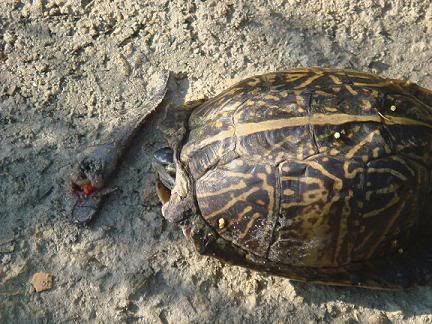
I took this picture in my driveway it's Florida Box turtle eating a walking catfish.

Ernie Eison
Westwood Acres Reptile Farm Inc.
WESTWOOD ACRES REPTILE FARM INC.

OHI Feb 15, 2009 01:50 PM

Ernie,

The spotted turtle should have bag limits on them just like any other species for which the need is demonstrated. Your post demonstrates a great example of the snowball affect. Rather than having Game & Fish do their job of licensing collectors and dealers, monitoring harvest and possession, and sending LE out into the field, you want them to take away somone's right to sustainably harvest a resource. Then the next state gets lazy and bans them and then the next and then the next. Pretty soon you are down to a couple states who have greatly increased pressure on them. What do you think they will do?

Meanwhile in the states where they are banned can you keep previously captured specimens for captive propagation? Can you sell the neonates or no longer wanted adults? Can't wild caughts be "washed" in that system? What about acquiring new blood?

And finally, so spottys are protected from collection but since they are not listed as Endangered or Threatened, because they are doing okay, the bulldozers of habitat destruction can still destroy them. If not, the wetlands themselves, the habitat all around them and eventually they will go extinct.

Why not do something that is fair and reasonable? Something which promotes captive reproduction and allows harvest especially in areas that are being destroyed? You don't want to protect them into extinction, you want to regulate the situation. What the government should be doing is buying two types of habitat. One type in which NOTHING can be harvested. And habitat that can be managed for harvest. That sounds smart, fair and reasonable.

Welkerii

antelope Feb 13, 2009 09:09 AM

Who are "we"? As in We are not amused, or me an my buddies, or me and this unidentified group you are affiliated with? We don't need no stinkin' badges? Brad is right, this question is loaded.
-----
Todd Hughes

brhaco Feb 13, 2009 08:46 AM

The entire question is flawed in several aspects-especially the fact that (most would agree) the taking of herps for profit (or indeed for hobby purposes) is a privilege, not a right!
-----
Brad Chambers
WWW.HCU-TX.ORG

The Avalanche has already started-it is too late for the pebbles to vote....

OHI Feb 13, 2009 02:04 PM

Brad,

Is gun ownership a right or a privilege? And is this not a free country where I have my own opinion on the subject, including definitions? Herps and all wild animals are owned by the people in each state where they occur. Thus I own them just as much as you. I think that any citizen has the right to use these resources, in a sustainable manner, for whatever purpose they desire so long as it is humane. I would support a permit system that is designed to have those taking more then some personal amount pay for their more extensive use of the resource all within a sustainable framework. Sustainble use should be afforded to all citizens who seek to use the resource. When the demand by humans uses up those surplus sustainable stocks annually then a fair harvest systems needs to be worked out so each citizen has an opportunity to use the resource. In my opinion no herp species is in such high demand that everyone can't get at least a portion of this surplus. There are not that many people who harvest herps from the wild. But there are certain people who harvest a lot more then most. So you simply initiate bag limits, if warranted, for those species for which the amount of take is shown to be causing a negative impact on that species.

Welkerii

BRhaco Feb 13, 2009 03:03 PM

First off, gun ownership is a RIGHT under the second amendment to the constitution. Unfortunately for herpers, reptiles are mentioned nowhere in said document

But now we are getting somewhere (did you notice you had to rephrase your question at length to make it answerable?). Put that way, I have few problems with it. Realize, though, that state agencies will be the ones deciding the specifics-seasons, bag limits, etc. These are unlikely to be generous except in the rare case that they have specific research pointing to a large harvestable surplus. And these same folks, almost invariably, will have an institutional mindset that is actively hostile to even the idea of commerce in any kind of wildlife.This has to do with issues going back more than a hundred years in wildlife management, to the days of Gifford Pinchot and Aldo Leopold. It also has to do with many's personal experiences of the abuses sometimes attributed to commercial collectors (I myself remember finding vernal pools in central Ohio totally ringed by drift fences and bucket traps by a notorious local commercial colector. He took spotted and tiger salamanders by the hundreds, totally extirpating local populations-due to this person and several others, Ohio now has draconian herp laws that are bad for ALL herpers). Right now, herps are the ONLY terrestrial vertebrates that can, in some states anyway, be collected from the wild and sold for profit.

In my view this is extremely unlikely to continue, regardless of what we do. But we risk losing everything if we set ourselves up in an adverserial position on this single issue, which after all affects a VERY few people nowadays.
-----
Brad Chambers
WWW.HCU-TX.ORG

The Avalanche has already started-it is too late for the pebbles to vote....

OHI Feb 13, 2009 04:22 PM

Brad,

The ability to capture and sell wild caught is the foundation of this industry without it this industry is done as we know it. It will also negatively affect the zoo, museum, research, education and venom industries. The herp industry is a job creator and we need to keep it that way. Making access to wild caught animals and commerce in these animals illegal is the wrong way to go regardless of the tired old and radical thinking of regulators, animal rights folks, academics and now idealistic hobbyists. Yes, the selling of some wildlife has been frowned upon in the past but there are exceptions. Further, in general, it is acceptable to sell natural resources. It all depends what they are used for, how they are used and the nature of the resource. The bans in selling wildlife in the past were related mostly to use as a food source. Those commercial hunters of the late 1800's and early 1900's were not capturing beaver, elk, deer, turkey and quail to take them home and breed them they were shooting and trapping them for food and fur. This is why it is a tired old arguement that needs new thinking not cowering to ignorant old thinking as some hobbyists are doing now. Herps are captured alive, propagated, bred and sold across state and federal lines for many reasons and the approach to this reality needs fresh new thinking.

Yes, some collectors may have damaged populations and over-collected. But they are few in number and all of us should not lose our privileges for the sins of a few. That is radical and extreme. And it is why those hobbyists who think in these terms hold wrong and damaging views. It is the new alliances and this vocal support agenda by idealistic hobbyists, that are supportive of these out-dated ideals, that are bad for the industry. Now, I agree with cooperation and partnerships but not at the expense of the industry or civil rights. There is a difference. And you have absolutely no right to give away the rights of others for your selfish agenda.

Now, I can understand why those who don't sell wild caught want to be sure that the powers-that-be know they are not selling wild caught. But it is this total disregard, the selling out of and the lack of concern about other industry folks by these ignorant, idealistic hobbyists and their vocal support of the wrong approach that makes them the enemy of the industry. Not to mention that they are selfish and the way the handle opposing views is appalling.

And finally, as has been discussed in this post and many others by me and others, there are other solutions then the radical old approach pushed by the old thinkers and idealists. These approaches address the majority of stakeholders, they are fair and they conserve wild herp populations. By far a better solution for the industry, the herps, the economy and preserving folks civil rights.

Welkerii

brhaco Feb 13, 2009 05:06 PM

"The ability to capture and sell wild caught is the foundation of this industry without it this industry is done as we know it. It will also negatively affect the zoo, museum, research, education and venom industries."

Says you-the commercial collector. In actuality, most unbiased observers (and remember, I myself have no particular bias for or against commercial collection) would come to the conclusion that the modern herp hobby has relatively little need for commercial collection. The vast majority of popular herp species are present in the hobby in much better than self-sustaining numbers (when was the last time you saw a wild caught corn snake, leopard gecko, cal king, etc for sale?). Need new blood for your breeders? Go out and collect it for yourself, or trade with someone who lives in that species range.

The herp industry is a job creator and we need to keep it that way.

No argument here-but many of us believe the way to preserve our hobby is decidedly NOT to attempt to defend the indefensible (speaking of political realities here, not idealism).

Yes, some collectors may have damaged populations and over-collected. But they are few in number and all of us should not lose our privileges for the sins of a few.

The problem is, such abuses are inevitable when the profit motive is introduced-it's the "tragedy of the commons" (google it)...

Now, I can understand why those who don't sell wild caught want to be sure that the powers-that-be know they are not selling wild caught. But it is this total disregard, the selling out of and the lack of concern about other industry folks by these ignorant, idealistic hobbyists and their vocal support of the wrong approach that makes them the enemy of the industry. Not to mention that they are selfish and the way the handle opposing views is appalling.

Let's see-now we're ignorant, self-serving (truly humorous coming from you, Mike!) short-sighted, radical, sell-outs? Now who's trying to start a "pissing match"?

-----
Brad Chambers
WWW.HCU-TX.ORG

The Avalanche has already started-it is too late for the pebbles to vote....

OHI Feb 13, 2009 07:18 PM

Brad,

Is that all you have is stigmatization, excuses and justifications? Please. You continue to NOT tell it like it is. It is impossible to have a reasonable debate with you. You are so worried about agreeing with reasonable ideas and logic you have to mix it up with far flung statements, slander and other useless statements meant to confuse and throw the deabte off topic. But when I debate with you it is really for others. Your tactics are plain to see.

And one more thing, I have read and studied The Tragedy of the Commons thoroughly. And the only real fix is to leave nature alone and not impact it at all. That means recreational collector hobbyists and picture takers as well. Do you want to go that route? I didn't think so.

Welkerii

brhaco Feb 13, 2009 08:08 PM

fair enough-I'm certainly content to leave both our positions as stated, and let other observers judge.
-----
Brad Chambers
WWW.HCU-TX.ORG

The Avalanche has already started-it is too late for the pebbles to vote....

wstreps Feb 13, 2009 10:19 AM

Essentially the question your asking is along the lines of ( would you jump off a bridge? ) it's true you can answer this type of question in a simple yes or no format. But it would be much smarter to consider the circumstances surrounding the jump before answering. If we don't have to blindly jump off a bridge we shouldn't.

The questions surrounding the sale of wild caught animals are so diverse that there is no way a blanket one word response could be viewed as credible. The specifics involved are to important to be dismissed.

Ernie Eison
Westwood Acres Reptile Farm Inc.
WESTWOOD ACRES REPTILES FARM INC.

OHI Feb 13, 2009 02:17 PM

Ernie,

This question is a moral judgement question. It has nothing to do with the animal or its populations. Let me re-phrase it. "Do YOU think that humans who legally collect a wild caught herp should be allowed to sell that wild caught herp within a state that allows the sale of wild caught herps? In other words do you think (personally) that it is okay for someone to sell a wild caught herp? Do you have any moral conflict with the right to sell wild caught? Yes or no. You guys are making this way to complicated.

Welkerii

jscrick Feb 17, 2009 02:24 PM

Haven't been here lately. Haven't even read all the discussion so far.
My answer is YES. Of course, with the usual common sense qualifiers.
Nobody ever got rich by collecting. Please, lets put that fallacy aside. It's just something very satisfying -- no different than Hunting or Fishing, or Bird Watching. It's in the blood.
Something I've done all my life and I don't feel this right should be taken away. Maybe they could grandfather my rights. Ha. In the future no youngsters may collect. Ha Ha.
jsc
-----
"As hard as I've tried, just can't NOT do this"
John Crickmer

jscrick Feb 17, 2009 02:39 PM

OK. So I've read a little bit more and I gotta say, I do get tired of the "That depends on what the definition of 'is' is".
I get tired of all the semantics and the personalities...can't see the forest for the trees mentality.
I would suggest that a prudent practice would be to protect habitat from development before getting into population viability issues. If there is any question at all, the population's territory should be preserved before anything else.
It's just so easy to scapegoat the collector/hobbyist. Especially, since the "Deciders", those who are the ones destroying habitat as a matter of their livelihood are the ones so critical of our herptile heritage. Do they concern themselves with habitat? No!
jsc
-----
"As hard as I've tried, just can't NOT do this"
John Crickmer

Site Tools