


Sorry for such a long post...
A thread below (by Doug L.) has spurred a little discussion regarding the range of syspila and mulitstrata in Nebraska. First, let me state that the monograph published by Ken Williams on the species Lampropeltis triangulum is an outstanding work. It’s the best thing we’ve got to work with so far, but it’s not a pinnacle work. There’s always room for improvement as further info is uncovered.
It is well documented that the form of Lampropeltis triangulum known as mulitstrata occurs in the eastern 2/3 Montana, western South Dakota (WEST of the Missouri River), parts of Wyoming, and northern Nebraska. This form intergrades (experiences mass gene flow) with the form known as gentilis to the south in northern Colorado and southern Nebraska. There is considerable debate as to whether mulitstrata and gentilis should be considered distinct from one another, as there are few, if any, discrete characteristics to distinguish one from the other (physically or biochemically). We’ll leave this little wrinkle out for this discussion (unless someone really wants to discuss it…LOL).
The mulitstrata form is known, as stated above, to be restricted west of the Missouri River in SD, while the form we know as syspila is found in a few counties to the east of the Missouri River within that state. The animals from along the river valley display characteristics of both forms. Why is this? Well, obviously there’s gene flow between the two populations. The river is no barrier to milksnake movement, as Dell can (will?) attest. Also, anyone who’s ever been to that area knows that the Missouri River in the Dakotas and Nebraska is sort of a demarcation between a more arid, xeric habitat (mulitstrata habitat) and a wetter, more mesic habitat (syspila habitat). One way to look at the situation is that the river valley provides a transition habitat, where one phenotype isn’t preferred over another. This area of non-differentiation is called a “primary intergrade zone” by those who study this sort of thing.
(I think wikipedia has a good, solid explanation of the different types of intergrades – “temporalis” along the eastern sea board is more like what we call a “secondary intergrade” with some possible reticulate introgression).
How does this translate into what we’re seeing in Nebraska with Doug’s animals? Williams, in his 1988 edition of his milksnake monograph, described animals from extreme north-eastern Nebraska, along the Missouri River and the South Dakota state line, as being mulitstrata X syspila intergrades. He lacked specimens along the Missouri River to the south of these, but as new specimens are turned up from this area (as Doug’s were), the picture becomes more complete. Intergradient animals are found all along the eastern portion of Nebraska, along the Missouri River Valley, and south (in the form of syspila X gentilis intergrades) along the Flint Hills of Kansas. The Flint Hills of KS provide a similar habitat transition zone as the Missouri River Valley does to the north.
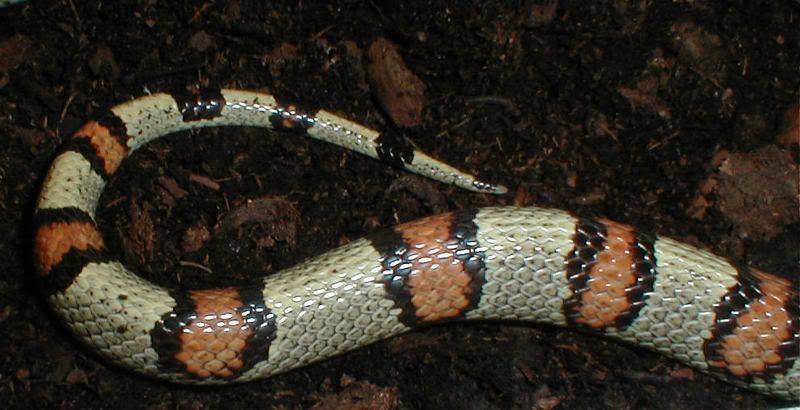
How do we know the animals Doug posted are intergrades? Well, aside from locality, we can see that the animals lack ventro-lateral blotches, a requisite of syspila and Lampropeltis triangulum triangulum. Secondly, we look at their head pattern. Some of the animals show a nice red cap, as a “good” syspila should. Others, from the same locality, show a black or mottled head cap, as a “good” gentilis or mulitstrata should. The very fact that the region produces animals which, as a group, are unidentifiable to subspecies evidences (strongly) that it’s an intergrade zone.
Please, add your thoughts, comments, criticisms, and photos!
-Cole Grover
Thomas Co., NE

Pennington Co., SD




 ......... oh snap


