Someone wants me to take on thier nile monitor. Said he is handlable but can be aggressive. It is already several years old and good sized. My questions are these...What sort of habitat are people keeping these guys in? Pics if any? I am housing a big savannah now and I have worked with a large nile before but sadly he was not housed "properly." Any input on dealing with a nile and keeping it happy and healthy would be appreciated. I want to make sure I am up for the challenge BEFORE I agree to adopt him. Thanks to all.
Reptile & Amphibian Forums
Welcome to kingsnake.com's message board system. Here you may share and discuss information with others about your favorite reptile and amphibian related topics such as care and feeding, caging requirements, permits and licenses, and more. Launched in 1997, the kingsnake.com message board system is one of the oldest and largest systems on the internet.


nile monitor questions...
weebeasties
Mar 03, 2009 11:01 AM
Replies (10)
lwcamp
Mar 03, 2009 11:27 AM
>>Someone wants me to take on thier nile monitor. Said he is handlable but can be aggressive. It is already several years old and good sized. My questions are these...What sort of habitat are people keeping these guys in? Pics if any? I am housing a big savannah now and I have worked with a large nile before but sadly he was not housed "properly." Any input on dealing with a nile and keeping it happy and healthy would be appreciated. I want to make sure I am up for the challenge BEFORE I agree to adopt him. Thanks to all.
Habitat: Deep diggable dirt with a large water bin large enough to soak in.
Here's a good general care sheet - some of the sections were obviously cut-and-pasted from the savanna monitor sheet, but the basic information is good.
www.wnyherp.org/care-sheets/lizards/nile-monitor.php
Here's a photo of an adult
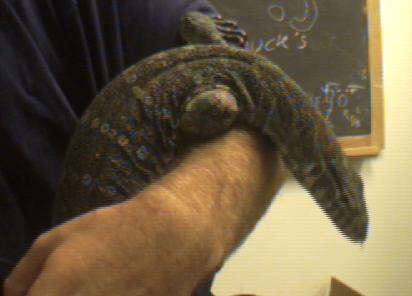
Here's a sub-adult
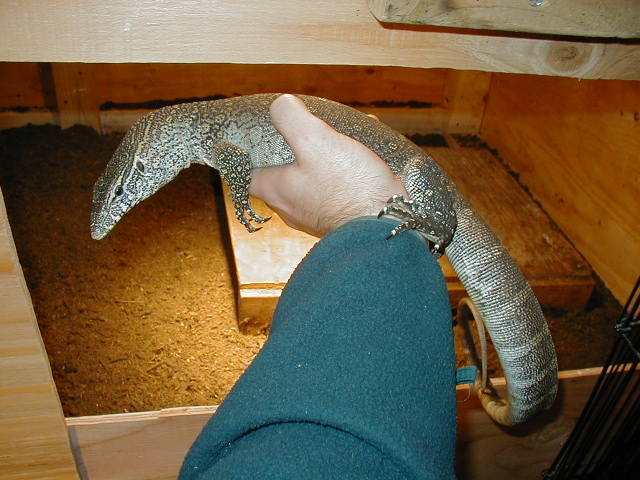
Also, a lot of people confuse Nile and ornate monitors - they are separate species and very different animals. Here's a page on how to tell the difference
panoptesv.com/HBD/ornatevsnile.html
If the lizard is an ornate, the basic care is essentially the same, although you have a greater likelihood of getting the lizard to trust you.
Good luck,
Luke
cinderellawkids
Mar 03, 2009 12:13 PM
>>>>Someone wants me to take on thier nile monitor. Said he is handlable but can be aggressive. It is already several years old and good sized. My questions are these...What sort of habitat are people keeping these guys in? Pics if any? I am housing a big savannah now and I have worked with a large nile before but sadly he was not housed "properly." Any input on dealing with a nile and keeping it happy and healthy would be appreciated. I want to make sure I am up for the challenge BEFORE I agree to adopt him. Thanks to all.
>>
>>Habitat: Deep diggable dirt with a large water bin large enough to soak in.
>>
>>Here's a good general care sheet - some of the sections were obviously cut-and-pasted from the savanna monitor sheet, but the basic information is good.
>>www.wnyherp.org/care-sheets/lizards/nile-monitor.php
>>
>>Here's a photo of an adult
>>
>>Here's a sub-adult
>>
>>
>>Also, a lot of people confuse Nile and ornate monitors - they are separate species and very different animals. Here's a page on how to tell the difference
>>panoptesv.com/HBD/ornatevsnile.html
>>If the lizard is an ornate, the basic care is essentially the same, although you have a greater likelihood of getting the lizard to trust you.
>>
>>Good luck,
>>
>>Luke
Keep in mind they double the size and feeding amount of a Savannah
-----
1.1.0 YBS
1.3.0 RES
1.0.0 red belly cooter
0.0.2 mud turtles
1.1.0 Savannah Monitor
0.1.0 Blackthroat monitor
0.1.0 Leopard Gecko
0.1.0 Mountain Horned dragon
2.1.0 Ball pythons
1.0.0 Bearded dragons
cats, dog, ferrets, rabbit, rats.
rappstar609
Mar 03, 2009 01:35 PM
I did this same thing last year, the 'take in of a nile' (seems like a common thing!) Mine was under 6 inches when I got him, and I couldn't even look at him without being whipped at, clawed at or bit at. Now he is almost a foot and I can't even look at him without being whipped at, clawed at or bit at. I have had him in a custom 4x5 (roughly) enclosure with a lot of dirt and hides, and more importantly a gigantic container for water with rocks/ places to hide, since that is where he spends 95% of his time. I keep the enclosure covered to maintain humidity and feed him either a couple pinks or a bunch of crickets about everyday. I hardly ever see him. I have tried to handle him with gloves before, but he absolutely hates it. He hates me, the world, and everything else. He is impressively angry.
I would recommend not taking in a Nile unless you have a decent budget and are prepared to build basically a water tight, humidity holding room for the Nile down the road. They get big.
Sidbarvin's got a pair of adults that are rather impressive as well, hopefully he will put his 2 cents in.
Good Luck!

-----
1.1 Savannah Monitors (Annah & Terrance)
1.1 Nile Monitor (Lyle)
1.0 Timor Monitor (Timmmmaaayy)
1.0 Blood Python (Kevin)
1.0 Ball Python (Martin)
0.1 Leopard Gecko (Bella)
2.0 Bearded Dragons (Peter & Jack)
1.0 Mexican Black Kingsnake (Hector)
1.1 Kenyan Sand Boas (Wayne & Maude)
1.0 Dwarf Gecko (Little Girl)
1.0 Curly Hair Tarantula (Pube)
1.0 OBT Usumbara Orange Baboon Tarantula (Sin)
1.0 Emperor Scorpion (Ashoka)
2.0 D. auratus (Poison Dart Frogs)
1.0 Peacock Bass (Gary)
bishopm1
Mar 03, 2009 03:31 PM
I have a 5 foot one. He was a rescue. I can't really talk I just have one and I didn't raise it.
I wouldn't say they are mean or aggressive. What they are is DEFENSIVE and effectively so. Afterall they come from a place where they rob crocodile nests. And mom Nile Crocs, thats aggressive! yes they will defend a against a predator much bigger than themselves (us). I think they seldom if ever become tractable and not to expect this. They are cheap and cute babies and people who don't know monitors buy them and then don't want them. Then it becomes a poor homeless wild animal expensive to keep. Yet since someone has brought them here they still deserve good care and respect. I am fond of the one I keep because he is the way he is. Anyone who comes to my monitor house has to come through his locked yard.
People who live in warmer states can make a nice walk in corner cage out of sliding glass doors that includes a window and a pen it can go outside and bask in the sun and swim in its pool. A plastic wading pool works well when they are smaller. It has to be made of sturdy materials they can't dig or climb out of and in a quiet place where no one will tease them.
Someone here does have a big tame one named Lyle the Nile.
weebeasties
Mar 03, 2009 03:34 PM
Thanks!! I love monitors. I do alot of rescue work and personally I find monitors almost easier than big iguanas to deal with. Now granted...I've known some rather demonic iguanas! Or maybe I've only known nice monitors!
Anyways thanks for the thoughts on caging etc. Space maybe an issue but since I raise alot of rats and mice food shouldn't be too much trouble. Question...if you have to move a full sized, full attitude nile from his enclosure do you just grab him or do you usually use some techniques? As I have mentioned I can handle mad, large iguanas and up to 5 foot alligators so is the nile goona be easier or harder to control than either of those? Again thanks guys and I'll post again if I decide to adopt this guy.
lwcamp
Mar 03, 2009 04:11 PM
>> Question...if you have to move a full sized, full attitude
>> nile from his enclosure do you just grab him or do you
>> usually use some techniques? As I have mentioned I can
>> handle mad, large iguanas and up to 5 foot alligators so is
>> the nile goona be easier or harder to control than either of
>> those? Again thanks guys and I'll post again if I decide to
>> adopt this guy.
Put on heavy gloves and long sleeves, then grab by the base of the tail and the lower neck. You may find it useful to step in just behind the rear foot facing you to block the tail just as you grab. Hold on tight, see if you can keep the animal's belly pointed away from you. It will try to roll and grab you with its claws, and then defecate on you. Gloves will not provide complete protecting against the bite of a large Nile - the pressure alone can break bones in your hand - but it should keep the teeth from cutting your hand up and can prevent most injury from medium sized animals or smaller. Put it in a very sturdy bag as soon as you can.
An alternative is to get a towel and grab the monitor with the towel, trying to roll it up so it cannot twist and get you. Still wear gloves and long sleeves, just in case. Having the head covered often calms a difficult monitor, and if nothing else it can't see to get you.
In either case, watch your eyes as you step in. They will aim for the eyes when they tail whip if your face gets close enough. This is not pleasant.
Collectors who don't care about injuring their quarry often use nooses. A leather strap might be wide enough not to injure the lizard (I don't know, I've never tried it). Attach the leather to a long, strong pole with a pull cord to tighten the noose. Put the leather loop over the lizards head and then pull tight to catch it by the neck. This only works if the Nile is out in the open.
If you do get bitten, Niles have an odd habit of going completely limp except for their jaws, which clamp down and do not let go. If you put the lizard down and release it, it might release you and try to make good its escape. Otherwise, plan for a monitor lizard to be attached to your hand for a long time.
I have not handled crocodilians or difficult large iguanas, so I can't help with the comparisons, sorry. (I've handled relatively docile large iguanas - Niles are much more difficult than these  .)
.)
Good luck, these are not the easiest lizards to work with.
Luke
varanid
Mar 03, 2009 06:01 PM
Niles are on my life list--I'd love to keep one, they're stunning lizards...but good god, I've seen enough big and angry ones to think twice, then three times, then some more times! I have a jones for african monitors in general though. Savs, niles, blackthroats, they're all amazing.
Some day I'm gonna buy one of those freaking HUGE 9' diameter tanks and have my dad help me build up a pen around it, use it for the little bugger.
sidbarvin
Mar 03, 2009 10:55 PM
Here is a link to some photos of a couple of mine. Both grew from hatchlings to well over four feet within a year. They are well over six feet now, the larger leaning toward seven.
http://www.repticzone.com/forums/Monitors/messages/1957148.html
elidogs
Mar 03, 2009 11:59 PM
I don't think you could give a lot of monitor keepers a nile monitor once they see their temperments in person There are some great looking healthy ones posted here though
negatronix
Mar 06, 2009 01:21 AM
I kept a Nile for 13 years. I bought him off some collectors when he was 2ft long and he ended up growing well over 5ft.
I kept him in a wooden cage with metal wire on the front. I placed large flat stones/pavers and mexican river rocks on the ground with loose rocky soil. I used a small kids wading pool with a large oak branch placed over the pool. I also had a variety of heat lamps, and UV lamps set up. The cage was 12'X4'X4', and was constructed in three 4' long sections over the years. He also had an outdoor pen with the same dimensions.
He was fairly mellow until he hit 4ft, then he just got really lazy. He didn't like to be handled very much, but didn't mind me getting into the cage and patting his back, or putting a harness on him and walking him around the yard.
I actually trusted him more than the Savannahs and Argus's that I had. I could read his mood much easier. Some days he would have ripped your arm off, while other days he would gently take an egg right out of my fingers.
