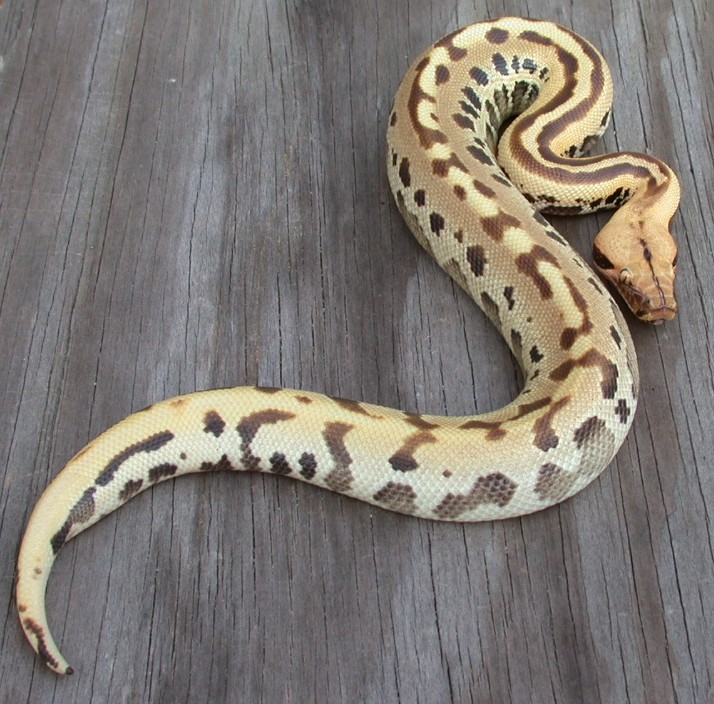
Looking into the Ultra Breits. Are these animals recessive co-dominant or lineage? I assumed they were recessive and any baby would be 100% het thouugh w/ visual markers. Any feedback would be great.
Thank you,
Joey
Welcome to kingsnake.com's message board system. Here you may share and discuss information with others about your favorite reptile and amphibian related topics such as care and feeding, caging requirements, permits and licenses, and more. Launched in 1997, the kingsnake.com message board system is one of the oldest and largest systems on the internet.



Looking into the Ultra Breits. Are these animals recessive co-dominant or lineage? I assumed they were recessive and any baby would be 100% het thouugh w/ visual markers. Any feedback would be great.
Thank you,
Joey
Recessive, the hets have a good look to them and you can line breed some amazing animals with this trait..

-----
Mike Jenks-Solar Serpents llc
Hi Joey,
I'm still relatively 'new' to producing Ultras. I hope this will be my 5th season producing babies.
>>Are these animals recessive co-dominant or lineage? I assumed they were recessive and any baby would be 100% het thouugh w/ visual markers. Any feedback would be great.
So far, no one to my knowledge can make any 'final' or certain genetic claims. I currently have the VPI line and Latte. I do not believe this trait passes in any 'normal' genetic fashion. Why? I bred my best male Ultra to a completely normal, unrelated female this past season and produced an Ultra male nearly identical in every way to his father. That pretty much throws all ideas of recessive, codom and maybe even dominant genetics out the window in my opinion. I have a few more breedings hopefully in the next season or two which will shine more light on it, but until that time I cannot make any absolute genetic claim and don't think anyone else working with them can. But, with that said they make for some INCREDIBLE looking snakes! I actually like the mystery of the gene because you just don't know exactly what to expect until babies hatch. Fun fun fun!
Matt
Hey Matt,
I'm not hip to what's been done with the breeding of this mutation, but have you checked your results against the possibility of this being a X-linked mutation?
Take care,
Jordan
Hi Jordan,
>>I'm not hip to what's been done with the breeding of this mutation, but have you checked your results against the possibility of this being a X-linked mutation?
I never checked into that (just did) and it seems to affect more males than females? (expression) Maybe I read it wrong?!?! I've produced a significant (majority) of females. So, who knows... I think it would make a good doctorate degree for someone interested in genetics for sure. 
Thanks for the insight!
Matt
Hey Matt,
Mostly females eh? Hmmm... that throws me for a loop, I'm going to follow this up with a female for you about your breeding results and run it by my genetics professor and see if we can figure this thing out...
In the mean time... X-linked mutations are on the X chromosome. On females they have 2 x linked chromosomes so they can have a heterozygous or homozygous genotype (* or phenotype, dependent on mode of transmission). Since males have an X and a Y they can only express the homozygous version of the trait.
There are variables with this mutations caused by development, which can cause an ontogenetic color change.. for instance with the pearled mutation in cockatiels, many males of this X-linked pattern and color mutation will turn to a normal appearing animal after their first molt. I would imagine that something similar would be possible in the phenotype of a male of an x-linked mutation making it appear different than a female may?
Take care,
Jordan
>>Mostly females eh? Hmmm... that throws me for a loop, I'm going to follow this up with a female for you about your breeding results and run it by my genetics professor and see if we can figure this thing out...
I've produced a mix of both males and females, but have been heavier on females every season.
>>In the mean time... X-linked mutations are on the X chromosome. On females they have 2 x linked chromosomes so they can have a heterozygous or homozygous genotype (* or phenotype, dependent on mode of transmission). Since males have an X and a Y they can only express the homozygous version of the trait.
>>
>>There are variables with this mutations caused by development, which can cause an ontogenetic color change.. for instance with the pearled mutation in cockatiels, many males of this X-linked pattern and color mutation will turn to a normal appearing animal after their first molt. I would imagine that something similar would be possible in the phenotype of a male of an x-linked mutation making it appear different than a female may?
Very interesting! When they hatch for us here, Ultras are 100% easily identified. They have a pattern and color tone (extrememly pale) that immediately sets them apart. Kinda like Pastel Jungle Ball Pythons. In the end I really hoped the trait was recessive, but with the information I've received from other breeders and the result we had last year it's still up in the air for me. Hopefully this season we will have some more results to provide more info on what's going on.
Thanks for your input, Jordan!
Matt
Matt keep in mind that there was collection bias in the populations of borneos brought into captivity. It is very possible that some imports were related and had similar genes. So what is thought to be dominant/codominant may really be recessive and the only way to disprove this is by further breeding out to unrelated animals. I think this is the case with the debate over granites/marbles. I still think they are different traits, but peoples experiences vary depending on teh animals they are working with. We are at the infancy with breeding STP's so it is too early to tell what lines there really are. With ball pythons, there were litterly hundreds of thousands of animals brought in from different countries. With borneos we are only talking a few thousand from relatively similar locations. Food for thought.
BTW keep up with the ultra's they are looking so much nicer!
-----
================================
www.richcrowleyreptiles.com
Support your local herp society
www.chicagoherp.org
Hi Rich!
>>Matt keep in mind that there was collection bias in the populations of borneos brought into captivity. It is very possible that some imports were related and had similar genes. So what is thought to be dominant/codominant may really be recessive and the only way to disprove this is by further breeding out to unrelated animals.
The female is a claimed CH import bought at a pet store in Texas about 5? years ago. It's possible VPI was moving het Ultras at very low wholesale values, but personally, I doubt that to be the case here as she does not resemble any VPI line Borneos I've ever seen. She actually has an eye and occular scale 'setting' that looks SO 'Blood' to me it's crazy! The suboccular scales say she's a Borneo, but overall she's a bit different than what I'm used to seeing.
> We are at the infancy with breeding STP's so it is too early to tell what lines there really are. With ball pythons, there were litterly hundreds of thousands of animals brought in from different countries. With borneos we are only talking a few thousand from relatively similar locations. Food for thought.
Good point, Rich! Only time will tell for sure. Hopefully this season we'll see some more results. I did not breed the Ultra male to that female this season, but will again next season for sure. I also have a few animals for this coming fall which may give a little more insight if they produce for next season.
>>BTW keep up with the ultra's they are looking so much nicer!
Many thanks! I really hope we can get some positive results from some animals this season... things could be pretty interesting!
Matt
Sorry I am way late on this I haven't been on any of the forums for a while. Mike just told me about this post so I wanted to chime in.
I have three adult Ultra Breits 1.2
Last year my male bred my older female
so Ultra x Ultra... 22 eggs all Ultra Breit
I also bred my Ultra male to a normal female
Ultra x Normal... 17 eggs... All visual hets
My younger female Ultra ovulated today bred to my Ultra male.
I think the female Ultra that went last year is taking this year off. So I will have more to add in a few months.
When I bought into this project they were explained to me as being Recessive... And so far with the breeding I have done I have no reason to believe otherwise.
Snake Genetics can be so much fun... LOL
Josh Ketchum
-----
Josh Ketchum
Sunshine Boas
Hey Josh,
Well those breeding results make 100% sense... I am curious if other people have had similar results?
If the hets are visually different from a wild phenotype, then would this not be an incomplete dominant trait? Since, simple recessive traits do not show three phenotypes (including, wild type).
Take care,
Jordan
Not to form a reply for Josh, but just a little more input to your post here:
>>If the hets are visually different from a wild phenotype, then would this not be an incomplete dominant trait? Since, simple recessive traits do not show three phenotypes (including, wild type).
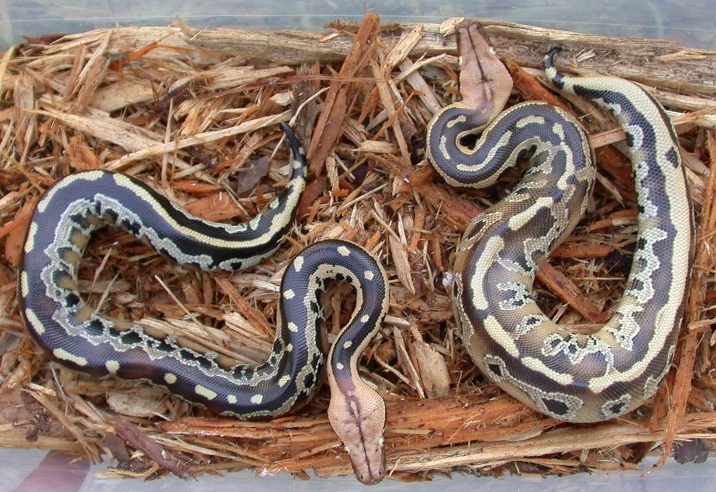
Jordan, they absolutely do look different (visual hets/normal/Ultra). There are a few folks that will tell you the same thing with what they have seen. You can have a clutch with three VERY distinct looking animals. With that said, I felt it was going to be a trait similar to Yellow Belly/Ivory Balls, but this past season tossed that out the window for me and left me wondering just what's going on. A friend suggested 'codon' type traits and the literature I read on them was just wild and a bit confusing too! (I'm a Chemist... boo!). Maybe saying 'codon' type traits is too vague or off the mark, but I'm open to any ideas! So, what can you tell me about codons linked traits?
Matt
p.s. - Animals from the same clutch produced a few years ago... They are VERY different looking! Believed to be a 'normal' and a 'probable visual het'. There were also 4 Ultras in the same clutch and a bunch of what I define as 'visual hets' and 'normals'.
Hey Matt,
You know... I have to admit, I don't know what your friend is referring to. A codon mutation would occur on the "MRNA" or Messenger R.N.A., which is basically a copy... if that mutates it will only affect that particular one or the future copies of it... it would not be an inheritable mutation.
take care,
Jordan
Hi Jordan,
Here is a link for the article. Maybe you can make some more sense of it for me?!
Ok this is NOT my strong suit... but I think it makes enough sense for me to get a grasp on it. This is referring to t-cells primarily. Keep in mind that Mrna is used to transfer the rna code from the nucleous of the cell outside for replication. If there is a mutation at this level, that the copy of that cell will be mutated. All of this occurs on an individual specific cellular specific level, and would not be something with a consistent mode of transmission which would associate to color or pattern. I didn't have the time to read the tail end of the article as I am working right now... but later on tonight or tomorrow I'll peruse it some more and if I catch a flaw in my explanation I'll be sure to post an amendment.
take care
Jordan
PrehistoricPets.com
>>I have three adult Ultra Breits 1.2
>>Last year my male bred my older female
>>so Ultra x Ultra... 22 eggs all Ultra Breit
>>
>>I also bred my Ultra male to a normal female
>>Ultra x Normal... 17 eggs... All visual hets
>>
>>When I bought into this project they were explained to me as being Recessive... And so far with the breeding I have done I have no reason to believe otherwise.
>>
>>Snake Genetics can be so much fun... LOL
Sounds like recessive too with those results and some of my previous results over the years, but Tracy has a possible 'Super' Ultra listed on her site, she's worked with it for over 10 years now apparently still has some head scratching questions from what I know. I produced an Ultra in the F1 generation which I never ever thought possible (Ultra x Normal), so that's why I threw out the idea of it being a recessive trait. Who really knows... time hopefully will determine exactly what's going on, but until then I still will not make a final genetic claim or guarantee hets since there are also other breeders who have questions about the genetics. Good times!
Matt
Help, tips & resources quick links
Manage your user and advertising accounts
Advertising and services purchase quick links
