Reptile & Amphibian Forums

Welcome to kingsnake.com's message board system. Here you may share and discuss information with others about your favorite reptile and amphibian related topics such as care and feeding, caging requirements, permits and licenses, and more. Launched in 1997, the kingsnake.com message board system is one of the oldest and largest systems on the internet.

Click for ZooMed
Click for 65% off Shipping with Reptiles 2 You

UVB comment/question

azalinx Mar 18, 2009 09:43 PM

After reading the latest issue of reptiles mag and the article about UVB lighting. I am really questioning the benefit of florescent lights of any kind to produce adequate UVB. From the study done the light would need to be pretty much with in a few inches to be useful. Let me know your thoughts on this as I know studies have been done before, but I have never really look this close at the results.

-John

Replies (27)

faygo19 Mar 19, 2009 08:39 AM

from reading the back of the reptisun 10.0 box it says you need to have it within 20" for it to be useful. If you put a mesh screen between the bulb and the reptile it needs to be closer.
-----
Do not attribute any action to malice that can be explained by stupidity.

azalinx Mar 19, 2009 08:48 AM

Thats from the manufacture, but when studies are done its not that effective from how I am understanding it. When tested at 12 inches away it reads at .5 on a UV index, which is the equivalent to deep shade through out the day. Not really what a desert animal is use to. I guess my concern is am I wasting $20 every 6 months by purchasing an ineffective means of UVB.

-John

faygo19 Mar 19, 2009 09:40 AM

I used the repti glo bulbs for a bit and changed to the reptisun 10.0 and noticed more color and a happier beardie. So thats why i use them. This is kinda like the whole egg thing. Studies came out saying eggs were bad for you. Then they came out saying they were good. Then they came out saying just the yokes are bad for you. Now they are saying eggs are good for you but with limits.
-----
Do not attribute any action to malice that can be explained by stupidity.

Lisabeth Mar 19, 2009 09:19 AM

I would be very interested to read this article. Is it available on the web?
-----
Lisabeth

1.1 Bearded dragons (Flake and Rusty)
1.1 Uromastyx geyri (Spiky and Salsa)
1.1 Guinea pig (Pumpkin and Moka)

azalinx Mar 19, 2009 09:40 AM

Not sure if its on the web but its the may issue of reptiles mag.

PHLdyPayne Mar 19, 2009 03:27 PM

The referenced article can be viewed at:
www.reptilechannel.com/reptile-magazines/reptiles-magazine/may-2009/reptile-lighting.aspx

The author's website is: www.uvguide.co.uk/index.htm

For reptiles in captivity, the repti-sun 10's are probably the best UVB florescent tubes available. Though the article does indicate these bulbs have to be very close they do provide sufficient UVB light exposure for most lizards. We can't all house reptiles outside in natural unfiltered sunlight, no matter how much we want to. If possible all reptiles will benefit from some exposure to natural sunlight.

Bearded dragons are more likely to get the bulk of their exposure to UVB in the wild during the mornings, seeking shade and burrows during the heat of the day when the sun is more directly above. The natural levels of UVB in the morning and evening is much less than levels of UVB at noon when the sun is directly above. High levels of UVB, especially with a high UVB index rating, can be harmful to animals (hence most seek shelter unless they naturally have ways to resist these higher levels, either via thick hides/fur/scales, or they head for shade, burrows etc.)

UVB is not a simple thing but the above website do give loads of useful information and go into great depth.
-----
PHLdyPayne

laurarfl Mar 19, 2009 08:57 PM

That is my understanding as well...

It's a big picture idea: The sum total of the ReptiSun 10.0 output would equal a general idea of the lizard's total basking throughout the day, considering it is not constantly in the sun.

faygo19 Mar 19, 2009 11:17 PM

It's a big picture idea: The sum total of the ReptiSun 10.0 output would equal a general idea of the lizard's total basking throughout the day, considering it is not constantly in the sun.

That is what i was thinking about the whole idea and i have read stories about how some people used higher UVB bulbs and their pets died. None would be just as harmful as too much unless you wanna dive into the whole taking vitamins to fix it but even that is up in the air on if vitamins work.
-----
Do not attribute any action to malice that can be explained by stupidity.

BDlvr Mar 20, 2009 03:28 AM

This is the downside of the high basking temp. idea thrown around here. Higher basking temps. make the animal bask less or move farther away from the bulbs to get to cooler temps. Unfortunately, in captivity they need to bask for long periods to absorb as much UVB as possible from these weak sources.

Paradon Mar 20, 2009 03:58 AM

I don't think it's absolutely necessary to offer UVB light to the beardies since they can absorb the vitamin D3 from the food they eat unlike iguana which would need the bulb. I know some people who raise bearded dragon without the bulb but they give them calcium with vitamin D3 as a replacement and the bearded breed and grow like crazy without any sign of MBD. Of course if you want to be on the safe you can use bulb. I know there are benefits from having the bulb. I know someone who has a Vietnamese leaf turtle which for some reason was suffering from lack of calcium. The shell was getting soft, so she started adding the UVB bulb. Nothing in the care sheet about these turtles say you need the UVB lughting, but withing a week the shell started getting harder and the turtle was back to normal in less than a month. And another thing about the bulb is that it seems to stimulate the appetite of the lizard.

laurarfl Mar 20, 2009 09:54 AM

You know, there is so much research in herpetology now (thank goodness!). We're finding out that iguanas cannot absorb D3 supplements and oversupplementation taxes their kidneys. UV Lights are so important to their overall health. I've read a study that showed that dietary D3 and exposure to sunlight demonstrated equal blood levels of previtamin D in monitors. I've heard stories of people of who do not use UV lighting on their beardies and supplement instead. I must say that the Reptiles mag article made me wonder 1)how much UV these lizards are actually receiving in captivity 2)if I need to go ahead and invest in a good UV meter.

Anyway, I don't pass judgement on others' husbandry because we all have to gather info and make our own decision. In the past year, I've decided to supplement my beardies more than I used to, but I still use UV lights. Like you, Paradon, I think it stimulates a natural appetite and photoperiod along with the vit D3 benefits.

faygo19 Mar 20, 2009 10:19 AM

For sure its not like beardies are running up to the store and buying rep-cal to use while they are hanging out in the burrows. They gather it from sun light and food as far as we know and to cut out one of theses would be a step in the wrong direction to me but everyone has their ideas and as long as their beardies are healthy then i guess that means a job well done.
-----
Do not attribute any action to malice that can be explained by stupidity.

PHLdyPayne Mar 20, 2009 02:16 PM

There are many things being discovered and still plenty of things about bearded dragon care we still don't know.

Naturally a bearded dragon's body will stop producing D3 once it reaches what it needs each day..even if they are still exposed to UVB rays. What they can't do, is stop their body from absorbing D3 taking in via diet (ie supplements) hence the worry of D3 toxicity by over supplementing.

What, to my knowledge anyway, we don't know, is exactly how much. D3 a dragon needs per day to facilitate all the natural body functions per day. For all we know, bearded dragons only need a total of 1 hour exposed to typical UVB levels experienced at sunrise. (which I think is something like 50 units but I could be off, don't have time to hunt down the actual value).

There is also the three or four part process of calcium usage in bearded dragons and most other day active reptiles. Exposure to UVB which is needed to create Vitamin D3 which in turn is required to make use of ingested calcium.

The calcium ingested by the dragon must also be accessible (ie not bonded up by oxates, phosphorus and other calcium binding elements (which is why spinach and kale are not the best despite having fairly high levels of calcium). So making sure the calcium eaten is usable is a sort of forth part.

If any of these parts are missing or insufficient then it affects the entire process. So you need a good source of UVB, a good source of D3, good sources of calcium etc to make it all work. I really don't think its possible to have too much UVB exposure..depending on the UVB index. High UVB index is damaging even with short exposures, but low levels of UVB index exposure is fine with little or no risks. Prolonged exposure of high UVB Index can cause things like skin cancer in us humans...and other conditions in reptiles such as photo-kerato-conjunctivitis.

High basking temps are beneficial as they are needed for reptile bodies to properly produce Vitamin D3, so an appropriately heated basking spot is necessary with access to more than just a single basking temperature in the necessary range. As UVB exposure should include most of the tank, not just the basking area, I don't feel having a higher basking temperature available at the highest point of the basking area is detrimental to total amount of UVB exposure. The idea being the basking spot should have multiple layers, not just one or two. The top most level I feel should have a higher than normal basking temp (say 130-140F), the next level down should be more 110-120F with the third level falling 100-110F and either the floor beside the basking area being 90-100F. This allows the dragon to choose how hot to bask in. This should be adjusted to fit your dragon. If he is always on the floor or in the 100F zone and never seems to use the hotter part, then lowering the wattage of the bulb can be done..to ensure more use of the basking area. In the past I have seen my dragon using the hottest part of the basking area first thing in the morning and right after eating. Once she reached her preferred temperature or exposure, she moved to lower areas of the basking area, or romp about the cage. Mid day she often went into her hide or under the basking area. But came out late afternoon early evening to bask, romp about more till about an hour or so before lights out. Though sometime she just stayed on her basking spot and slept there.

Each year we learn more about reptile care, new better products come out each year as well. Some prove bad (as are some of the compact florescent bulbs but many have been reformulated since manufacturers realized the problems), others very beneficial. As more research is done in reptile care, and the demand for better products increased as reptile pets become less and less of a tiny niche market compared to other pets, improvements will continue. I like to learn each new method and read all opinions, digest what is said pro and con wise, apply logic to it, research points I am not sure of, ask questions and see what makes the most sense.

Many methods work very well with decades of success. It doesn't necessarily mean new or little known methods that are also working for individuals are wrong...just different. Some are bad, yes, especially the more adaptive species who tolerate user errors far better than others.

There was a time mice were kept in cages with cedar chips and they seemed to thrive quite well. But they only lived 2-3 years. Everybody felt that was the natural life span for a typical domesticated mouse. Then research revealed the oils in cedar chips acted as a toxin to mice. Not enough to kill them out right but it greatly stressed their livers and shortened their lifespan. When mice were housed on aspen shavings it was found they lived much longer 3-4 years on average. Maybe a year longer of life isn't a huge difference, but this is a prime example that even the old 'true and tried' methods are not necessarily the best method once new research found the flaws.

Also, keep in mind that many long term breeders/keepers of reptiles had to wing it from 'scratch' and found what worked for them. But many had little to no contact with others of their ilk...except at the few and far between reptile shows etc. where they can exchange ideas. The World Wide Web made it immensely more easy for reptile owners to discuss different methods. In some ways I think over the last ten years, the rapid increase of knowledge over the internet has made many keepers, both new and old, 'lazy'. We go for the simple and ease of cleaning..instead of the more 'zoo' method of recreating the natural habitat as closely as humanly possible. That and we want to cram as many cool reptiles in the smallest space possible while ensuring the reptile's basic needs and ensure easy care and maintenance on our part.

This gives ups the 'bare essentials' method, and 'everything they need and make it nice too' method which is more advanced both in setting up and daily maintenance. Then the middle ground which combines the two extremes.

Bare essentials for bearded dragons would be:

40-50gal breeder tank (single adult dragon)
basking log
hide
water dish
UVB bulb
Basking light providing surface temp of 95-115F, air temp low 90sF basking end, 75-80F cool end
Paper towel (or newspring, reptile carpet) substrate.
Thermometer with probe.

Zoo level would be:

5'x2'x2' enclosure (or larger if multiple dragons)
soil/sand mix substrate, 6" deep, gravel layer for drainage with top inch nearly bone dry with subsequent layers having more water content. Possible bioactive as well.

Natural hides and basking areas of rock outcroppings, logs, etc.
Basking spots providing a high top temperature of 130-140F with lower basking temps decreasing the lower down the basking area one goes.

Live or fake sturdy dragon safe plants arranged to be pleasing and provide shady areas.

High UVB producing bulb such as Mercury Vapor Bulbs or halogen UVB bulbs. Or exposure to natural unfiltered sunlight due to outdoor enclosure or skilight/windows that are non polarized (won't block UVB. All standard window glass is polarized to block about 98% UVB)

etc.

A middle ground will combine elements from both extremes.
-----
PHLdyPayne

BDlvr Mar 20, 2009 03:08 PM

I've never seen any study that says that high basking temps. are required for proper D3 production. Please supply references.

The problem with the basking steps plan is this:

I make the assumption that the UVB is mounted at the same level as the basking bulb. The highest level must be far enough away so that the dragon cannot touch the bulb. This level would have the most UVB. The next level down would be cooler so the dragon may bask longer but the UVB levels would be less and so on with each level.

The main point of proponents of the high basking spot temp. is that dragons would warm up to their preferred temperature faster. Then they would move to cooler area. Unfortunately if you follow the recommendations of Reptiles Magazine this always means farther away since they recommend that light only come from above.

Some things to consider is that all dragons are not the same. I'm sure many can survive without UVB. But, are they better off without UVB? That's pretty doubtful based on current research. I have known of BD's and tortoises that contracted MBD even with UVB and proper supplementation. Matabolization of Calcium certainly differes somewhat for each individual.

Constant high basking temps. also goes against conditions found in nature, where temperatures are cooler in the morning causing reptiles to heat slowly not quickly. Also consider that some days there is no direct sun at all. Probably the best single environment is an average, not the high or cool end of the spectrum. Even a 5+ x 2+ enclosure isn't near large enough to offer a range of temps. found outdoors.

In the wild basking temps. of 130+ do exist, on a hot day in the middle of the day during the summer. But, based on what the Austrailian Zoo Keeper said and my observations of my dragons(23) in my outside cage(NJ), dragons will not bask in them for long. They prefer the cooler basking temps of the morning and evening in the summer or more of the day in the spring and fall. So why simulate a condition that is not what the dragon is looking for. Higher temps. also mean lower humidity in an enclosure which again can be problematic.

The best UVB bulbs seem to be Mercury Vapor. Unfortunately they are not very practical in many enclosures and don't work at all in stacked enclosures like mine. My basking spots are 105-110 and in general most of my dragons(23)lie on the outside edge of the light circle leading me to believe that they would not like it hotter. Yes, in the morning when they warm up they are directly in the light.

I am involved with another large well known BD forum. This is the only place where there are starch supporters of these high basking temps. A year ago there was no one here that pushed basking spots higher than 110. I'd like to find the research that fueled this sudden change.

faygo19 Mar 20, 2009 03:41 PM

It seems someone will take somethign from reptile mag and then use it in their own cage along with things such as high basking temps. Nothing i have read said anything about using basking temps over 110*. I may be wrong though but I have not seen anything.
-----
Do not attribute any action to malice that can be explained by stupidity.

TheVirus Mar 20, 2009 06:23 PM

I'm indifferent about UVB lighting. Some of my dragons have reptisun 10.0s and some don't have any UVB lights. Neither behave any different.

The first UVB bulb we ever bought was for beardies and in 93'. It was a compact bulb and "top of the line" for $40. I produced a thousand babies (appox) and raised them for selling without any fancy bulb. We had a couple iguanas for years before (and after) we got the dragons and they never had any fancy bulbs. The only UVB they got was on warm NY days when we had the window open.

The questions I would like answered are 1) How much UVB does a dragon need to produce D3? 2) At what core body temperatures is a dragon able to metabolize oral D3?

Bdlvr,

The basking temps are only an option. They can bask at any temp they want. We allow them to choose instead of deciding their basking temp for them. For the most part, my dragons bask in the 135* basking spot and then lay around the beam of light just like yours.

Its like Robyn said in another thread, you can't have high basking options and poor air movement. Or high basking options and no areas of any real humidity. If you upgrade one area, you have to up upgrade all areas.

BDlvr Mar 21, 2009 12:22 PM

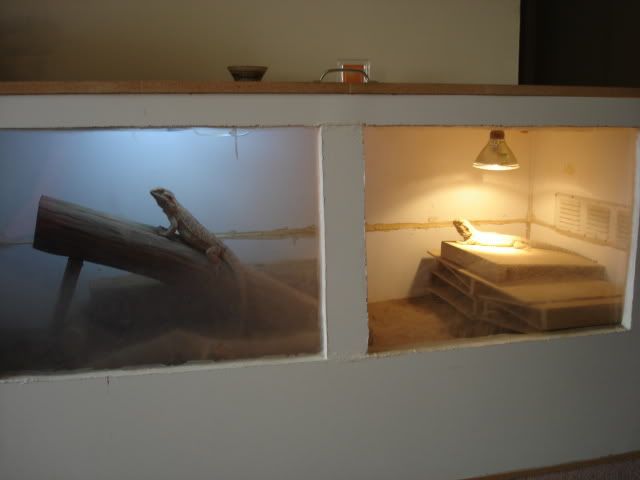
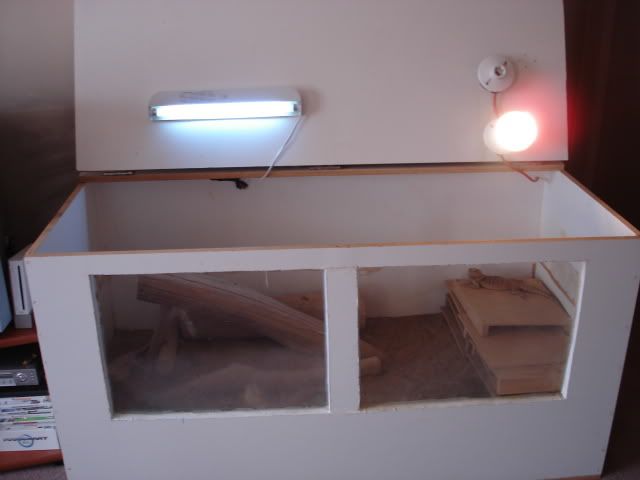
Maybe you can post a picture of your setup?

TheVirus Mar 22, 2009 11:59 AM

Sure. Never said it was pretty


BDlvr Mar 22, 2009 01:39 PM

It doesn't need to be pretty, just functional. How are you measuring and controlling the temps?

TheVirus Mar 22, 2009 06:22 PM

I totally agree I measure the temps with a digital thermometer w/probe and temp gun. I don't use dimmers or anything. The bulbs are 45 or 50 watt halogen indoor/outdoor floods. They make the basking spot 135-140 while keeping the cool end around 80. They make a lot of heat within the light's beam, but don't raise ambient temps too high. They can be used in smaller enclosures as well.

BDlvr Mar 23, 2009 03:24 AM

You should consider installing thermometers permanently and putting a dimmer on the bulb. Small changes in the room temperature change the ambient in the cage a lot. All my enclosures have constant readouts for basking, hot and cool side temps., as well as humidity. All of my heat providing bulbs have output adjustments. This is a good idea for all enclosures. As an owner of an overheated dragon I'll never agree with the ultra high temps. but if you are going to experiment with it you and others need to be very careful and safe.

laurarfl Mar 20, 2009 09:46 AM

I don't know of anyone who used a Repti Sun 10.0 on their beardies and caused death. Now with that said...there are proper usage requirements with any bulb. There is a minimum distance for safe usage and ideal placement. There are also bulbs that were producing incorrect wavelengths of UV (dipping into UVC which can be lethal as it causes cellular death and DNA destruction) There are also thinner skinned species of lizards who are not designed to handle hours upon hours of strong UV or bright light.

I didn't quite get the correlation between between your reply and my post, if it was even directed at my post. I wanted to make sure I didn't communicating something I didn't intend to communicate. The UV output of the 10.0 bulb is not really that high for a beardie. There is some great and interesting research out there to read.

faygo19 Mar 20, 2009 10:59 AM

I was agreeing with your thoughts!
-----
Do not attribute any action to malice that can be explained by stupidity.

laurarfl Mar 20, 2009 12:19 PM

Got it...I didn't catch the flow and was hoping I came across OK, y'know!

faygo19 Mar 20, 2009 12:29 PM

for sure you are all good
-----
Do not attribute any action to malice that can be explained by stupidity.

knack_dragon Mar 19, 2009 12:12 PM

I wonder if this has to do with that study done in the UK about some brands and stuff. You guys know what I'm talking about? Well as some people have said here, I do think its HOW you use it. the zilla50s were talked about before. I use them now but nothing happens. I wish they would do an updated study

PHLdyPayne Mar 19, 2009 03:33 PM

The article was written by the guy who put up the UVB website you are thinking of. The study on the harmful effects of compact florescent UVB bulbs is only one part of that website.
-----
PHLdyPayne

Site Tools