Reptile & Amphibian Forums

Welcome to kingsnake.com's message board system. Here you may share and discuss information with others about your favorite reptile and amphibian related topics such as care and feeding, caging requirements, permits and licenses, and more. Launched in 1997, the kingsnake.com message board system is one of the oldest and largest systems on the internet.

Click for 65% off Shipping with Reptiles 2 You
https://www.crepnw.com/
Click for 65% off Shipping with Reptiles 2 You

New snake owner tips?

Riven Apr 28, 2009 05:05 PM

Hello all, nice to meet you!

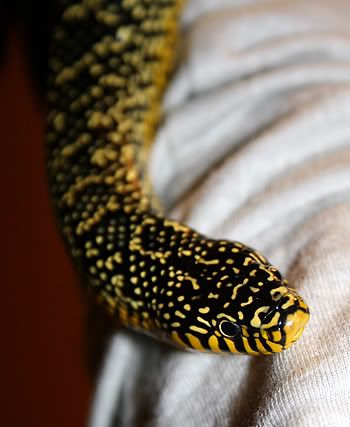
Yesterday I became the proud owner of a black and white stripe California King Snake. After some research, my husband and I believe it is a San Diego Stripe. We purchased the snake from a very reputable local reptile store after a thorough examination for any odd lumps or bumps (of which there were none). Along with the snake, we got all items necessary to care for him (with the exception of the tank, which we already had). We are unsure of gender and age, as the manager who had all the records for the snakes was out of the office, so the girl couldn't tell us what our snake is (though he is yet toothless and about 14-16 inches long). We've been calling it Talon, and for now referring to Talon as a male.

Talon has a nice set up in a 20 gallon aquarium. He has aspen snake bedding about 2 inches thick along the bottom, 2 'hiding' spots (one on the warm side of the cage, the other on the cool side), a good sized pool with about an inch or maybe more of water in it. He has a heating pad attached to one side of the tank with a heat lamp containing a 60 watt UV light above (the 100 watt made the aquarium very hot very fast). One side of the tank maintains a temp of about 84-86 degrees fahrenheit, the other side (where the water is) about 75-78. The humidity meter ranges between 35 and 45, which according to the meter is in the low end of the moderate range, bordering on the 'desert' range. He also has a piece of driftwood in the center of the tank for climbing.

The reptile store had been feeding him about once a week. A friend of mine that raises rosy boas suggested we increase feeding to twice a week. Talon ate a pinkie mouse today with little encouragement (he seemed quite hungry!). We move him from his tank into a cardboard box using leather gloves to signal its time to eat. This is an attempt to teach him not to strike us whenever we reach into the tank, thinking we are handing him food.

This is my first snake, and though I have cared for them before I have never owned one myself. I am wondering if there is anything that I should be aware of?

I am adding a pic of Talon, just to share what he looks like
Image

Replies (10)

HogBilly Apr 29, 2009 02:21 AM

I'll let others give you the proper response about care because I'm about to hit the hay for the night, but I had to say.

He's not toothless. Just very, very small teeth, and they're usually hidden by gums anyway.

Congrats on the new little guy.
Image

celticvamp Apr 29, 2009 06:21 PM

As you've already been told the snake is not toothless. Also the UV light is useless other than for you to be able to see him. Ambient light from the room he's in is good enough. If you want a light to help with heat just use a regular incandecant bulb. There has been no proof that UV light benifits the snake in any way.

Riven Apr 29, 2009 09:12 PM

Really? The paperwork I got from the Reptile place I purchased the snake from said that without UVB lighting, snakes can develop Metabolic Bone Disease. It's less likely in snakes, more likely to develop in reptiles who are active during the day like iguanas, but the bulb was inexpensive and I wanted to be sure I provided a good environment for him. Can the UV light do him any harm? I certainly do not want to cause him any harm.

celticvamp Apr 29, 2009 09:48 PM

I'm certain the snake don't need UV light. There will be more posts on here that'll confirm it. Will the UV harm the snake? Not likely just make sure the snake has a place to escape it and don't leave it on throughout the night. Turning it off at night allows it to keep the day/night schedule. The only real use the snake has for light. Remember UV light is radiation. Too much at certain levels and spectrums can cause burns.

markg Apr 30, 2009 01:07 PM

Hello there. Nice species to work with, those Cal kings are. Great choice on your part.

I'll clear up some of the pet-store info that new owners receive.

Humidity:
Kingsnakes spend by far most of their time in the soil, underground, under hides, etc, where humidity is moderate, or at least, where moisture doesn't evaporate quickly. Holes in the ground are usually dry but prevent moisture loss and probably sit in the 60-ish relative humidity range. Even for desert kings. In fact, kings often have higher population densities where ground water is available. What that means is just because it is might be a desert region kingsnake, it is just as in need of a reasonable humidity as any other similar kingsnake, even Cal kings not in desert areas.

My advice to you is to put the snake in a container with about 1/4 inch of room-temp water, and let the snake stay there for 5 minutes to hydrate. You can do that periodically as needed, or you may provide a humid hide. A container of coir fiber substrate "Bed-a-Beast" can serve well for this. So can tight hides like 1" PVC pipe in the cage where the snake can coil up and keep the moisture in. You can mist the pipe every few days. Heck, mist the whole cage.

Heating:
You do not absolutely need the light for heat. My advice here is to just use the heat pad, then cover about 90% of the screen top of the cage. Keeps the heat in better with just a heat pad. Kings bask by laying against a warm mass for as long as they need to, then they move away. They actually use cool temps as their base, not warm. I would shoot for a temp of 90 deg above the heat pad, unless the room is warm (above 78), then go lower.

If you think you need more heat, a very easy way is to get another heat pad and tape it or even lean it up against the side or back of the tank. This way you can remove it during Summer when it is not needed. Lean a piece of plastic sign or styrene foam behine the heat pad to push the heat into the tank.

Lights tend to dry out the air, unless the wattage is very small. 60 watts does dry things out, which is OK if the snake has a very deep burrow-able soil substrate. But since the substrate is dry aspen only 2 inches deep, the 60 watt bulb is likley not the best approach.

Another method is to do what I just said, use a soil-type substrate somewhat deep, like 4 inches for your tank, then just use the light in a reflector dome, no heat pad. The snake will hide in the soil and barely break the surface just under the lamp to bask. The soil helps reduce moisture loss.

Feeding:
Another myth is this once-a-week schedule. Needs vary depending on age, size, temperature and reproductive status. A young snake like yours will probably eat every day if offered small food. I would feed food items slightly larger than the snake's girth every 3-4 days. Use frozen/thawed rodents, far easier. I can tell by the pic that the snake is thin. He/she could use some extra meals now when the Springtime feeding response is strong. When the snake is an adult, the feedings can get less frequent unless the snake is a breeding female.

My appraoch: I feed them when they are hungry. In Spring, young kings will eat constantly unless going into a shed cycle.

You picked a great species to keep. By approximating the guidelines I've given here, your snake will thrive for many many years. My oldest king was CB and lived to around 18 yrs old. Black and white king too.
-----
Mark

Riven May 01, 2009 09:53 PM

Thank you so much Mark! I appreciate all your helpful advice.

We went back to the pet place today and got the snake gendered, we have a male. We removed the heat lamp and put the heating pad on the underside of one side of the tank, which seems to have improved the humidity and better regulates the temperature of the enclosure.

A good friend with years of experience with boas recommended ground up walnut shells as a good bedding. So we will likely be replacing the bedding soon. Does anybody have experience with that sort of bedding?

We've increased his feed to one pinkie mouse every 2-3 days since he seemed really hungry the first day or two we had him. I will trim him back to 2 times a week after he's fattened up just a little (he's 16 inches long or so and maybe a tiny bit over a half inch thick). He has settled down on this feeding schedule and now comes out for about 30 minutes to an hour every evening to cruise his tank. He is quite amenable and comfortable with being handled, it seems. He hasn't struck or been at all aggressive with us except the first time we fed him, when he was very very hungry.

I am really glad I found this forum, it's been so helpful, and I am looking forward to learning more here. If all goes well in some time I am hoping to adopt a quality female in the future

markg May 04, 2009 01:18 PM

Good for you. A few more comments.

I like your approach to feeding - feed him more oftem until his weight is good, then reduce frequency a bit. That works.

Cal kings can get crazy depending on temperature, time of year, and perhaps just personality. Meaning they can musk or act defensively at times. Normal. If it happens just go with it.

Walnut: I used to use that, and I had a few snakes wheeze, just a few out of many. Found out that the walnut dust caused that, so I stopped using it. The affected snakes stopped wheezing almost immediately when removed from the walnut. Just a word of caution for you. Keep an eye out for anything like that. May not happen, just be mindful of it.

-----
Mark

trolligans May 22, 2009 03:39 PM

you can feed the snake more than one pinky per meal. Pinkies vary in size, but a 14 inch king can easily take 3 pinkies in a sitting. Pet stores only feed them once a week because it's cheaper. They keep the snake on a maintenance diet. Let your snake grow. 5-7 pinkies per week should be about right for his size.
-----
1.0.0 Great Plains Ratsnake
1.0.0 Corn, Lavender Aztec het for Amel
0.1.0 Black Ratsnake
0.0.1 Texas Rat (tame)
1.0.0 Broad Banded Water Snake, Hypo
1.0.0 Black Bassador Retriever
2.1.0 Godchildren, 1 Evil, 2 possible hets

Riven May 22, 2009 04:05 PM

Thanks very much trolligans. We've been feeding him about 5-6 pinkies per week, he's now probably 16-18 inches long and a fair bit thicker than he was when we got him. The last few days he has been pretty inactive, sleeping under the aspen bedding on the cool side of his tank, so we think perhaps he is getting ready to shed. He is still very amenable to being picked up and handled, though I've avoided pestering him too much if he's uncomfortable in his skin.

After he has shed, should he be offered extra, or more frequent food? I have been told snakes often won't eat during their shed, but I want to be sure that he has as much as he needs before and after.

celticvamp May 24, 2009 07:07 PM

Normally a shed cycle takes a total of between three and six days. A young snake most likely around four days. You don't have to offer an extra large meal after a shed just offer the normal size meal and then just start the weekly cycle again at that time.

Site Tools