which one do you think is better any pros/cons i'm thinking about getting the radiant heat pannels in place of some of my heat lamps and wanted to get some info from people that have used them
Reptile & Amphibian Forums
Welcome to kingsnake.com's message board system. Here you may share and discuss information with others about your favorite reptile and amphibian related topics such as care and feeding, caging requirements, permits and licenses, and more. Launched in 1997, the kingsnake.com message board system is one of the oldest and largest systems on the internet.



raidiant heat pannels vs uv heat lamps?
legacyline
May 14, 2009 02:34 AM
Replies (25)
Jaykis
May 14, 2009 09:58 AM
Snakes don't really need UV, so I stick to under-cage heating tape with a temp gradiant on one end.
zach_whitman
May 14, 2009 10:38 AM
Agreed. Why would you want the radient heat over belly heat anyway? They are expensive, inefficient, and heat up the entire cage too much. I would only use them for arboreals.
pooter
May 14, 2009 07:55 PM
Zach - I am going to have to disagree with you a bit. I am slowly switching over to rhps at this point and I have them to be fantastic - and actually pretty easy to keep a good gradient (much better gradient then tape). Also - they are more effecient then any other form of heating.
pooter
May 14, 2009 07:56 PM
Zach - I am going to have to disagree with you a bit. I am slowly switching over to rhps at this point and I have **FOUND** them to be fantastic - and actually pretty easy to keep a good gradient (much better gradient then tape). Also - they are more effecient then any other form of heating.
Br8knitOFF
May 15, 2009 07:35 AM
I would agree.
Especially, if you're trying to provide some humidity- combine a heat panel with a PVC cage with strategic ventilation...
I'm using panels with my bredli, JCP and was using it with my IJ's before they went to a new home.

//Todd
captnemo
May 15, 2009 04:59 PM
Agreed. When using RHP's over perches, shelves, or other basking sites, I feel they offer a very natural gradient to allow for efficient thermoregulation.
The reason I'm not a fan of belly heat is that it's not as natural in the way it works. True many snakes use asphalt, rocks, etc. after it has been heated up, but overhead basking is most likely the main type of thermoregulation in the wild.
-----
"He who would stifle debate rather than engage in it, does so at the expense of his integrity and credibility"
Mike Curtin
Jaykis
May 16, 2009 09:42 PM
" but overhead basking is most likely the main type of thermoregulation in the wild."
That would possibly be because the sun is overhead??? I've used both and prefer undercage heating. I very seldom use perches in a cage, so warmth is from the bottom.
zach_whitman
May 18, 2009 09:52 AM
Like I said in my original post, for arboreal species it works great. But for many species IE most colubrids and small boids they get more of there heat from the hot rocks they are sitting on than from the sun directly hitting them. Most radiant heat panels that I have seen used are simply way too big for the applications they are used for.
For example in this large rack I use 3 separate heat cables routered into groves in each shelf. The hot side is around 90 degrees but it is only the back 5 inches of the tub. This leaves the front of the tub at room temperature (usually 65-70)
This gives me great heat for 8 large adult colubrids for only 150 watts.
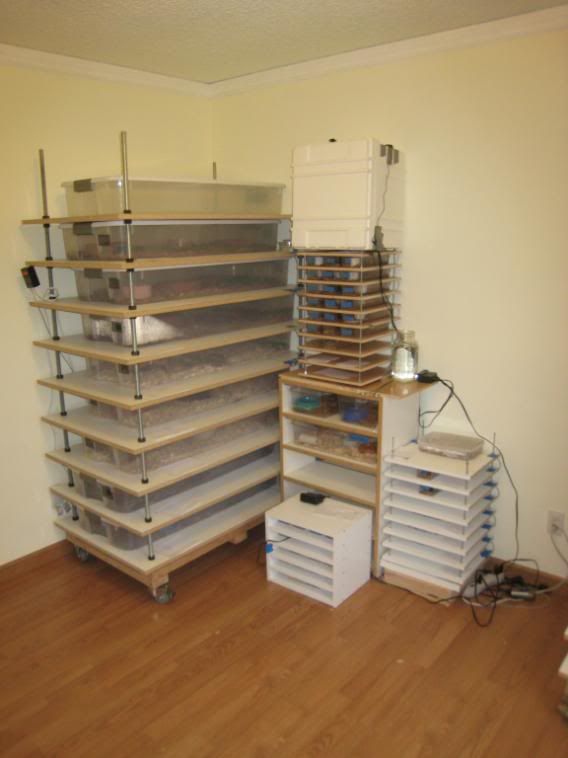
This rack holds over 20 smaller snakes for the same 200 watts.
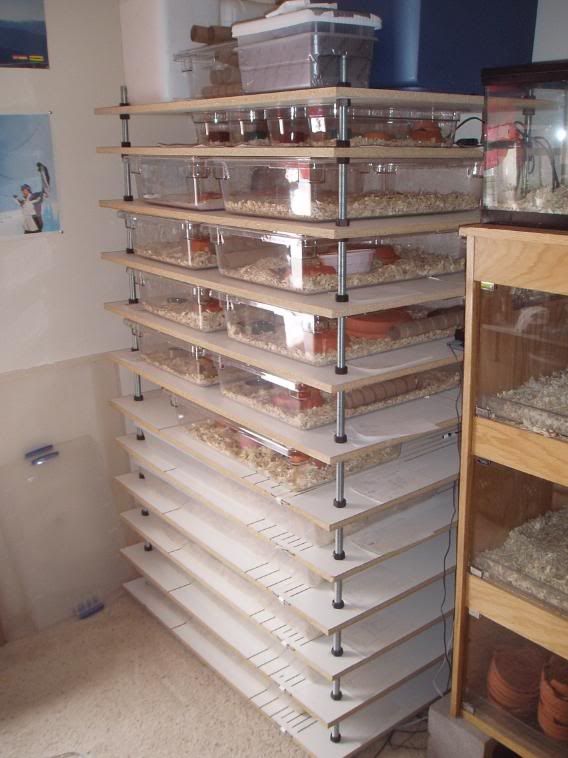
And my heat cable costs under $20 while an RHP costs 3 or 4 times that.
Like I said, I don't see the value unless its for VERY large species or for arboreal species.
pooter
May 18, 2009 10:37 AM
Zach, in your earlier post you had used the verbage "cage". Now, you are using racks as an example. To me, the word "cage" and the word "rack" mean different things. This changes the dynamics of the conversation completely.
In my opinion, the type of "enclosure" does make a huge difference. There are several obsticles that make it difficult to use RHPs for racks, and several things that make heat trace or tape more practicle.
On the flip side, if you are considering cages, I think there are several obsticles to using cable/tape and several things that make RHPS a better choice.
With that said, keep in mind, RHP's are not all equal. There are several mfg's out there that aren't worth buying. RHP's put out a higher amount of BTU's per watt, can be used within the cage so you don't loose energy due to cage materials, can utilize the RHP to get a better gradient etc...
You can take an RHP and create an elevated basking spot, have a warm end and a cool end... they work great.
If you want to talk racks, it is a completely different situation.
captnemo
May 18, 2009 01:30 PM
I use heat tape for my racks, RHP's for the cages. I choose to use back heat for the racks, though, as I feel it radiates heat more evenly that way. Very gradual dissipation from about 90F on the warm side down to the mid-70's on the cool side.
-----
"He who would stifle debate rather than engage in it, does so at the expense of his integrity and credibility"
Mike Curtin
zach_whitman
May 18, 2009 11:13 PM
With that size tub (48x22x9 I believe) they act more like cages than racks. They also have a 1x3 inch screen vent cut out on each side. Either way, I have used tons of vision/boaphile type cages and still prefer UTH for most applications. Again arboreals and very big heavy bodied snakes being the exception.
pooter
May 19, 2009 09:30 AM
What does the size and/or ventilation of the tub have to do with anything? The difficulty w/ using RHP's on a rack has nothing to do with size or shape of the tub, it is the mechanics of a rack system. The fact that the tub has to slide in and out that makes it difficult to use. That design is also what makes using an external heating system "better" in that case, such as heat tape or heat trace.
You have the right to prefer uth if you want, but remember just because it is your preference doesn't mean it is the only way, the best or the most effecient, it is just your preference.
While it is the lowest "startup" cost, heat tape has been proven very poor in terms of effeciency. Heat trace is a better option, but not as easy to get your hands on. Heat pads are at the bottom of the list, and good rhps are at the top of list when considering "energy" that is used to actually heat the animal and create the gradient.
There is less energy lost w/ RHP's, there is a higher amount of BTU's per amount of energy consumed, and you don't waste energy heating the bottom of your cage enough to get the inside to the right temps.
zach_whitman
May 19, 2009 11:18 AM
I plastic box is a plastic box, and heat is heat. My concern is that my snakes have the right gradient. After that my concern is that it costs me as little as possible. After trying lots of stuff (and doing the math) I am pretty sure I have found that way.
What species are you using the RHPs for? And what are the dimensions of your box?
pooter
May 19, 2009 10:04 PM
Zach - it doesn't take an advanced engineering degree to know that each "box" is not equal as you claimed. A tub that is about 1mm thick plastic is going to have very different thermal and insulative properties then a AP cage that is around 12.5 mm thick of PVC. That is not rocket science. One size does not fit all and to claim it does is foolish.
Heat tape is cheaper then RHP's no doubt, but not as efficient and does not provide the same control over gradient.
But with statements like "a box is a box" I doubt we are going to get anywhere, no matter how long we go back and fourth. So lets just agree to disagree.
Snakesunlimited1
May 14, 2009 08:34 PM
"Snakes don't really need UV, so I stick to under-cage heating tape with a temp gradiant on one end."
A recent paper looked at the result of UV exposure in corn snakes (because there are lots of them and that makes it easy for a control group) and found an increase in calcium levels in the blood of the UV exposed corns. So if UV does increase the amount of active calcium in the blood of a snake can we really keep making the blanket statement that UV is not needed?? Is it a benefit but not needed?? Is it needed but not essential?? They can obviously live without it but is their life better with it??
Granted we don't see deformities in snakes like with do in turtles and lizards but then again I have never seen a snake with legs or a shell. I wonder what we will need to see in our snakes to get the tubberware army of herpers to add UV. All that said I have not incorperated a UV system into my collection yet but I will be soon. There is a zoo or two using a $3.50 light bulb that kicks out a huge amount of UV, that is the route I want to go with all my females at the very least. I will try to note what changes I see once I get rolling.
Jason
captnemo
May 15, 2009 05:01 PM
I primarily use RHP's for convenience of stacking cages, but some of my animals have been kept with UV. I haven't noticed a difference, but the idea is thought provoking.
-----
"He who would stifle debate rather than engage in it, does so at the expense of his integrity and credibility"
Mike Curtin
Doug T
May 14, 2009 10:46 AM
I've replaced the heat lamps with rhp's in several of my cages. I've had some snakes actually get minor burns from flood lamps because they sat under the light too long. That was from a 60 watt bulb from about a foot away!
I've found with some of my cages that a rhp and a heat mat below makes for a nice and toasty warm spot.
>>which one do you think is better any pros/cons i'm thinking about getting the radiant heat pannels in place of some of my heat lamps and wanted to get some info from people that have used them
boredfoot
May 15, 2009 06:58 AM
I've got radiant heat panels in two of my enclosures. I really like them, because they keep the ambient air temperature warmer inside than a UTH--and no risk of bulb burns. The whole ambient air thing is really helpful in the winter in a cold climate like mine--our air temps fluctuate a lot between furnace cycles all winter.
They also make it easier to keep humidity up. I just put the water bowl underneath the radiant panel. You can even mist the panel directly without any concern and get an instant humidity boost.
One of my panels has been in place for two years. No problems whatsoever.
Thumbs up on radiant.

Jaykis
May 15, 2009 10:44 AM
I can't see how you would get better temp gradiants with overhead heat then a heat tape under half of the cage, but it's just personal preference. Besides, the snakes will move their hide boxes to whatever temp they like. Most heat tapes are 5 watts a foot, so 4' is 20 watts. That's pretty efficiant.
captnemo
May 15, 2009 05:04 PM
With a low ambient temperature, a snake may be forced to lay directly on UTH's for extended periods of time. This could increase the possibility of thermal burns, especially in the case of a t-stat malfunction.
-----
"He who would stifle debate rather than engage in it, does so at the expense of his integrity and credibility"
Mike Curtin
Jaykis
May 15, 2009 11:53 PM
Mike, no one should have UTH that high that they would cause burns. Heat rocks can be a problem, because many people don't think they need a thermostat on them.
captnemo
May 16, 2009 04:54 PM
I agree, however, 11' heat tape registers at over 110F, and ZooMed heat pads register at OVER 150F. IF there is a t-stat malfunction, this will burn an animal.
In addition, let's say that the ambient room temp. in a cold climate is 65F. If the snake has an 88F hot spot, that animal will choose to sit on this hot spot continually, while the rest of its body is substantially cooler. Personally, I think an overhead approach would be much more beneficial.
-----
"He who would stifle debate rather than engage in it, does so at the expense of his integrity and credibility"
Mike Curtin
Jaykis
May 16, 2009 09:31 PM
Which is why I never use a heat pad....nor a "hot rock".
captnemo
May 17, 2009 01:15 PM
.
-----
"He who would stifle debate rather than engage in it, does so at the expense of his integrity and credibility"
Mike Curtin
Jaykis
May 18, 2009 04:50 PM
Heat tape is only a half or less of the cage.
