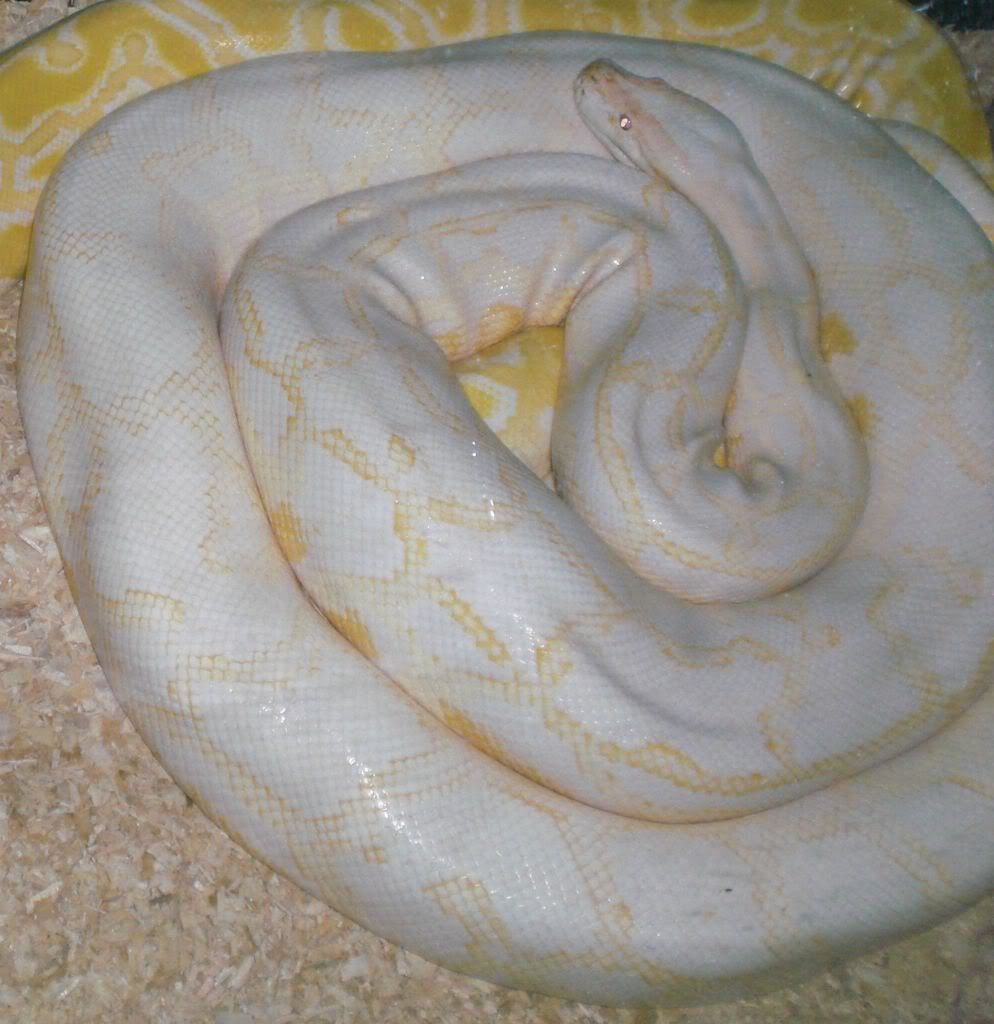
No body has been able to tell me what kind of burmese this is. Hopefully someone on here can.
http://i586.photobucket.com/albums/ss302/berad_dean/CIMG1159yf.jpg
http://i586.photobucket.com/albums/ss302/berad_dean/CIMG1159.jpg
Welcome to kingsnake.com's message board system. Here you may share and discuss information with others about your favorite reptile and amphibian related topics such as care and feeding, caging requirements, permits and licenses, and more. Launched in 1997, the kingsnake.com message board system is one of the oldest and largest systems on the internet.


No body has been able to tell me what kind of burmese this is. Hopefully someone on here can.
http://i586.photobucket.com/albums/ss302/berad_dean/CIMG1159yf.jpg
http://i586.photobucket.com/albums/ss302/berad_dean/CIMG1159.jpg
Exactly what do you mean by "what kind"? If you mean the name of the color morph, it may well be one of a kind, in which case, it's called whatever it's owner feels like calling it. There may be no "official" name.
I've never seen one quite like it, but maybe someone else here knows something...
-----
What goes up must come down...unless it exceeds escape velocity.
Looks to me like an extremely light Labyrinth morph albino. Very interesting snake. Anyone else?
It looks like a hybino A double het in there somewhere it is hypo and albino just a guess.
-----
Archie Bottoms
Double recessive, or Double Homozygous, not double het. a double het for recessive most generally appears normal. I would agree on the hybino guess.
I've seen a number of normal looking albino Burmese Pythons that when kept outside for a long time fade out and look exactly like that. My guess that's an albino Burmese that has simply been kept outside for an extended period of time...thanks
-----
Tom Crutchfield
www.tomcrutchfield.com
That was my first thought, but I don't think so for two reasons.
1) There's a sharp cutoff (along pattern lines, not at a specific height) between the parts that have a lot of yellow and the parts that do not.
2) Parts of the pattern that would have the brightest yellow/orange on an albino are white on this specimen while parts that would have lighter yellow still show up.
I've seen a few sun-bleached burms like you describe, this looks different to me. But I certainly could be wrong. It's happened once or twice before... 
-----
What goes up must come down...unless it exceeds escape velocity.
Help, tips & resources quick links
Manage your user and advertising accounts
Advertising and services purchase quick links
