I have a 2 year old female. She's always been completely normal but just recently she started looking and acting strange. She seems bloated but I don't see or feel any eggs. She is also twitching the skin on her back when I touch her or even get close to her like her skin is sensitive. No other twitching (i.e. legs or feet/toes). Her "symptoms" sound kind of like a calcium deficiency but she ate about 100 silkworms 2 weeks ago. She also eats superworms which are dusted with calcium with each feeding (a few times a week) and vitamins once a week. She eats turnip greens but no other veggie - doesn't like anything else. She also doesn't like crickets. I just gave her water from a syringe and she drank a ton. She has a large cage with appropriate gradient temps, a uv light the entire length of the cage (the light is pretty new) and a basking spot that she spends alot of time in. I put a nesting box with moist potting soil in her cage just in case she is gravid. She has not been bred and doesn't show any signs of digging. She's not interested in the nesting box yet but I just put it in there tonight. Color, attitude, general appearance (except for looking kind of fat) are all good. Any thoughts would be greatly appreciated!
Reptile & Amphibian Forums
Welcome to kingsnake.com's message board system. Here you may share and discuss information with others about your favorite reptile and amphibian related topics such as care and feeding, caging requirements, permits and licenses, and more. Launched in 1997, the kingsnake.com message board system is one of the oldest and largest systems on the internet.


Help - Beardie acting weird
Replies (84)
If you have some pictures of her and the set up those would help a lot. What are your temps ie basking and hot to cold side? Also what kind of UV light do you have in the cage? On top of that if you are feeding large silk worms 100 seems to be a crazy amount. How often does she poop and when was the last time she did that?
Her temps are good - 100 at the basking spot - around 80 on the cool side. It's a large enclosure - 4' x 2'. The uv light is a ZooMed 10.0. The silkworms were small (1 inch tops) and she ate that many over a period of about a week, not all at one time. She was pooping twice a week for the past month which is uncommon. Her whole life she's pooped every 3 weeks or so. Weird but normal for her. She hasn't pooped in about a week.

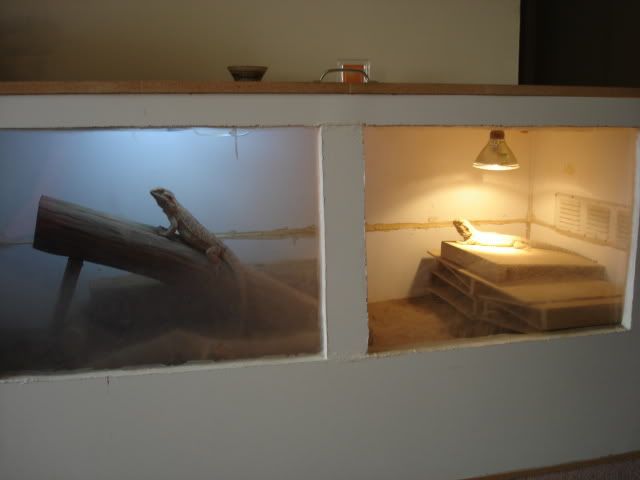
I agree the temperature for the basking spot should be hotter, with a range falling in 110-120F. The basking log you have is too 'fat', and doesn't seem to provide much range, as the top is too close to the light itself (which could result in burns) and where the bulk of the light hits (from the white 'glare' of the setup photo) isn't where your dragon is basking and it looks rather steep.
A lower flatter log would be better so it provides more surface area. An incline is good but not too steep, or a tiered setup. The stone cave could be removed as its too small as a hide and to far way from the basking area to really provide a good basking spot...unless you move it to be right up against the inside curve of the log (so it is directly under the light.)
Below is a picture of my old bearded dragon's setup before I had to sell it and the dragon when I moved about 6 years ago. Best place to find a piece of driftwood like the one I used is along the shores of rivers and lakes, just make sure its not on private property. They can be sealed with a varnish like urathane (make sure it has a good 24 hours 'curing' time to air out and dry completely).
BDLvr's cage basking areas are good, a step system with different levels but your cage size will make it more difficult to set up. My cages are 5'x2'x2' and I think BDLvr's are either 4'x3' of floor space or 5'x3', I can't recall offhand.
The pooping issue. You mentioned it was normal for your dragon not to poop for 3 weeks. To be honest, this isn't good. It indicates either improper digestion, dehydration, parasites or blockage. Adult dragons should poop once a week or more and they will if they are sufficiently hydrated and fed.
Feed large silkworms, they have more moisture content and 'meat' than the small. You can also add hornworms and butterworms too. Superworms are good to, but always nice to mix them up. Dusting with a calcium and multivitamin once a week is fine, being an adult, 3 times a week is a bit excessive. Your question about waxworms...I wouldn't bother with them. They tend to be very high in fat and dragons can tend to like them too much and refuse other more healthy worms. They are fine as an occasional treat however. (maybe a couple every other week mixed with other insects)
For greens, though you mention she only eats mustard greens, I would still offer her a variety. Take 2-4 types of greens (I suggest mustard greens, collard greens, dandelion greens (at least one of those three, two would be better) mixed with endive, escaroli or other healthy green (see www.beautifuldragons.com nutrition chart for other greens that can be mixed in occasionally). Chop finely and mix well. This makes it harder for your dragon to pick and choose what greens she likes the most.
Hydration seems to be the biggest issue if she drank alot. Try soaking her a couple times a week and get her basking temps up a bit more.
How are you measuring temperatures, by the way?

-----
PHLdyPayne
I think the picture is deceiving because of the angle I took it. The spot that she's laying on the log is not her usual spot and it's way behind the basking light so no chance of burns. When she's basking she lays right under the light and seems fine. She spends most of her time there. The other rock is usually on the cool side but I moved it to put the nesting box in there. I think temps and dehydration are likely suspects. I'm going to correct that right away.
Any thoughts about the meeting with my rankins?
I'll try mixing different greens together too. I get my silkworms from Mulberry Farms but they're always sold out of larges. What's another place online I could try?
I use a temp gun.
If your Rankins only grabbed her by the neck and you pulled him off before he can get his tail under hers, there shouldn't be any worry about fertile eggs. Having a mature male around may trigger her to produce eggs but typically signs of being gravid are pretty obvious. She will go off feed completely and start digging about the cage looking for a good spot to lay eggs. Right now she isn't doing these things.
I am sure there are plenty of other places that sell silkworms and hornworms online, other than Mulberry Farms. I know of four or five of them in Canada so I am quite sure there will be quite a few in the US. Try a Google search for silkworm suppliers or feeder insects. You can also check the Businesses tab in the header and the classified sections for feeders.
-----
PHLdyPayne
Here's a pic of the whole setup.

Your set-up is too dry and cold.
I'd bet that the symptoms you describe are related to dehydration and improper temps. Dragon looks heavy on the front end, could be a blockage. Better temps (120,130 degree surface temp basking spot measured w/ temp gun) will help. Use 2-3" of hard-packing soil or cypress mulch as a substrate to keep some constant moisture(30-50% RH). Take out the nest box, nice idea but it's just taking up useable floor space  Give a soak 1-2x week for 5-10 minutes in chlorine-free tap water.
Remove that giant log, it's also eating up the usable space in the cage. Build a retes stack, check www.proexotics.com for pictures and information located in the FAQ. It's a way better method for basking species.
Good luck. Nice dragon too
yeah, I just put that nesting box in there last night just in case. It will come out today. I'll also get a higher watt basking bulb and give her a soak. Couldn't find the retes stack on that website. Can you give me the url?
nevermind on the url - I found it. Thanks.
You don't need a higher wattage basking bulb. In your tank, a 45-50 watt PAR-38 halogen flood would be more than enough. You build the height of the stack to work with the bulb. You must have an infrared temp gun for these set-ups too, all items you can find on the online store at ProExotics.
Good luck
She needs higher temps but not 120-130. I would shoot for a basking spot (surface temp. of 105-110 max) I'm concerned that her metabolism is so slow. It could be temps, but it could also be other problems. Personally first I'd give her a bath. Then I'd get the temps. up. If you try to raise the basking temps. to the level somone else suggested then the ambient in the entire cage will be wrong due to the cage's size and design. The basking site you have is fine. i see no real additional value in getting Retes stacks. The mulch is not the right idea either.
Keep what you have. Leave the nest box in just in case. And just get the basking spot temp. up. Silkworms are my primary food but they should still be dusted. Is she eating?
Mulch is not ideal, but it retains MOISTURE, a huge and glaring weakness in your set-ups BDlvr.
Retes stacks are excellent because they don't just offer a wide surface that soaks up heat, but they also offer HIDES.
Good luck SandDog and most definately check out ProExotics. They do amazing things over there
Ok. I like the idea of keeping the log because it looks better. The cage is in the middle of my house so it needs to look nice but of course I want it to be right for my dragon. Anyway, would a higher watt bulb be the best way to increase temps? I'll give her a bath and see if that helps. She drank so much water last night, I'm starting to think she was dehydrated and that was causing some constipation.
"I like the idea of keeping the log because it looks better. The cage is in the middle of my house so it needs to look nice but of course I want it to be right for my dragon. Anyway, would a higher watt bulb be the best way to increase temps? I'll give her a bath and see if that helps. She drank so much water last night, I'm starting to think she was dehydrated and that was causing some constipation"
The log "looking good" to you gives your dragon no benefit.
Higher wattage bulbs are the WRONG way to go. You can get higher temps with less watts by raising your basking surface. Easy.
Good luck.
but of course I want it to be right for my dragon.
It appears that you didn't read my whole sentence. There's no reason why I can't have both a nice looking and correct setup.
I don't need your help anymore. Thanks.
It's hard to answer a bulb question. You really need to experiment. You need to get the basking spot to be 105-110 with an ambient (air) temp. in the low 90's on the hot side. A spot bulb will give a hotter basking temp. without increasing the ambient too much but a smaller basking spot. A flood bulb gives a larger basking spot but also raises the ambient more. Do you see what I mean? Try a couple bulbs and wee what the temps. become is my best suggestion.
I think you should consider adding a vent on the hot side. But, it depends on what your cool side temp. is. In the summer I add glass venting to increase the airflow and keep my cool side cool, enough for good thermoregulation. What is your cool side ambient?
When did she eat last?
You can see how I vent in the pictures and here's a link to how to do it.
http://www.dachiu.com/beardeddragoncare/venting.html

What an amazing setup - really nice! I do see how you vent them. I'll look into doing that. That's way more air than I have and I bet her cool side isn't cool enough. I know what you mean about the bulbs in your other post. I'm sure I have a box of them from experimenting with it when I first got her. I'll dig that out and get that basking spot to where it needs to be. Thanks for your help.
You never answered whether she was eating or not. I wouldn't totally rule out that she might be gravid.
No, the last thing I offered (2 days ago) were superworms and then butterworms. She didn't want either. I don't think she's eating her greens but I don't know for sure because I put them out in the morning and when I get home from work they're shriveled so it's hard to tell. I give her fresh greens in case she's hungry but doesn't want to eat the old stuff but she hasn't eaten that.
Another thing that I forgot that might be important.... The other day I took my little rankins dragon out to show my friend how he waves at my BD. Well, apparently he's sexually matured since I last did that because he jumped on her, bit her neck and head-bobbed. I took him away immediately, but could that have triggered egg production?
How are you venting the cage?
It has 3 holes in the back up high about 4" in diameter with screens. I also leave the cool side door open a few inches.
I just ordered silkworms. Hopefully she'll eat those. What do you think of waxworms?
I think waxworms are too high in fat and never feed them. I'd be a good idea for you to buy a weight scale and try to manage her weight. If she isn't gravid then I think she looks too fat. I would only feed her a few bugs every other day and then daily salads. If you put a bottom full of water in the salad dish the salad won't dry out so quickly.
I feed my adults 4 adult silkworms every other day. If they are superworm eaters then I feed them about 12 every other day. I weigh mine weekly and try to keep them in a health weight range by adjusting the quantity of live food.
I can't imagine how she would have gotten fat because she isn't that great an eater; probably because of the improper temps. She did have alot of silkworms a couple of weeks ago though - could that have made her fat that quickly.
It's really tough for me to give an opinion without knowing her weight. She just looks bloated or fat in the picture, but it could just be that the camera adds 10 pounds. lol.
I won't tell her - she'll be self conscious. Well, I have my work cut out for me. Increase temps, more venting, more baths, monitor weight etc. I ordered large silkworms so hopefully she'll eat those. I'll get a weight on her tonight and let you know. Thanks for all your input.
Your still missing moisture. A constant source of moisture produced within the tank. Your set-up is too dry.
You could easily fit 2-3 inches of soil into that 4 x 2 you have. 6 to 8 inches would be ideal but 2-3 is sufficient for providing a staple source of moisture. Your dragon will poop every couple of days, not 3 weeks at a time They can also dig a little bit, a much enjoyed activity.
Good luck
Soil is not a good substrate choice.
Soil is an excellent substrate choice, quite simply the best. It's really easy to understand too as lizards live on soil in their natural environments
Sand, tile, floor cages, wheat bran, and millet are terrible choices. What do they all have in common?
I use a deep dirt substrate for my dragons simply because the dragons use it. What I mean is, dirt allows for the most instinctual behaviours. Simply put, it allows me to create an environment where all my dragons needs are met with in the enclosure. I only have to add to the enclosure. I never have to remove my animals from their enclosures to satisfy their needs.
Substrate can be far more than something they simply walk on. A good substrate allows for hydration, security, nesting, brumation, and aids in shedding. It helps to create an environment filled with micro-environments.
Tim
Dirt hides feces, and wet dirt feeds mold and mildew. It's not the same having dirt in an enclosure, as dirt in the wild, where there is unlimited ventilation and drainage. Plus there's a lot more dirt in the wild for the feces to be spread out over.
Dragons can dig and brumate in sand with no problem. Here's a picture of 3 brumating dragons in sand.

I think the big thing is someone who has a different kind of setup was giving information to another person with a different kind of setup. You cannot have a moist setup and use 130* temps and tell someone using a dry sand or tile set up to use the same temps. You need to understand that many people on here are using different set ups right or wrong and that the proper information needs to be giving for that set up. You should advise them of the issues with the kind of setup they are using if its something bad. Also the dirt setup is not proven in the domesticated beardie world. Some breeders use it but that does not mean that it is proven. Many breeders even right now do not use UVB lights yet are breeders. So you need to give the guy more information on what your setup has and how long you have been running it. I find that for most people asking for help on here they need more basic setups which is why the tiles and sand work so well.
I don't think any breeders use dirt. It's way too high maintenance. When you have a lot of animals you have to be a meticulous cleaner otherwise there will be a significant smell. With a lot of animals you really have to think efficiency. Most breeders choose substrates that are the easiest to keep clean and that rules out particulate substrates. The other problem with dirt is that you have dirty dragons. Definitely a no-no for someone that will be marketing their animals.
Im trying to figure out where the dirt thing came from? I havn't read on any other fourm someone using dirt as a substance and i have read about people using rabit food lol.
BDlvr,
I've had the same batch of dirt in one of my enclosures for four years and it still smells the same as the day I dug it up. The key is to not bake it before you put it in. You want bacteria in the soil to help break down any waste you might miss.
Poop isn't the same color as the dirt in my enclosures and is easily distinguishable.
Sand has to be changed because it spoils and starts to stink. When the dirt is set up properly (right mix and moisture level) there is no mold or fungus.
Faygo,
I don't think you'll find too many people on beardie forums using techniques like I use. Beardies are very easy to care for and attract people with little to no experience. Typically people on beardie forums keep easy lizards (leos, iggs, beardies, etc...) Theres no need to set up an all inclusive environment because its so easy to just remove them (soaking, nest boxes, etc..).
Your beardie husbandry has been proven to be successful. I applied it for years.
Just a small little point.. Iggs (ie iguanas) are not easy lizards to keep. Like large monitors, they need special care and consideration. Very large cages, high UVB and humidity etc. Definitely not in the same category as leopard geckos and bearded dragons.  Bringing it up mostly to avoid any confusion. Far too many green iguanas are bought by people who have little to no clue of their care requirements and other issues. (these guys get anywhere from 3-5 feet and males can be over 5 feet. They bite, tail whip and claw if in a bad mood or not tamed down enough, not to mention they pretty much need a room sized enclosure.
-----
PHLdyPayne
Beardies spread their feces around and it is not just found on top. Often it is difficult to find the feces in sand so I'm sure you are not finding it all in the dirt. The other problem is the liquid content. Dirt should be changed if used, just as often as the sand I use. This is just good hygiene. People often make decisions for their animals based on whats easiest for them. I don't.
BTW, I don't dispute that dirt can be used. It, just like every substrate has disadvantages. I could choose to have wet sand which would certainly have the same advantages you claim wet dirt has but without the disadvantages. This time of year the humidity is in the normal range for the species. In the winter I humidify the air in my house so that the humidity is in the proper range.
If you have a high basking temp, the only way to keep the ambients correct is with significant venting which causes dehydration. I'm sorry, the 120-130 basking basking temp. makes no sense to me and doesn't work. I have tried it. I'm never opposed to trying something new, but when the drawbacks exceed the advantages then the idea should be discarded.
Just sand can be used, but it dries out too fast and you'll have to add water more frequently, even weekly. I have earthworms and pill bugs in my larger enclosures and if the feces is laid in the morning, by afternoon its half gone. Any tiny bits that may be missed with daily maintenance will be taking care of by the "cleaner bugs" and bacteria.
To successfully apply 130* basking temps you need to have little ventilation. Too much ventilation and you'll have to use high watt bulbs which will further dehydrate the animals. The key is to use low watt bulbs placed close to the basking site. I heat a 5'x 30"x 30" enclosure using one 45 watt halogen flood bulb.
With higher basking temps you need better humidity options. With better humidity options you need higher basking temps. 130* is simply an option. They are not forced to use it. They can use 130,125,120,115,110,105, etc. When set up properly all sub adult and adult dragons use 130* at times.
Why don't you post a picture.
I'll post three

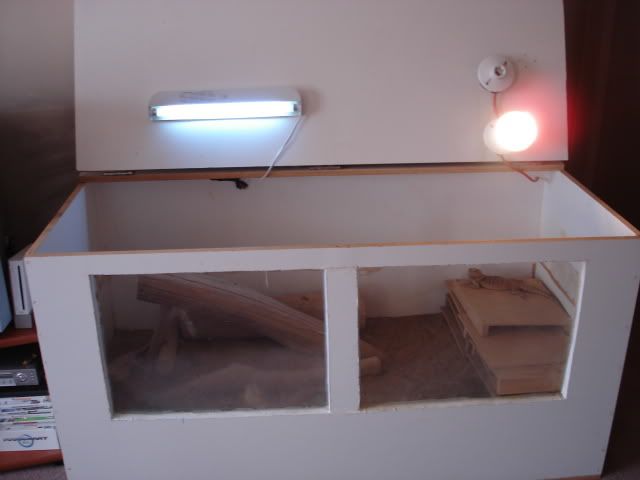
Sorry, but to me your setup looks marginal. It looks dark and dirty. You should get a UVB fixture the length of the enclosure. Where is the venting? The problem with little venting is that the cool side is usually too warm. How are you measuring and adjusting ambient temps? As the ambient temp in the room changes so does the ambient in your enclosure. How are you correcting for this? Your basking temp is random depending in the ambient also. I would bet your enclosures have an extremely low humidity. Are you measuring the humidity somehow?
I have taken all of these things into consideration in the construction and design of my enclosures. The reason I build my own is not that I have too much time on my hands but that commercially available enclosures don't consider all of the variables.
My ambients and basking temps are controlled. This is important if a hot day comes along and you are not home. I have a rescue dragon where the owner did not consider this. He is very mentally handicapped.
I really could not even imagine changing to a setup like your yours considering where I am now in dragon care.
Grasping at straws? Ambients are fine. I control the fluctuations in my enclosure by having heat and central air. My house is always 72. I've been doing this for a long time.
I don't measure humidity. Judging by the pics I would say it was time to add water to the substrate. You still don't understand its not about high humidity. Its about a humidity options.
Lengthen my UVB? Why? I could take it out and my dragons health and behaviour would not change. You should create an environment where your dragon doesn't need UVB. Then you can add one as a bonus. If your dragon needs UVB, then its basking temps are too low.
I agree the enclosure is dirty, as it is full of dirt, but thats of little consequence to me or my dragons.
You can't be the beardie master if you can't even set up a habitat were all the dragons needs are met with in the enclosure. UVB, nest boxes, baths, are not needed. You can use them if you want, but theres a difference between needed too and wanting too. Every aspect of life can be achieved in the above enclosure. Dragons can grow up, breed, lay eggs, the eggs can incubate, and the babies can hatch.
We'll let the masses make their own decision. I would never subject one of my animals to that set up. Just my opinion.
I can agree to disagree
Just for the record, there is a vent on the cool side. Its equal to the vent on the hot side. Its just not visible in the pics.
There is a vent to the right of the hotspot(first pic). Heat escapes with too much venting
A soil substrate produces its own moisture gradient! Soil retains water, allows that water to become vapor in the air. The Virus never has to worry about low humidity or dryness in the tanks - the soil takes care of it.
BDlvr, in your custom tanks there are too many vents on the cool end and you use a dry substrate. Your tanks depend on how humid the room they are kept in is. If the room is dry, your tanks are dry guaranteed. I used to run a humidifier in the herp room too before I got into a soil set-up. It's not very efficient to use watts to produce moisture.
An often overlooked key to excellent husbandry is moisture. A soil substrate can provide consistent moisture along with many other positives.
Venting only works when there is an inlet and outlet. Inlet should be on the cool side and outlet should be on the hot side. One side venting does not work.
Air escapes where there is a hole, did you pass elementary science?
Robyn uses dirt with most of his reptiles (see his website for info about soil/dirt substrates)
The use of soil with dragons is possible..but it is higher maintenance and require a proper balance between moisture content and naturally 'dry'. Ideally, how I understand it, there should be 3-6 inches of a soil/dirt mix with the top inch hard packed and nearly completely dry but moisture present deeper. The idea is to allow the dragon to dig a 'cave' to the cooler and moist dirt and they can regulate their need for moisture and coolness by doing this. It will be necessary to moistened the top layer of dirt time to time.
Though any poop in the cage should be removed if found, its also a good idea to 'stir up' the dirt every month or so to ensure micro organism can break down fecal matter and reduce odor and germs. There is much more to this than I know of and I really don't recommend it for the typical dragon keeper. It is far more work and though it has benefits, proper humidity and hydration can be maintained with the 'dry spartan' methods.
Fresh greens offered daily and lightly misted (or left in water in the bottom of the bowl) provides plenty of moisture. A water dish in the cage can also increase humidity levels and provide water to drink (some dragons will actually do this, but many just ignore it). Humidity in a dragon's cage should never stay over 60% for long periods as this can produce respiratory infections and other issues. around 40% is good.
Using soil is basically creating a semi-arid style vivarium and dragons can do well in these setups. There are many large scale breeders who keep their dragons in outdoor enclosures and these are all on natural dirt.
However, like all sandy/dirt like substrates there is still a risk of impaction. Impaction can be caused by ingesting way too much dirt, sand etc for the bowels to move out and the risks are increased if other things husbandry wise are lacking, such as sufficient temperatures, dehydration, parasites, high presence of calcium (too much calcium at once can reduce acidity in the stomach which will mess up digestion big time, something calcium based sand can increase greatly). Every aspect of husbandry must be considered as part of a whole.
Thus for somebody who hasn't had alot of experience with dragons or reptiles in general, the bulk of us recommend the easiest ways to ensure husbandry needs are met. Weekly baths, well dampened greens, gut loaded insects, ideal temperatures etc. make it easier and more effective for the new comer to dragons to ensure healthy and happy dragons. As experience increases and more research is done, more 'advanced' keeping methods can be used (ie soil/dirt substrates and a vivarium style setup etc.)
Using soil/dirt as a substrate isn't a 'wrong' way just a more advanced way. It requires much more work and knowledge to ensure it works correctly...and if you happen to get a dragon who enjoys eating dirt, it may not be suitable (if they eat enough of it, its going to cause problems, best the dragon isn't kept on a substrate it can eat). Hybrid cages are also possible too. Have only a quarter or third of the cage containing soil/dirt or sand for the dragon to dig and enjoy, while the rest of the cage is a non particulate substrate to ensure clean eating areas and easy to see defecations (assuming they are nice enough to go where you want them to go.)
-----
PHLdyPayne
I understand micro organisms can break down the pooh and clean up the housing units. Anyone have any idea on how long that takes? I read in one someone uses worms in the cage and those help break it down more. Im just wondering from the people that use dirt how long would it take to break the poop down and not be around at all anymore. I mean we have dumps in the world and almost everything breaks down and turns back into soil but really the time frame is the important part. Sorry im not trying ot bash i think the dirt thing is a great idea if everything adds up. I mean really beardies wouldn't poop within 4' of the hole they live in or would they?
Not sure on how long it takes for fecal matter to break down. There are various factors involve to properly maintain a bio-active vivarium. There is also a need to turn the soil around too, to keep thing 'stirred up'. Worms and other insects in the soil certainly can do alot of this for you.
Best way to get a deeper understanding on how this works for a semi-arid setup is to google arid or semi arid vivariums, or Live Vivarium setups. Reptile Magazine has had a few articles in the past relating to this and of course for rainforest and forest style vivariums, there are much more info out there. Arid, semi arid or dessert type vivariums not as common but still possible.
All this talk about the value of having some humidity for bearded dragons makes me wonder if a low humid hide would benefit them especially in cages that don't use loose substrates. Humid hides are often used with snakes and other humid needing lizards. I think its even recommended to have a humid hide for many gecko species, even those who normally come from a semi-arid environment (ie leopard geckos). Though leopard geckos are nocturnal and don't 'bask' in the heat under the sun, they do hide all day...
The following is addressed more to TheVirus, Kmartin and BDlvr:
There are still many variables and unknowns with bearded dragons and though these boards do invite name calling, please, do remember it is against the TOS for anybody to 'bash' another. Its fine to say 'I don't agree with what you are saying' but be tactful, and leave out the 'no you are wrong' type phrasing. I really do hate having to remove some good posts because either they contain TOS violations along with the good info or enough of a reference to a violating post I have to pull it too.
It is clear there are many different ways of doing things and not all are bad. The important thing is whatever is done, is producing a healthy thriving animal. There are pros and cons with each method but if the pros far outweigh the cons, then its a good setup. Nearly all reptile keepers and breeders started from not knowing anything about the proper care...and over years and peer discussions (even before internet was so readily available) used trial and error to come up with the best way to care for their animals.
My strongest suggestion is always keep an open mind, even if the new information seems radically different. Analyze it objectively and instead of automatically rejecting it cause its different, try and see why it works so well with others. Length of time keeping bearded dragons or reptiles etc. does have some value, numbers of total animals and overall age of dragons is important too. One could keep bearded dragons for 20 years but never kept an adult past 4 years of age isn't quite the same as keeping bearded dragons 20 years and each one they own they kept from egg to grave...with them living on average 10 years.
Pets and breeder animals are a bit different too, as most breeders tend to sell off older animals that are past their breeding prime, replacing them with new blood from different lines or offspring of the 'retired' pair. Or a combination of both. Large scale breeding operations also have space limitations and resort to the simplest and most efficient methods...mostly due to space and cost concerns. This means their methods of husbandry are likely different than the hobbyist who just has a couple dragons as pets, maybe with some breeding on the side. And of course everybody in between.
I have been around these forums and other forums for about ten years, maybe longer, now. I have heard all kinds of different ways to care for bearded dragons. Some don't work at all due to sickly animals etc. Others have used methods against the norm without problems. Even using things for substrates I would never even consider...such as seeds and rabbit food. Each them these odd things come up I logically try and figure out why it would work or not work, what are the pros and cons..so I research. I don't' always keep a lengthy record of where I read things and some sites may be bogus, but I do try and find more than one source of information, to better validate it. I also ask questions, especially during the special guest chats we have.
There is still plenty for me to learn. Alot of times there just isn't any information to find out due to lack of real research. I would love to do some of this research myself, in a controlled environment..but I lack the money and space. Like buying every brand of calcium based sand on the market and finding out if it can actually be digested as the bags all claim. Then I heard of somebody on these forums or the chat rooms, who tried this himself. Found that even using acid stronger than is typically found in animal stomachs, calcium sands don't break down sufficiently even after 24 hours. He drained the acid away and dried the remaining sand, weighed it and it was exactly the same weight (or a tiny fraction of a difference). It also clumped up and reduced acidity of the acid.
I would love to do this test myself, but I have no access to the tools I would need. If I was still in University, I could use the Chem lab for this easily. Things I don't know about that particular test was whether he used an agitator with the acid/calcium mix (an agitator will simulate the movements of the stomach as it churns etc during normal digestion), among other things.
I would also love to have several clutches of dragons...raised them up all the same, then breed them and each baby from these raised from hatching to full adulthood under several different conditions, with weekly and monthly testing to monitor growth, bone density, levels of calcium in the blood etc. to see if they thrive better in different situations. Such as no UVB conditions (heat light, no source of UVB at all. No supplements at all. One with supplemental Vitamin D3, etc. to see which group thrives best..
Oh the things I would do if I had unlimited funds I have rambled on long enough..I hope this proves interesting to anybody who has taken the time to read my latest long winded post.
-----
PHLdyPayne
I enjoyed the rant
It seems to me that if you single out people by name for the sole purpose of criticizing or chastising that would be the definition of "Bashing" But then again it's not a level playing field here so i'm sure this post has a very short life.
That was a great, open minded, long winded response
I just want to make a comment about my personal opinion of humid hides. The problem I have with humid hides (even with leos)is that its a set hide (lxwxh), at a set humidity percent, at a set temperature.
I like to set up habitats with many different hide/humidity/temp options. What I mean is, areas that that have all sort of combinations of the three. Hot, humid, tight/dark hides. Cool, humid, dark/tight hides. hot, not so humid hides. Dry hides, and every combination in between.
I don't even use humid hides with leos. I have a pair of nine year old leos in an enclosure with the same husbandry concepts as the beardies. Just specie and behavioural differences. A couple months ago I looked in the enclosure and a baby was looking back at me! To me, its just further evidence of how effective these husbandry practices are (and how I'm still making mistakes....missed a clutch enough times to hatch!)


Ideally your spot cleaning soil everyday just like any other substrate. It's not as hard as some would think to find fecal in the enclosure. Remove what you can from the surface wth a paper towel and that's it. If your worried past that, you can spray that area with a non-toxic cleaner like nolvasan.
The top inch or two of soil should be worked every 1-2 months, or as needed. Dragons love to dig so they will be changing the landscape as they see fit. The top layer of soil should also pack hard, so it will have some moisture up top, but most resides on the bottom.
I use 3 inches of soil in a 5x2 set-up and I add a gallon of water every month or so. The more soil, the more water you have to add to the mix to get the gradient down. An accurate indoor hygrometer is a must with a soil set-up too - you need to see a constant relative humidity reading. I think 20-50% relative humidty is a good gradient for dragons to have available. And were just talking the air, deep soil retreats are more moist.
Where's your picture? As I said before, a picture is worth 1000 words.
Can't get one up today, maybe tommorow if I can figure it out. What would you like to see in the picture?
Pictures give posters credibility. On this site anyone can masquerade as an expert.
I'm good with tools, not computers
Here's a pic of a 130 degree sruface temp bask stack with temps dropping 3-5 degrees all the way down @ each level. Ambient in the cage is always 75-85, roughly 3 inches of a soil mix.

And those temps keep dropping....

Still going....

From 130 degree surface temp all the way down to 75

Top of stack - hard to see the reading @ 127.5F

Can you post a picture of the entire cage? I would like to see the whole thing and your substance looks like sand that has woodchips in it so maybe a better picture of that. Im interested in this idea and just trying to grab some for visuals of it. Thanks
I also noticed that your temps went from basking of 127.5 to 82.3 thats a monster drop off from your top level to the next avalibe spot of heat. If that is the case then i know why your bearide is hanging out in the 127.5 area. Not sue if you missed a level or something.
Yes. those pictures show that you have mastered the use of a temp. gun. But, they don't show much of anything about your experience. They do show though the uselessness of retes stacks.
Your animal is forced to use a high temperature basking spot because it is the only one available. Drop down even one level and the temps. are too cool even as a hot side ambient and there is no beneficial UVA or UVB. The wide sloping basking spot as suggested before would be much better if you must have those high temps.
The 120-130 range is a six inch circle or so. Off to the side of that there is 110,100, and 90 degree areas available. Light reflects and is still useable. The dragons use the high temp bask spot when needed and then shuttle just a few inches to the side when they have hit their target temperature.
The lower levels of stack are not meant for basking, they are for hiding. As you can see they don't get much light I posted these pics to illustrate that a high basking hotspot can used and ambient temps can be kept in check. Something you have said was not possible in past posts.
You don't want sloping basking structures. Only a small area can stay at a consistent temperature as the light is not reflected evenly on a surface.
Before I go though, I urge you to do some research on a guy like Frank Retes before calling his basking stacks useless. He has more field experience and reptile knowledge in his little finger than both of us combined.
That guy is a big snake guy which is what those racks are made for kinda funny that you point that out for yourself. Beardies are not snakes incases you have become confused.
?????
I still have a few questions that did not get answered though...how long are your racks? HOw much space is availibe if your beardie didn't like the 127.5 temp? Is there a spot on the rack that hits around 110 and how big is that spot? Where does your beardie sit for most of his time and what kind of temp is that? Also the UVB balbs are designed to give off less UVB than the sun so that you can have it on for 12-14 hours a day. Does your beardie get enough UVB if it is hiding in the rack? I know you said you let them outside but during the winter is my question. Where does your beardie spend its time? Can i get a picture of the dirt too!
>>I still have a few questions that did not get answered though...how long are your racks? HOw much space is availibe if your beardie didn't like the 127.5 temp? Is there a spot on the rack that hits around 110 and how big is that spot? Where does your beardie sit for most of his time and what kind of temp is that? Also the UVB balbs are designed to give off less UVB than the sun so that you can have it on for 12-14 hours a day. Does your beardie get enough UVB if it is hiding in the rack? I know you said you let them outside but during the winter is my question. Where does your beardie spend its time? Can i get a picture of the dirt too!

Ok most of the questions have been answered any pics of your dirt? Plus what are the temps of the areas they seem to be hanging out in. Ofcourse i cannot say they sit in those spots all day from one pic but i bet those spots are near 110 than 127
>>I still have a few questions that did not get answered though...how long are your racks? HOw much space is availibe if your beardie didn't like the 127.5 temp? Is there a spot on the rack that hits around 110 and how big is that spot? Where does your beardie sit for most of his time and what kind of temp is that? Also the UVB balbs are designed to give off less UVB than the sun so that you can have it on for 12-14 hours a day. Does your beardie get enough UVB if it is hiding in the rack? I know you said you let them outside but during the winter is my question. Where does your beardie spend its time? Can i get a picture of the dirt too!

So your dirt is more of a 75% sand 25% mix of dirt rocks and wood?
Good guess, but more about 50/50 sand-to-topsoil with a few handfuls of cypress mulch for water retention.
Let me add to my soil set-up isn't ideal, you want a deep, diggable soil 6-10 inches. I only have 3 inches because that's what the cage allows for. It's a shame I learned about awesome husbandry after I spent the big bucks on some less than useful caging!
ok it still looks very much like sand so i guess really besides the mositure thing its really doing the same thing as sand. Im all for humidity as long as it is the right levels. The wood for sure could be debated but besides that it looks normals plus or minus your setup on how they get heat.
I assure you, it's a 50/50 mix
But they don't do the same things. I can pack the surface down with my hand. I can add water and it will retain. My dragons get some muscle activity working through it. Sand cannot provide these things Faygo.
Sorry Faygo, I kept on trying to post my answers to your questions but with the pics must have ran out of space.
1) Rack size varies according to cage size. That particular rack in the pics is 12x12 and 8 inches tall. Biggest I have built is 18x15 and 6 inches tall
2) Check the above pic with 2 dragons basking, plenty of space. That rack is 18x12
3) The dragons basking in above pic are in 110-100ish areas. Good sized area, enough for a few adults. 130 is just an option
4) Hard to say, when 130-75 is available they make use of it all. I have a 3-level basking stack on the opposite side of that cage that hits 115 on the surface at it's highest. They use the 4-level higher temp stack more often, no BS
5) The dragons get no UVB in the hides, as they get little UVB exposure hiding in the wild either. I wouldn't get too caught up in the UVB debate Faygo, heat is the proven catalyst to reptile success.
The big thing about UVB is i read in one article that even when hiding in shrubs they still found that normal levels of UVB are present. So unless they are hiding underground or in a log they are still getting the UVBs that are said to be good for them. You talk about wanting to make it more of a natural inviroment for your beardie but then do not give them the natrual things to produce D3. Thats is where im getting at. Not trying to harp though just what i am seeing if you have basking areas from 127-110 and there is lots of space for all the temps ranges then having higher temps is fine in my book because they can also move away. On that same not if you put the light close enough they will for some reason burn themselves on it so i guess you can say they really don't know the best for themselves.
I wish there was some way we could move this thread to the left
Reading is good, but its just written word until its applied. You can read all day that UVB bulbs are "needed", but all it takes is one person to be successful with out them to prove that they are not "needed". UVB lites help the dragon produce D3, however, supplemental D3 works too as its been applied and proven. I blame the reptile industry for pushing their product over good husbandry. Remember, we kept reptiles (including beardies) before UVB bulbs.
So while I'm not saying to not use UVB lites, I feel that the dragons whole habitat should not be designed around it. Uvb lites should only supplement good husbandry. It shouldn't be the reason why the animal is alive and in good health.
First off beardies live span was very short before UVB was introduced. Also the powder D3 has been used recently but I have not read any studies done saying this is indeed a replacement of UVB lights. Everythign i have read so far said that both together work great. If you have any please drop a link to them I would love to read them.
Also good husbandry is The application of scientific principles to agriculture, especially to animal breeding. In that sense you are using studies that scientist have made to raise your breadie. Please apply that to some of the things you are doing. UVB stidies have been done and they show that beardies use and need them.
"First off beardies live span was very short before UVB was introduced"
Really? Do you know many old beardies? Do you know many young ones? I think that they're not living very long still. The few that have had good long term success is trumped by the thousands who haven't.
"Also the powder D3 has been used recently"
Again, really? I can remember having to dust crickets in the 80's.
"Everythign i have read so far"
Reading is good, but your trying to argue your point by stating things you've read. My points are made from things I've actually done.
"UVB stidies have been done and they show that beardies use and need them"
No, its been shown that UVB lites allow beardies to produce D3. To me, the fact that your beardies "need" them (at least you think they do) and mine don't, shows that other aspects of your husbandry are not up to par. Besides, this argument is pointless because I never said to not use UVB lites.
My point has been made since you said it im reading stuff that a scientist has studied and you are going based on the stuff you have done. You need to rethink the process that you say yourself is needed. Good husbandry
