Do they know what causes fatty liver disease in monitor lizards? Is it something that effects all monitors or just certain species? Also is there any clue that might suggest wild monitors die from fatty liver disease or just those held in captivity?
Reptile & Amphibian Forums
Welcome to kingsnake.com's message board system. Here you may share and discuss information with others about your favorite reptile and amphibian related topics such as care and feeding, caging requirements, permits and licenses, and more. Launched in 1997, the kingsnake.com message board system is one of the oldest and largest systems on the internet.


FLD?
elidogs
Jun 06, 2009 01:21 PM
Replies (28)
FR
Jun 07, 2009 12:45 PM
Fatty liver Desease appears to be a condtion cause by lack of support, Like not even heat(in captivity)
If their metabolism is not functioning at full speed, they cannot accomplish some bodily tasks.
From my experience, if varanids are allowed a full range of temps, they will not EVER have this problem. There may be other contributors as well, like an impaired immune system. Which also occurs when a monitor cannot access the temps and conditions it needs.
It was once thought that fatty foods(rodents) contributed to this condition, Sir that is so false its laughable. It does appear to be cause by feeding GOOD food items to a individual thats not functioning correctly and at half speed.
In a nutshell, a monitor needs to use the energy it consumes or it will place excess energy as fat. If the body is not functioning correctly, it places fat in the oddest(not normal) places.
I have never seen FLD occur in wild reptiles of any kind and have not read about it in wild varanids. But then they have choices. Cheers
elidogs
Jun 07, 2009 01:15 PM
So none of your monitors ever get fatty liver disease after years of eating rodents and crickets?
FR
Jun 07, 2009 02:06 PM
Nope, never. But then, we have heat. If you check the cases, you will find, all are kept at suboptimal temps. Cheers
elidogs
Jun 08, 2009 12:57 AM
"Nope, never. But then, we have heat. If you check the cases, you will find, all are kept at suboptimal temps. Cheers"
What temperature ranges do you keep for your indoor monitors? Like 72F to 135F?
Paradon
Jun 08, 2009 08:37 AM
Here is a good article by Douglas Mader. Good read!
Hepalipidosis
FR
Jun 08, 2009 09:33 AM
Ok, its not dumb at all, well maybe a little.
I have no arguement with the articule, except some, hmmmmmmmm ok, I do. Most of the articule is right on. But the real point is missed.
The articule says, its a problem with metabolism. That I totally agree on. In my experience, this is the key and the cure. The rest of the stuff mentioned is most likely periphereal.
The cure is to allow a full range of metabolism. Then the periphereal problems and FLD ARE GONE. This is so easy to do.
So yes, the articule is right on, except the authors do not have the experience to exact a cure.
To feed them poor quality foods is the cure, hmmmmmmmmm how about reving up the motor, and allowing the monitor to burn the energy it consumes. support an increased metabolism is the cure. Then you can feed them anything and they will prosper.
Cheers
Paradon
Jun 08, 2009 10:10 AM
Hmmm! Isn't doctor Douglas Mader one of the best herp vets there is? He basically wrote the book on reptile medicine.
robyn@ProExotics
Jun 08, 2009 11:12 AM
Being an expert in medicine has no particular tie to being an expert in husbandry or captive care.
Vets have a grasp of knowledge far beyond my own understanding, yet most will recommend a "hot spot" of 95F or so for a lizard. Why is that?
Because medicine and husbandry are two completely different fields : )
-----
robyn@proexotics.com

FR
Jun 08, 2009 12:33 PM
First there are a lot of good herp Vets. He does write alot. Others practice a lot. But neither is the point.
Herp vets do nothing but see "sick" reptiles. They spend their time fixing what is already REALLY broke. Abused animals suffering from all manner of abuse. Also because their owners brought their sick reptiles to the vet, the owners cared.
So its nothing against the vet(s) or the owners of the sick reptiles.
The point is, They are not experts in keeping varanids(in this case) healthy. They do not do this. They only read what you read and fall for the same things others fall for(sadly)
The real problem is, they theorize how to keep monitors healthy, THEY DO NOT practice keeping varanids from getting sick in the first place. In fact, most vets are very prejudiced because they see nothing but failure. Just think what they would say if they had decades of success with monitors.
In this case, The vet said what caused the problem. But you and others do not dwell on what the paper said. You dwell on something, one thing you can grasp, rodents. He did mention metabolism. But you ignored that(so do others) The truth is, metabolism is key, rodents are not.
ITs also not about rodents or fat for that matter, its a condition when an animal stores fat in places its not suppose to be. They are suppose to store fat in the body cavity and in the tail. NOT IN THE ORGANS. So when they DO store fat in the organs, SOMETHING IS WRONG. So you and the vet address the fat. Its not the fat, its whatever is causing them to PLACE that fat in their liver.
Yes, you can lower the fat, but did to fix what was causing the animal to place fat in the liver, NO YOU DID NOT. So you actually fixed nothing. You simply prolong the problem.
This is very much the point, rodents are not the problem, what is causing fat to be stored in the liver is the problem. So reducing the fat is not a cure. Also, why not use young skinny rodents instead of fat jumbos????????
I breed mice, and normally they are not fat, they contain no more fat then any other whole prey item. Have you ever pinched open the body of a cricket, hmmmmmmmm FAT. Or a superworm, FAT. Full of fat.
So sir, that paper is dumb because it does not address fixing the problem. Its dumb because lets you think its about diet. Its not about diet, its about metabolism and stress levels, which indeed was mentioned. Cheers
Paradon
Jun 08, 2009 12:57 PM
Well, he didn't mentioned varanid. He does say feed it corrrectly, so in varanid feeding it rodents shouldn't be a problem. The article said it's not the food that is causing it, well not really anyway, but improper husbandry. I think that is the main point: people not keeping their reptiles correctly. I think you are missing the point of the article. Maybe fat has something to do with it after the animals get sick, but it's the result of poor husbandry. He is saying FLD is one of the few complication arises from poor husbandry.
Paradon
Jun 08, 2009 01:10 PM
And no, FLD is not what usually kill the animals.
jasper2
Jun 09, 2009 09:29 AM
I am sorry to say this but you are missing some thing as well.
The monitor is not storing fat in his liver "for some reason".
They store most fat where they should, in their pads and tail and maybe between organs. The fatty liver problem starts when they STOP eating. then the body shifts to burning it's own fat. The fat comes out of the tissues and goes into the bloodstream, and then it goes into the liver. the liver attaches the fat to a certain protein to make the fat useable for the normal cells in the body. BUT here is where thing go wrong: there is so much fat coming in at once that the liver can't produce enough protein carriers to handle all the fat and it can't leave the liver. This is what causes the liverfailure. This is a wellknown problem in cats and shetland ponies as well.
At this stage the only thing that works is as Dr Mader wrote, it doesn't even matter what species you are treating. Just giving them extra heat etc won't work anymore.
Of course it is easy to prevent the problems to begin with with good husbandry.
SHvar
Jun 08, 2009 10:22 AM
Fr, but mine range from an air temp of around 64 (below ground sometimes) to above ground at 68 to 86, then surface temps of up to 150f with my current cages (2 had higher surface temps, one was 168, one was 195). So realistically air and surface ranges of 64f-150f.
elidogs
Jun 08, 2009 01:21 PM
"Fr, but mine range from an air temp of around 64 (below ground sometimes) to above ground at 68 to 86, then surface temps of up to 150f with my current cages (2 had higher surface temps, one was 168, one was 195). So realistically air and surface ranges of 64f-150f."
I have a harder time getting the cooler temps in the summer... I can get them down to about 80F on the cool side. In the winters I can get them down to 65F on the cool side if I want too. I try to shoot for about 72 on the cool side and 130 on the hot spot of the cage. Typically, mine sleep under the rocks under the light, they choose it day after day. Sometimes they will sleep under the water bowl but they never stay.
ryan_m
Jun 07, 2009 01:23 PM
Hey FR,
Great post. Do you think this applies for reptiles across the board? I know large temp ranges work great for species like Bearded Dragons and Uromastx...but how about snakes. Would you say species of python and colubrids could benefit from a bask in the 110ish range aslong as they had a proper gradient? Just wondering what you think. Thanks.
FR
Jun 07, 2009 02:10 PM
I cannot say all reptiles, but I can say, all that I have worked with. Which includes pythons and colubrids. In there case, a range from 55F to 100F year around is very very very successful. Of course thats not necessary, you can a have 100F hot areas year around and have temps in the fifies in the winter and have higher lows in the summer. As Fifties are not easy to maintain in some parts of the country. Cheers
TOM_CRUTCHFIELD
Jun 07, 2009 02:58 PM
This year I for the first time tried to breed Diamond Pythons and kept them outside year round. Diamonds are notorious for being extremely difficult to breed. Well they were out and had CHOICES. One night it got down to 38 degrees but the next day every one was basking. I temp gunned one and it was 96 degrees and still basking!!!You hear most folks say snakes can't be kept that hot. Well sir, mine could be whatever temp they chose and they decided to be 96 degrees. To make a long story short I had 15 eggs and just hatched 15 babies my first time trying. I beleive it all has to do with an understanding of what you have..here's a few pics...
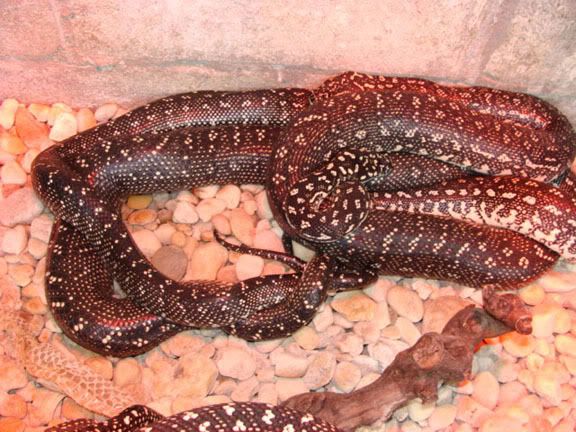
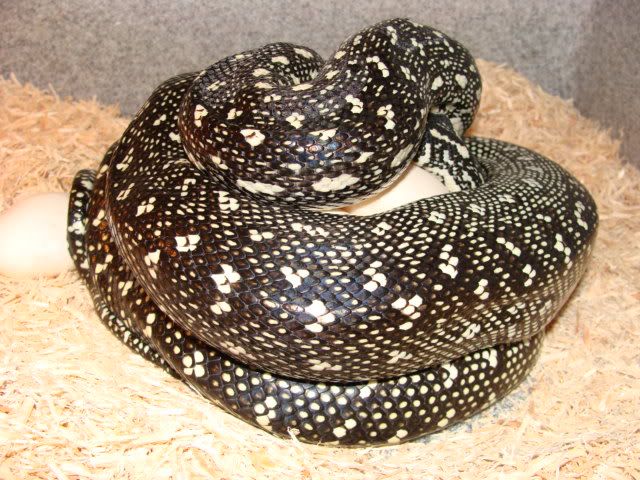
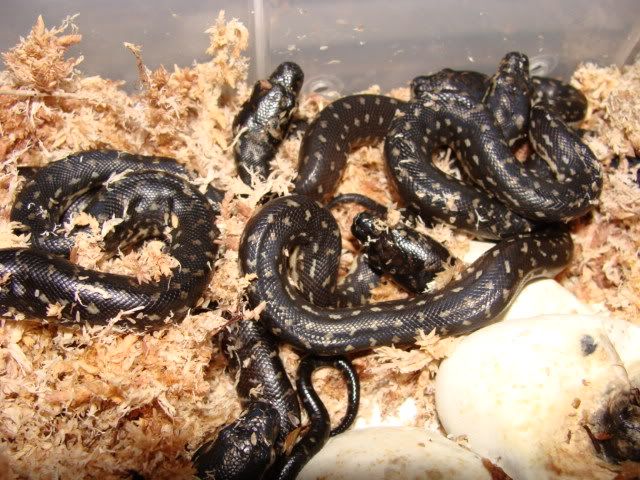
You asked about snakes and that's my answer. I also have several gravid prasinus species utilizing the same formula and mine aren't fat...
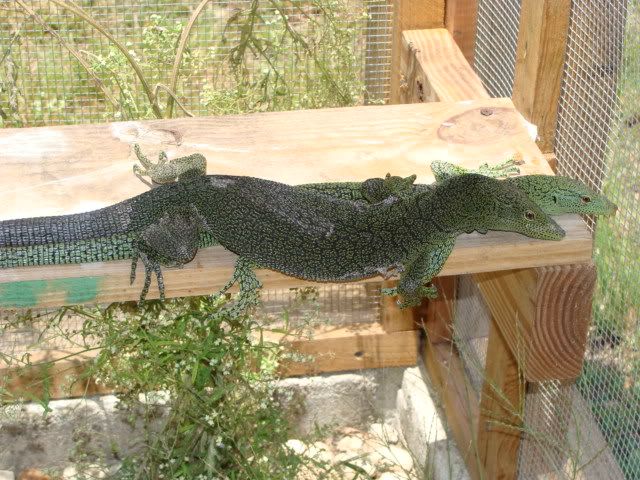
-----
Tom Crutchfield
www.tomcrutchfield.com
robyn@ProExotics
Jun 07, 2009 04:59 PM
Hey Tom, we take a similar approach to the Boelen's, another difficult to breed python.
We offer a wide variety of choices in light/dark, dry/moist, and temps. At times, it has been as wide as 55F to 120F. This was in 7 large Vision cages all interconnected...
Knowing that the species is a high elevation species (6000 ft), dark jet black, known to bask on the rock outcroppings, those field temps would be well over 110F, and night temps would drop significantly at those elevations.
We still haven't bred them, there is more to that puzzle, but I think a wide temp gradient for these types of species is key.
We have also offered a very wide temp gradient for the porphyraceus ratsnake species, with tremendous breeding success, as many as 9 clutches in one year from a female Coxi.
It isn't specifically TEMPS that have the wide application, but rather CHOICES, whether light/dark, dry/moist or cold/hot : )
-----
robyn@proexotics.com
TOM_CRUTCHFIELD
Jun 07, 2009 05:16 PM
Wow, nine clutches is a lot. I had no idea they could lay that many clutches. These are now hatching as well so I'm pretty stoked. These are from my first clutch with 5 more to go. I should have albino Iguanas hatching weekly now for a while...
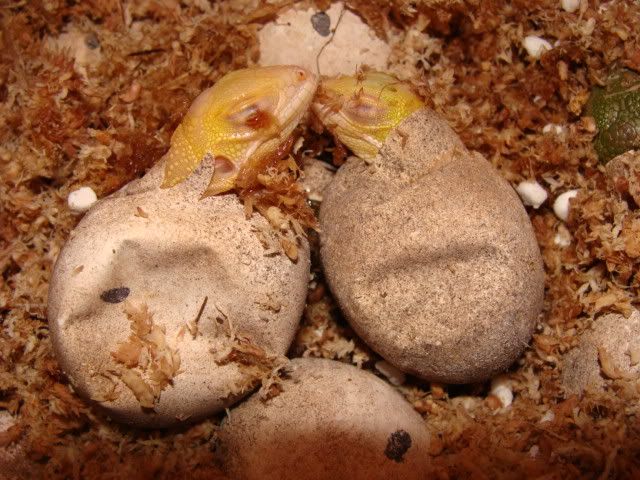
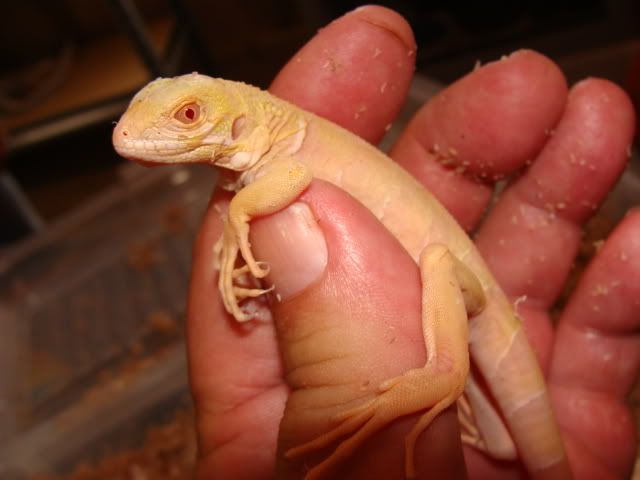
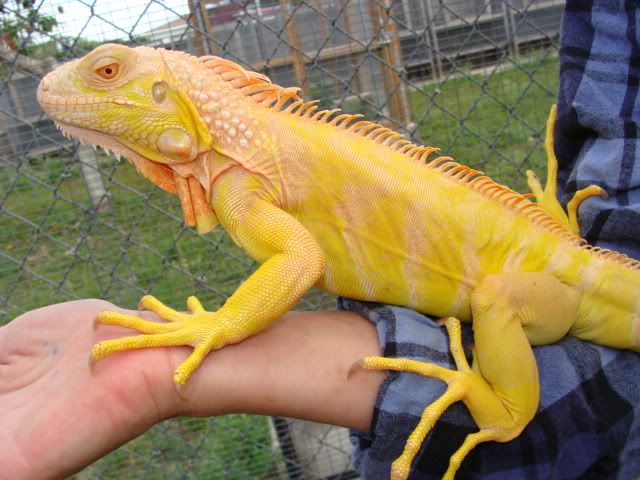
-----
Tom Crutchfield
www.tomcrutchfield.com
robyn@proexotics
Jun 07, 2009 10:12 PM
Wow, that sure is pretty.
-----
robyn@proexotics.com
gbassett
Jun 07, 2009 02:08 PM
FR I agree with you but one thing you did not point out is the fact that monitors need a larger cage with lots of things to do ie deep substrate for borrowing loges to clime on and stuff to explore
If you have a two foot monitor in a four foot fish tank and feed it nothing but mice all day it will develop fatty liver disease
greg
FR
Jun 07, 2009 02:18 PM
I have no proof or evidence that is true. I have on occasion left raise ups in small tanks to long and they did not get FLD, they simply outgrew the cage until they got out on the own. hahahahahahahahahaha. Hall pass.
So far, I have not found a way to cause FLD, I have even kept monitors in cages for over a year with no lites. But again, in our summer its still hot.(when I did this, it was a test) the monitors tested were fine.
So yes, I only can say, rodents do not cause it, something else does. As what we do does not cause it.
But from my reading and talking with vets, its common for an individual with FLD to be kept in a cool cage and your right, and small cage. So the combination may be needed. Cheers
gbassett
Jun 07, 2009 02:55 PM
Are you the infamous Frank Rets(sorry if I miss spelled your name)if so i would love to pick tour brain on monitor captive care
greg
robyn@ProExotics
Jun 07, 2009 04:52 PM
"...the mighty infamous, always misbehaving and mischevious!"
(Busta Rhymes)
-----
robyn@proexotics.com
SHvar
Jun 07, 2009 11:02 PM
When reptiles alot of fat, then fast suddenly, they start using their fat reserves at a fast rate when conditions are more condusive to a higher metabolism. Their body cannot handle the loads of fat being circulated through their system and organs start to fail.
IE, fatty liver disorder, or fatty liver disease. It happens when someone realizes their monitor is a chubby butterball, and starts to feed nothing, or alot less and the lizard loses weight to fast. When getting a lizard to lose weight it must be done with very small meals more often, not with fasting.
elidogs
Jun 08, 2009 12:55 AM
"When reptiles alot of fat, then fast suddenly, they start using their fat reserves at a fast rate when conditions are more condusive to a higher metabolism. Their body cannot handle the loads of fat being circulated through their system and organs start to fail.
IE, fatty liver disorder, or fatty liver disease. It happens when someone realizes their monitor is a chubby butterball, and starts to feed nothing, or alot less and the lizard loses weight to fast. When getting a lizard to lose weight it must be done with very small meals more often, not with fasting."
Yeah,alot of the savs seem to get really porky. I try not to let mine get too fat in the first place. I mean what do people think these monitors are.... tegus?
SHvar
Jun 08, 2009 10:13 AM
Alot of bosc owners have fat lizards, Im not sure if they think that is normal, or how they are supposed to be. Its more difficult to get them to lose weight safely than to keep them at a healthy weight. Then again I saw some fat beardies years ago (havent gone out of my way in the last few to notice now), and couldnt figure out how the owners did that. Mine would eat, and eat, and eat until full then stop, and would make use of it.
elidogs
Jun 08, 2009 01:15 PM
I've never had beardies but I've seen people talk about the greed of sav monitors on here...but rightly or wrongly.... mine stop eating when they are full....or basically full. I try to give them that temp range everyone talks about....so I think they are no more greedy then any other monitor from my experience. I have one monitor that is due to eat on days the others are not due to eat. He will charge after the crickets and they will grab a few but basically not eat. Then a day or so later they will eat and he will not.
I think the way to make them too fat is too much food and not enough heat. Or you can make them go nuts for food by too much heat and not enough access to cool spots...neither one is good IMO. I think the key is choice.
