After 27 days of incubation (yesterday), the first neonate started pipping.
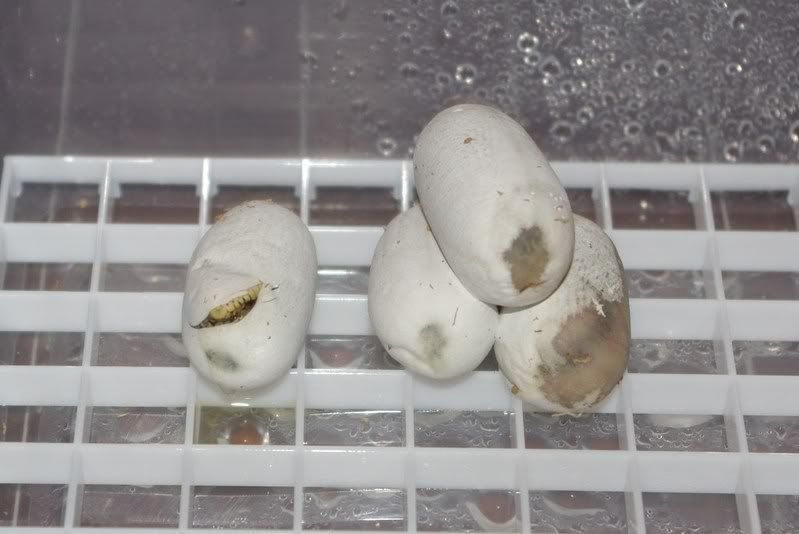

This was the scene, this morning.

-----
-Toby Brock
Southwestern Center for Herpetological Research
Welcome to kingsnake.com's message board system. Here you may share and discuss information with others about your favorite reptile and amphibian related topics such as care and feeding, caging requirements, permits and licenses, and more. Launched in 1997, the kingsnake.com message board system is one of the oldest and largest systems on the internet.


After 27 days of incubation (yesterday), the first neonate started pipping.
This was the scene, this morning.
-----
-Toby Brock
Southwestern Center for Herpetological Research
I am dancin' for ya' Toby!! What's the deal with Spidey? Hangin' on or hangin' out, lol!
-----
Todd Hughes
>>I am dancin' for ya' Toby!! What's the deal with Spidey? Hangin' on or hangin' out, lol!
>>-----
>>Todd Hughes
LOL! Thanks, Todd! You're the third person on as many sites to mention him stuck to the wall. I actually watched him crawl out of the egg, and climb up there, before taking that shot. It is the first time I have seen a neonate crawl up, instead of curling up in a bottom corner. Makes me wonder at arboreality in dione, which is supposed to be a fairly terrestrial ratsnake. It will be interesting to see where the others go, after they hatch. Maybe it has something to do with the zero-substrate incubation? Maybe not?
Two others are currently pipping! Pics later...
-----
-Toby Brock
Southwestern Center for Herpetological Research
>>>>I am dancin' for ya' Toby!! What's the deal with Spidey? Hangin' on or hangin' out, lol!
>>>>-----
>>>>Todd Hughes
>>
>>LOL! Thanks, Todd! You're the third person on as many sites to mention him stuck to the wall. I actually watched him crawl out of the egg, and climb up there, before taking that shot. It is the first time I have seen a neonate crawl up, instead of curling up in a bottom corner. Makes me wonder at arboreality in dione, which is supposed to be a fairly terrestrial ratsnake. It will be interesting to see where the others go, after they hatch. Maybe it has something to do with the zero-substrate incubation? Maybe not?
>>
Toby, maybe it has something to do with getting away from the nest, conditions, or simply trying to escape from the container. 
>>Two others are currently pipping! Pics later...
>>
>>
>>-----
>>-Toby Brock
>>Southwestern Center for Herpetological Research
Holy crapoly.....
...my fastest hatch was eastern kings in 43 days,.....I knew the diones was fast, but man.......
good luck...congrats....
..
-----
......12
......75/ 11-1
...........................
1(normal,mojave,3 spider mojaves)
.
>>Holy crapoly.....
>>
>>...my fastest hatch was eastern kings in 43 days,.....I knew the diones was fast, but man.......
>>
>>good luck...congrats....
>>
>>
>>..
>>-----
>>......12
>>......75/ 11-1
>>...........................
>>1(normal,mojave,3 spider mojaves)
>>.
Thanks! They have been known to hatch in as little time as 13 days! Now that's fast!
-----
-Toby Brock
Southwestern Center for Herpetological Research
Those are cool little windows built into those eggs, is that the norm?
-----
Todd Hughes
>>Those are cool little windows built into those eggs, is that the norm?
>>-----
>>Todd Hughes
Windows are common in dione, Todd, but I am guessing that windows like this are not. From what I've heard, they usually go white a few days after laying, but these remained transparent throughout incubation.
-----
-Toby Brock
Southwestern Center for Herpetological Research
very cool!
-----
Todd Hughes
>>After 27 days of incubation (yesterday), the first neonate started pipping.
>>-Toby Brock
>>Southwestern Center for Herpetological Research
Congrats! Yep, mine always started hatching about 28 days.
Terry
>>>>After 27 days of incubation (yesterday), the first neonate started pipping.
>>
>>>>-Toby Brock
>>>>Southwestern Center for Herpetological Research
>>
>>
>>Congrats! Yep, mine always started hatching about 28 days.
>>
>>Terry
Thanks, Terry!  I love this species!
Maybe 28 days is about average for this locality?
-----
-Toby Brock
Southwestern Center for Herpetological Research
Congrats! Koreans are on our wishlist for ages but are quite hard to find here in Europe!
Our dione's hatched after 21 days. Unfortunatly they are locality hybrids which will stay in the collection. The female was a chinese yellow and the male was a striped Kazachstan.
Unfortunatly due to a misterious disease all but one of our males have died within 2 months! The vets could not find any cause of death except some worms and flagelates. All the animals in our collection have been treated and with the last check nothing was spotted!
Next year we will try to breed our 3 adult Chinese females with new CB Chinese males that will be in our collection at the end of the year just before they go into hybernation.
Am still looking for a adult russian male, The Xi'an pairs and the Kazachstan pairs will be ready to mate next year hopefully.
>>Congrats! Koreans are on our wishlist for ages but are quite hard to find here in Europe!
>>
>>Our dione's hatched after 21 days. Unfortunatly they are locality hybrids which will stay in the collection. The female was a chinese yellow and the male was a striped Kazachstan.
>>
>>Unfortunatly due to a misterious disease all but one of our males have died within 2 months! The vets could not find any cause of death except some worms and flagelates. All the animals in our collection have been treated and with the last check nothing was spotted!
>>
>>Next year we will try to breed our 3 adult Chinese females with new CB Chinese males that will be in our collection at the end of the year just before they go into hybernation.
>>
>>Am still looking for a adult russian male, The Xi'an pairs and the Kazachstan pairs will be ready to mate next year hopefully.
Sounds like you have some exciting Dione's to work with. At one time I had some Chinese dione and I think they had the longest incubation of my three forms. The others were South Korean and Ukrainian. My Ukrainian dione hatched in 13 days. This species is extremely variable.
The South Korean dione are very nice snakes and fairly large too, as are the Chinese from the s.e. part of their range. Actually, there are several different Chinese forms, as are the Xian, mentioned by you. I'd be very interested in hearing more about these Chinese snakes and the Russian snakes, like the areas they are from, size, clutches, etc.
PS: Some day there will likely be some genetic studies on various populations of this species. I wouldn't be surprised to see it divided into many subspecies, or even several species. I think this is a good snake to keep localities for.
Regards....Terry
-----
Conserving reptiles by helping to protect habitat...
www.ratsnakehaven.com
www.scenicsantaritas.org
>>Thanks, Terry! I love this species!
>>
>>Maybe 28 days is about average for this locality?
>>-Toby Brock
I think it probably is, Toby.
I wonder how big your female got to be? The original female got well over 40 inches and produced a clutch of 16 one year.
Terry
-----
Conserving reptiles by helping to protect habitat...
www.ratsnakehaven.com
www.scenicsantaritas.org
>>>>Thanks, Terry! I love this species!
>>>>
>>>>Maybe 28 days is about average for this locality?
>>
>>>>-Toby Brock
>>
>>
>>
>>I think it probably is, Toby.
>>
>>I wonder how big your female got to be? The original female got well over 40 inches and produced a clutch of 16 one year.
>>
>>Terry
>>-----
>>Conserving reptiles by helping to protect habitat...
>>www.ratsnakehaven.com
>>www.scenicsantaritas.org
Hey Terry, I think she is somewhere around 3 ft long. Maybe I'll try to get a measurement on her soon. This was her first clutch, and she laid eight eggs, although four were slugs. I think she did pretty well, for a first timer. I'm already looking forward to next year's clutch!
-----
-Toby Brock
Southwestern Center for Herpetological Research
This morning.

-----
-Toby Brock
Southwestern Center for Herpetological Research
Yeah, we need more females. Save me one, if you can...
Terry
>>Yeah, we need more females. Save me one, if you can...
>>
>>Terry
Will do, Terry.
-----
-Toby Brock
Southwestern Center for Herpetological Research
hehe, well sure Toby, it didn't want to get its' scutes wet!
-----
Todd Hughes
All four are out and in their own tubs, now. This photo is from last night. They were all huddled under the cornsnake eggs at the other end of the tub, this morning. New pics after they shed and eat...

-----
-Toby Brock
Southwestern Center for Herpetological Research
Help, tips & resources quick links
Manage your user and advertising accounts
Advertising and services purchase quick links
