Reptile & Amphibian Forums

Welcome to kingsnake.com's message board system. Here you may share and discuss information with others about your favorite reptile and amphibian related topics such as care and feeding, caging requirements, permits and licenses, and more. Launched in 1997, the kingsnake.com message board system is one of the oldest and largest systems on the internet.

Click here to visit Classifieds
Click for ZooMed
Click here for Dragon Serpents

Neonate Chinese Beauties

tbrock Jul 06, 2009 09:06 PM

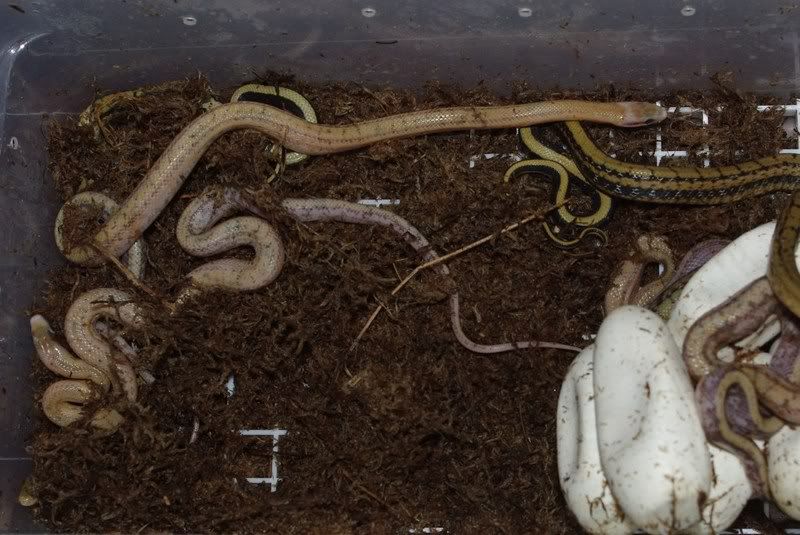
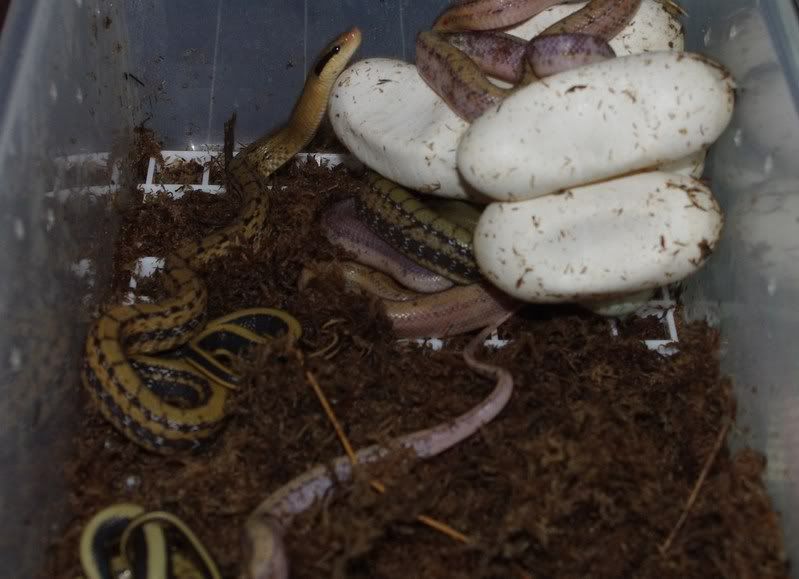
I came home to find that seven of eight have hatched out perfect BIG babies! Four calicos and three hets for calico, so far - one to go. I had to use my old camera while the new one's batteries are charging. Better pics tomorrow.

Image
-----
-Toby Brock
Southwestern Center for Herpetological Research

Replies (18)

souix Jul 06, 2009 09:26 PM

>>I came home to find that seven of eight have hatched out perfect BIG babies! Four calicos and three hets for calico, so far - one to go. I had to use my old camera while the new one's batteries are charging. Better pics tomorrow.
>>
>>
>>
>>-----
>>-Toby Brock
>>Southwestern Center for Herpetological Research
-----
The Ratsnake Foundation Online Society

tbrock Jul 06, 2009 09:38 PM

>>>>I came home to find that seven of eight have hatched out perfect BIG babies! Four calicos and three hets for calico, so far - one to go. I had to use my old camera while the new one's batteries are charging. Better pics tomorrow.
>>>>
>>>>
>>>>
>>>>-----
>>>>-Toby Brock
>>>>Southwestern Center for Herpetological Research
>>-----
>> The Ratsnake Foundation Online Society
-----
-Toby Brock
Southwestern Center for Herpetological Research

RandyWhittington Jul 06, 2009 09:38 PM

That's awesome Toby. Congrats!!!!!!!!
-----
Randy Whittington

tbrock Jul 06, 2009 09:54 PM

>>That's awesome Toby. Congrats!!!!!!!!
>>-----
>>Randy Whittington

Thanks Randy!

-----
-Toby Brock
Southwestern Center for Herpetological Research

ratsnakehaven Jul 06, 2009 11:36 PM

>>I came home to find that seven of eight have hatched out perfect BIG babies! Four calicos and three hets for calico, so far - one to go. I had to use my old camera while the new one's batteries are charging. Better pics tomorro

>>-Toby Brock

Good deal, Toby. A good ratio too. Looks like they're going to be nice looking too. No trouble hatching, eh? Give up some details, bro...

Terry

tbrock Jul 07, 2009 10:42 AM

>>Good deal, Toby. A good ratio too. Looks like they're going to be nice looking too. No trouble hatching, eh? Give up some details, bro...
>>
>>Terry

Thanks very much, Terry!

I just wrote up a very long and detailed summry of my experience with this clutch - but apparently I ran too long, and it disappeared when I tried to post it. Very frustrating! I will try again soon - maybe I will have to type something up and then copy and paste it. This is one of the worst problems with this site, in my opinion.
-----
-Toby Brock
Southwestern Center for Herpetological Research

antelope Jul 07, 2009 01:46 AM

Congrats Toby!!! I know you've been sweatin' those, you did good!
-----
Todd Hughes

tbrock Jul 07, 2009 10:44 AM

>>Congrats Toby!!! I know you've been sweatin' those, you did good!
>>-----
>>Todd Hughes

Thanks Todd! Yeah, I am so relieved. LOL
-----
-Toby Brock
Southwestern Center for Herpetological Research

tbrock Jul 07, 2009 01:27 PM

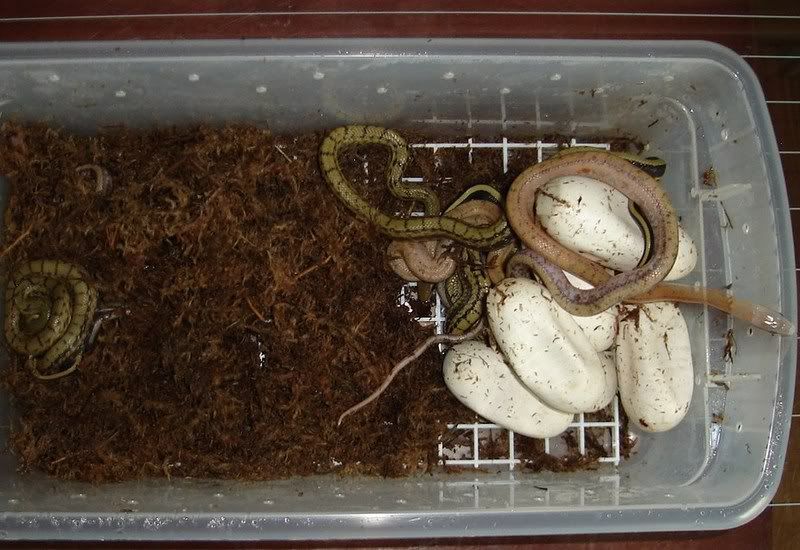
100% healthy hatch! Number eight hatched without a problem - another nice het. Four hets, four calicos.

A couple pics with a better camera, before putting them in their own tubs.

-----
-Toby Brock
Southwestern Center for Herpetological Research

ratsnakehaven Jul 07, 2009 02:03 PM

>>100% healthy hatch! Number eight hatched without a problem - another nice het. Four hets, four calicos.
>>
>>A couple pics with a better camera, before putting them in their own tubs.
>>
>>
>>
>>
>>
>>
>>-----
>>-Toby Brock
>>Southwestern Center for Herpetological Research

Congrats, Toby, and nice pics. What do you think was the key to hatching them?

Terry

tbrock Jul 07, 2009 05:15 PM

>>Congrats, Toby, and nice pics. What do you think was the key to hatching them?
>>
>>Terry

Thanks Terry!

I will comment on the factors I feel were important to the success of this clutch soon. I had typed up a very long and detailed account of this clutch, my thoughts, and summary - in repsonse to your earlier question regarding it, but when I was finished, and tried to post it - it disappeared, and the site wanted me to login again. Apparently, you are supposed to type and think a lot faster than me, if yu want to say something here. Kinda left me with a bad taste. I'll put together a summary this evening.

-----
-Toby Brock
Southwestern Center for Herpetological Research

tbrock Jul 07, 2009 09:23 PM

>>Congrats, Toby, and nice pics. What do you think was the key to hatching them?
>>
>>Terry

Okay, let me give it another shot, Terry. I will attempt to be more brief than I usually am. LOL

I radically changed some things this year, regarding the incubation of eggs and even husbandry of the adult, breeding snakes. I arrived at the current methods through much discussion with exerienced breeders of Orthriophis sps., yourself (Terry), Rob Stone, Randy Whittington, Ian Jessup, Sue White, and others. Thanks to all of you who have endured my questions and rambling. Also, my own personal research, online and in printed material regarding the captive incubation of various snake species' eggs.

I will talk about the diet of the parent snakes first, as this was a completely new idea to me. In a survey at the Ratsnake Foundation, several Orthriophis breeders were asked what they considered important in the captive propogation of Beauties, and a few responded that diet was an important factor in the development of the eggs. Well, this was not entirely new to me, but the idea that the type of prey may have something to do with the health of developing embryos or even possibly with the consistency or density of the egg-shell. These breeders said that a high percentage of their Beauties' diets is avain, and which they (the breeders) feel has much bearing on the eggs. Maybe this is due to different levels or types of proteins or fats in avians compared to rodents, or maybe the hollow bones of birds will cause the eggs to have less densely calcified eggs. In my case, I had previously only fed a rodent diet, and which I also added a calcium supplement to for gravid females, in order to promote good muscle tone. So, I may have been contributing to the over-calcification of the eggs through diet and additional, un-needed calcium. I began feeding all of my adults, females and males, a diet of approximately 50% chicks to 50% rodents (rats and mice). The resulting eggs seem to have somewhat thinner and more brittle shells than my previous clutches.

Incubation: I had previously incubated a clutch of Beauty eggs (2007) in moistened sphagnum, in a Hovabator, at + 82* F, which resulted in two healthy babies hatching, of six "good" eggs. The others were dead in egg and badly deformed. In 2008 I incubated a clutch of seven good eggs, at 80* F - 82* F, on top of moistened vermiculite (ratio of 1:1) in the same Hovabator. These eggs were extremely hard and thick-shelled, and I believe I over-hydrated them in an attempt to make them soften up. The result (IMHO) was that I made the egg-shells tougher and more leathery, and made the eggs too full of fluid as well. The combination resulted in eggs which never dented in prior to the hatching date, and being extra tough ad full of fluid caused five of seven babies to drown in their eggs. Two healthy baby calicos hatched from this clutch. The other five dead in egg babies were fully and prefectly formed, without deformites - heartbreaking.

This year, I decided to try something completely different, and made an incubator using water as the medium, which is referred to as no-substrate incubation. I was frustrated with incubation mediums, and felt that I was probably largely to blame for problems through either too wet or too dry medium, and that I was not very trusting of myself to make a perfect ratio for these eggs. My thoughts at the beginning of this were that the eggs need high humidty, but don't tolerate moist conditions well. Also, according to some breeders, Orthriophis eggs need good ventilation, which was also sort of a novel idea to me at te time. I have seen/heard of many breeders who provide very little ventilation for their eggs, and really downplay how much fresh air has to do with healthy babies. My incubator design was somewhat modelled on designs which use coolers as the body of the incubator, but I used a 29 gallon glass tank. I put about three inches of waterin the bottom of the tank, with an aquarium airstone submerged in the middle of the tank, bringing in fresh air, and boosting the humidity as well. I wrapped the tank in thick cardboard, to block light and to insulate somewhat. I put a section of 3" heat tape under the bottom of the tank as the heat source, and monitored temps and humidity with a good, digital thermometer/hygrometer. I placed two panes of glass over the top of the tank, to keep humidity high and temps fairly constant. I was maintaining a humidity of 98% - 100% and temps from 77 - 81 F for at least a month before I put a clutch of eggs inside. The eggs were placed in a shoebox tub, with numerous holes, on top of a section of fluorescent light diffuser (egg-crate). The first clutch I incubated in the incubator was a clutch of four Elaphe dione eggs, which all hatched out very healthy and perfect. I maintained the Beauty eggs in these conditions for seven weeks. At this time, I found that the eggs had begun to dent in, and panicked, thinking that they were dehydrating. I wrapped them in a light layer of slightly moistened sphagnum, but uncovered them after a few days, when it became clear that this was having no effect. Sue White brought to my attention that Ball Python breeders, who use this method of incubation expect the eggs to start denting in a couple weeks prior to hatching. Also, the idea that somewhat drier eggs may be easier for babies to break free of, was offered at this time. I remember that you had mentioned a theory that maybe these eggs would do best if temps were lower toward the end of incubation, and I also started lowering the temps, and humidity, but openeing the glass top of th incubator for longer periods and turning off the heat tae at night. I eventually stopped using the heat tape at all, and ended up with incubation temps of 75 - 78* F. So, the eggs slowly but steadily sunk in more and more up until starting to pip, on July 4th, which was 64 days of incubation. The eggs cracked, and seemed more brittle than leathery, which seems to have helped the babies escape. So, I think that it was a combination of factors that helped this clutch. I may think of something else later. Seems I can't just be brief! LOL

-----
-Toby Brock
Southwestern Center for Herpetological Research

ratsnakehaven Jul 07, 2009 11:49 PM

>>>>Congrats, Toby, and nice pics. What do you think was the key to hatching them?
>>>>
>>>>Terry
>>
>>Okay, let me give it another shot, Terry. I will attempt to be more brief than I usually am. LOL
>>
>>I radically changed some things this year, regarding the incubation of eggs and even husbandry of the adult, breeding snakes. I arrived at the current methods through much discussion with exerienced breeders of Orthriophis sps., yourself (Terry), Rob Stone, Randy Whittington, Ian Jessup, Sue White, and others. Thanks to all of you who have endured my questions and rambling. Also, my own personal research, online and in printed material regarding the captive incubation of various snake species' eggs.
>>
>>I will talk about the diet of the parent snakes first, as this was a completely new idea to me. In a survey at the Ratsnake Foundation, several Orthriophis breeders were asked what they considered important in the captive propogation of Beauties, and a few responded that diet was an important factor in the development of the eggs. Well, this was not entirely new to me, but the idea that the type of prey may have something to do with the health of developing embryos or even possibly with the consistency or density of the egg-shell. These breeders said that a high percentage of their Beauties' diets is avain, and which they (the breeders) feel has much bearing on the eggs. Maybe this is due to different levels or types of proteins or fats in avians compared to rodents, or maybe the hollow bones of birds will cause the eggs to have less densely calcified eggs. In my case, I had previously only fed a rodent diet, and which I also added a calcium supplement to for gravid females, in order to promote good muscle tone. So, I may have been contributing to the over-calcification of the eggs through diet and additional, un-needed calcium. I began feeding all of my adults, females and males, a diet of approximately 50% chicks to 50% rodents (rats and mice). The resulting eggs seem to have somewhat thinner and more brittle shells than my previous clutches.
>>
>>Incubation: I had previously incubated a clutch of Beauty eggs (2007) in moistened sphagnum, in a Hovabator, at 82* F, which resulted in two healthy babies hatching, of six "good" eggs. The others were dead in egg and badly deformed. In 2008 I incubated a clutch of seven good eggs, at 80* F - 82* F, on top of moistened vermiculite (ratio of 1:1) in the same Hovabator. These eggs were extremely hard and thick-shelled, and I believe I over-hydrated them in an attempt to make them soften up. The result (IMHO) was that I made the egg-shells tougher and more leathery, and made the eggs too full of fluid as well. The combination resulted in eggs which never dented in prior to the hatching date, and being extra tough ad full of fluid caused five of seven babies to drown in their eggs. Two healthy baby calicos hatched from this clutch. The other five dead in egg babies were fully and prefectly formed, without deformites - heartbreaking.
>>
>>This year, I decided to try something completely different, and made an incubator using water as the medium, which is referred to as no-substrate incubation. I was frustrated with incubation mediums, and felt that I was probably largely to blame for problems through either too wet or too dry medium, and that I was not very trusting of myself to make a perfect ratio for these eggs. My thoughts at the beginning of this were that the eggs need high humidty, but don't tolerate moist conditions well. Also, according to some breeders, Orthriophis eggs need good ventilation, which was also sort of a novel idea to me at te time. I have seen/heard of many breeders who provide very little ventilation for their eggs, and really downplay how much fresh air has to do with healthy babies. My incubator design was somewhat modelled on designs which use coolers as the body of the incubator, but I used a 29 gallon glass tank. I put about three inches of waterin the bottom of the tank, with an aquarium airstone submerged in the middle of the tank, bringing in fresh air, and boosting the humidity as well. I wrapped the tank in thick cardboard, to block light and to insulate somewhat. I put a section of 3" heat tape under the bottom of the tank as the heat source, and monitored temps and humidity with a good, digital thermometer/hygrometer. I placed two panes of glass over the top of the tank, to keep humidity high and temps fairly constant. I was maintaining a humidity of 98% - 100% and temps from 77 - 81 F for at least a month before I put a clutch of eggs inside. The eggs were placed in a shoebox tub, with numerous holes, on top of a section of fluorescent light diffuser (egg-crate). The first clutch I incubated in the incubator was a clutch of four Elaphe dione eggs, which all hatched out very healthy and perfect. I maintained the Beauty eggs in these conditions for seven weeks. At this time, I found that the eggs had begun to dent in, and panicked, thinking that they were dehydrating. I wrapped them in a light layer of slightly moistened sphagnum, but uncovered them after a few days, when it became clear that this was having no effect. Sue White brought to my attention that Ball Python breeders, who use this method of incubation expect the eggs to start denting in a couple weeks prior to hatching. Also, the idea that somewhat drier eggs may be easier for babies to break free of, was offered at this time. I remember that you had mentioned a theory that maybe these eggs would do best if temps were lower toward the end of incubation, and I also started lowering the temps, and humidity, but openeing the glass top of th incubator for longer periods and turning off the heat tae at night. I eventually stopped using the heat tape at all, and ended up with incubation temps of 75 - 78* F. So, the eggs slowly but steadily sunk in more and more up until starting to pip, on July 4th, which was 64 days of incubation. The eggs cracked, and seemed more brittle than leathery, which seems to have helped the babies escape. So, I think that it was a combination of factors that helped this clutch. I may think of something else later. Seems I can't just be brief! LOL
>>
>>
>>
>>-----
>>-Toby Brock
>>Southwestern Center for Herpetological Research

Hahaha! It was perfect, Toby...any shorter and it wouldn't have meant as much.

Sounds like you had a very cool incubator. The tank itself provided the humidity and you didn't have to rely on the incubation box or substrate..neat idea.

I'm incubating at room temps this year and unfortunately they are a little higher than I expected, around 82-83*F at the warmest time of day. Must be the new roof holding the heat in better. At least I don't have any trouble with humidity, as the monsoons have raised us up to around 55-60%. I just have an incubation box with vermiculite on a shelf. Most colubrids aren't nearly as difficult as the Orthriophis eggs.

I think you did a great job with those guys. Anytime you can get 8 perfect hatchlings you're doing something right. Congrats on getting 4 calicos and 4 hets. Hopefully the sex ratio will be decent too.

Best...Terry

tbrock Jul 08, 2009 03:28 PM

>>Hahaha! It was perfect, Toby...any shorter and it wouldn't have meant as much.
>>
>>Sounds like you had a very cool incubator. The tank itself provided the humidity and you didn't have to rely on the incubation box or substrate..neat idea.
>>
>>I'm incubating at room temps this year and unfortunately they are a little higher than I expected, around 82-83*F at the warmest time of day. Must be the new roof holding the heat in better. At least I don't have any trouble with humidity, as the monsoons have raised us up to around 55-60%. I just have an incubation box with vermiculite on a shelf. Most colubrids aren't nearly as difficult as the Orthriophis eggs.
>>
>>I think you did a great job with those guys. Anytime you can get 8 perfect hatchlings you're doing something right. Congrats on getting 4 calicos and 4 hets. Hopefully the sex ratio will be decent too.
>>
>>Best...Terry
>>
>>

Thanks Terry!

I agree that the other colubrids I have bred, have had much easier eggs than these. I will probably incubate at room temps from now on, as I think that the lower incubation temps were one of the factors in these babies' successful development. I am planning on using a different cage for an incubator, next year, which will hold more tubs, and have easier access via front sliding doors.

What are you incubating eggs from, right now?

-Toby
-----
-Toby Brock
Southwestern Center for Herpetological Research

ratsnakehaven Jul 08, 2009 04:50 PM

>>Thanks Terry!
>>
>>I agree that the other colubrids I have bred, have had much easier eggs than these. I will probably incubate at room temps from now on, as I think that the lower incubation temps were one of the factors in these babies' successful development. I am planning on using a different cage for an incubator, next year, which will hold more tubs, and have easier access via front sliding doors.
>>
>>What are you incubating eggs from, right now?
>>
>>-Toby

I got a clutch from the Brazos Island female and my new bimac. Unfortunately, I was in MI when they both layed, and it was the first clutch for both. Both clutches were mostly slugs. I don't think they had adjusted to the new conditions very well. In the case of the B. I. rat I probably didn't leave them together long enough. Anyway, I'm sure next year will be better.

PS: I tried with a desert king (too young) and another Emory's, but they didn't take.

TC

tbrock Jul 08, 2009 03:14 PM

>>>>Congrats, Toby, and nice pics. What do you think was the key to hatching them?
>>>>
>>>>Terry
>>
>>Okay, let me give it another shot, Terry. I will attempt to be more brief than I usually am. LOL
>>
>>I radically changed some things this year, regarding the incubation of eggs and even husbandry of the adult, breeding snakes. I arrived at the current methods through much discussion with exerienced breeders of Orthriophis sps., yourself (Terry), Rob Stone, Randy Whittington, Ian Jessup, Sue White, and others. Thanks to all of you who have endured my questions and rambling. Also, my own personal research, online and in printed material regarding the captive incubation of various snake species' eggs.
>>
>>I will talk about the diet of the parent snakes first, as this was a completely new idea to me. In a survey at the Ratsnake Foundation, several Orthriophis breeders were asked what they considered important in the captive propogation of Beauties, and a few responded that diet was an important factor in the development of the eggs. Well, this was not entirely new to me, but the idea that the type of prey may have something to do with the health of developing embryos or even possibly with the consistency or density of the egg-shell. These breeders said that a high percentage of their Beauties' diets is avain, and which they (the breeders) feel has much bearing on the eggs. Maybe this is due to different levels or types of proteins or fats in avians compared to rodents, or maybe the hollow bones of birds will cause the eggs to have less densely calcified eggs. In my case, I had previously only fed a rodent diet, and which I also added a calcium supplement to for gravid females, in order to promote good muscle tone. So, I may have been contributing to the over-calcification of the eggs through diet and additional, un-needed calcium. I began feeding all of my adults, females and males, a diet of approximately 50% chicks to 50% rodents (rats and mice). The resulting eggs seem to have somewhat thinner and more brittle shells than my previous clutches.
>>
>>Incubation: I had previously incubated a clutch of Beauty eggs (2007) in moistened sphagnum, in a Hovabator, at 82* F, which resulted in two healthy babies hatching, of six "good" eggs. The others were dead in egg and badly deformed. In 2008 I incubated a clutch of seven good eggs, at 80* F - 82* F, on top of moistened vermiculite (ratio of 1:1) in the same Hovabator. These eggs were extremely hard and thick-shelled, and I believe I over-hydrated them in an attempt to make them soften up. The result (IMHO) was that I made the egg-shells tougher and more leathery, and made the eggs too full of fluid as well. The combination resulted in eggs which never dented in prior to the hatching date, and being extra tough ad full of fluid caused five of seven babies to drown in their eggs. Two healthy baby calicos hatched from this clutch. The other five dead in egg babies were fully and prefectly formed, without deformites - heartbreaking.
>>
>>This year, I decided to try something completely different, and made an incubator using water as the medium, which is referred to as no-substrate incubation. I was frustrated with incubation mediums, and felt that I was probably largely to blame for problems through either too wet or too dry medium, and that I was not very trusting of myself to make a perfect ratio for these eggs. My thoughts at the beginning of this were that the eggs need high humidty, but don't tolerate moist conditions well. Also, according to some breeders, Orthriophis eggs need good ventilation, which was also sort of a novel idea to me at te time. I have seen/heard of many breeders who provide very little ventilation for their eggs, and really downplay how much fresh air has to do with healthy babies. My incubator design was somewhat modelled on designs which use coolers as the body of the incubator, but I used a 29 gallon glass tank. I put about three inches of waterin the bottom of the tank, with an aquarium airstone submerged in the middle of the tank, bringing in fresh air, and boosting the humidity as well. I wrapped the tank in thick cardboard, to block light and to insulate somewhat. I put a section of 3" heat tape under the bottom of the tank as the heat source, and monitored temps and humidity with a good, digital thermometer/hygrometer. I placed two panes of glass over the top of the tank, to keep humidity high and temps fairly constant. I was maintaining a humidity of 98% - 100% and temps from 77 - 81 F for at least a month before I put a clutch of eggs inside. The eggs were placed in a shoebox tub, with numerous holes, on top of a section of fluorescent light diffuser (egg-crate). The first clutch I incubated in the incubator was a clutch of four Elaphe dione eggs, which all hatched out very healthy and perfect. I maintained the Beauty eggs in these conditions for seven weeks. At this time, I found that the eggs had begun to dent in, and panicked, thinking that they were dehydrating. I wrapped them in a light layer of slightly moistened sphagnum, but uncovered them after a few days, when it became clear that this was having no effect. Sue White brought to my attention that Ball Python breeders, who use this method of incubation expect the eggs to start denting in a couple weeks prior to hatching. Also, the idea that somewhat drier eggs may be easier for babies to break free of, was offered at this time. I remember that you had mentioned a theory that maybe these eggs would do best if temps were lower toward the end of incubation, and I also started lowering the temps, and humidity, but openeing the glass top of th incubator for longer periods and turning off the heat tae at night. I eventually stopped using the heat tape at all, and ended up with incubation temps of 75 - 78* F. So, the eggs slowly but steadily sunk in more and more up until starting to pip, on July 4th, which was 64 days of incubation. The eggs cracked, and seemed more brittle than leathery, which seems to have helped the babies escape. So, I think that it was a combination of factors that helped this clutch. I may think of something else later. Seems I can't just be brief! LOL
>>
>>
>>
>>-----
>>-Toby Brock
>>Southwestern Center for Herpetological Research

Correction: 2nd paragraph - Sue White should be Sue Knight.
-----
-Toby Brock
Southwestern Center for Herpetological Research
DraigGochHerp Jul 07, 2009 03:14 PM

Congratulations Toby, 100% success and 4 4, I bet you would have happily settled for that at the outcome.
Graham.
-----
30 Snakes :
Corns, Milks, Kings, American Rats, Asian Rats, Boa, Diadem
www.ratsnakefoundation.org

tbrock Jul 07, 2009 05:06 PM

>>Congratulations Toby, 100% success and 4 4, I bet you would have happily settled for that at the outcome.
>>Graham.
>>-----
>>30 Snakes :
>>Corns, Milks, Kings, American Rats, Asian Rats, Boa, Diadem
>>www.ratsnakefoundation.org

Thanks very much, Graham! Yep, I am thrilled with 100% success! LOL
-----
-Toby Brock
Southwestern Center for Herpetological Research

Site Tools