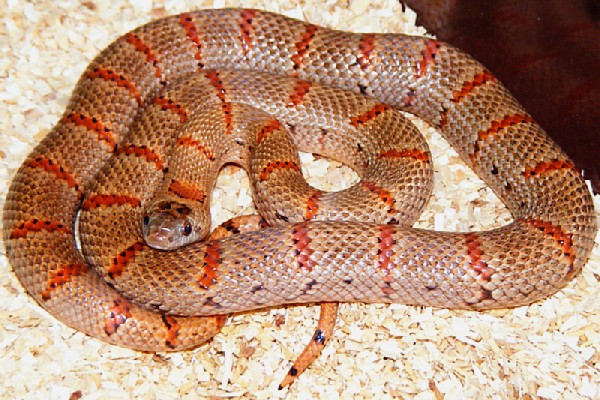
John,
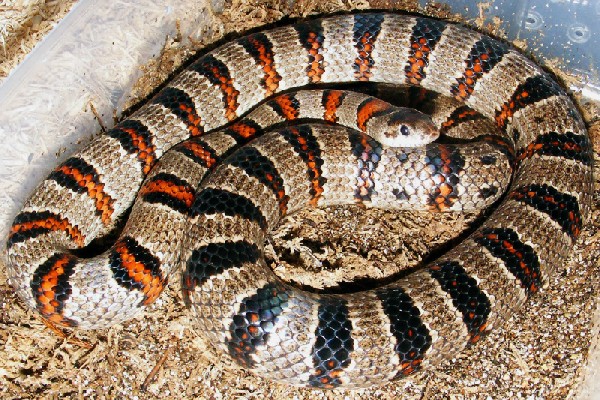
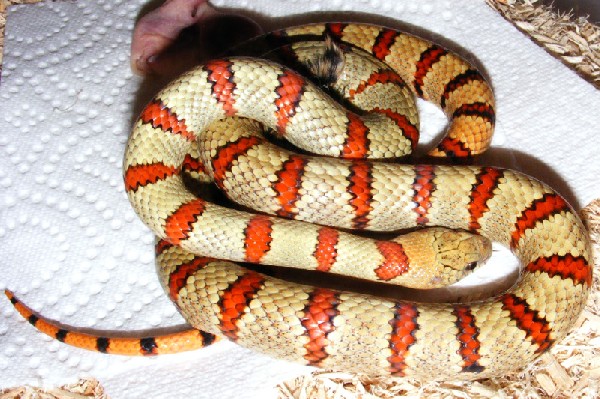
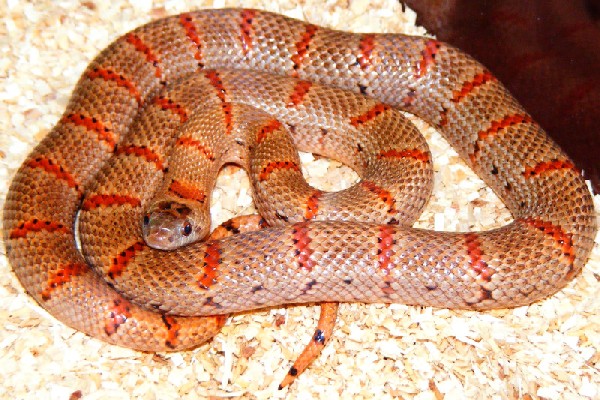
>>Great looking "Pinners" Jim....Some are quite nice IMO...
Thanks man…
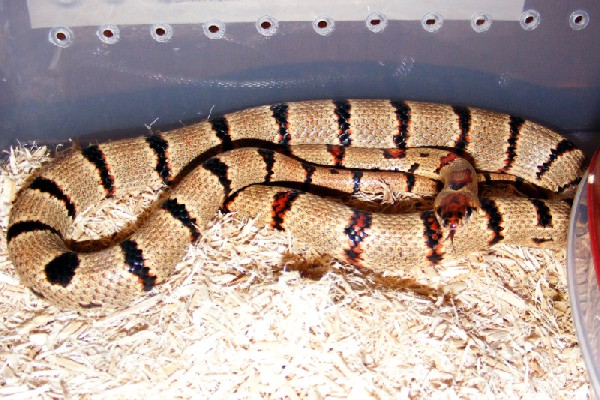
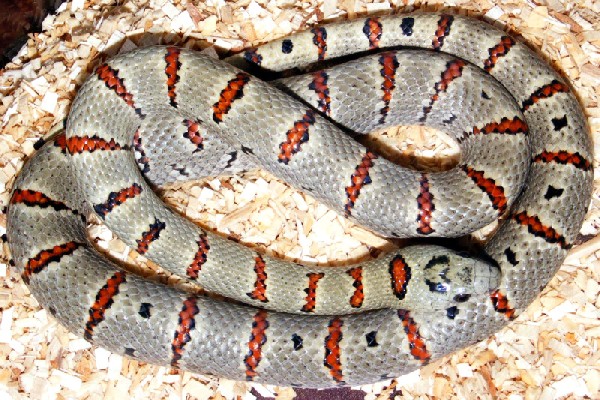
>>Others...Not Pinners in my book, but.....I don't know where my book is from...LOL…All REAL NICE thayeri though....
Again, thanks. Regarding “Not Pinners in your book”, well they are closer to being a “pin-band” than the other generally accepted band phenotypes IMO. So, I don’t know where my book is either. That’s just the best I could come with for them…They certainly are not “key-hole banded” or “broad & double saddle split banded” either…
>>After you breed a line for generations you'll never get a phenotype resembling an F1 generation...Similar yes...but too many genes taking place at once...
Correspondence with Tim Gebhard suggests the same but, on occasion, the animals throw our rule book out the window…The “broad double saddle split” phenotype virtually disappeared from captivity with out-crossing (as breeders selectively breed for color-orange, peach, etc without regard for preservation in captivity) but, it obviously remained as “relic” genetic phenotype and when paired (by accident-box of chocolate syndrome), reveals itself once again…The first photos that I saw of this phenotype was in the trio photo from the specimens collected by Hobart Smith (1944) and despite the out-crossing, is still with us in captivity…
>>We should be happy with what we are working with...F6 generations or better...(Shannon just displayed this with his Ruthies). Alleles are aligning and neonates should looking nothing like "wild Type", but when they do...They are awesome for sure...We are in the business of selective propagation not natural selection...
I’m not in the “business” of selective propagation and my work will be to limit out-crossing to work on the genetic potential of the genetic line itself with a core set of adults…With all of the “out-crossing” that has already been done, nobody really knows the genetic potential of each pair of adults because they are constantly “inter-mixed”…If you are looking for a “box of chocolates”, then out-crossing is the way to go but, if you are trying to find the genetic potential of a core set of adults, then out-crossing is not your cup-of-tea. In other words, it’s about preservation of what was and not trying to create the next “morph” with me.
An example of this is with the Brooksi…Have you really tried to find a normal, un-morphed, un-heterozygous Brooksi with provenance lately (I’m talking about Brooks Canal phenotypes and not the other locales)? What I used to remember from the early specimens from Bartlett, May, Love’s, Medac (Lemke), etc, just ain’t “out there” anymore…Everybody went “morph” crazy and what was (all of their work) has virtually disappeared from captivity…
I say this for a reason, the Brooks Canal area is now encompassed within the Everglades National Park and this makes acquiring new genetics from this locale virtually impossible…Now throw in CITES and even more specimens are (and will be) “removed” from captivity…
In short, I’m trying to “preserve” what was rather than “create” the next new…No worries man, I’m very happy with what I’m working with and with the thayeri, it’s a big “box-of-chocolates” for each of us…Could this “philosophy” be a dead end? Maybe but, there are only a few (and I mean very few) folks out-there that have maintained their original specimens over the years…There’s one in particular that with very (and I mean very) minimal influx for almost 3 decades has maintained a stable collection of specimens (and a lot us have acquired specimens from him over the years-me included)…I guess that’s part of what he means when he says he’s “out of the mainstream”…
This is nothing more than my philosophy about what I’m going to work on with my collection & my opinion…
Later,
Jim.
PS: My terminology regarding “F” generation is as follows, F1 means an out-cross and F2 means a sibling breeding for my work…I’m working on patterns (dorsal & ventral) and genetic lines rather than colors, aberrancy, etc…
-----
CSRAJim


_(Medium)-med.JPG)


-med.JPG)
-med.JPG)
-med.JPG)



-med.JPG)
-med.JPG)