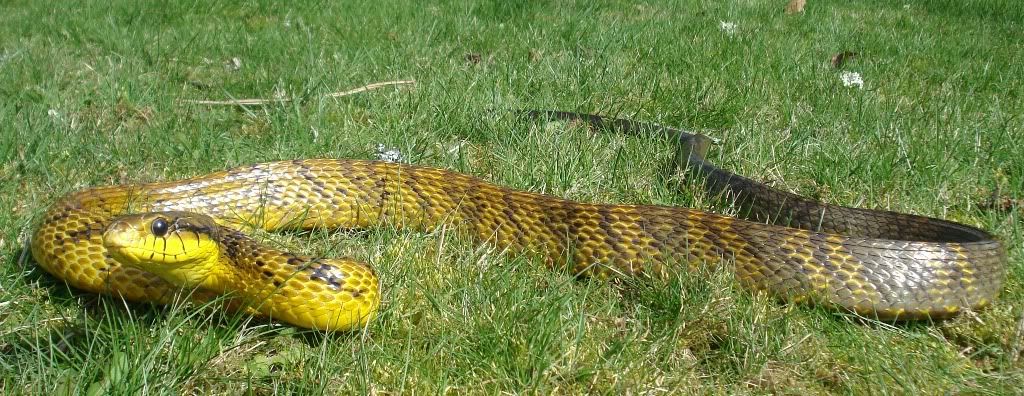
A friend of mine found this guy on Iiha Grande off the coast of Brazil. I have had no luck with an ident. It was about 5 meters long.

Reptile & Amphibian Forums
Welcome to kingsnake.com's message board system. Here you may share and discuss information with others about your favorite reptile and amphibian related topics such as care and feeding, caging requirements, permits and licenses, and more. Launched in 1997, the kingsnake.com message board system is one of the oldest and largest systems on the internet.



Snake from Brazil
Buckle
Aug 18, 2009 10:02 AM
Replies (18)
RyanT
Aug 18, 2009 10:28 AM
That's a Tiger Rat Snake. Not sure about subspecies, possibly Maculatus? Harmless and big, but couldn't have possibly been 5 meters.
DMong
Aug 18, 2009 12:15 PM
Are those giant oak trees down there??..haha!
As previously mentioned,five feet, yes,...five meters,...hardly!
Yeah, a Tiger Ratsnake, aka Tropical chicken snake(Spilotes pullatus ssp.) five subspecies are known. Twelve feet has been a recorded length.
~Doug
-----
"Better to be silent and thought a fool, than to open mouth and remove any doubt!"
Buckle
Aug 18, 2009 01:28 PM
Thanks for the replies. I am working with second hand information on the length. You may want to chalk it up to fright. =)
Trolligans
Aug 18, 2009 02:20 PM
when people get excited they have little ability to judge length or distance.
I've rescued people from an "8 foot monster" that measured to be about 50 inches. It happens all the time.
-----
1.0.0 Great Plains Ratsnake
1.0.0 Corn, Lavender Aztec het for Amel
1.0.0 Ghost Sonoran Gohper
1.0.0 Black Bassador Retriever
2.1.0 Godchildren, 1 Evil, 2 possible hets
0.1.0 Girlfriend, WC, Adventure Chick Phase
DMong
Aug 18, 2009 03:25 PM
n/p
-----
"Better to be silent and thought a fool, than to open mouth and remove any doubt!"
lep1pic1
Aug 18, 2009 07:20 PM
I got called on a ten foot snake under a trailor it turned out to be a 16 foot retic.
-----
Archie Bottoms
DMong
Aug 18, 2009 09:57 PM
Yeah, that would certainly be the exception to the rule..LOL!
Nine out of ten times as we all know, they are grossly exaggerated the opposite way.
I'll bet that was quite a surprise to stumble upon that monster after expecting something much smaller..LOL!,...WOW!!
~Doug

-----
"Better to be silent and thought a fool, than to open mouth and remove any doubt!"
anuraanman
Aug 19, 2009 09:07 AM
9 out of 10 is a very conservative estimate 
I recently went to a ladies house to move a snake out of her barn. She described it as being bright, full of colors and patterns and HUGE. She also said it was between 1 and 2 feet long but that she just couldn't believe how huge it was. I guess she's used to baby garters or something. The snake was reported as a rattler but we all know how that goes... Anyway, knowing that people always over estimate the size of snakes I went there expecting to pull out a second year milksnake or something. The first thing I found after arriving at the barn as a 50-inch Eastern Milksnake shed. I know the sheds can stretch a little bit but even after compensating for that the snake has to be bigger than any other on record in the state. An absolute beast! Never did find the snake after 4 trips. 
DMong
Aug 19, 2009 09:49 AM
About a week ago, I layed out a fresh Boa constrictor shed from a 7 foot female of mine, a measuring tape placed next to the shed "confirmed" it to be from a specimen just over 10 feet long!..LOL!
~Doug

-----
"Better to be silent and thought a fool, than to open mouth and remove any doubt!"
anuraanman
Aug 19, 2009 02:21 PM
I don't know of any official studies about shed stretching but based on ratsnake observations in the area it appears to be between 10% and 20%, usually closer to 10. I imagine it shrinks over time and is different for larger-bodied snakes. It's very hard to get good data like that in the field because you rarely find sheds in one piece and with many species that don't always have identifiable patterns (adult black rats, ring-necked, etc) how would you ever figure out which snake the shed belonged to? It would be interesting to get a bunch of people to keep track of snake vs. shed lengths X number of days after shed. Having that sort of data could be useful in field studies when only a shed is found.
DMong
Aug 19, 2009 02:54 PM
Yes, that would be interesting. As you mentioned, if a fresh shed is left to lay on it's own after being shed, it will definitely shrink a good degree. I measured the boa shed while fresh, then left it alone for a while til it dried out. Not surprising, it shrunk by many inches(forget exactly how many though). I also took a later shed, stretched it out, then put weights on both ends to keep it from shrinking back considerably. As expected, when it dried out while being weighted down, there was no difference in it's length whatsoever.
I pulled the fresh shed out only minutes after being shed, and there wasn't a single tear at all after unravelling it. Man,..that big shed was like a big rubberband, or giant accordion, it really is unbelievable how much they can actually stretch..LOL!
I always love it when someone tells me how accurately they have measured their snake by using the shed skin!..LOL!
~Doug
-----
"Better to be silent and thought a fool, than to open mouth and remove any doubt!"
Greg Longhurst
Aug 19, 2009 05:16 PM
Just for grins, allow me to make the observation that a real snake skin..hide, not shed, is also an extremely inaccurate gauge of the owner's length.
~~Greg~~
DMong
Aug 19, 2009 07:35 PM
Hi Greg!,...
Hey!,...good to hear from you again!. Yes, you are absolutely correct. I've done plenty of actual snake hides in my time(from dead animals only), and as you said, those stretch a great deal as well. Many "tall" tales of snake lengths stem from those too!..LOL!
take care, ~Doug

-----
"Better to be silent and thought a fool, than to open mouth and remove any doubt!"
tokaysrnice
Aug 20, 2009 10:31 PM
I think your all wrong, I'm pretty sure it's Pseustes sulphureus.
Nate
DMong
Aug 21, 2009 04:06 PM
You're right, the two species do look STRIKINGLY similar, even down to the gradual pattern/color change towards the tail that both can exhibit(more typical of sulphureus). But looking REAL close, the ventral scales seem to be somewhat larger, the thicker labial suturing, lack of post-ocular striping, and a little more abstract pattern as opposed to a more less "chevron" patterning typical of sulphureus leads me to think it is still a Spilotes pullatus though.
BTW, a really great observation on your part!
best regards, ~Doug
-----
"Better to be silent and thought a fool, than to open mouth and remove any doubt!"
DMong
Aug 21, 2009 04:10 PM
It also has huge dorsal scales that are indicative of Spilotes pullatus.
best regards, ~Doug
-----
"Better to be silent and thought a fool, than to open mouth and remove any doubt!"
tokaysrnice
Aug 21, 2009 05:39 PM
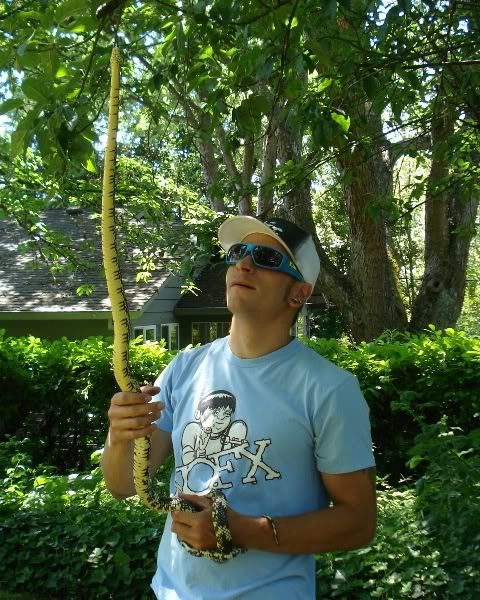
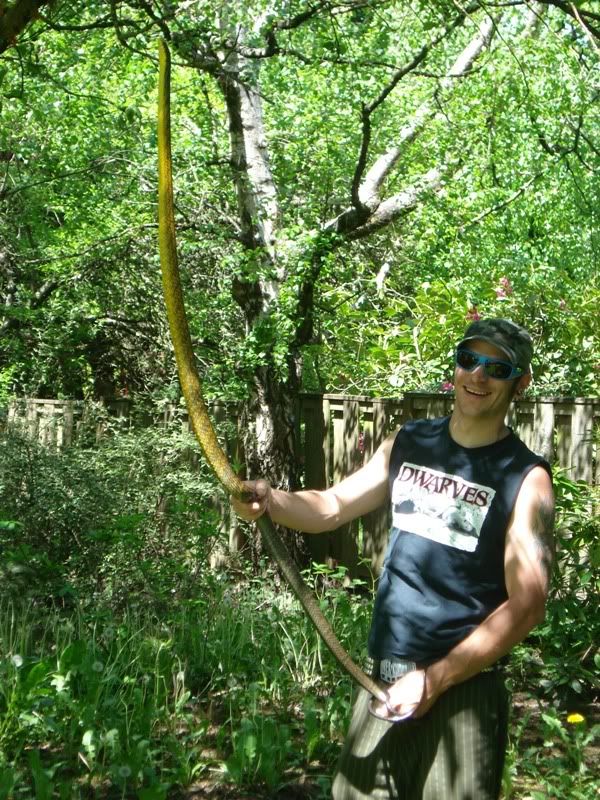
I can't see the thicker labia or the or the larger ventrals. I do notice the lack of post ocular striping but that is a variable among P sulphureus anyway. The real reason I think its sulphureus is the fact I remember Sighthunter posting a pic very similar to that snake years ago.
Another thing to think about is the fact I see a lot more pics of large wild Pseustes than Spilotes, not much to base anything on just something to think about.
In my short time keeping both Spilotes and Pseustes (several years) I don't really see a need for being a different species anyway, very very similar snakes. So similar that they are known to "hybridize" in the wild. This could be one of those.
Whatever it is, it's really awesome and I want 1 or 5.
Nate
DMong
Aug 21, 2009 05:54 PM
As you mentioned, I guess if that snake was a mix of genetic lineage, it would easily look like that too, this is certainly possible. Interesting thought!
BTW,...those are some great lookin' animals you posted pics of....REALLY nice!
Talk about swift climbers huh??..LOL!
best regards, ~Doug
-----
"Better to be silent and thought a fool, than to open mouth and remove any doubt!"
