Reptile & Amphibian Forums

Welcome to kingsnake.com's message board system. Here you may share and discuss information with others about your favorite reptile and amphibian related topics such as care and feeding, caging requirements, permits and licenses, and more. Launched in 1997, the kingsnake.com message board system is one of the oldest and largest systems on the internet.

Click here for Dragon Serpents

Lavender Texas Rats

scaledverts Aug 30, 2009 10:03 PM

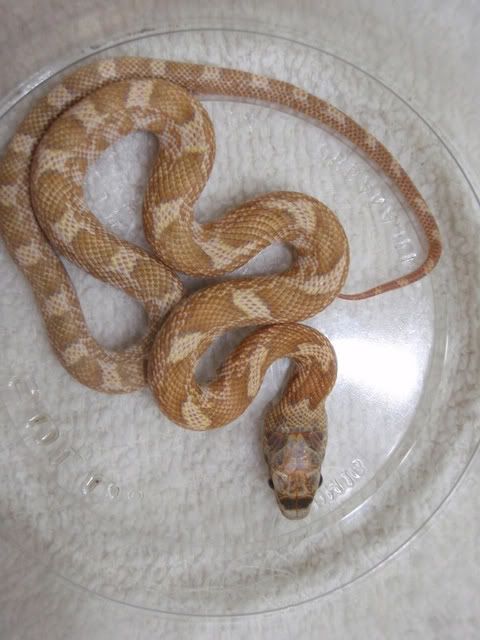
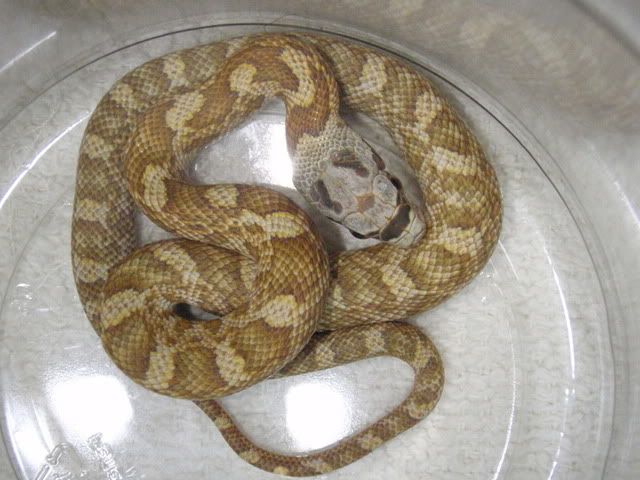
Hello - I picked up a pair of lavender texas rats They were labeled as albino but they appear to be lavender to me. Does anyone know the genetics of the lavender morph? It looks like it could be a t positive albino morph.

Here is the male. He has a very nice light coloration.

Here is the female.

They will make a nice addition to my leucistic and het leucistic texas rats.

Thanks,
-----
Kyle

Common sense is genius dressed in its working clothes. - Ralph Waldo Emerson

8.9.2 Milks and Kings
2.2 Hognose
3.3 Kenyan Sand Boas
0.1.14 Texas Rat Snake
1.1 Macklots Pythons
1.1 Geckos

Replies (5)

byron.d Aug 30, 2009 10:38 PM

They are T Positive or 'Lavender' albino. Some breeders just call them albinos...

They will both lighten up quite a bit as they reach adulthood.
My female still has some great color on her but my male looks like a T Negative amel with dark eyes.

Glad you found some!

byron.d

DMong Aug 30, 2009 10:45 PM

Well,..they certainly look to be a "form" of albinism. From what I can see, the eyes are deep ruby-red as well, and an overall very light apperance, and certainly not T-neg.. I guess they could also be catagorized as a "lavender" albino too, which is usually something reserved for what most suspect as being tyrosinase positive. But who really knows,....without a laboratory "dopa" test, who really knows any of this for absolute certain, that has always been the "assumption" anyway.

I'm really not sure how those originated to tell you the truth. It looks like a very good phenotypic representation of lindheimeri, but from many years of experience, one can never exclude the possibility of there not being other obsoleta complex involved in the lineage to any varying degree. After all, they are virtually identical meristically to several others in the obsoleta complex, and other underlying pigmentation in their color scheme can be surprisingly variable too.

But to be quite honest, in my opinion those are pretty darn interesting to me whatever the case may be there. I think you did real well scoring those guys!

best regards, ~Doug
-----
"Better to be silent and thought a fool, than to open mouth and remove any doubt!"


RichH Aug 31, 2009 09:27 AM

..

scaledverts Aug 31, 2009 11:21 AM

My understanding of it is that you are correct that they are t positive albino. Their eyes are definitely dark, I have not looked closely enough to see if they are ruby red or not. I will take a look at them and see. I know that they are not the typical t negative albino eyes that you typically see. I have never seen these for sale at an expo (this table had about 5 or so). You do see the albino leucistics (with red eyes). I would assume that these are leucisitc t negative albinos but who knows right?

Has anyone bred the lavenders out? If it is t positive, I am curious if it acts in a manner that is similar to the t positive albino gene found in nelson's milks. It appears that the gene in this species is co-dom.

ahh fun with genetics.

-----
Kyle

Common sense is genius dressed in its working clothes. - Ralph Waldo Emerson

8.9.2 Milks and Kings
2.2 Hognose
3.3 Kenyan Sand Boas
0.1.14 Texas Rat Snake
1.1 Macklots Pythons
1.1 Geckos

DMong Aug 31, 2009 02:01 PM

Yeah,..I am going to ride along with the t-positve "lavender" deal with these as well. And yes, the "pink-eyed" albino leucistics are definitely a t-negative form, likely coming from their closely related kin the amel Black Rat.

Now, I will bet a dollar to a dime this is nothing even CLOSE to the t-positive albino nelsoni that my boy Shannon Brown is sporting. This is a form that is absolutely unheard of in colubrid circles. It isn't the same "co-dom" genetics we know about in the python and boa hobby either, as that would imply "super" forms being produced when bred together. I, nor anyone else as of yet really knows what to make of this thing yet. In time more will be known though, and Shannon is busy finding out more and more with all the crazy stuff that he is popping out as we speak. That really is one unique deal he has there!

I would compare yours more with what we see in Cal. King genetics, although the colors are certainly different because of the remaining variable underlying color scheme(s) involved.

Those are really cool animals you aquired there!

~Doug
-----
"Better to be silent and thought a fool, than to open mouth and remove any doubt!"

Site Tools