


Reptile & Amphibian Forums

Welcome to kingsnake.com's message board system. Here you may share and discuss information with others about your favorite reptile and amphibian related topics such as care and feeding, caging requirements, permits and licenses, and more. Launched in 1997, the kingsnake.com message board system is one of the oldest and largest systems on the internet.

Click for 65% off Shipping with Reptiles 2 You
Click for ZooMed
Click here for Dragon Serpents

Define Hypomelanism....

Jlassiter Sep 06, 2009 05:56 PM

What DEFINES Hypomelanism??????
First of all I know what is accepted in the hobby for each of the following species or subspecies I mention below...

Is it different for each species or subspecies???

I believe Hypomelanism is a reduction in black pigment....Not a reduction in black pattern...

Bob Applegate's "Special" Pyros have reduced black pattern. The black it does have on its head is pure black thus not hypo, correct?

Then there's hypomelanistic cornsnakes that have no area of black pigment....The area where the black is suppposed to be is not replaced by on off black color rather absent and the red saddles are touching the ground color.....Anyway, is this hypomelanistic?

Hypomelanistic Splendida have a brownish coloration instead of black....But so do some calkings.....Are they hypo?

Then there's brooksi....I don't see the bluish/grayish/brown area replacing the black area of pattern as with the hypomelanistic milksnakes in the hobby.......I see a reduction in black pattern not pigment...I could be wrong though.....

Here are some thayeri that I have either produced or purchased with reduced black pattern.....Are/were they hypomelanistic?


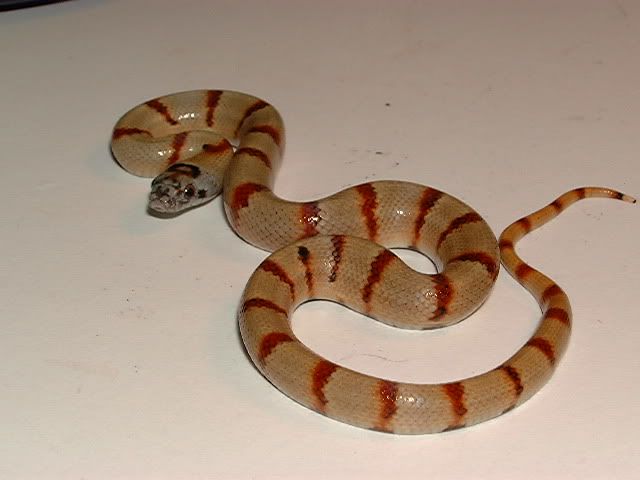
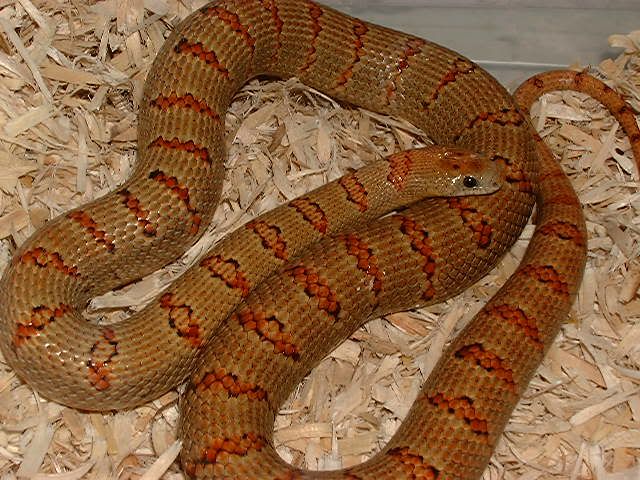
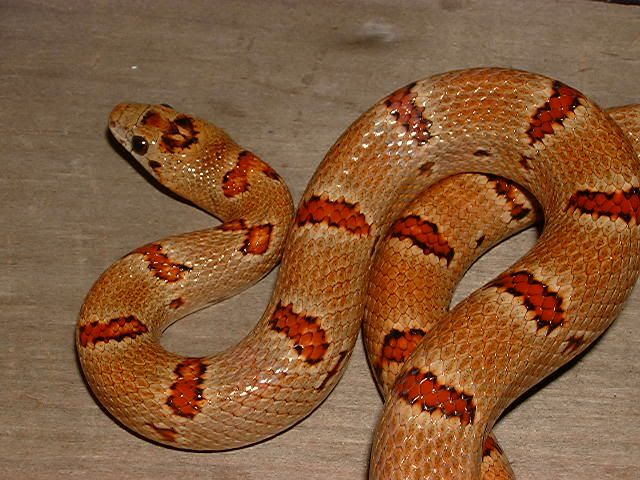
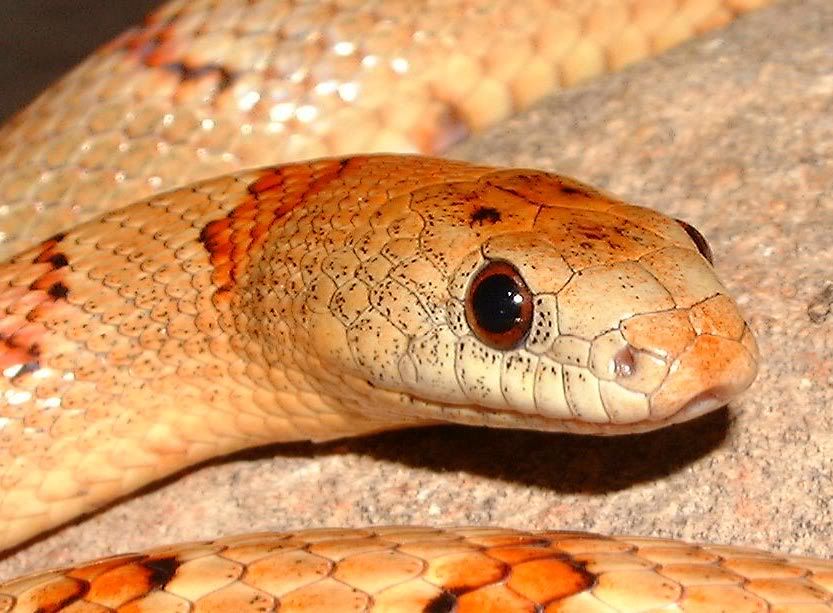

-----
John Lassiter

"Poor planning and procrastination on your part does not constitute an emergency on my part....."

Replies (28)

peter54 Sep 06, 2009 06:32 PM

I concur. "hypo" can be referred to as "weak" or "pale" coloration.

Nokturnel Tom Sep 06, 2009 06:46 PM

Well John, there's an easy way to find out.
Hypo is always [I think anyway] a simple recessive gene. So in my opinion nothing should be labeled Hypo until you breed it, make hets, and prove it out.
If the expected percentage of your clutch shows the reduced Black, well then I think you have a good argument. However... calling any Thayeri Hypo will probably lead you into seriously annoying territory without that proof.
Thayeri just may be the toughest snakes to pin the Hypo trait down on...
I think if it were me.......I'd take one of those beauties and breed it to a melanin soaked dirty mate and start there. It's a long term project [4-6 years is long for me] but if it pans out.. well you win.
They're killer any which way...nice group
Tom Stevens
-----
TomsSnakes.com
twitter.com/TomsSnakes

Jlassiter Sep 06, 2009 06:55 PM

Tom,
The problem is this...I don't think these thayeri are hypo....

I think they are similar to Applegate's Special Pyros though...and when they are bred together all the offspring have reduced black.....A line bred trait...
Are the Applegate Specials a line bred trait?....I think so....I always see varying degrees of black in offered offspring....

I call these thayeri reduced black because they have reduced pattern not reduced pigment.....
But I look at other species and subspecies and don't know why they are called hypo....
And....I don't think anything is recessive with thayeri....LOL
Too much polymorphism and codominance at work with the recessive genes......makes for fun clutches though.....
-----
John Lassiter

"Poor planning and procrastination on your part does not constitute an emergency on my part....."

Bluerosy Sep 06, 2009 07:34 PM

This is from Randy Wrights collection.


-----
www.Bluerosy.com

Jlassiter Sep 06, 2009 07:56 PM

>>This is from Randy Wrights collection.

Nice and clean, but has not gone through any ontogenesis (speckling) yet....
Also...BOLD black borders...No reduced black pigment nor pattern.

What are you getting at here Rainer?
-----
John Lassiter

"Poor planning and procrastination on your part does not constitute an emergency on my part....."

Bluerosy Sep 06, 2009 11:59 PM

Nice and clean, but has not gone through any ontogenesis (speckling) yet....
Also...BOLD black borders...No reduced black pigment nor pattern.

What are you getting at here Rainer?

I am not sure what I am getting at. Maybe we look at the wrong things to determine what is a hypo. And there are some things we cannot see, at least from far away or a quick glance.
If you look at some dark female Peanut Butters you cannot tell if it is a normal or Peanut Butter when they are neonates. Unless you get up close with a magnifying glass and compare the black pigments of a normal to a PB and know what to look for. And that is the balck pigment in tricolors. But a yellow snake like a Florida king is not as contrasting and a tricolor. I saw the extreme reduction in black bands with hondurans from the beginning. The lighter black specimens were later coined "extreme hypos" and commanded a higher price.

I think Zenny was the first one to look at the Florida kings upclose with a magnifying glass , or as we joked with a microscope. He studied the eyes and iris and made notes of each scale, patterns, head plates ect until it made some sense to him. He was not always correct with his terminolgy but he certainly was persistent with gentic reccessive traits..

Oh the snake pictured above is a pyro. Yet Dr. Bechtel has a tricolor pictured in his book as an axanthic. Shouldn;t a n=mostly red snakes like a truicolor be considered a Anerythric=stic (meaning a mostly red snake lacking red opatterm) and Axanthic meaning a mostly yellow snake lacking yellow pattern.

http://www.fototime.com/{478AFE12-CC21-443E-8151-DDEF6B553D2A}/standardpict/exp=f&modt=39912.7995020602&ssdyn=1/IMG_0046.jpg

http://www.fototime.com/{DC33B710-ED5D-4919-8062-1811257CF4D5}/standardpict/exp=f&modt=39912.7995615509&ssdyn=1/IMG_0047.jpg

Qnd then some reccessive traits just effectb pattern. Actually a lot of visual reduction in a reccessive also effects pattersn with abberancies not not seen in het carries. Why is that>

John---Great topic by the way! That is what i love about this forum! We may all not agree and egos get hurt. But it is all abot the snakes we love. You should change your name to Adam or whoever named the animals. That is if yu beleive mans first job was naming te animls. it is in our blood. Jst like hunting is.

Isn'y herpetoculture a gret hobby for both Feild observers and opeiople with breeding progrm to inmprove to ths orld this sa gret hobby and God oput those special trits i them h=jut fo u to uj ;
-----
www.Bluerosy.com

Jlassiter Sep 07, 2009 12:18 AM

>>Oh the snake pictured above is a pyro. Yet Dr. Bechtel has a tricolor pictured in his book as an axanthic. Shouldn;t a n=mostly red snakes like a truicolor be considered a Anerythric=stic (meaning a mostly red snake lacking red opatterm) and Axanthic meaning a mostly yellow snake lacking yellow pattern.

I agree a mostly red snake lacking that pigment should be anery and not axanthic....xanthin is yellow/orange pigment....erythrin is red pigment.

>>John---Great topic by the way! That is what i love about this forum! We may all not agree and egos get hurt. But it is all abot the snakes we love. You should change your name to Adam or whoever named the animals. That is if yu beleive mans first job was naming te animls. it is in our blood. Jst like hunting is.

Interesting Idea that I would have to agree with.....
There is certainly room in our hobby for opinions....

Thanks for the reply Rainer....
-----
John Lassiter

"Poor planning and procrastination on your part does not constitute an emergency on my part....."

Bluerosy Sep 07, 2009 01:14 AM

There is certainly room in our hobby for opinions

Now if we could get everyone to the cornsake gentics. We'd all be fine.

1)I would like to adhere to Cornsnake gentics> are the closets to the truth.,,Why (see below)

2) they make the most sense with the exception of just a couple animals.

3)They were the first ones around. Kinda pioneered gentics in cornskaes and all snakes in general.

4)Theoretically the hobbiest could have just made up different names out of ignorance.
-----
www.Bluerosy.com

Bluerosy Sep 06, 2009 06:51 PM

Who's definition?

hypo-melanism is a broad term when properly defined. But I like to think herpetoculturists use the term for a lighter reeccessive trait. Heck even that gets shady when you could say a lavender albono is a hypo.

Herpetoculturists differ in interests. For example, a Field collectors (or observers-whatever )standpoint may like to tag different looking specimena as a new "morph".

We have different people interested in different things when it comes to reptiles. Field collectors/observers who like to target certain spp find a light individual they call it a hypo. They have no interest in proving it out and just call any light animal a hypo.

My definition of hypomelanism is a reduction of dark pigment that is a reccessive trait. Not a simple trait. I may find a light colored water snake but I would not call it a hypomelanistic unless it proved to be a reccessive trait. But tht is just me.

A field guy else might find a light colored calif king and is a hypo. Who is correct?...We are all correct. After all it is just a name man made up.

How about lets ask the question , what is a morph?
-----
www.Bluerosy.com

Jlassiter Sep 06, 2009 06:57 PM

>>How about lets ask the question , what is a morph?

My answer to that question is this.....Everything we produce in our snake rooms are morphs....Selective propagation and not natural selection.....
-----
John Lassiter

"Poor planning and procrastination on your part does not constitute an emergency on my part....."

RossCA Sep 07, 2009 02:34 PM

Herpetoculturists differ in interests. For example, a Field collectors (or observers-whatever )standpoint may like to tag different looking specimena as a new "morph".

>>
>>We have different people interested in different things when it comes to reptiles. Field collectors/observers who like to target certain spp find a light individual they call it a hypo. They have no interest in proving it out and just call any light animal a hypo.

Not all of us fieldherpers fall into that catigory. I found a very light Cal king in the desert that most likely is a hypo, but I make it clear to everyone I'm not going to be convinsed 100% until I prove it out. I plan on breeding it next year. The thing is I've hunted that area for years and have seen lots of kings there. I've even seen many kings posted from that area and none were even close to the shade of brown my king is. For that reason alone, I feel its safe to label it a hypo. If this was in certain parts of S.D. Co. I wouldn't dare label it a hypo. There is a lot of variation down there in shades of brown. I think people need to be very familiar with an area before labeling something a hypo. If there is a broad range of variation in a given area, it won't take years to find out.

-----

Beaker30 Sep 06, 2009 07:02 PM

Hypomelanism is a reduction in the deposition of the pigment melanin which for all intents and purposes is black. The prefix hypo means "under". So on a true hypomelanistic animal what should be black pigment will appear in a lighter color such as gray or brown. In other words, on places where the animal should be black, like the saddle borders on thayeri, it will be grey or brown.

Reduced black is what you are showing on your animals. The black pigment is still ,there is just very little of the black pigment being deposited. In other words, the black is still black, there's just less of it.
-----
God Bless Evolution.

Jlassiter Sep 06, 2009 07:03 PM

>>Reduced black is what you are showing on your animals. The black pigment is still ,there is just very little of the black pigment being deposited. In other words, the black is still black, there's just less of it.

Exactly what I said...Reduced pattern of black not reduced black pigment.....
-----
John Lassiter

"Poor planning and procrastination on your part does not constitute an emergency on my part....."

Beaker30 Sep 06, 2009 07:09 PM

Reduced black pigment is a confusing way to say it. Its a reduced deposition of black pigment in areas that should be black so they appear gray. Reduced black is a normal amount of pigment deposited, just across a smaller area.
-----
God Bless Evolution.

Jlassiter Sep 06, 2009 07:13 PM

>>Reduced black pigment is a confusing way to say it. Its a reduced deposition of black pigment in areas that should be black so they appear gray. Reduced black is a normal amount of pigment deposited, just across a smaller area.

Well....I think gray is reduced black pigment....And I still agree with you Craig....And a smaller area is reduced pattern....
-----
John Lassiter

"Poor planning and procrastination on your part does not constitute an emergency on my part....."

Jlassiter Sep 06, 2009 07:18 PM

Its a reduced deposition of black pigment in areas that should be black so they appear gray. Reduced black is a normal amount of pigment deposited, just across a smaller area.

LOL....I think that is a more confusing way to say it.....LOL
-----
John Lassiter

"Poor planning and procrastination on your part does not constitute an emergency on my part....."

FR Sep 07, 2009 10:32 AM

If you take a melinistic thayeri and a normal and one you posted above with little to no black, TO any non reptile biologist. He would label them melinistic, normal, and hypomelinistic.

As a melinistic thayeri does not have darker then normal black, it just has more of it. Yet, its melinistic or hypermelinistic, compared to normal.

Of course when it comes to captive races, the term is used to better serve the breeder and there is nothing wrong with that.

The word hypo means, under or less then. Which can be applied in many ways and it is. Cheers

Jlassiter Sep 07, 2009 12:14 PM

>> As a melinistic thayeri does not have darker then normal black, it just has more of it. Yet, its melinistic or hypermelinistic, compared to normal.

Agreed Frank....
I certainly never thought of it that way....

But in a hypermelanistic thayeri you can see a 'pattern' when they hatch.....The 'normally black' area of the pattern is even seen....All other pigments are infused with black...
The normal black patterned area is not larger just all other pigments are taken over.......LOL

Thayeri are certainly a subspecies of snakes that do not fit the cookie cutter of genetics....
Thanks for your reply Frank....
-----
John Lassiter

"Poor planning and procrastination on your part does not constitute an emergency on my part....."

FR Sep 07, 2009 01:36 PM

There are natural occuring melinistic, gophers(pits), rattlesnakes, coachwhips, hognose, garders, getula kings, there must be more.

Also there are polymorphic snakes of many species. Even our local coachwhips cannot figure what what color or pattern to have. And don't get started on kings. Or ground snakes, or or or, there are lots of polymorphic snakes.

I did not a striped thayeri shed in nature, good dang thing I did not find that snake or we would really be screwed up. Cheers

Jlassiter Sep 07, 2009 01:59 PM

>>There are natural occuring melinistic, gophers(pits), rattlesnakes, coachwhips, hognose, garders, getula kings, there must be more.
>>
>> Also there are polymorphic snakes of many species. Even our local coachwhips cannot figure what what color or pattern to have. And don't get started on kings. Or ground snakes, or or or, there are lots of polymorphic snakes.
>>
>> I did not a striped thayeri shed in nature, good dang thing I did not find that snake or we would really be screwed up. Cheers

Cool Frank.....great info......glad you chimed in...
-----
John Lassiter

"Poor planning and procrastination on your part does not constitute an emergency on my part....."

Jlassiter Sep 06, 2009 07:31 PM

Also...
Those last three pics are thayeri produced by me in 2002.....
Even 7 years ago I did not call them hypo...
And I still don't....
-----
John Lassiter

"Poor planning and procrastination on your part does not constitute an emergency on my part....."

Jlassiter Sep 06, 2009 07:32 PM

What about a hypo corn or a hypo boa?......
They have reduced black pattern rather than pigment....No grays or browns.....
-----
John Lassiter

"Poor planning and procrastination on your part does not constitute an emergency on my part....."

Upscale Sep 06, 2009 08:54 PM

Any snake can display a lighter than normal appearance, and is in every respect hypomelanistic compared to the darker norm. But it could really be just a “light” one. “Light” is not subject to Punnett Square rules of inheritance. The true hypomelanistic trait is a genetic defect (or desireable trait depending on the looker) that prevents normal expression or a reduction of melanin (I think there are two basic types and a lot of degrees of both). The effect is restricted to melanin, otherwize you are talking about another or additional trait. This simple recessive trait is predictably passed on in the rules of Mendelian inheritance.

Jlassiter Sep 06, 2009 09:10 PM

>>
>>
>>Any snake can display a lighter than normal appearance, and is in every respect hypomelanistic compared to the darker norm. But it could really be just a “light” one. “Light” is not subject to Punnett Square rules of inheritance. The true hypomelanistic trait is a genetic defect (or desireable trait depending on the looker) that prevents normal expression or a reduction of melanin (I think there are two basic types and a lot of degrees of both). The effect is restricted to melanin, otherwize you are talking about another or additional trait. This simple recessive trait is predictably passed on in the rules of Mendelian inheritance.
>>

That is a great explanation of the "known" hypomelanistics in our hobby....
Thanks for your reply.
-----
John Lassiter

"Poor planning and procrastination on your part does not constitute an emergency on my part....."

Upscale Sep 06, 2009 09:37 PM

By the way, the two types of albino, to me, are just the extremes of both hypomelanistic traits. The T positive is the extreme complete inability to express melanin in those hypos that have that defect, where the T negative is the extreme complete reduction to the point of no melanin. Both are just extreme hypomelanistics of two types. I think there are alleles for every degree of it, so the inheritance and variability of every morph can be logically accounted for, and selectively bred for. To me, that makes it all make a lot more sense. They are all some sort of hypo variant.

Bluerosy Sep 06, 2009 11:20 PM

By the way, the two types of albino, to me, are just the extremes of both hypomelanistic traits. The T positive is the extreme complete inability to express melanin in those hypos that have that defect, where the T negative is the extreme complete reduction to the point of no melanin. Both are just extreme hypomelanistics of two types. I think there are alleles for every degree of it, so the inheritance and variability of every morph can be logically accounted for, and selectively bred for. To me, that makes it all make a lot more sense. They are all some sort of hypo variant.

And the peanut butter (hypo type II) and a T-negative is just a varience of hypo in Florida kings..(?)

Peanut Butter x T neg = Jelly

-----
www.Bluerosy.com

Upscale Sep 07, 2009 08:13 AM

I believe the specific hypo types are a lot more than just two, so I don’t agree exactly that peanut butter is type II. I think maybe it’s type three, four, five, or whatever. Maybe Type I or II and then add an a,b,c,d, etc. So if peanut butter is actually hypo Type IIe, for example, and bred to a Type IIg (T neg) the e and g share the locust that results in a visual Jelly (Type IIf or whatever you’d call it) The Jelly sorta proves there is an f between morph e and g. That’s how my mind works, not necessarily how the genes work!

ChristopherD Sep 07, 2009 12:56 PM

In the human traits there are red heads,which appears hypomelanistic and hyper red,so maybe some research on this phenomina will answer questions,Just a thought,interesting though

Site Tools