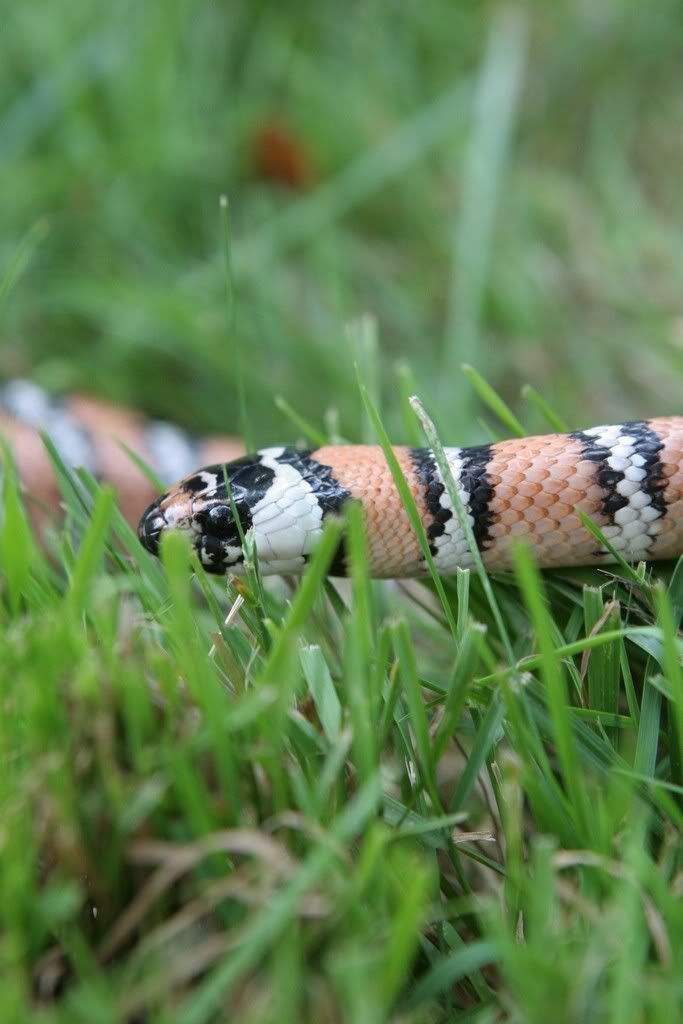
LOL, hey Mark. All-too-often lineage gets lost when it comes to captive breeding, and for numerous reasons. And then to trace back is always so difficult. Here is what i factually know. I learned of a small group of hypo-e agalma last year (which were never bred) that perished (also last year) with the exception of a single female. These animals suddenly died from what I was told, with no outward symptoms or no clear rationale. There is another single specimen that Terry Dunham had received years ago but was placed on loan with a fella whose name I don't recall at the moment. I inquired with Terry a couple years ago about that specimen, and heard little in return. I'm not even sure if that snake is still alive. Otherwise, I know of no other hypo-e agalma out there with the exception of mine and a pair I released this year to our friend joecop.
I wish I knew more about where, when, and who owned this specimen you speak of from years back. Mine originated from a pairing circa 1995 between a wild-caught anerythristic Martir agalma and a female Juarez agalma (due to the inavailability of female Martir specimens). These few heterozygous anerythristic babies were then dispersed...... very few remained, most perishing in various ways over the years (one female I know of actually had a pair of these specimens years ago and were predecessors from my line of agalma. She left them in her car, with other rare snakes, to grab a bite to eat somewhere in California. Upon returning to her car, all she found was an empty parking spot and an oil stain. Her car was found in Mexico weeks later and, of course, with no snakes inside).
The extremely few remaining specimens were bred to Juarez lines and, from what I understand, none of the original hetero babies were ever bred together as they belonged to different folks. A few of these remaining specimens turned a pinkish hue in short time, and in the next couple generations several more were produced after being introduced to new Juarez lines, but again, this was happening on a VERY small scale. Could these all be from the same origins stemming from the mid-90's? It's very likely, but I can't say for sure. Can this line produce an anerythristic agalma some day? It's likely but not guaranteed, however it's somewhere within their genetic make-up. So who knows -- over the next few generations the hypo-e factor could gradually deplete the production of erythrocytes rendering an anerythristic looking specimen as well. Either way, I could care less to be really honest. I like the look of hypo-erythrism, particularly how it enhances the white bands right off the bat. It's something certainly different. If a lavender snake pops out one day, well.........we'll cross that bridge if and when we get there.
Do share more of your story too Mark....thanks much......
-----
Jerry Kruse
And God said, "Let there be zonata subspecies for all to ponder..."