When is the best time to start brumation? How long should i brumate last years hatchligs? All are feeding well but one. Should i do anything special to brumate this one picky eater?
Thanks,
Mike
Welcome to kingsnake.com's message board system. Here you may share and discuss information with others about your favorite reptile and amphibian related topics such as care and feeding, caging requirements, permits and licenses, and more. Launched in 1997, the kingsnake.com message board system is one of the oldest and largest systems on the internet.


When is the best time to start brumation? How long should i brumate last years hatchligs? All are feeding well but one. Should i do anything special to brumate this one picky eater?
Thanks,
Mike
What king of milks, from warm Mexico or cold North America?
I'll tell you what I did, and it was awesome. For milks from Mexico (Sinaloans), I put them in a big plywood box, and I put a heat pad inside at one end, and let the other end get real cold. Then I put a whole group of Sinaloans in there. Then I checked them to see what they did. It was fascinating. And no, not all of them stayed on the cold side all the time. Some even fed. All bred just fine. I think they copulated in there before Spring.
I think a wide temp range in Winter is better, a large cage mostly cool but a small basking area on one side. Then see what they do. Your picky eater might benefit from it.
Anything else is guesswork on your part. You and I cannot tell what the snakes want at a glance. Give them the choice and see what they do. Some might choose the cold all season (older snakes often do this), some might stick to the warmth for a longer period (babies, reproductive females). Not all do the exact same thing.
BTW, temperature may play some role in reproduction, but brumation as is done in captive collections is not all that necessary. Male sperm can't be too warm or too cold for optimum motility, but it doesn't need "55 deg for 8 weeks" necessarily. Male snakes know better than you how to control that as long as you give them the choice of temps. And reproductive females simply do not need 8 weeks of cold. Give them the choice of some warmth in an otherwise cool cage. This works better when the cage is big, even if it is just a Winter cage.
If you really want sucessfull reproduction, keep males and females together as described all Winter. That works better than the "place male in females cage for 10.5 seconds, etc etc at 80.5 degrees, etc etc).
Ever wonder why reptiles kept outdoors breed so darn well compared to indoors?
Now, for milks from parts of the country where it is darn cold (Eastern milks for example), I know nothing.
-----
Mark
That is some interesting ideas there. Mine are easterns. The theory of it should be the same though correct?
Mike
I'm sorry, you did say Ltt. Yeah, they aren't like Sinaloans in temperature preferences. I don't know if my posted method would work or not, but for those Northern latitude snakes, I would shy against it. So cool them per the others' advice.
-----
Mark
>>Ever wonder why reptiles kept outdoors breed so darn well compared to indoors?
How do we know how captive reproduction rates compare to those in the wild? Are there any studies? I'm not saying your method's not a great idea, i'm just trying to keep the conversation fact-based.
Intuition (agreed, not fact-based) tells me a WHOLE bunch of other plant and animal management programs exceed the results that would be achieved if the plants/animals were left untended, as it were.
Tell me more.
So I didnt come from the stork??
>>So I didnt come from the stork??
Finally i've made sense to SOMEONE!  Thanks Jeff.
terry
I know what you mean. I understand that managed care (i.e. sweaterbox at 55 deg for 8 weeks) yields the most captive offspring for the dollar at this time.
It also treats every snake the exact same, meaning the same narrow choice margin for males, females, young, old, reproductively active, reproductively inactive, etc. Does this matter? I think it does but really, I simply do not know. Point taken. I spouted info as fact. It isn't proven fact.
-----
Mark
Mike,
When is the best time to start brumation? How long should i brumate last years hatchlings? All are feeding well but one. Should i do anything special to brumate this one picky eater?
Glad most of those critters are doing well for you. If you have no opposition to feeding the neonates all winter, I'd keep any that are still feeding up and active. The non-feeder should be brumated just like the adults.
Brumating of adults generally follows a standard protocol. Allow their "guts" to empty for ~2 weeks following the last feeding by keeping them on heat as you would with regular maintenance. Then, remove them from heat for an additional week, allowing them to sit at room temperature, with no access to a basking area. Next, begin the actually cooling period. I shoot for 2-4 months at 45-55 degrees F. Check on the animals weekly to assess their health and assure that they have access to clean water.
I’m not trying to step on markg’s toes here, but North American triangulum are NOT the same as the tropical forms (sinaloae, nelsoni, hondurensis, polyzona, etc.). They need to experience a full cool-down to successfully “re-set” their biological clocks. If not kept cool enough, they quickly lose condition by burning their energy reserves. Offering your nominate triangulum a basking area during cooling is not only unnatural (=unknown side effects), but also complicates the cooling process for you.
-Cole
Thanks Cole,
So i should really ony brumate the picky one?
Mike
>>Thanks Cole,
>> So i should really ony brumate the picky one?
>>Mike
Hi Mike, a couple points as you seek answers here.
1) There are always multiple ways to make things work. I've bred animals where i used one method and a friend used mostly the most-opposite methods, and we both succeeded to our considerable satisfaction. You'll get different answers here to your questions, and those answers may all be good ones. There's no single right answer to most questions.
2) Because one person seldom has the only correct answer (see #1 above!), weigh the ideas you're given here against what makes sense to you. "Common sense" is based on knowledge and insight, so your snake-common sense will change as you read more and try more and observe more. Be willing, as you have been with your questions here, to say "I don't know" or "I'm not sure" and you'll do well. Don't believe all of what anyone--myself included--tells you.
3) On your specific question: A lot of people have found that reluctant feeders come out of brumation feeding well the next spring. So cooling a non-feeder or poor feeder makes sense (the poor feeder may lose more weight if you keep it warm over the winter, and it feeds only occasionally, than it would if you cool it--AND you get the benefit (usually) of an improved appetite the following year. As for those that are feeding, remember brumation's role in stimulating breeding condition (with the pros and cons being noted on this forum) does not apply to hatchlings. So if you've got a youngster that feeds through the winter, you get 3-6 months of growth you'd not have gotten if you cooled it, but you've not done anything to harm its eventual cycling for breeding in subsequent years, at least not so far as I have noted, nor have i seen anyone report that. So it seems it makes sense to continue feeding those that are, and cool those that aren't. Your common-sense evaluation may differ, and that's fine.
4) I'd like to hear more from the people proposing here that brumation's not necessary and that many of these colubrids breed in late fall or during the winter. I know some (all? I'm barely a novice) rattlers do, but i haven't seen anything in the literature sugggesting most colubrids do. I HAVE heard from fellow breeders who brumated their pyros together and reported seeing breeding activity in late winter/very early spring before the snakes had been warmed. This might or might not be unique to pyros. It might or might not be evidence that as others have noted here, temperature is not the sole measure of brumation. (see #5)
5) I know that with some hookbill birds studies have shown that changes in reproductive organs occur only when the animals can get deep into the (dark) nest boxes aviculturists use, and which mimic nesting sites in the wild. So LIGHT is an important component of brumation. Where would colubrids in NA be during brumation? Underground. Where it's DARK. Most herpetoculturists I know darken the rooms where brumation's occurring, in addition to lowering the temperatures. If you can't lower the temps, throw a black cloth over the cage(s) where you're attempting to brumate.
6) I also know animals seem to have some internal clock that regulates them apart from the manipulation/management we apply. Males stop or reduce feeding during the early breeding season. Both genders can stop/reduce feeding as winter approaches, even in a room with no windows with lights on automatic timers and sustained temperatures.
7) But those conditions can be manipulated too. I bred birds for 20 years and have noted a lot of what i learned about them applies also to snakes. One observation is that different species react differently (pyros vs hondurans and feeding into the winter, for example). I bred Australian Gouldian Finches which in their southern hemisphere homes would breed during our winter rather than summer. But Australia had banned their export for years before I began breeding them, so I was working with specimens acclimated over multiple generations to breed during our warm northern hemisphere summers. Still, kept warm and with artificial light maintained at long-day periodicity, i could breed that species year-round. That may in part be because in the wild Goulds are opportunistic breeders, breeding when (usually spring in the southern hemisphere, which would be our fall) rains trigger the growth of grasses whose seed heads are the primary food for hatchlings (Goulds are one of a number of species referred to, in fact, as "grassfinches" . In years of drought, if there aren't rains, the goulds may skip breeding entirely for the year. On other occasions, with late-season rains, "baby" goulds as young as 3 months, before they've even gone into their adult plumage, will reproduce. So this is perhaps a more malleable species. While the ability to manipulate their breeding cycles doesn't apply directly to snakes, it does suggest the need to consider different kinds of snakes' behavior differently as well. To go back to an earlier example, pyros are observed in early spring in the wild moving around while there's still snow or ice on the ground, and i think garters behave similarly when they gather for mass copulation in northern states and Canada. I haven't seen evidence of that behavior being typical of colubrids.
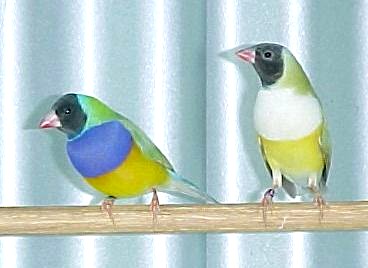
Just for fun, pix of a pair of Gouldian finches. I've always been intrigued by color mutations, which is why my work with Goulds pre-dated my work with Hondo and Pyro morphs: These two show the black-headed type; in the wild, there are also red (common) and yellow (uncommon) headed varieties. The white-breasted morph was established in South Africa: a buddy and I and an acquaintance in California imported the first few white-breasteds and got them established in the U.S. There's also a very uncommon blue-breasted morph. And in addition to the "green" body plumage (back and wings) there are morphs in which that plumage is blue (a recessive) or yellow (a sex-linked co-dominant, if i recall correctly). And of course before i"d even stopped breeding goulds about 15 years ago, those various morphs had been combined into a multitude of combinations of head, chest and body colors. It was very interesting. I hope it's at least not boring here.
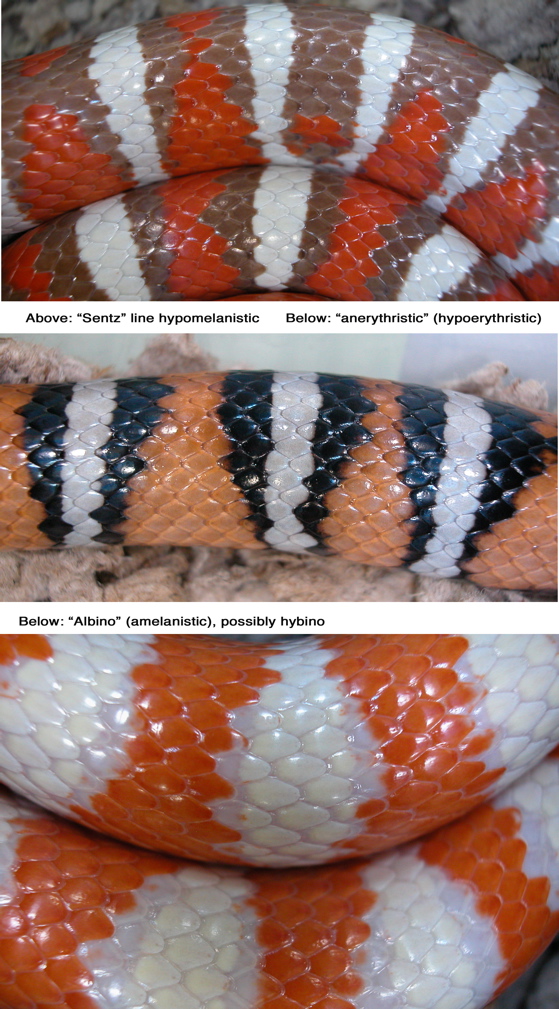
Lastly, snake pix just to keep us on topic (though they're kings, not milks). See the link just under the photo.
Ok here are some shots of my LTT's. I hope this helps.
How do i post multiple pics?
Mike

>>1) There are always multiple ways to make things work. I've bred animals where i used one method and a friend used mostly the most-opposite methods, and we both succeeded to our considerable satisfaction. You'll get different answers here to your questions, and those answers may all be good ones. There's no single right answer to most questions.
>>2) Because one person seldom has the only correct answer (see #1 above!), weigh the ideas you're given here against what makes sense to you. "Common sense" is based on knowledge and insight, so your snake-common sense will change as you read more and try more and observe more. Be willing, as you have been with your questions here, to say "I don't know" or "I'm not sure" and you'll do well. Don't believe all of what anyone--myself included--tells you.
>>
GREAT post here, particularly the points I quoted above. I think your comments should be made a "sticky" post in every forum!
-----
Joe
--
Help, tips & resources quick links
Manage your user and advertising accounts
Advertising and services purchase quick links