Reptile & Amphibian Forums

Welcome to kingsnake.com's message board system. Here you may share and discuss information with others about your favorite reptile and amphibian related topics such as care and feeding, caging requirements, permits and licenses, and more. Launched in 1997, the kingsnake.com message board system is one of the oldest and largest systems on the internet.

Click here for Dragon Serpents
Click for ZooMed
Click for 65% off Shipping with Reptiles 2 You

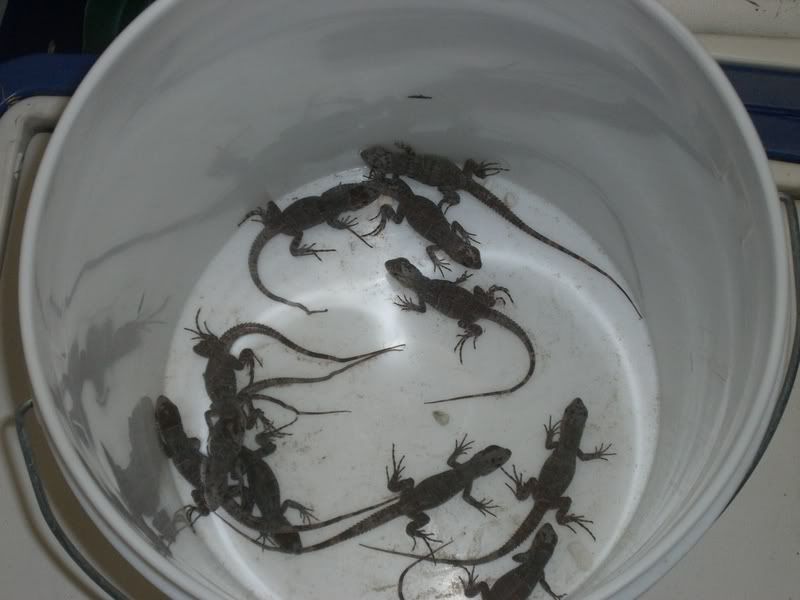
CTENOSAURA MELANOSTERNA BABIES

TOM_CRUTCHFIELD Oct 01, 2009 02:10 PM

Here's a nice little clutch of Rio Aguan Iguanas we just hatched. It's my first time seeing babies or breeding them so I'm excited. WE'VE HAD A STELLAR YEAR IN PRODUCING HERPS AND WE ARE STILL NOT FINISHED...


-----
Tom Crutchfield
www.tomcrutchfield.com

Replies (17)

Mark M Oct 01, 2009 08:46 PM

Great job Tom. Save a couple for me! I've bred these six or seven times. Actually I was the first to breed these in the states some time back back in the 90's. The pics is some I hatched a year or two ago.
Image

tgreb Oct 02, 2009 07:19 AM

I know several guys that got multiple clutches of these guys. Too bad they make such crappy pets. Maybe we can let them go in FL somewhere and have our own population here in the states(sarcasm). Anyway great job for a lizard that is SUPPOSED to be so endangered.

TOM_CRUTCHFIELD Oct 02, 2009 07:26 AM

Actually, I have 2 more clutches as well...lol
-----
Tom Crutchfield
www.tomcrutchfield.com

TOM_CRUTCHFIELD Oct 02, 2009 08:20 AM

To be honest with you many things "considered endangered" are NOT and in fact quite common in the wild. THE MOST COMMON MONITOR IN ASIA IS VARANUS BENGALENSIS AND IS ON THE U.S. ENDANGERED SPECIES LIST. I've seen numerous websites with supposed numbers of wild Cyclura that I know for sure are far less than actual wild numbers. A friend of mine did a survey of wild Cuban Crocodiles and personally told me there likely were in excess of 10,000 wild ones but the published amounts were 3,000-4,000. I asked him why the published info was less than he told me and he said he liked to err on the side of the croc. In other words it's good business to have rare things one can get grants to "save". This is NOT something new and is something that will be continued. Someone like me could take any rare Cyclura and in a few years have so many you'd have to give them away practically. This year alone I've hatched just under 50 Cyclura cornuta and that's without even trying hard and with breeding just a few pairs. Rhino's are a good example of what I'm saying. The few remnants of Cyclura ricordi that are in U.S. collections are rarely bred yet I bred them EVERY YEAR when I was working with them. It's all about where you live and how you keep them. Personally I think SOME of the private breeders are far better than most institutions. Before I get flamed by any Zoo folks I think some are doing a decent job BUT if your financial survival depended on how many you produced your success rate would improve. That is just plain common sense...
-----
Tom Crutchfield
www.tomcrutchfield.com

tgreb Oct 02, 2009 11:10 AM

.

TOM_CRUTCHFIELD Oct 02, 2009 01:01 PM

I may get criticized but I'm going to say this publicly a short time ago I was at the Shedd Aquarium. It is, I think, the finest Aquarium in the U.S. They had a lewisi exhibit with a pair of pure lewisi which had a dividing wall between the sexes. I asked why and was told that the male chases the female and nips at her toes and tail so they didn't want him to injure her. Goodness that is what pairs of Cyclura do oftimes in courting and in fact ALL times of the year. If you expect to house pairs of Cyclura togeter and have them produce it will always be a bit violent. I WAS AMAZED THE POWERS THAT BE DIDN'T KNOW THAT AND WEREN'T WILLING TO SEE WHAT WOULD HAPPEN. I can assure you keeping them apart won't produce anything. They could see each other thru the wall and it was clear to me by watching that they would be compatible if dominance was allowed to happen. This is just ONE example. It's possible they simply haven't had experience with Cyclura or in all fairness they may belong to someone else and their afraid to risk injury. ONE THING I DO KNOW YOU CAN'T BREED THEM BY KEEPING THEM APART..There is no offense intended but I'm simply stating what I saw and was told...


-----
Tom Crutchfield
www.tomcrutchfield.com

Jeff Lemm Oct 03, 2009 07:18 PM

That male is very aggressive and it is no secret that males can get aggro with females, especially in the fall. I have seen aggressive males kill females - even in the wild. lewisi are known to be more aggressive than other Cyclura. Sure, some pairs do fine together - I have lewisi that have no issues. Others are psycho together. I'm sure you knew this

Manny Oct 02, 2009 04:39 PM

Yeah! give me something else to collect..lol

TOM_CRUTCHFIELD Oct 02, 2009 04:55 PM

Manny, it would be a hidden undisclosed location and I would only tell perhaps B. K. or D. M.[collectors of invasive herps and others for Strictly Reptiles] as I know they'd never tell anyone where they are...LOL
-----
Tom Crutchfield
www.tomcrutchfield.com

Manny Oct 04, 2009 05:57 PM

Mums the word lol

Mark M Oct 03, 2009 01:08 AM

When you say "crappy pet", are you saying this because they arn't cuddly like a hamster or rabbit? If so, your right. If your comparing them to other iguanas, your wrong. With melanosterna, you need to be patient. It takes three to four years for them to tame down. And when I say tame, that means they wont run and hide when you walk by their cage and will feed out of your hand. As juveniles, they are very flighty. If your looking for a lizard that will sit on your shoulder while you clean the dishes, melansterna is not the lizard for you.

DianaS Oct 03, 2009 04:41 AM

Hi Guys, when I go in the terra's they jump all over me, And you are right they are not for cuddling, they have their own will and every animal is different, but no reptile is for cuddling, that is my opinion. And you have to be patient with them.
I like watching them when they are eating and how they react to me and each other.
But the Melanosterna looks impressive to me, the head and eyes are beautiful.

But still a great job Tom, go on.

tgreb Oct 03, 2009 03:47 PM

Yeah I meant "bearded dragon" tame. Most people won't wait 3-4 years for a lizard that wont bolt when you enter the room. Mine are very aggressive. They actually attack the food (and occasionally me). LOL. It is a riot. Ask Bob too I think is missing a couple fingertips. Also they get really stressed when you have to handle them. Removes their trust for you for at least a few months most times longer.

TOM_CRUTCHFIELD Oct 03, 2009 06:51 PM

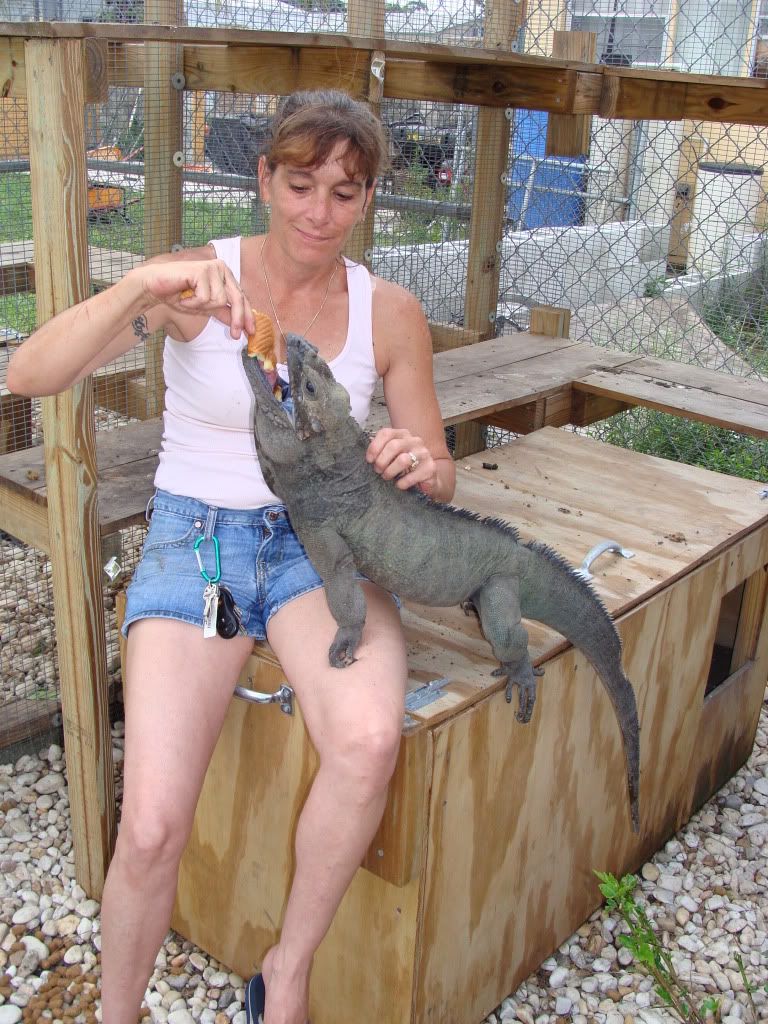
Most of mine are so tame you can carry them around and they like it. Patty, my girlfriend and " Lizard Whisperer" goes and sits with them with treats and they seem to love her. At the sound of her voice they come towards her. Two big male Rhino's she let's out in the yard and they follow her like pet dogs..She really deserves the credit with the Lizards especially the Iguanids...


-----
Tom Crutchfield
www.tomcrutchfield.com

Kellyp Oct 11, 2009 09:42 PM

I am finally talking about something other than yellow iguana's. Here are pictures of two of my male melanosterna's at 18 months of age. The one with the dark dewlap is one of yours Mark and the other is from Europe. I believe Diana S. I too was fortunate enough to hatch out 28 babies so far with another clutch of 15 to hatch any day now. I agree with the rest of you that the babies are very flighty. I also think if you are trying to raise a group of them up they are very nasty towards eachother but I have found that with a little gentle and consistent handling all of mine have calmed down nicely. I believe having them in big walk in enclosures has actually helped. So I think they have pet potential. Its just about how much time you have to invest in the animal. I have noticed a couple of the babies that I have are much calmer then the rest of the group so perhaps with selective breeding just like any other domestic animal desireable traits can improve over time in this case a calmer personality.

lizardrc Oct 05, 2009 01:18 AM

Thanks for the debate here and the info in that one.
Many years ago, when I was doing thesis research I was able to check out some zoos behind the scenes and hear about the current projects and such. I would say that there really is a necessity for private breeders and AZA/zoos to work together more and more. I am aware of some breeders who have supplied animals for some zoos for their exhibits. On the flip side, I would presume that Zoos strive to do the same for private breeders to increase chances of success?
Tom, it sounds like you are saying this doesn't happen?

The whole money debate escapes me, zoos need to charge admission, breeders need to sell some offspring.
My take is that herpers who are working with species and producing results, really enjoy and care about the species they are working with.
Lastly,
I've seen lots of herps in other Countries that would be illegal to export and US keepers very eager to work with!, yet, are flattened daily on the developed roads of today's society, some actually on purpose.
I guess Zoos are the only "reputable" way to get animals out for further study/propogation/etc. but I think there should always be a direct line from Zoos to reputable breeders for further expansion, money making or not.
I think the goal is the enjoyment both in the wild and captivity of these fine species before we mow everything down as we grow and expand. Jeff, are any of those Islands for sale with threatend iggs? Do you see Hollywood buyers gobbling them up?
Thanks and congrats Tom, on the babies.

Image
-----
WWW.LIZARDRC.COM

TOM_CRUTCHFIELD Oct 05, 2009 08:01 AM

Thanks for your kind words. Almost every Aussie herp on the market today came in from illegal ancestors yet NO one today would think about trying to smuggle anything out of Australia. The reason is that they are more expensive in Australia than here. That's right, a Woma is still an expensive sought out boid in Australia. When you commercialize anything the poaching of it stops in a rather short time. Even though technically it was illegal at the time I'm NOT sure it was a crime to bring ALL those herps here as now IF anything were ever endangered in Australia certainly there are many thousands here for repatriation if need be. My greatest regret is giving my pure lewisi to AZA Zoo's which let them die and eliminated them from the private sector [who originally bred them anyway]forever. Life Fellowship and myself were breeding these lizards and talking about their desperate situation for decades before the AZA was interested in any way. Yet now it seems that Life Fellowship or myself would be denied the right to breed them even though we were the ones worried about them in the first place. I pioneered the outside enclosures for Cyclura in S. Florida and produced my first Rhino Babies in the 1970's. A lot of people today cast a bad light on past smuggling but don't realize it was a different time and place. Many of these same people themselves have and breed many Aussie and other herps with illegal origins without a thought of the hypocracy involved. Early on many of the AZA Zoo's themselves were the knowing recipients of smuggled herps and were happy to aquire them at the time. I KNOW THIS IS FACTUAL FROM PERSONAL EXPERIENCE. What bothers me is that saving all kinds of wildlife has to do with paying for it, you know real $$$$$. Why is renting Pandas from the Chinese for millions of dollars to have them on exhibit so you can increase the Zoo Admissions and sales any different than selling progeny produced to finance saving the other wild ones? In actuality it's NOT any different. Money can be derived from a great variety of ways to save wildlife in nature. Eco-tourism, Zoo admissions and sales, big game hunting, sales of wildlife products[croc skins etc], and of course the sale of living animals are only some of the ways. The sale of skin products derived from killing herps disgust most herpers yet the REASON that many crocs have been brought back from the tip of extinction is because of Crocodile Farms all over the world that do just that. Alligators here in Florida are a shining example of that. Once Alligator Farming was legal the poaching STOPPED and now Alligators number over a million in the wild here in Florida alone. If I've upset anyone with these FACTS I'm sorry but it is what it is, Many years ago I coined the phrase "CONSERVATION THRU COMMERCIALIZATION" and I believe I have been proven correct many times over these many years..Again this is all "food for thought" for a lot of you out there who may not know the real history of Herpetoculture and all the political nonsense involved...Hey, I was just and am a guy who always loved herps...The fact that I made a decent living from it was always secondary to my love for the critters...
-----
Tom Crutchfield
www.tomcrutchfield.com

Site Tools