Reptile & Amphibian Forums

Welcome to kingsnake.com's message board system. Here you may share and discuss information with others about your favorite reptile and amphibian related topics such as care and feeding, caging requirements, permits and licenses, and more. Launched in 1997, the kingsnake.com message board system is one of the oldest and largest systems on the internet.

Click for 65% off Shipping with Reptiles 2 You
Click for ZooMed
Click here to visit Classifieds

handling tree monitors

eschmit04 Oct 04, 2009 11:13 AM

Hi all, I am a python guy and have an increasing interest in monitors and lizards. Because my main focus is on pythons I cant have something that needs its own room, my retic and anaconda take that space already.

My question is on CB tree monitors (green, blue, yellow). Are they tameable/handlable? I work with my snakes daily, and have tamed my green, and my tic. I am hoping to be able to handle the animal without him stressing out, constantly running and hiding etc.

thanks for your time,
Ed

Replies (33)

sulfurboy1o3 Oct 04, 2009 12:31 PM

They are animals that stress out pretty easy.I've been chatting with a keeper who recently produced some black trees and his cbb animals are shyer then all heck. To get them to be 'better' captives,you're going to have to build a trust with them and let them call all the shots. Force handling isnt tolerated too much, esp by tree monitors. Pose as no threat and more so of 'the food giver' and work from there. This should help you have a some what rewarding captive, instead of an animal super scared and stressed.

Might want to think of another captive/small but more rewarding? Even if you got a tree monitor to the point of it being very tolerant of handling, those claws will mess you up if you didnt have gloves on all the time.

my $0.02

TheSerpentsCoil Oct 04, 2009 04:30 PM

Go with some of the c.b/c.h. green tree monitors. They are expensive but worth the money IMO. My experiences with them have been great! They will climb right onto your hand and even eat out of your hand! They aren't the least bit shy! If I ever get into them that's the route I'm going as I also like to handle my animals a bit!
-----
John Light

eschmit04 Oct 04, 2009 04:56 PM

Thanks for the posts! Thats exactly what I have been looking at. And just what I wanted to hear. I spend a lot of time with my animals, and am happy to work with them. What size enclosure do you keep them in? I would love to have one of these little guys that could hand out.

One question I have is, are monitors afraid of snakes? Any problems keeping them in the same room as snakes.

Thanks for your time!
Ed

eschmit04 Oct 05, 2009 09:28 PM

I also wanted to ask if there are any other smaller monitors similar to the green and blue tree monitors that are a less expensive?
I have been looking at both the peach throat and blue tailed monitors.

Thanks for your help!
Ed

Edited on October 7, 2009 at 16:54:56 by PHGinger.

sdi Oct 06, 2009 04:16 AM

I don't know if you are interested in desert species or not. You may want to try an ackie. Price is pretty reasonable and they are more hardy than the tree monitors.

I have a blue tree and they are clearly not "lap monitors".

Steve - sdi

irherps Oct 06, 2009 09:09 AM

Ive been keeping peachthroats for a couple of years. Four of the Jobiensis I have a uscbb and they are much easier to work with than the other wc individuals that I have. With this being said they are still not a monitor for someone who is new to monitors, they would be a better choice than any of the trees but still not a good first monitor. I would start with one of the oz species. Either Tristis or an ackie is the way to go. Have a good one and good luck. Ian

j3nnay Oct 06, 2009 10:17 AM

Both the peach throat and blue tailed are in the mangrove monitor complex, and share a lot of the characteristics of the mangrove monitor. They can be beautiful and rewarding but like the previous poster said, they are not for the beginner. I still have a faint scar on my left hand from picking up a blue tailed the the wrong way and it was able to turn around and nail me. And it was a relatively tame one - they're just not monitors that take well to handling.

Your experience with the pythons limits you - most of those do become tame the more you mess with them, unlike other species that need to be left alone to thrive. What works for your big constrictors may not necessarily work for the monitors, especially when it comes to 'taming' them.

If you really want a tropical monitor, go uglier but sturdier. Brown and black roughnecks can be rewarding if you put the time in. For smaller than that, like previously suggested, the ackies are a great way to go. You're just not going to find a tropical, pretty, tree dwelling monitor that accepts regular handling with grace; it's not how they work.

Check out www.proexotics.com. There's some great information there that'll help you decide what you can and can't do.

~Jenny
-----
"We call them dumb animals, and so they are, for they cannot tell us how they feel, but they do not suffer less because they have no words."
- Anna Sewell (1820-1878)


manchild Oct 06, 2009 11:52 AM

Dumerils and Roughnecks are not a good choice if you are looking for a monitor to handle.None of the Indo Asian specie are.Blue tails are very shy,and Peach Throats can be a shy species as well.Most monitors don't take well to handling,I have never kept snakes,but I think compering snakes to monitors is like compering apples and oranges.I would recommend you do a lot of research and find out what you want out of a monitor before you decide to get one.

greg

eschmit04 Oct 06, 2009 12:43 PM

Thanks for all the posts everyone! This is the info I have been looking for. I completely understand there is a huge difference in both husbandry and handling from pythons to monitors. I am more than willing to learn, and will definitely take my time. As I said my big snakes are my passion, so my biggest concern is size, I already own and house retics and condas (they take up a LOT of space), so I don't have too much to spare. That's why I have looking into the smaller monitors. Also, (sorry for the ignorance) but I am also much more interested in the (raptor style) monitors, as opposed to the (big slow) monitors.

If it really cant happen, then I will not attempt. But like I said I am happy to do the work and homework if I get pointed in the right direction.

thanks again,
Ed

SpyderPB6 Oct 06, 2009 02:10 PM

Some stuff to keep in mind.

The size to enclosure scale requirements of monitors can often be several to many times that of large constrictors. Monitors utilize space much more than snakes. They key differnce to keep in mind is they are highly active.

Cheers,
Mike.

JSKAHN Oct 07, 2009 05:15 PM

I have Ackies and do not ever find them boring.I also have 5 Tristis. I think that you would enjoy Tristis. I found that they are not shy, like I was told. They are "raptor like" and love climbing all around the cage.They are also more reasonably priced that some of the rarer monitors, and not difficult to breed.
Joe

irherps Oct 08, 2009 01:20 PM

I do agree with you that black and brown roughnecks are not great first monitors. That being said the Dumeril's that I have owned have been some of the most docile varanids I have ever worked with. Ive never worked with black roughnecks so I cant coment on them. I have three uscbb that I bought from Ben Aller and they are super docile. The other two I have are both wild caught but are still verry easy to work with. Aside from their eventual size and moisture requirements I would say they wouldnt be a bad first monitor. This is just my experience of course. Thanks Ian

manchild Oct 14, 2009 12:08 PM

I too have worked with Dumerils monitors,and I think they are great monitors.Once they have settled in,there awesome.But unless you have a good understanding of monitor husbandry I would not recommend them as a first monitor.I will agree with you that they are one of the calmest monitors I have ever worked with.

greg

j3nnay Oct 21, 2009 08:43 PM

My first monitor was a dumeril's. He did wonderfully and tamed down with little/no effort. He shed well and looked great. He ate for me like a champ and was fairly undemanding. Had a daily routine worked out, and wasn't fazed by much of anything. He was an imported adult. Compared to the other species I've worked with through my job, he was a saint. The other monitors we received in that shipment also thrived, even without the deep soil substrate and 130 degree basking site that I provided mine. Technically, the rest of the group should have slowly declined, but instead the longer they stayed at the store the thicker and better looking they got.

Maybe we just got a particularly spectacular batch, but I find it hard to believe that 10 monitors imported from who-knows-where indonesia are all going to have the exact same quirks. Subsequent batches have had very similar characteristics. Give them time to get settled, feed them, worm them, and be patient. They do great.
-----
"We call them dumb animals, and so they are, for they cannot tell us how they feel, but they do not suffer less because they have no words."
- Anna Sewell (1820-1878)

bob Oct 07, 2009 07:31 PM

Ed, I have kept both WC and CB or farm raised hatchling green trees and kordensis, with both the CB babies are a million miles away from the eratic WC imports. I have a friend who had a nice male green tree CB from a farm hatched baby and it grew up to be more docile then a kimberly rock monitor. Alot depends on how they are set up [how secure they feel] and how much they are handled and of course genetics do fall into the picture to. I have never had the black trees so I cant speak about them. I think the best choice are V. Reisingeri which are a bit larger more like a blue tree but even WC adults are docile, my friend had 4 of them and they are far different then the GTM. They are more rare and I have seen them being sold as yellow phase GTM by some importers who dont know. Nice monitors for looks and by far general personality even ion adult WC specimens.
Bob

eschmit04 Oct 07, 2009 10:42 PM

Bob you are the second person with personal experience to tell me that the cb green trees are far more capable of being tamed out than the wc or farmed raised specimens. I am really considering a cb green tree, but obviously have much knowledge to gain. I am also going to look into the other species you mentioned! Thanks again for your time!

Much appreciated!

eschmit04 Oct 07, 2009 10:56 PM

Bob all I can say is WOW! V. Reisingeri is absolutely gorgeous, and you say in your experience both the wc and the cb specimens are docile? Sounds to good to be true! Do they have a common name? I'm going to have to do some major homework. What enclosure size would be needed to house a single specimen?

A couple things I want to clarify. I am very aware there is a huge difference between pythons and monitors, I stated it in the beginning as more of a disclaimer.. Also I realize there is a huge difference in the husbandry, care, and taming of monitors, that is why I am doing my research now.

Thanks again for the posts and keep them coming!

Ed

bob Oct 08, 2009 06:09 AM

Ed, my friend had 2.2 V.Reisingeri for a few years and got eggs on a regular basis, the eggs were good but alot of times he did not get them in time or didnt incubate properly. He did finally hatch 1. Now he is out of them as far as I know. He had a 4 by 4 ft cage with 6ft. height to house a single pair. If you are only looking to keep one as a pet I would suggest a single male and you could probably use a much smaller enclosure. They are an awesome species. An importer from FL use to get them, extreme reptiles I think was the name of the place. If more people knew about them I think they would become very popular but they have had little to nill exposure. I had to email the one importers who sent me the pics of yellow green trees and tell him they were indeed V. Reisingeri, this is a very overlooked rare gem.
Bob

bob Oct 08, 2009 06:15 AM

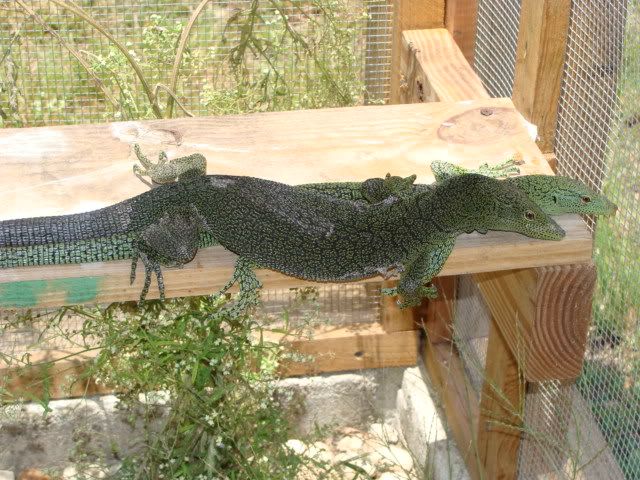
Ed, here is a pic of 2 V. Reisingeri my Europen friend hatched out a few years ago.
Bob

eschmit04 Oct 08, 2009 09:47 AM

Well Bob, I thank you very much! I am going to be spending quite a bit of time tracking one of these bad boys down!

It seems like a dream come true..

I think I emailed your friend last night actually. I found a gentleman on the forums saying he had two pairs of V. Reisingeri. I may be in touch in the future as well if I think someone is trying to pass something else for V. Reisingeri.

Look like I found the monitor for me. I have much homework to do and will keep you posted.

Thanks again Bob!

bob Oct 08, 2009 03:55 PM

Good luck with them, they are an investment quality species in my opinion. Nice size,temperment and my favorite is their colors. They would actually be a good choice monitor for a classroom as they are not flighty at all or never once was my friend ever bitten or attempted to be bitten by the WC adults. Really a world away from any of the other Indo tree monitors. I would have them myself but to many projects going now. They never got the exposure they deserve in the reptile market and were only discovered a few years ago. They would be a good choice for a new comer as well, far better then GTM or Kordensis.
Good luck with them, if you have any other questions you can email me privately at hila100000@aol.com
Bob

eschmit04 Oct 08, 2009 06:01 PM

Thanks again Bob! You will be hearing from me soon. Can anyone point me in the direction of a good breeder or importer? I haven't found a single bit of info on them.

Also Do you think a 6lx3dx2h with a lot of branches and cork board would be adequate? Thats just the same as my green anaconda, and retic so it would work out well if adequate.

thanks,
Ed

bob Oct 09, 2009 05:56 AM

Ed, they are tree monitors so height might not be nessesary but I would strive for at least 5-6ft. high enclosure with some ficus trees, artificial ones at that and some kind of vine and corkbark, like all other monitors they like to feel secure and being a tree species would be a natural benefit of height to their liking. I think Extreme Reptiles use to import them a couple of years back but I dont know if they still do. With all monitor species WC imports usually are very heavy on males and females are usually the tough ones to come by. I would look under kingsnakes importers list, I think you should find an importer who can get them, Maybe Tom Crutchfield would be a good person to ask, I know he works with a large vaiety of Indo tree monitors. Good luck in your pursuit and keep me posted, they are a diamond in the rough species as far as being exposed to monitor keepers. I think once people see them in person they will be on alot of peoples wanted lists.
Bob
www.herphatch.com

eschmit04 Oct 09, 2009 03:38 PM

So I spoke to a couple people on the phone today regarding V. Reisingeri and they seemed to disagree that V. Reisingeri was anymore docile and low key than the green trees. Can anyone shed some light?

Also I have been told that a CBB green tree monitor can be very docile and mellow if worked with. No problems with husbandry and health. However some people have said they are handleable, and some have said they do not enjoy being handled regardless. Can you interact with a young CBB green tree in a way that he does not fear you?

Thanks everyone!
Ed

bob Oct 10, 2009 11:18 AM

Ed, like any mammal,bird or reptile their is a rule of common sense, if young varanids are handled regularly they will get to know you, their surroundings, your scent and feel more comfortable and relaxed, this applies to a common pet as well [a dog]. Walk up to a dog that doesn't know you and see how cautious they are, and after getting to know you they get relaxed around you use to your scents and all is well. Same rule applies to monitors. My experience with V. Reisingeri is based on 4 WC specimens that were at my table in an enclosure at the Hamburg show. These 4 were very docile but under the wrong circumstances would not have been. Its all about understanding the animal be it reptile or mammal or bird. I had a kordensis hatchling that would crawl up my arm and have seen CB GTM that do the same thing as adults. There are always exceptions to the rules and they are dictated by common sense. This pair of tree monitors consists of a WC GTM and a CB farmed in Indo Kordensis female I once had, the male was very flighty and aggressive, the female would climb up my arm, proof enogh for me and I didnt handle her much either. There can be no generalization on this topic and you will get different answers from everyone you speak to.
Good luck, Bob

manchild Oct 14, 2009 01:05 PM

I'm going to disagree with you.Telling someone that if they Handel a shy,nervous monitor daily it will calm down is wrong.Tree monitors don't take well to handling at all(they are a look don't touch)If you follow your advice you will end up with a extremely stressed out or dead monitor.I do believe they can calm down in captivity,but if you force yourself on them they will always view you as a threat.

greg

bob Oct 15, 2009 12:58 PM

Everyones experiace is different, my kordensis female knew what forceps meant, she would get excited just seeing forceps as it was a learned behavior. After getting fed with forceps she knew. She also had no problems hanging out on my shoulder. Now that was in a facility, Im sure if I would walk outside with her on my shoulder or take her somewhere she would react differently. Im only commenting on my experiance and I think any good keeper who has experianced raising up Indo farmed GTM or kordensis would agree with me. If you havent expericed it you are just guessing and nothing more.
Bob

sdslancs Oct 15, 2009 04:48 PM

Some GTMs seem to be practically imprinted on their owners.
This gal has the CBB in the vid and a WC GTM she says both are very tame. It's hard to argue with that, when you see them outdoors, free to run away, yet choosing not to. All her lizards look super healthy too

.

bob Oct 15, 2009 07:57 PM

Excellent video, if that doesnt make you a beleiver you missed the clue buss. That is tamer then any of mine ever were but then again I do not handle them so much and Im sure those nice legs she is sporting may have added to the equation:}
Bob

bob Oct 15, 2009 08:03 PM

http://www.youtube.com/watch?v=y--jrsAR4XU&NR=1 This is even better!!
Bob

TOM_CRUTCHFIELD Oct 16, 2009 06:22 AM

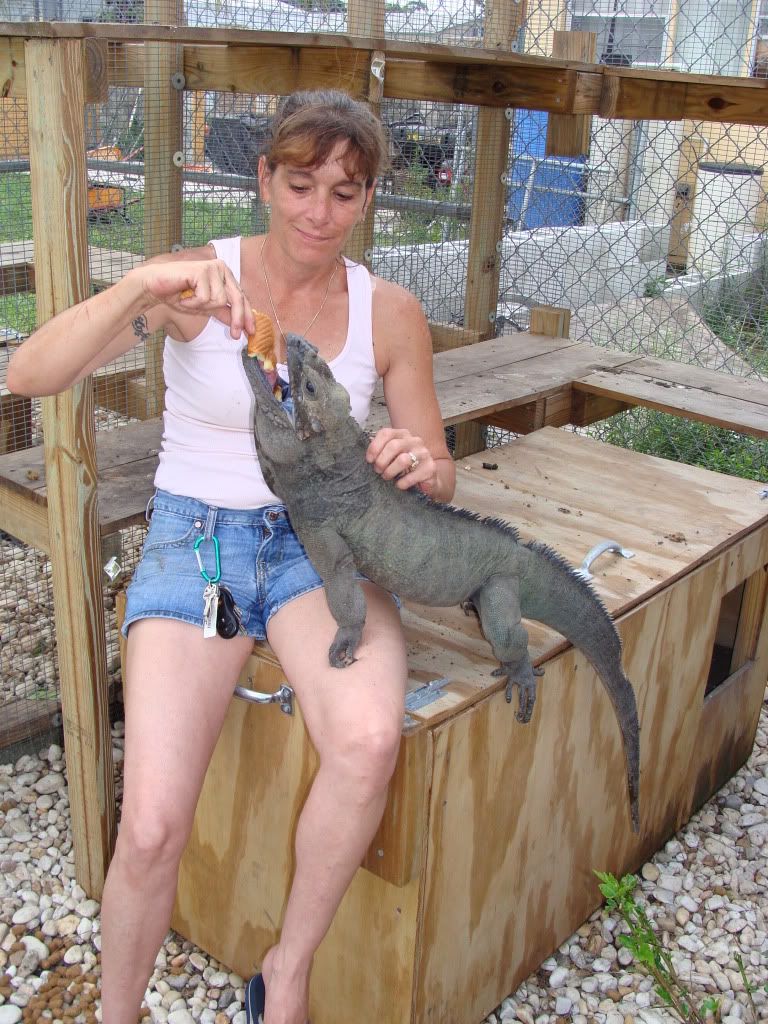
I agree with Bob and I have literally almost 40 years experience backing me up. I'm now working with Tree Monitors of 3 types. ALL WERE IN THE WILD LAST DEC. IN INDO. I acclimate them by putting them in relatively small cages WITHOUT hiding places[in most cases] and very quickly they learn your NOT going to kill them and calm down. I'm NOT trying to make pets of them I just want to be able to observe them without them hiding. When they will grab and eat food in my presence I then move them to their breeding enclosures. Most of mine will now allow you to touch them, feed from my fingers, and allow me to observe their natural behaviours. I do this with my iguanids as well and have Green Iguanas [albinos] that I put in a Mango Tree to take pics!!!I have HUGE Rhino Iguanas that Patty takes out and lets them roam free for a day WITHOUT being monitored[pardon the pun] in any way. Here's a few pics that tell it all...THANKS


-----
Tom Crutchfield
www.tomcrutchfield.com

TOM_CRUTCHFIELD Oct 16, 2009 06:36 AM

Toward the end of this video when you see the GTM sit on her leg and expand it's rib cage and flatten it's body it's an exteme basking behaviour. This indicates that the lizard is very content and happy as that's a NATURAL BEHAVIOUR. It is obvious that this lizard has NO FEAR of its keeper of any kind. She has done an excellent job in husbandry of these normally shy Varanids.....


-----
Tom Crutchfield
www.tomcrutchfield.com

bob Oct 16, 2009 07:21 AM

Tom, that flattening out basking behavior was something I did notice to and you are absolutely correct, no lizard or monitor would do that unless it felt it was in a safe enough place to do so, basking is a risk for any of the monitors/lizards as they get preyed upong by many other predators in the wild, birds of prey being one of the biggest threats coming from above. I had a small cat on top of an outdoor cage years ago and a 1/2 grown pilbara female was jumping up trying to bite this cat through the mesh. It was pretty comical but I had to live trap this wild cat and find him a home, he was becoming a regular.
Thanks for sharing, Bob

Site Tools