jaws?
I read somewhere that indigo snakes cannot take large prey because they can't un hook their jaws, i was wondering what other snake species can't do this?
Welcome to kingsnake.com's message board system. Here you may share and discuss information with others about your favorite reptile and amphibian related topics such as care and feeding, caging requirements, permits and licenses, and more. Launched in 1997, the kingsnake.com message board system is one of the oldest and largest systems on the internet.


jaws?
I read somewhere that indigo snakes cannot take large prey because they can't un hook their jaws, i was wondering what other snake species can't do this?
I couldn't tell you exactly what the anatomical difference is between indigos and most other snakes, but the whole premise of the question is based on a common misunderstanding.
Snakes jaws are not "hinged" the way a human's (and other mammals I'm familiar with) are. The lower jaw consists of several pieces connected by stretchy ligaments. My guess would be that indigos just have shorter ligaments, but I don't know that for sure.
However, I can say that like indigos. king/milk snakes don't seem to be able to expand their mouths as far as other snakes. Probably a common trait among snake eaters...
-----
What goes up must come down...unless it exceeds escape velocity.
Not sure about rough greens but I know the North American and Asian Smooth Greensnakes will not eat prey items that are wider or taller than their heads. This suggests to me that they are not capable to open their jaws to the same extent as other colubrids. They are insect eaters, by the way.
For what it's worth, In the late 60's early 70's, I had some Rough Green Snakes(O. aestivus) as a kid, and they ate some pretty big locusts before that were much bigger than their heads that would leave a very big visible lump in their midsection. I remember they had to stretch a good deal to consume those items.
~Doug
-----
"a snake in the grass is a GOOD thing" 
Thanks for sharing that. I have read about the two smooth greens not taking food wider than their head in book and in my experience with smooth greens believe the books are correct. I would have assumed the same for rough greensnakes but know they are a bit more distantly related than the most commonly-accepted nomenclature suggests.
I'm glad you shared that as well, because I really wasn't aware of that either regarding the smooth greens(vernalis).
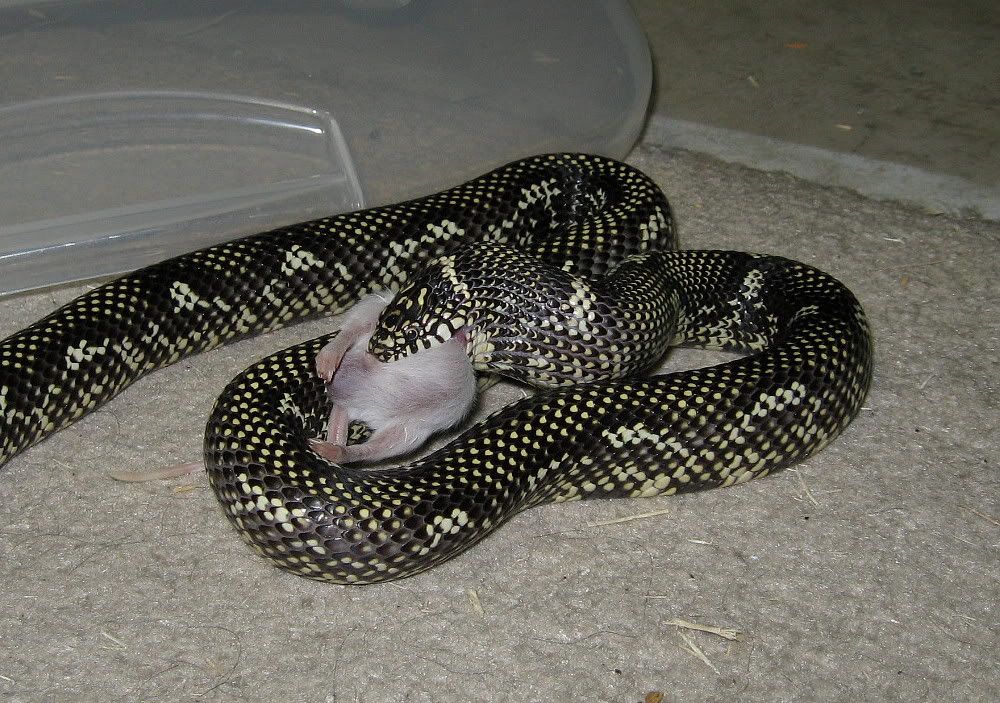
Ya know, I had several Indigo's way back then too , and it seems to me they ate some pretty good sized meals as well, but I would also tend to agree that their heads are a little more like kings and milks with rather indistinct heads compared to their neck size, and that they can't stretch their mouths open to the point that ratsnakes can for example, but they certainly can "FORCE" the meal to conform to their necks with their fantastic neck strength though, this I have witnessed many, many times. They just keep cramming the meal in until it conforms and consumed. My floridana, and Outer Banks are renowned for doing this when they eat larger prey items. Their necks are without question WAY more powerful than all my other types of snakes.
~Doug
~Doug
-----
"a snake in the grass is a GOOD thing"
I just happen to have a pretty good pic of one of my aberrant Outer Banks King females cramming down a meal. If this was a video, you could get a much better idea of her powerful neck muscles. She is really undulating her neck as she's forcing this thing down.
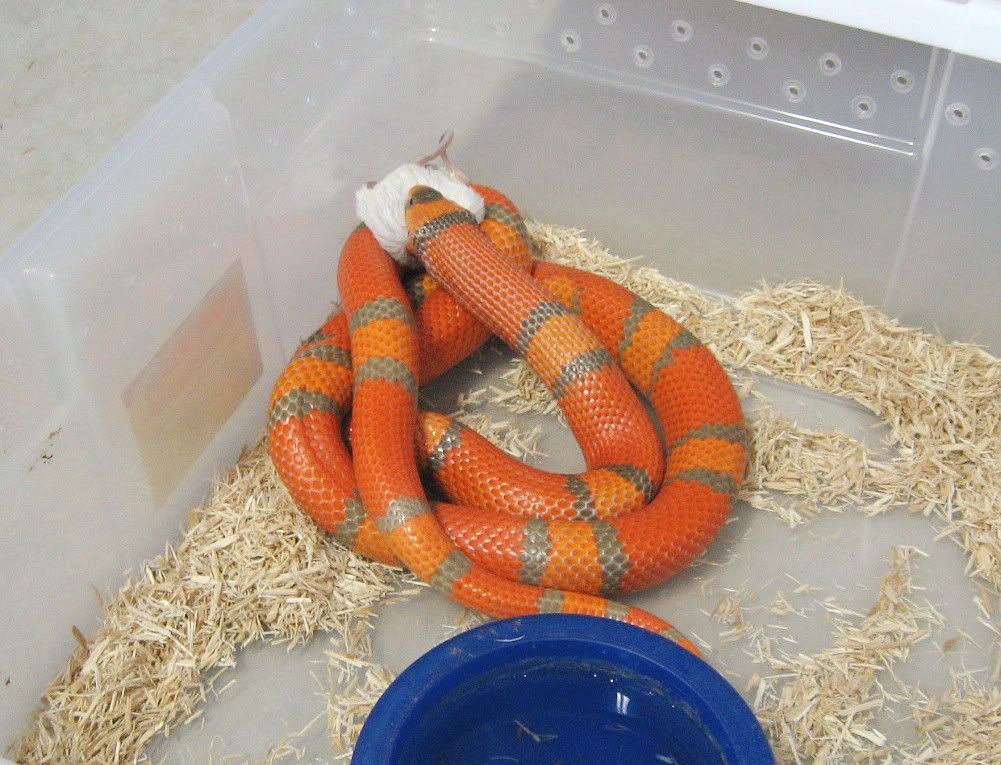
Also, this adult female extreme hypo is a pretty tough customer too that has the same type head, but not the same strength as the getula though.
~Doug
-----
"a snake in the grass is a GOOD thing"
dmong are kingsnakes a lot stronger than milk snakes?
Yes, although some of the bigger Latin American milks are very strong and robust, the getula complex of kings takes it to the next level with their power and voracity. Those guys are strong beyond belief!, which is how they got there common name "kingsnake" to begin with. They can overpower any other North American snake, with the possible exception of the large Indigo of course, but this certainly depends on the size of either one involved too.
Another characteristic that lends to their common name, is the fact that they can even be bitten by any North American crotalid(viper), and show little, if any effect from the bite whatsoever.
I have many kings that I have to literally put the cage on the ground before I open the lid, because they come shooting out and chase me down several feet for a meal..LOL! Just like horses get all worked-up and anxious just prior to a race, then when the gate opens, they are OFF!..LOL!
Yes,....they are certainly true "kings" of the snake world.
~Doug

-----
"a snake in the grass is a GOOD thing"
Regarding the comments at the beginning of this thread, I saw an illustration in a snake book once (can't remember which book) that showed about six different types of snake skulls with various types of construction. I remember one or two in particular that were illustrated to show less evolved skulls with smaller, less flexible jaws. I think they were worm snakes and other burrowing species.
-----
---
http://www.mikefoux.com
http://snakerack.blogspot.com
1.2.0 Hondurans Het Amel
1.1.0 Hondurans Anery, Het Hypo
0.1.0 Honduran Hypo
0.1.0 Honduran Hypo, Het Anery
0.2.0 Pueblans
1.0.0 Pueblan Hypo
0.1.0 Corn Bloodred
0.0.1 GBK Blair's Phase
1.0.0 California King
0.1.0 California King Blue-eyed Blond
0.0.1 Speckled King WC
1.1.0 Brooksi Hypo
0.0.1 Jungle Carpet
0.1.0 Ball, Normal
0.0.1 Sulcata
1.2.1 Leopard Geckos, various morphs
0.1.0 Wife, Caucasius Mexicana
Oh yeah, there are definitely huge differences in snake skull anatomy, depending on what they happen to specialize in.
Here is a common kingsnake(getula) skull that I have in my computer files.
~Doug

-----
"a snake in the grass is a GOOD thing"
I found the book I was referring to. It's called "Snake", by Chris Mattison. The skull diagrams are on p. 18. I'll scan them whenever I get a chance.
-----
---
http://www.mikefoux.com
http://snakerack.blogspot.com
1.2.0 Hondurans Het Amel
1.1.0 Hondurans Anery, Het Hypo
0.1.0 Honduran Hypo
0.1.0 Honduran Hypo, Het Anery
0.2.0 Pueblans
1.0.0 Pueblan Hypo
0.1.0 Corn Bloodred
0.0.1 GBK Blair's Phase
1.0.0 California King
0.1.0 California King Blue-eyed Blond
0.0.1 Speckled King WC
1.1.0 Brooksi Hypo
0.0.1 Jungle Carpet
0.1.0 Ball, Normal
0.0.1 Sulcata
1.2.1 Leopard Geckos, various morphs
0.1.0 Wife, Caucasius Mexicana
Chris Mattison also authored a pretty good general snake book titled " ~ A-Z of Snake Keeping ". It isn't a real "specialized" book that targets great detail with specific types, but it is a very good "over-all" broad-spectrum book in my opinion for helping people to understand snakes better, especially the less advanced novice snake owner.
~Doug
-----
"a snake in the grass is a GOOD thing"
Cool; I'll have to look into that one.
The one I mentioned is full of great info and pictures. It would make a great classroom book. In fact I intend to get another copy to donate to my wife's classroom. Also, in the back it has a list of every species of snake organized by family and genus.
-----
---
http://www.mikefoux.com
http://snakerack.blogspot.com
1.2.0 Hondurans Het Amel
1.1.0 Hondurans Anery, Het Hypo
0.1.0 Honduran Hypo
0.1.0 Honduran Hypo, Het Anery
0.2.0 Pueblans
1.0.0 Pueblan Hypo
0.1.0 Corn Bloodred
0.0.1 GBK Blair's Phase
1.0.0 California King
0.1.0 California King Blue-eyed Blond
0.0.1 Speckled King WC
1.1.0 Brooksi Hypo
0.0.1 Jungle Carpet
0.1.0 Ball, Normal
0.0.1 Sulcata
1.2.1 Leopard Geckos, various morphs
0.1.0 Wife, Caucasius Mexicana
ur right actually indigos well known to feed on big florida king snakes but the vice versa has not been recorded much
the whole indigo family along with mussies are the only snakes here i know of that are pound for pound stronger than common kings
Just in case you are interested, you are misusing the term "family".
Indigos belong to the genus, Drymarchon. Kings and Milksnakes belong to the genus Lampropeltis. Racers are in the genus Coluber. All of the above snakes, including most other snakes in North America, are in the exact same family, "Colubridae"
In North America we have 5 native families of snakes: Colubrids, coral snakes, pit vipers/rattlesnakes, slender blind snakes, and boas/pythons. I believe there has been some talk about splitting colubridae up into smaller families but I think it is more likely that the use of subfamilies will be adopted instead.
There is a paper that examines the apparent gape limit in the boid subfamily Erycinae (sandboas, rosyboas, rubberboas). You can read it here - http://faculty.unlv.edu/jrodriguez/17.pdf
-----
Chris Harrison
San Antonio, Texas
Thanks for the reference, Chris. As I was reading the thread, I kept thinking that my kenyan fits into this category. He has a small shovel shaped mouth that latches on to a food item, and then works it slowly side to side to get it down.
rgs,
althea
Help, tips & resources quick links
Manage your user and advertising accounts
Advertising and services purchase quick links
