Reptile & Amphibian Forums

Welcome to kingsnake.com's message board system. Here you may share and discuss information with others about your favorite reptile and amphibian related topics such as care and feeding, caging requirements, permits and licenses, and more. Launched in 1997, the kingsnake.com message board system is one of the oldest and largest systems on the internet.

Click here for Dragon Serpents
Click for 65% off Shipping with Reptiles 2 You

How often have these guys survived?

Shiari Nov 10, 2009 10:58 PM

So, I bought from someone a little hypo with an exceedingly aberrant pattern. I've seen similar from DIE hatchlings. Nautley and his/her siblings (all normal patterned) hatched out early enough to look like amels rather than hypos, and Nautley was the runt. S/he is now a whopping 5 grams and just had his/her third feeding here with me. Nautley is eating great, defecating normally, and is growing.

So... to the question in the title, how many of you have had little guys like this hatch out and actually survive?


Image

Replies (40)

Godfrey Nov 11, 2009 01:52 PM

The important thing is that it has eaten three meals presumably with no problems. If this is the case you should be on the right track. I would avoid power feeding, however. With proper temps the snake should do just fine. Good Luck!

DMong Nov 11, 2009 02:09 PM

>> " I would avoid power feeding, however. With proper temps the snake should do just fine."

Yes, I totally agree, feeding very tiny delicate snakes is definitely the wrong thing to do. Their fragile little insides are not capable of digesting very large meals like bigger more robust snakes can. The more important thing is to feed these snakes small meals, and very gradually work your way up in size. When tiny snakes regurge, it can take a MUCH bigger toll on the snake as opposed to a larger one.

Anyway, it sounds like this little tike has a very good chance of growing up just fine.

I had a tiny runt 9 gram Outer Banks king last year, and noe she is the monster of the sticticeps trio I have.

Keep the meals small for a good while until it has visibly grown a little bit more, and this will help ensure things continue to go well.

Good luck with that nice little critter!

~Doug
-----
"a snake in the grass is a GOOD thing"

DMong Nov 11, 2009 02:14 PM

>> "feeding very tiny delicate snakes is definitely the wrong thing to do"

LOL!!, it was supposed to read,..."feeding very tiny delicate snakes "LARGE MEALS" is definitely the wrong thing to do"

Geesh!,...it was comical with those two important words being left out..HAHAHA!!

~Doug
-----
"a snake in the grass is a GOOD thing"

Shiari Nov 11, 2009 07:18 PM

I've been running around like crazy during my tiny bits of free time to find newborn mice to freeze to create meals small enough. >_< If I can't find anymore... half-pinks are probably in this little one's future for a bit longer.

foxturtle Nov 12, 2009 04:04 AM

Runt corns in my collection last about as long as it takes for my runt kings to get hungry.

DMong Nov 12, 2009 10:17 AM

Ouch!,....especially over hear..LOL!

~Doug
-----
"a snake in the grass is a GOOD thing"

Shiari Nov 11, 2009 07:16 PM

Have you, or anyone you know, had any with this pattern pop up and live though? That was the second part of the question. I've seen several creatures *this* aberrant... but all have been from dead-in-egg photos, as if the pattern is tied to health problems. The only other one similar that I saw that actually hatched... died after a few months, and never really grew. So I'm worried about that aspect of him/her.

Kevin Saunders Nov 11, 2009 07:51 PM

>>Have you, or anyone you know, had any with this pattern pop up and live though? That was the second part of the question. I've seen several creatures *this* aberrant... but all have been from dead-in-egg photos, as if the pattern is tied to health problems. The only other one similar that I saw that actually hatched... died after a few months, and never really grew. So I'm worried about that aspect of him/her.

I've seen some that were more aberrant and never known it to be tied to health issues. What jumped out at me most in yours was the proportions of the head/eyes. I can't say for sure, but it looks like something might be up with the scalation on the head as well. That (along with the pattern) makes me think some developmental anomaly is responsible, maybe due to a hiccup in incubation temperatures. Like the others said, as long as it's eating and digesting fine it should be ok.

Shiari Nov 11, 2009 08:22 PM

The scales between his/her eyes are, indeed, malformed. They don't touch, and one of the more rostral scales attempted to split in two without doing so fully.
Image

DMong Nov 11, 2009 10:23 PM

Even though the frontal, and supraoculars didn't totally fuse correctly, don't let that in itself worry you too much, I've produced over the years some snakes with minor head scale deformities very similar to that, and it didn't negatively affect them at all. Even right now I have a hatchling albino Honduran that has sort of a "hair lip" crease in it's rostral scale, and it doesn't hinder the little guy in the least..LOL!

As a matter of fact, many times snakes that initially have ill- fitting head scales to begin with can tend to have them fuse closer together, at least many times to some degree at least.

I think as long as you keep it in a very small enclosure that is about 80 82 degrees, feed only very tiny pinkies(or pinkie parts) it should be okay. And like the other poster said, the aberrant pattern doesn't necessarily have to be tied in conjunction with a faulty, or lethal gene either.

I would think things will work out just fine here in this case.

So go ahead, sit back, and enjoy that cute little hypo tike, that little joker has some very rich coloration too.

~Doug
-----
"a snake in the grass is a GOOD thing"

tspuckler Nov 12, 2009 07:54 AM

A snake's pattern has nothing to do with its survivor-ability rate.
Many corns are hatched each year with wacky patterns.
Some people specifically breed corns for wacky patterns.
As long as the snake is eating and behaving normally, I wouldn't worry about it.

Tim
Third Eye
Third Eye

Shiari Nov 12, 2009 08:04 PM

It is and is isn't. If something's gone genetically "wrong" while in development, it could have impact on more than one body system. Rather like how a lot of the corns I've seen that look like true piebalds actually had the absence of color associated with a spinal deformity.

So, while it may be nothing, there might also be *something*. Again, I've seen plenty of DIE pictures on the corn snake forums I frequent that are very bizarrely patterned and often highly deformed. The fact that Nautley isn't is a good sign, but other conditions may take a while to make themselves known.

DMong Nov 13, 2009 12:42 PM

It is and is isn't. If something's gone genetically "wrong" while in development, it could have impact on more than one body system. Rather like how a lot of the corns I've seen that look like true piebalds actually had the absence of color associated with a spinal deformity.

So, while it may be nothing, there might also be *something*. Again, I've seen plenty of DIE pictures on the corn snake forums I frequent that are very bizarrely patterned and often highly deformed. The fact that Nautley isn't is a good sign, but other conditions may take a while to make themselves known.

Yes, that is all very true, and certainly can, and does happen from time to time. There are a myriad of different genes that can travel in conjunction with other certain traits for whatever reason(s).

There are TONS of genetic combinations made within an organisms DNA and the way these are sequenced and arranged on the chromosome helix. Literally millions, and even billions of possible combinatins can be made. We know absolutely NOTHING about the vast majority of these either, and we tend to only think about, and relate only to the few characteristics and traits that we can "see", when in fact there are "ZILLIONS" of things that go on that we cannot see.

Some of these are good traits, some are a little less desirable, and only may have a small effect on the snake(lack of size, slight scale anomalies, food preference, behavior characteristis, lack of vigor(lethargy) etc... Look at the "bug-eyed" trait that can often travel right along in tandem with the leusistic Texas Rat gene, and the original line of bloodred corns having a pre-disposition for being very small, less than robust lizard eaters. All this stuff and SOOO much more goes on within the egg that is part of the organisms gene encoding that we know absolutely "diddly-squat" about..LOL!

In any case, yes, almost anything can be a possibility when it comes to the very complex dynamics of an animals genetic makeup.

Another tid-bit came to mind just now too. As weird as this may sound, white dogs that have very light pink skin often have an undesirable gene that expresses deafness, I know this for an absolute fact. Additionally, dogs with extremely light colored eyes can often have a gene associated with it that involves the dogs behavior, and they can often be EXTREMELY fearful of certain things(people, etc..) and can be what are known as "fear biters". This is another thing that I have personally witness many times over the years, because my mother was very renowned for her involvement with dogs, and dealt with thousands upon thousands of them during her very long professional dog career.

In any case, yes, there are many genetic characteristics that can show up together with others to compose desireable traits, less than desirable traits(but not lethal), and very lethal single genes, or combinations of genes. Many breeders just automatically assume that they did something wrong during the incubation process, when in fact the embryo never stood a chance anyway due to a lethal gene that affected it sometime during it's development.

~Doug
-----
"a snake in the grass is a GOOD thing"

tspuckler Nov 13, 2009 02:08 PM

"Again, I've seen plenty of DIE pictures on the corn snake forums I frequent that are very bizarrely patterned and often highly deformed."

Pattern is one of the last things to develop on corn snakes while in the egg. So when you see a snake that is DIE it doesn't necessarily mean that the deformity is related to an odd pattern. What's more likely is that the snake died before its pattern fully developed.

I consider piebald corns to be a color variation. So I stand by my statement that a snake's pattern has nothing to do with it's survivor-ability.

There are plenty of normally colored/patterned snakes that hatch out deformed or die in the egg.

It's quite possible that someday there will be a specific pattern of corns that has a tendency to be defective in other ways. But that is not the case with any known patterns at this time.

Tim

Shiari Nov 13, 2009 02:35 PM

I think you are misreading what I'm trying to say.

I'm not saying that the pattern *causes* a deformity or abnormality.

I'm saying that a deformity or abnormality can be the cause *of* the aberrant pattern. Every "piebald" corn to date (this does not count the pied-sided, which seems to be completely tied to the diffused gene) has had a spinal kink in the white patch. The white did not cause the kink, the deformity in the spine caused the white.

Understand?

There's something in a lot of dogs with a merle coat called 'lethal white'. Its the reason why two merle dogs should not be bred together. A lot of the pups never make it to birthing, or die shortly after. Those that live and have the lethal white combo are predominantly white, typically with blue eyes. They're very often deaf and/or blind and have other health conditions. The genes that cause those conditions also have an effect upon the coat color.

draybar Nov 13, 2009 05:44 PM

>>I think you are misreading what I'm trying to say.
>>
>>I'm not saying that the pattern *causes* a deformity or abnormality.
>>
>>I'm saying that a deformity or abnormality can be the cause *of* the aberrant pattern. Every "piebald" corn to date (this does not count the pied-sided, which seems to be completely tied to the diffused gene) has had a spinal kink in the white patch. The white did not cause the kink, the deformity in the spine caused the white.
>>
>>Understand?
>>

You asked about the snake pictured, right?
You asked "how often do these guys survive" did you not?
If given proper care they live as long as any other corn snakes.
The snake pictured simply has a slightly different pattern.
Nothing more, nothing less. Very common
If it is eating and you care for it properly it will be fine.
There have been thousands of corns born with patterns like that. To date, there have been no issues associated with such patterns.
you can speculate all day long..but it won't change anything.
it didn't die in the egg so comparrisons to DIE's do not apply.
It doesn't have kinks so comparrisons to kinked hatchlings do not apply
it isn't piebald so comparrisons to piebald specimens do not apply.
which brings me back to your statement...have you seen EVERY piebald corn ever hatched to date?
And if you have, have they really ALL had kinks at every white spot?
Do you really think the kinks caused the white spots?
Then why are other kinked corns not white at their kinks?
Or why don't kinks in all other corn morphs cause pattern anomolies?
-----
Corn snakes and rat snakes..No one can have just one.
"Resistance is futile"
Jimmy Johnson
(Draybar)
Draybars Snakes

_____

tspuckler Nov 13, 2009 06:48 PM

Thanks Jimmy,

That's pretty much what I was trying to say - though you said it in a whole 'nother way.

Tim

draybar Nov 13, 2009 08:14 PM

>>Thanks Jimmy,
>>
>>That's pretty much what I was trying to say - though you said it in a whole 'nother way.
>>
>>Tim

I guess I was a little harsh but she didn't seem to really want an answer to her question.....oh well

-----
Corn snakes and rat snakes..No one can have just one.
"Resistance is futile"
Jimmy Johnson
(Draybar)
Draybars Snakes

_____

Shiari Nov 13, 2009 08:42 PM

You say thousands. I've yet to see particularly many. As a vet tech, I tend to be a worry wort about the health of my animals, especially as so many of them have health problems.

Kink is a generic term for a spinal deformity. It's like saying "heart disease"... is it hypertrophic or dilitative cardiac myopathy? "Cancer" is a good example too. Is it a sarcoma? a carcinoma? And of those, which type? Adenocarcinoma? Fibrosarcoma? Lymphoma? Osteosarcoma? There are many potential causes for kinks, some of which can result in piebalds that were located around kinked spots in the snake's body.

As to seeing every piebald? No, of course not. And neither have you. The ones that have cropped up have been greeted with hope... but they all had spinal deformities located in the piebald patch. So far as the majority of the community is aware, there is no genetic piebald corn yet.

So, you say there's no difference between something like Nautley and a normal runt. All right, I am perfectly willing to admit that yes, that IS the most likely. HOWEVER, what I was asking was in personal experience, hopefully with stories included, how have corns with highly abnormal patterns, which CAN be linked to underlying health issues, fared? Did they thrive? How long were they in your care? Were they fertile? You know, general signs of overall physical well being.

I guess it's my fault, for being medically oriented, that I hoped to get replies with some actual backing to them.

Carol Huddleston had a motley-type animal similar to this result from a okeetee proven not het motley paired with a motley. The little one barely grew despite eating well, and ended up dying at a few months old. So here I am with my motley-ish snake and the dead one is my only example. You must admit, it's not terribly comforting.

draybar Nov 13, 2009 09:34 PM

>>You say thousands. I've yet to see particularly many. As a vet tech, I tend to be a worry wort about the health of my animals, especially as so many of them have health problems.

do you mean so many snakes have health problems in general or do you mean yours have so many health problems.
I've only got around 80 snakes at this time but none of these snakes have any health problems.
corn snakes are hardy animals. If kept properly they are usually free from health problems. Most problems are results of improper husbandry.
Yes, some corns get sick and have health problems but the number of healthy corns far outnumbers the unhealthy ones.
we all worry about the health of our animals but we also have a tendency to believe experienced breeders when they try to assure us there is no danger to a snake with an aberrant pattern
In experienced breeders I am speaking of Tim Spukler and the others who tried to assure you the snake would be fine.

>>
>>Kink is a generic term for a spinal deformity. It's like saying "heart disease"... is it hypertrophic or dilitative cardiac myopathy? "Cancer" is a good example too. Is it a sarcoma? a carcinoma? And of those, which type? Adenocarcinoma? Fibrosarcoma? Lymphoma? Osteosarcoma? There are many potential causes for kinks, some of which can result in piebalds that were located around kinked spots in the snake's body.

still a mute point...your snake isn't kinked so it isn't an issue
>>

>>As to seeing every piebald? No, of course not. And neither have you. The ones that have cropped up have been greeted with hope... but they all had spinal deformities located in the piebald patch. So far as the majority of the community is aware, there is no genetic piebald corn yet.

YOU are the one that said EVERY PIEBALD TO DATE, not me.
I was only questioning the statement YOU made.

>>
>>So, you say there's no difference between something like Nautley and a normal runt. All right, I am perfectly willing to admit that yes, that IS the most likely. HOWEVER, what I was asking was in personal experience, hopefully with stories included, how have corns with highly abnormal patterns, which CAN be linked to underlying health issues, fared? Did they thrive? How long were they in your care? Were they fertile? You know, general signs of overall physical well being.

why do you add in "with underlying health issues"?
what underlying health issues?
are you assuming it has underlying health issues because it has an aberrant pattern or is there something you're not telling us?
we are trying to tell you that aberrant patterns are common and seen every day. To this date there are absolutely no health issues connected to these aberrant patterns. I have hatched close to a 1000 hatchlings many of which had some form of aberrancy. 1000 isn't "that" many but I've picked up a little along the way. Tim Spuckler, who told you the same thing, has probably hatched 5 or 10 times that many corns. These are normal
I don't know what else to tell you.

>>
>>I guess it's my fault, for being medically oriented, that I hoped to get replies with some actual backing to them.

nice little back-handed insult.
what kind of backing do you want
experience with hundreds to thousands of corns?

>>
>>Carol Huddleston had a motley-type animal similar to this result from a okeetee proven not het motley paired with a motley. The little one barely grew despite eating well, and ended up dying at a few months old. So here I am with my motley-ish snake and the dead one is my only example. You must admit, it's not terribly comforting.

some snakes just aren't going to make it, simple as that. Just like some dogs, cats, people, whatever, don't make it. That's nature.
You said you wanted replies with actual backing and here you are using one example to base your whole analysis on..hmm

-----
Corn snakes and rat snakes..No one can have just one.
"Resistance is futile"
Jimmy Johnson
(Draybar)
Draybars Snakes

_____

DMong Nov 13, 2009 10:08 PM

Carol Huddleston has also breed and raised many countless aberrant patterned snakes that are absolutely fine, just like zillions of other people, including me. There are lots of health issues, and other problems stemming from a multitude of genetic reasons, but an aberrant pattern anomaly certainly ain't one of them. I have owned and bred countless snakes over the course of many years, and I've never seen any connection whatsoever with aberrant pattern being tied with a genetic defect.

I even agreed with the fact that there is TONS of stuff that isn't known about genetics, but I've seen way more normal patterned snakes that weren't quite right, or didn't survive as opposed to any pattern anomalies. This just isn't so.

Bug-eyedness with leucistic Texas?, definitely, and other things as well, but certainly not just because a snake has a weird pattern. Heck, if this was the case, three-quarters of all the snakes would be dead or screwed up. There are TONS of pattern/color mutations that have been bred for decades, and I have yet to hear of just ONE that was actually ever linked to a pattern anomaly.

If the poster read my post earlier, I mentioned the same dog traits that she did. Now being a vet tech, and around dogs and cats all the time, this is NO DOUBT where the idea started, because white haired dogs with pink skin very often have those problems with being deaf, etc..., but you cannot compare the apple to the orange, they just aren't the same thing at all, simple as that.

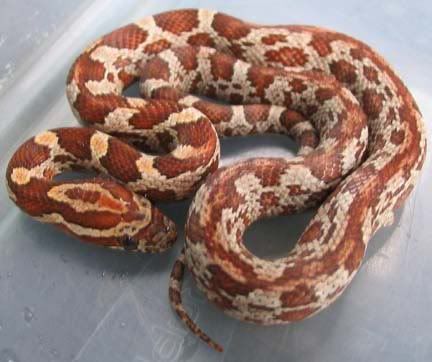
Here's a wacko aberrant hypo Honduran I have that is as healthy as an ox!

Oh, and do I have enough snake experience to be credible enough to voice such an opinion you might ask?,.....well, 42 years since 1967 should be enough experience I would think.

~Doug

-----
"a snake in the grass is a GOOD thing"

Shiari Nov 14, 2009 01:37 AM

Your snake is gorgeous, and it does reassure.

Words such as "thousands okay" have the same impact to me as a new pet owner telling me that Main Coons don't have a genetic predisposition to heart problems because none of the breeder's had heart problems. :/ It's sort of like "That's nice, can I see some ultrasound results from his/her animals? And would you like to come look at this one over here with a grade IV heart murmur?"

That's sort of how I feel when faced with the zig zags, patterns unlike Nautley's, on the one hand and the other snake with Nautley's pattern-type with a failure to thrive, and then died, on the other.

DMong Nov 14, 2009 03:27 AM

Now I'm thinking that you are around so many animals with horrible problems(being a vet tech) that you are "expecting" these same problems from every weird looking snake there is..LOL!

Take a couple valium(or Ketamine..LOL!), and relax,.....this is not the way it is with snakes, believe me. No hip dysplasia either..LOL!

There are countless TENS OF THOUSANDS of weird patterned snakes produced every single year with zero problems. I produced about 130 snakes this year, and no problems, aside from the two-headed albino Honduran that didn't survive out of the egg, but it had absolutely normal rings, and was NOT an aberrant patterned individual...LOL!

A good friend of mine has produced about 11,000 snakes, of ALL different kinds over the course of many years, and he produced TONS of pattern anomalies over the years too, and NONE have a corrolation with lethal, or defective genes. Snakes die, and don't hatch for all sorts of weird reasons, but the weird pattern theory just isn't one of them.

So has the valium or Ketamine kicked in yet?..LOL!

I hope this just about concludes the funky pattern mystery now...I'm going to bed!

Oh!, one last pic for ya,...this weird piebald bloodred corn is alive and well too, and couldn't be doing better.

-----
~Doug

"a snake in the grass is a GOOD thing"

Shiari Nov 14, 2009 04:34 AM

"Now I'm thinking that you are around so many animals with horrible problems(being a vet tech) that you are "expecting" these same problems from every weird looking snake there is..LOL! "

Think you hit the nail on the head. :P

And that snake is amasing. O_o Is there any ghost in the lineage that it could be a chimera? How wonderfully bizzare. Any sign of it being genetic?

DMong Nov 14, 2009 10:55 AM

That particular animal is owned by a good friend of mine, and I used to have some of it's genetic background written down and stored somewhere, but now I cannot remember where the heck I put it.

I do know however that the weird trait has not been hereditary in any breedings up to this point, which is too bad.

So keep in mind, the "bug-eyed" trait that can affects a fair number of the leucistic Texas Ratsnakes in tandem with the desired leucism is really the only known undesirable trait in any of the colubrid type snakes that I am aware of. In Ball pythons, there is a "bobble-head" trait, but that is an entirely different deal, and any of this nonsense is EXTREMELY, EXTREMELY, EXTREMELY few and far between.

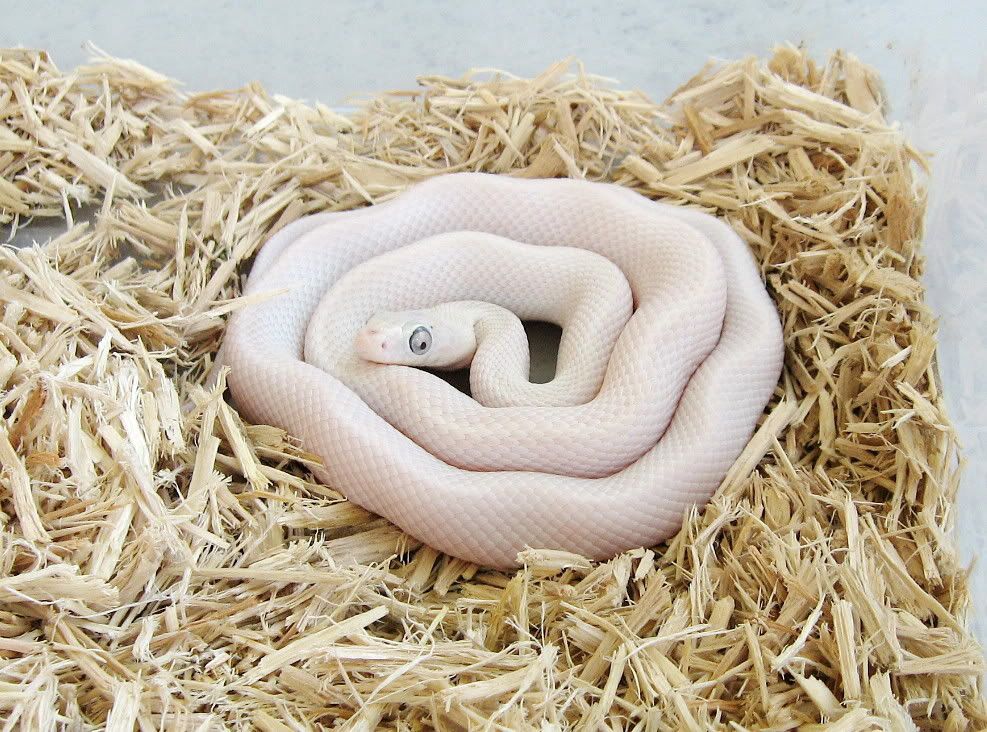
BTW, the "bug-eye" characteristic displayed with this individual is very mild actually, it can also be WAY more pronounced than this. And no, I do not care for this particular mutation at all, and it is VERY undesireablr to me. If you google this up on the net, you will see what I mean, there are some very groteque examples of this "tandem" trait out there in the hobby.

~Doug


-----
"a snake in the grass is a GOOD thing"

Shiari Nov 14, 2009 07:42 PM

For other undesirables, there is genetic 'stargazing' in corns. It is a recessive, heritable neurologic condition that appears to primarily affect fine motor control. It first popped up in the sunkissed morph, but is genetically unrelated.

http://www.youtube.com/watch?v=iXKNn_cgj1k

Shiari Nov 14, 2009 01:31 AM

"do you mean so many snakes have health problems in general or do you mean yours have so many health problems. "

I appear to have a personal curse with pets. My dog, at two years old, has hip dysplasia, food allergies, flea allergies, some sort of autoimmune-thingy that has nearly killed him 5 times AND may have diabetes insipidis on top of it. I have a cat with asthma, another one that was found with a diaphragmatic hernia, a third with severe aggression issues, and a fourth that likes to consume non-food items and has had to have surgery to remove them from his stomach.

Of my first dogs, one had epilepsy, the other liked to form tumors. I had, as a child, a baby hamster that was born with only three legs who developed heart problems, eye problems, and then cancer at 1.5 years of age.

I caught a wild western fence lizard as a little kid that had a seizure disorder.

Cursed I tell you! So like I said... I tend to be paranoid. So far, except for one sinus infection, my snakes have been healthy knock on wood.

"still a mute point...your snake isn't kinked so it isn't an issue "

The point is not moot in relation to the general idea that sometimes odd patterns have a detrimental cause. No, it is not specifically a kink, but could it be something else? Probably not, but again... paranoid.

"YOU are the one that said EVERY PIEBALD TO DATE, not me."

If I did say that, and I will go back and check, my apologies for not including the words "that I've seen". And rereading this post, I just noticed that I did not manage to include the word 'not' in the previous sentence. I often think faster than I type and sometimes words get lost.

"why do you add in "with underlying health issues"?
what underlying health issues?
are you assuming it has underlying health issues because it has an aberrant pattern or is there something you're not telling us? "

I add that because the possibility exists. There is likely a correlation between the highly aberrant patterns seen on some DIEs and the fact that they died. A genetic "oopsie" that made them inviable that could also play with the pattern. Just as with double merles and lethal white, or the tendency for white and blue-eyed animals to be deaf. Add the deformed head scales on top of the strange pattern and I have to wonder if there's something else that might not be visible.

"nice little back-handed insult. "

Insult truly not intended, and re-reading, I see how it definitely reads that way. Sometimes on forums I forget that people aren't psychic. And that what worries me with my vet tech, and personal pet, background is not going to magically translate itself across the internet.

Your snakes have lovely examples of saddle fusing/zigzag, but it's not quite what I was talking about. I don't know how to explain it better. My worry is probably because he's not a zig/zag, wide stripe, or aztec. I'm used to seeing those, but not pseudo-motleys that go straight to the tail tip. Most "notleys" I've seen have been proper motley look for about... 1/3 the length of the body? If need be, think of me and my paranoia as being as if I'm from the 'planet of easily frightened people' from the old cartoon Earthworm Jim. "Aaaah! something motley! Aaaah! something not motley!"


draybar Nov 14, 2009 04:43 PM

>>
>>"still a mute point...your snake isn't kinked so it isn't an issue "
>>
>>The point is not moot in relation to the general idea that sometimes odd patterns have a detrimental cause. No, it is not specifically a kink, but could it be something else? Probably not, but again... paranoid.


oops "moot" point
Anyway Tim already told you, and this can be confirmed by any major breeder, experienced herpetologist, zoologist or veterinarian...the pattern/color is the last thing to develop in the egg.
Many DIE's have odd patterns and colors but that isn't why they died, that is simply because they didn't survive long enough for the colors and patterns to develop fully

>>
>>"why do you add in "with underlying health issues"?
>>what underlying health issues?
>>are you assuming it has underlying health issues because it has an aberrant pattern or is there something you're not telling us? "
>>
>>I add that because the possibility exists. There is likely a correlation between the highly aberrant patterns seen on some DIEs and the fact that they died. A genetic "oopsie" that made them inviable that could also play with the pattern. Just as with double merles and lethal white, or the tendency for white and blue-eyed animals to be deaf. Add the deformed head scales on top of the strange pattern and I have to wonder if there's something else that might not be visible.
>>


But that is what we have been trying to tell you. It isn't likely. To date there has been no correlation between aberrant patterns and physical or health problems.

>>
>>Your snakes have lovely examples of saddle fusing/zigzag, but it's not quite what I was talking about. I don't know how to explain it better. My worry is probably because he's not a zig/zag, wide stripe, or aztec. I'm used to seeing those, but not pseudo-motleys that go straight to the tail tip. Most "notleys" I've seen have been proper motley look for about... 1/3 the length of the body? If need be, think of me and my paranoia as being as if I'm from the 'planet of easily frightened people' from the old cartoon Earthworm Jim. "Aaaah! something motley! Aaaah! something not motley!"


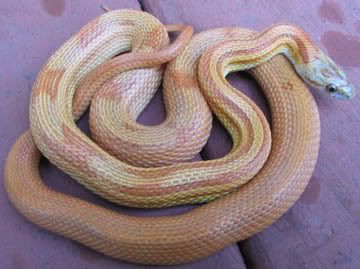
The ones I pictured are not Aztec, zig zag or wide stripe they just have cool patterns.
Sure these patterns might not be quite as aberrant as the one you pictured but it is still just an aberrant pattern and if you care for THAT snake properly you will still have it as long as you are willing to do so.


This brings me back to the piebalds again.
You believe the kinks or spinal deformities cause the white?
I just don't think I can see that. In this case I do not have experience but it just doesn't seem to add up.
Why would these deformities only cause white spots on the few "piebald" specimens and not all corns with spinal deformities?
Piebalds seem to be connected to bloodred but not all kinked bloodreds are piebalds, have white spots at kinks and/or pattern differences.
In conjunction to that, why don't kinks or spinal deformities cause any color or pattern differences in all other corn morphs?

Along with aberrant patterns most of us have had quite a few "kinked" specimens pop up over the years. So far there has not been any evidence of spinal deformities having a connection with pattern aberrancies or anomalies

Now there might be a slight "stretching" of the skin at a kink but this only "expands" the pattern it doesn't actually change it.

-----
Corn snakes and rat snakes..No one can have just one.
"Resistance is futile"
Jimmy Johnson
(Draybar)
Draybars Snakes

_____

draybar Nov 14, 2009 04:47 PM

>>
>>oops "moot" point
>>Anyway Tim already told you, and this can be confirmed by any major breeder, experienced herpetologist, zoologist or veterinarian...the pattern/color is the last thing to develop in the egg.
>>Many DIE's have odd patterns and colors but that isn't why they died, that is simply because they didn't survive long enough for the colors and patterns to develop fully
>>
>>
>>
should read as "pattern/color is one of, if not the last thing to develop in the egg"
-----
Corn snakes and rat snakes..No one can have just one.
"Resistance is futile"
Jimmy Johnson
(Draybar)
Draybars Snakes

_____

Shiari Nov 14, 2009 07:36 PM

"This brings me back to the piebalds again.
You believe the kinks or spinal deformities cause the white?
I just don't think I can see that. In this case I do not have experience but it just doesn't seem to add up.
Why would these deformities only cause white spots on the few "piebald" specimens and not all corns with spinal deformities?
Piebalds seem to be connected to bloodred but not all kinked bloodreds are piebalds, have white spots at kinks and/or pattern differences.
In conjunction to that, why don't kinks or spinal deformities cause any color or pattern differences in all other corn morphs? "

The answer to this is likely, as I said, that there are many different things that cause kinking, just as there's multiple causes of heart disease, and multiple types of cancer. We don't know what causes kinking in snakes. Some appear genetic and can be inherited, some appear to environmental, and some are simply congenital deformities. Maybe these particular piebald examples had a protein derangement that caused a bending of the spine is those location that also bleached out all color. Maybe the backbone didn't fully form there. I don't know the exact *why*, but the fact that on *these* snakes (not all kinked snakes of course, but these *particular* ones) the kinks were *only* located in the pied patches, and that the pied patches were *only* around a kink suggests a correlation between the lack of pigment and the spinal deformity.

I tried to make a distinction in one of my earlier posts that I'm talking true piebald, rather than pied-sided which is how the bloodred-related white patches are typically called. The piebald corn pics I saw were of a normal hatchling, with white blotches mostly to fully ringing the body, the way it does in ball pythons.

Kevin Saunders Nov 15, 2009 11:45 AM

"My worry is probably because he's not a zig/zag, wide stripe, or aztec. I'm used to seeing those, but not pseudo-motleys that go straight to the tail tip. Most "notleys" I've seen have been proper motley look for about... 1/3 the length of the body?"

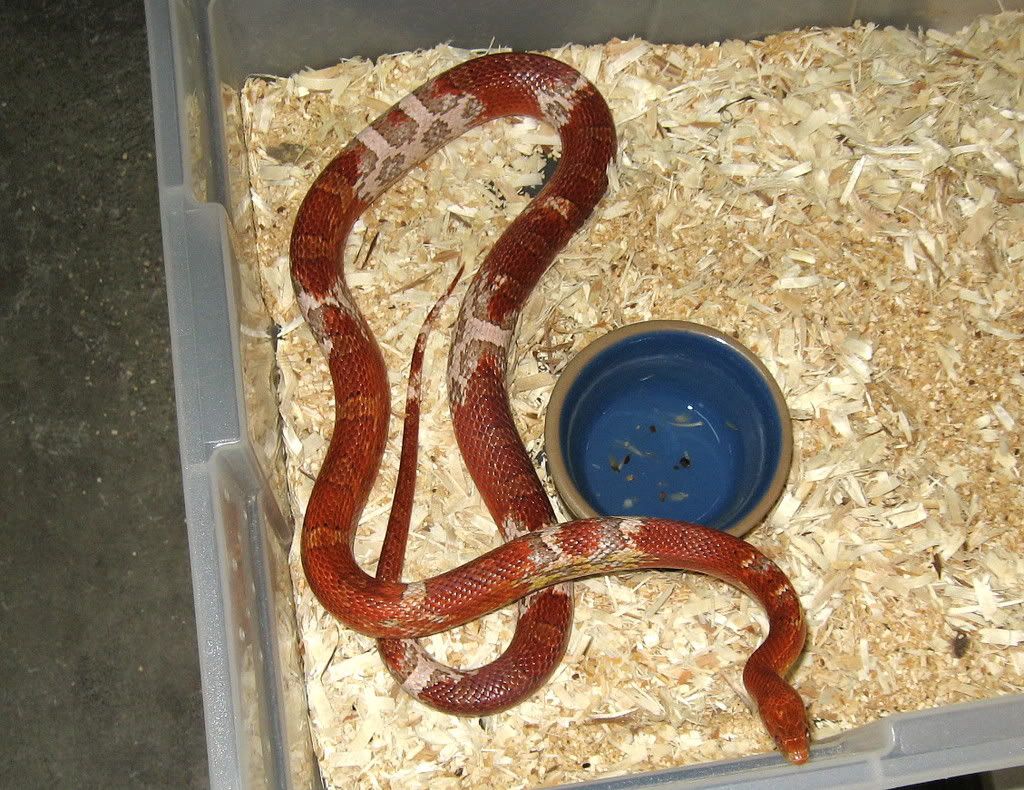
These aren't my pictures or snakes, but they are aberrant individuals with pseudo-motley patterns. They both look like healthy adults to me, so maybe this will help put your mind at ease.

DMong Nov 15, 2009 12:29 PM

Yeah, but she will figure they could just as easily die tomorrow from their weird patterns!..LOL!
-----
"a snake in the grass is a GOOD thing"

tspuckler Nov 15, 2009 03:31 PM

You're not kidding about that, Doug.
Here's one that I produced 15 years ago.
Its been doing quite well the past decade and a half
(though I'm sure its days are numbered due to its odd pattern).

Tim
Third Eye
Third Eye

DMong Nov 15, 2009 05:14 PM

Holy smokes Tim!, looking at that one's odd pattern, I'm totally surprised it made it out of the egg at ALL!

joking of course..LOL!

~Doug
-----
"a snake in the grass is a GOOD thing"

Shiari Nov 15, 2009 08:09 PM

Okay guys, honestly, enough. There is a thing known as taking the joke too far.

I explained the reasons behind my concern (similar pattern that suffered from failure to thrive and then died), explained why being told "thousands" does not reassure, and have stated time and again that I do NOT think that patterns cause health problems, but may instead sometimes be the result of an underlying issue. As you've said, it's last to form, so problems have a chance to affect it.

Seeing truly aberrant creatures that have thrived from personal experiences IS reassuring. So enough.

tspuckler Nov 16, 2009 08:48 AM

"why being told "thousands" does not reassure..."

You used almost no data to conclude that aberrant patterns are indicative of other health defects. There have been very few piebalds hatched and you've only seen a fraction of them.

Several people have told you that thousands of healthy snakes with odd patterns are hatched each year.

So when it comes to "enough." I think that something you should be say to yourself. You wasted a heck of a lot of time trying to extrapolate your theories when there's an awful lot of evidence to the contrary.

And you wanted to do is argue with people who have a heck of a lot more experience than you.

You've been given the same reply in several posts by several different people to answer your initial question.

So yeah, "enough."

Tim

Shiari Nov 16, 2009 10:42 AM

I was not given evidence aside from the words "there's been thousands". Say you've got a tumor. It looks like a tumor that turned out to be fatal cancer for your aunt sally. In comes a doctor that you don't know if he's just graduated or had years of experience and he says "Bah, there's thousands of benign tumors" and then proceeds to show you a skin tag as if that is somehow related to the suppurating thing on your leg.

If people can't tell piebald from pied-sided bloods, or have not heard of stargazing, how am I supposed to know how "experienced" you are?

But no, you're right. Enough is enough. This forum is too slow to try to see where someone is coming from, and too quick to harass further even after someone apologises and admits that they tend to be very paranoid about their pets. Because clearly, being concerned is a *bad* thing.

DMong Nov 16, 2009 01:36 PM

"If people can't tell piebald from pied-sided bloods, or have not heard of stargazing, how am I supposed to know how "experienced" you are?"

Well, I can assure you that all of us here that have been commenting on this have heard of ALL those things you mentioned, and know the differences of all the above too, and a whole lot more for that matter. I seriously doubt there are too many people in the entire world out there that know a whole lot more than I do about snakes(since 1967). I mean, I guess you could give me a snake quiz if you want to see if I am worthy of commenting about this..LOL! And of course I don't know everything about them, and neither does anybody else on this planet, it's absolutely impossible. And all the other's that have made comments about this have TONS of experience as well(decades), I know this for an absolute fact, and have known and corresponded with them about snakes for years.

We totally understand that there are a lot of things that are very unknown regarding genetics, we are the very first to admit this, and there is ALWAYS the possibility of certain undesirable traits or characteristics going in tandem with others, how could there NOT be, this is just basic common sense to me??. We are simply telling you what we know, and have seen over the several decades we've been involved with snakes.
We could continue to speculate all sorts of bad scenario's all day long, but all we are simply trying to say is that probably 99% of any genetic problems have nothing to do with aberrant patterns, the other one rercent very well could, who knows. And not just corns, but MOST snakes too, that is all we are trying to get across here.

This will be my last comment about it, as I don't see a need to continue beating a dead horse corpse over it, so I will just leave it at that.

BTW, I would totally enjoy someone giving me a snake quiz, I think that would be lots of fun. Any quiz I have ever done regarding them was FAR to basic, and geared way to much towards the everyday general public I can't even remember a snake quiz that I didn't get a perfect score on either. Now I on the other hand could give a snake quiz that would boggle most peoples mind, and I'm quite certain many would fail miserably to be quite honest. This would be a good way of seeing how much people do, or don't know, but it would also prove quite embarassing to some too.

BTW, we are certainly not saying your odd patterned corn isn't, or can't have any defect(s) either, we are simply stating what we know over the course of many years.

best regards, ~Doug
-----
"a snake in the grass is a GOOD thing"

shaky Nov 17, 2009 07:35 PM

Shiari,
As you are aware, many of us have heard of heat spikes and other egg problems relating to deformities, death and pattern aberrancies. Usually these are quite apparent as medical issues.
However, the issues are not apparent in your snake save for the small size, which has not been an issue. Therefore, no one is sure what else to say.
Most often, if a corn snake seems healthy, then it is. If something happens later to change that, we can perhaps give better advice.
Enjoy your pretty little snake.
-----
Jack Jeansonne

cornsrule Nov 16, 2009 11:52 AM

I've got to agree with Shiari on this one. I respect your years of experience and your advice, but in the middle of a heated argument, she was able to take a step back and laugh at herself and make a move towards resolution. You guys just kept making fun of her and being hurtful.

Site Tools