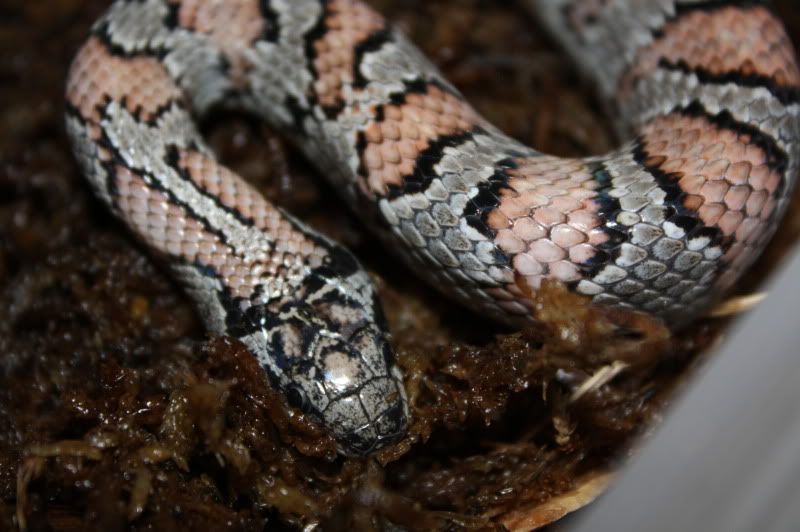
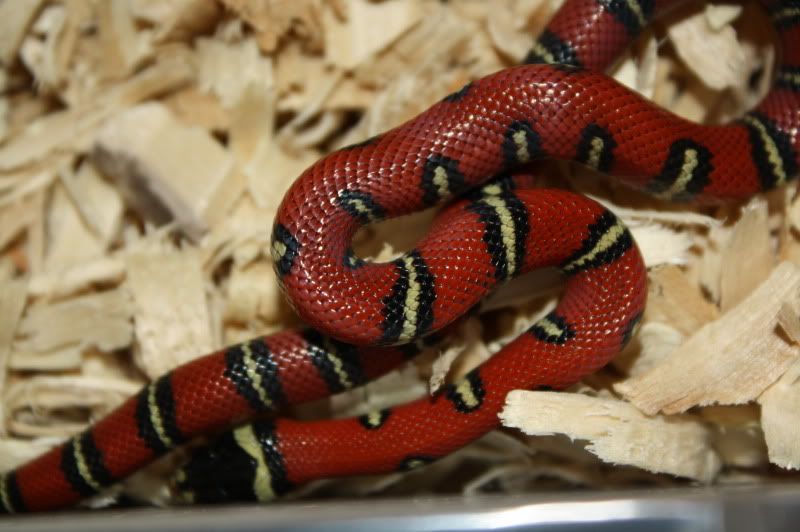
I certainly don't know where Isis' line originated, but that is always a possibility, but I'm sort of wondering if it isn't just from an exceptionally yellow holbrooki(like some of Todd's, etc..), then when the melanin is removed, it just completely left the underlying yellow pigment that was totally throughout the entire snake, so now not only the belly is a strong yellow, but so is the entire dorsum. These other lighter speck lines could simply be from lighter cream/beige bloodlines instead, since there is huge variation involved with them, and all the other neighboring ssp. for that matter too.
Amels that display strong yellow coloration(and other colors too, pinks, yellows) are fairly common, just as in certain nelsoni(Tim Spuckler's for example), and even Honduran's and others, at least to some degree. The idea that an amel snake has to be white once the melanin is no longer present is just not always so at all. Amelanism would ONLY remove the black, brown, and gray coloration, nothing else. Many times there are other additional underlying pigment(s) in a snakes color scheme that are exposed when there is a complete absence of melanin.
Also, the extremely yellow nelsoni individuals do not start out this way as hatchlings, but rather display a gradual ontogenetic change over time as they mature. I have done a fair amount of reading about the different pigment cells(chromatophores), and what colors they can be responsible for.
The ongoing yellowing in animals is often caused by caratinoid retention. Individual animals can have a certain genetic pre-disposition for doing this, and are known to retain much more of this than others, which allows the pigment cells to continue developing more and more yellow coloration as it ages throughout it's life. This is what I and others suspect is going on with these individuals that get much yellower later on in life, just as those incredibly yellow nelsoni individuals that Tim has. Same thing with a few Honduran's I have as well. They started out white too, and now they have a greenish/yellow cast to their once-white color scheme.
So either it had the underlying yellow pigment to begin with, or it developed more yellow as it got older, both of which are fairly common in amels.
Anyway, I'll say it again, that is one nice high-yellow animal!
~Doug
-----
"a snake in the grass is a GOOD thing"