Reptile & Amphibian Forums

Welcome to kingsnake.com's message board system. Here you may share and discuss information with others about your favorite reptile and amphibian related topics such as care and feeding, caging requirements, permits and licenses, and more. Launched in 1997, the kingsnake.com message board system is one of the oldest and largest systems on the internet.

Click here to visit Classifieds
Click for ZooMed

Breeding question...

morrokko Dec 10, 2009 10:44 PM

Hello again!
So i found out here in CO hognoses are NOT regulated as long as they are captive bred captive born out of state according to the head of herpatology and special licencing. YAY!
BUT selling them i need to talk to the CO Vetranary office.

BREEDING QUESTION!
Anyone ever heard of breeding a western to a mexican hognose? Is it possible?
Just curious,
Thankyou!!!
Laura

Replies (18)

Jon R Dec 10, 2009 11:02 PM

I don't know if you would have much luck breeding them together, because they breed at different times if year. but you would have the best luck with a Mexican male to a western female I would think.

But here's my question. Why would you want to?? If you have one if each, just get mates for them and breed true. Or just breed mexicans and don't worry about the co state laws at all.

Jon

morrokko Dec 10, 2009 11:44 PM

Hey thanks for replying! I was just wondering cause a friend of mine has a mexican male and i have a western female, we thought it would be interesting to see what we get.
A just for fun project ya know.

I worry about the laws in CO because i wanted to buy a pair of albino western hogs and needed to know if it was going to be legal to breed and sell them. Looks like it will be as long as i have papers to go with them. According to fish and game anywhoo...

Gregg_M_Madden Dec 11, 2009 07:39 AM

You would get a subspecies intergrade... It has been done before... I am willing to bet that some of the captive bred stock may have a little bit of mexican blood mixed in... Like most species that are bred in captivity, locality and subspecies are not really looked into at the start of it being established in captivity... Breeding locality spacific animals and subspecies is usually an after thought.. How many of us have locality spacific Western hogs??? I will bet the number is very small... However more people are getting into the locality spacific Mexicans which is a great thing...

Jon R Dec 11, 2009 11:23 AM

The mexican and plains status have been changed. They have dropped the sub-species and taken them to the species level. They are now heterodon nasicus and heterodon kennerlyi. That means a breeding between the two would result in a hybrid, not an intergrade.

To my knowledge, there is no confirmed natural occurring intergrades between the the two where they co-exsist. The different breeding seasons seem to naturally control this from happening.

I dont believe there has been much of this happening in captivity. I think most plains are true plain and the mexican are pure as well. I have never seen an animal that would make me question this. Everything that I have seen that looks plains, scales out as plains and everything that looks mexican scales out to be a mexican.

As far as locality pure animals, there are not many locale specific plains, but the majority of mexicans in captive breeding programs are. This probably has to do with the the amount of morphs available in the plains, the large amount of animals in captivity, and the fact that they have been bred in captivity longer.

My $.02

-Jon

brhaco Dec 11, 2009 12:09 PM

Regardless of taxonomy, it would be a simple matter to cross kennerlyi and nasicus (though I would never do so, of course!). In my collection both breed reliably at the same time of year. Even if they are distinct species, they are much closer than a lot of other inter-species hybrids out there.
-----
Brad Chambers
WWW.HCU-TX.ORG

"Some things are flat impossible-until they're done."
Robert A. Heinlein

Toaddiggers Dec 11, 2009 10:24 AM

Hi Laura, Let me give you one word of advice regarding the answer you received from the Colorado official you spoke to about the hognose. Get it all in writing. Ask specific questions and get their answer in writing for your own protection.

Wendell

eksnek Dec 11, 2009 11:28 AM

Please don't do it! Personally, I wouldn't want the offspring even if the entire clutch was offered to me for free. I will not ,knowingly, even buy/trade with anyone that mixes species and/or subspecies. I actually keep a list of companies/breeders that work with hybrids/integrades and i stay far away from them. I will do what i can to not support such practice.

Let's keep these awesome animals PURE! (as much as possible)

Best,
Kenny

bbox Dec 11, 2009 05:43 PM

I wanted to comment on a few things that have been posted thus far. Yes you can breed a Mexican with a plains. I did it several times in the late 80's/early 90's when I did not have a good male Mexican. I may have photos of the offspring somewhere, but they are prints and I do not have a scanner.

I also have some photos of what certainly appear to be natural crosses between the two subspecies (I am not sold on the species status given to kennerlyi). Their ranges do not overlap, they gradually change from one to the other. No major gaps in the range in Texas. The Pecos river is certainly not enough of a barrier to stop gene flow between the two subspecies, although specimens that I have seen from just west of the Pecos definitely show Mexican characteristics and the ones from just west show Plains. I wish that I had the photos of my old Val Verde county stock scanned in to show. I will see what I can dig up if I get the time this weekend.

Finally, I do currently breed locality kennerlyi and gloydi (yes, I still consider gloydi valid), as well as several morphs. For those that are so opposed to crossing these animals, you had better stay away from any morphs. I know that many of the red hogs out there have a lot of gloydi blood in them. Breeding a "plains" hognose from Texas to one from South Dakota is a lot worse than breeding a "plains" hog found just east of the Pecos to a "Mexican" hog from just across the river IMHO.

Just my .02

eksnek Dec 11, 2009 07:19 PM

I thought that gloydi is no longer considered a subspecies?

If there was a cross between the dusty and plains, is there a way to identify?

Regards,
Kenny

bbox Dec 12, 2009 01:16 AM

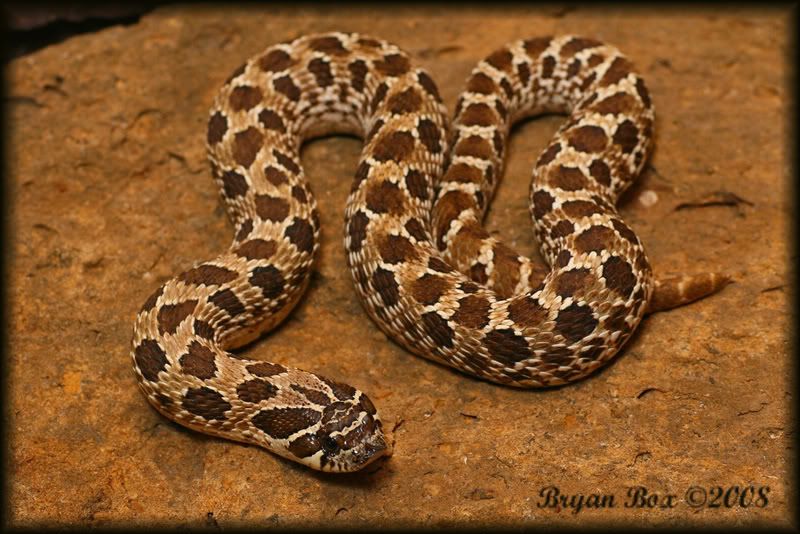
Many people no longer recognize gloydi. Gloydi normally have a lower blotch count and their blotches tend to be more square than round. They usually are found in area that have more trees (oaks in particular). Pattern seem to be similar to the emory rat vs the corn snake in Texas (to me anyway). Very few people have "gloydi" available and you rarely see wildcaughts. If anyone has photos of some from the far eastern portion of their range, I would love to see some.

According to Dixon, male gloyi have fewer than 32 blotches head to anal plate, nasicus nasicus has 35 or more. This particular wild caught male is from the furthest east portion of the "plains" range in north central Texas. He has the more square blotches and a blotch count of 32.
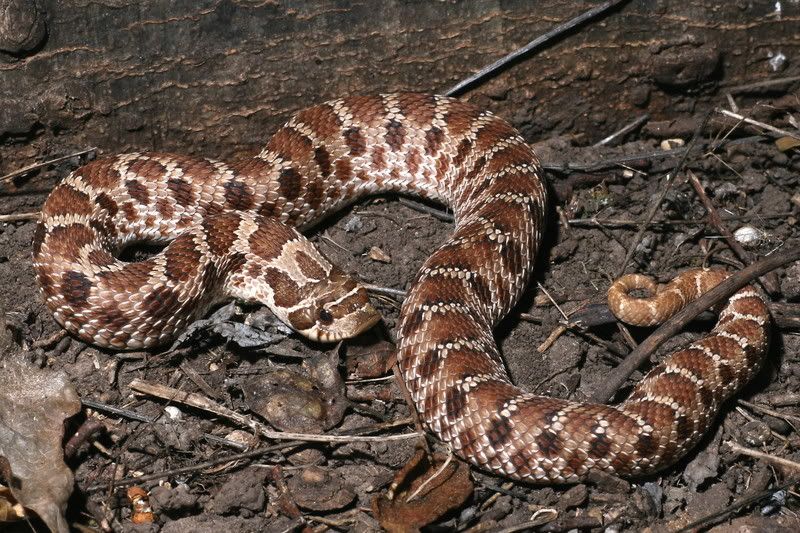
Females "plains" have more than 40 blotches and "gloydi" have fewer than thirty-seven. This wildcaught female is from the same county as the male above and has 33 or 34 blotches (depends on what you consider a blotch). It also has much more square blotches.
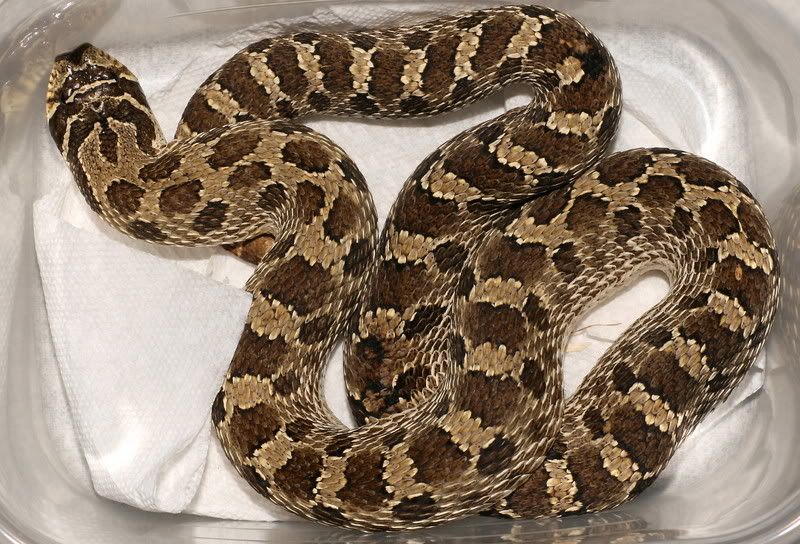
This female has between 37-39
and this female has around 34-35
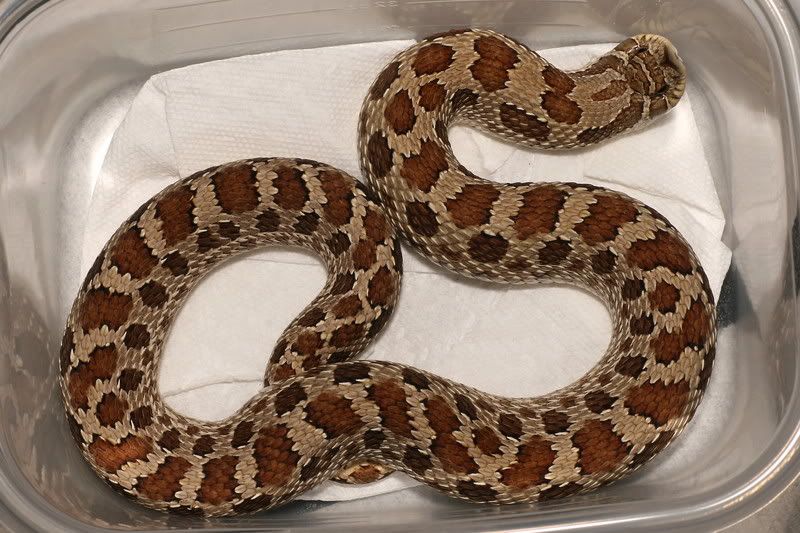
I would love to see some more photos of wildcaughts from the eastern portion of the nasicus range. According to Dixon, all of these key out to either "gloydi" or somewhere in between the two subspecies, and certainly do not look like most wildcaught "plains" I have seen. You do see this "gloydi" influence in many of the captive westerns due in large part to animals that I produced many years ago that were worked into several large breeders' collections.


eksnek Dec 12, 2009 10:27 AM

Thanks for the informative post.

I guess for my own sanity, I still need to decide to whether or not to consider gloydi a valid ssp. So far, i think that a natural variation of colors/pattern of plains hogs from different locations is not enough to to convince me that it is a different ssp. Plus, selective breeding in captivity alters blotch counts, shape of blotches, color etc...Being that i am not a locality fanatic, breeding hogs of the same ssp. from locales does not bother me. I am only concerned with mixing subspecies and species.

On the other hand, if the pure plains and pure "gloydi" have any scale variation then i would be more inclined to recognize gloydi as a seperate ssp. Do you know if there is any?

Regards,
Kenny

Gregg_M_Madden Dec 12, 2009 02:17 PM

Can you point me in the direction of the literature that states Heterodon nasicus kennerlyi has been given full species status??? I have been looking like crazy but have yet to find anything that states this... Infact, most of what I have read says the opposite...

Also, do you know what tests were done to be able to grant them full species status??? Was there molecular testing done??? I know that pattern differences and scale counts are not enough to validate a species...

Anyway, it is nice to see others who like "pure" animals but honestly, there is nothing pure about keeping reptiles in a cage or rack and when you captive breed, you toss natural selection out the window anyway... Even though I would not breed a Mexican to a Western, I would be in no place to tell someone not to do it... To each their own...

Not all hybrids are evil and un-natural... In fact hybridizations is natures fast foward button in the evolutionary VCR... There are studies being conducted now that prove natural hybridization is how new species are created...

Jon R Dec 12, 2009 03:08 PM

I'll do a search for the papers I read. I know the status has been changed in the Herps of az page.

As far as hybrids go, I would never tell anyone not to do it, and I wouldn't judge anyone for doing it. I just wouldn't do it myself.

I have several localities of kennerlyi, alterna, and green rats.
And even though they won't produce all the variations that could be found in the wild and they live in a rack, it does not mean they, or their offspring will not be a good representation of the animals from those areas.

This has turnned into a pretty good thread. I like hearing others opinions about this subject.

Jon

Gregg_M_Madden Dec 12, 2009 04:12 PM

Awesome Jon... I have been looking because I had heard something about a separation and said something on a UK forum about it... Unfortunately I had no literature to back myself up so I hade to kinda back out of the talk... This will help me out a lot...

brhaco Dec 13, 2009 08:23 AM

Here's the paper in PDF form.

http://logojoe.com/snakes/heterodon_kennerlyi.pdf
-----
Brad Chambers
WWW.HCU-TX.ORG

"I am free, no matter what rules surround me. If I find them tolerable, I tolerate them; if I find them too obnoxious, I break them. I am free because I know that I alone am morally responsible for everything I do." - Robert A. Heinlein

Jon R Dec 13, 2009 12:34 PM

Here is the reptilesofaz.org kennerlyi link. They have dropped nasicus.
http://www.reptilesofaz.org/Snakes-Subpages/h-h-kennerlyi.html

Gregg_M_Madden Dec 13, 2009 05:44 PM

Brad and Jon, you guys rock... Thanks for the literature...

giantkeeper Dec 14, 2009 02:12 PM

Bryan, I love your animals and your photography. This female is out of this world!


-----
Chris & Alliey
www.bloodyleopard.com
E-mail Us

Site Tools
