Reptile & Amphibian Forums

Welcome to kingsnake.com's message board system. Here you may share and discuss information with others about your favorite reptile and amphibian related topics such as care and feeding, caging requirements, permits and licenses, and more. Launched in 1997, the kingsnake.com message board system is one of the oldest and largest systems on the internet.

Click for 65% off Shipping with Reptiles 2 You
Click for ZooMed
Click here to visit Classifieds

Elaphe bimaculata..notes on localities..

ratsnakehaven Dec 22, 2009 03:35 PM

In the spirit of a previous strand on localities and for Christmas, in general, I'm going to talk about bimaculata, localities, and show some specimens I've had in the past and present.

Elaphe bimaculata, the Chinese twin-spotted ratsnake, comes from a fairly small range for a species of ratsnake, in the lower Yangtze River Basin. It is a subtropical region of China; but bimacs are a montane snake in the sense that they inhabit foothills and medium elevations of surrounding mountains. So, the climate for them is warm temperate, with cold temps in winter causing them to brumate, at least partially. They may be opportunistic baskers.

The reason this is suggestive info is because the idea of "locality" comes into play. One wouldn't think there would be much in the way of localities with such a limited range, but several range limiting factors come into play. One is the fact that populations of bimaculata are separated by mountains and valleys. They don't seem to inhabit the valleys, which means that populations can be isolated that way and evolve differently. The other big locality maker is the Yangzte River itself, one of the largest in Asia. Snakes from south of the river are going to be isolated from snakes north of the river, even though they are the same species.

As a result of isolating factors we get locality snakes from China. The only thing is nobody knows quite where they come from, or which locality, because the collectors don't pay attention to that. So we have a species of ratsnake with a relatively small range and a really wide spectrum of color/pattern.

Part of the point of this post is to show that localities do matter and sometimes you can have a lot of locality variation in a rather small region of the world.

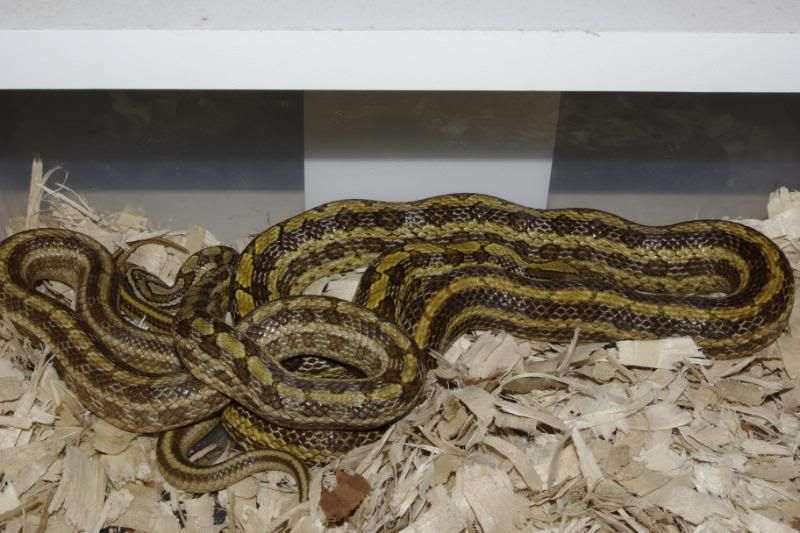
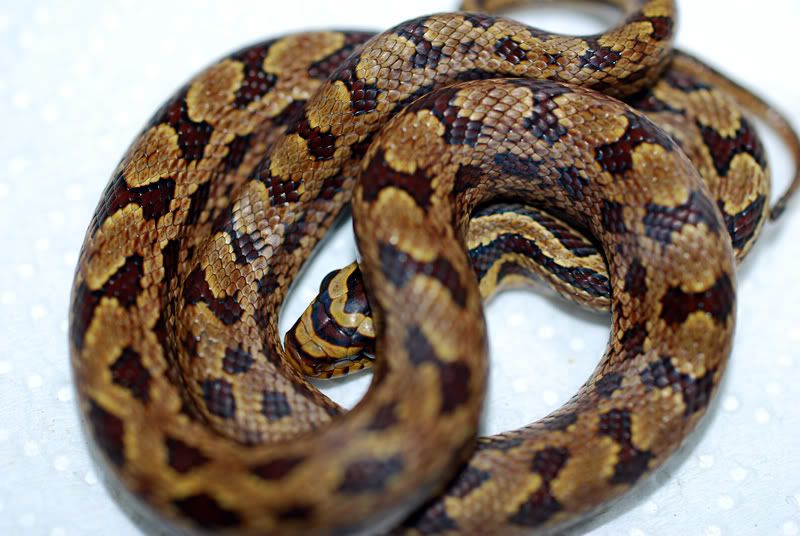
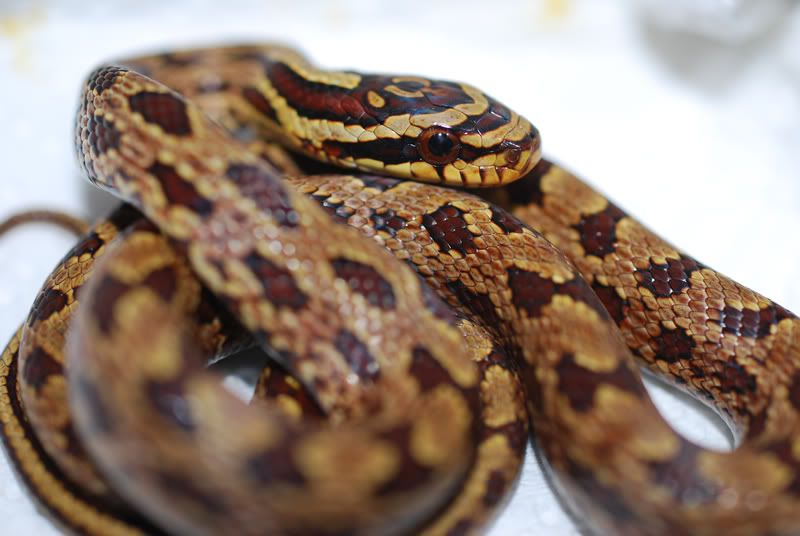
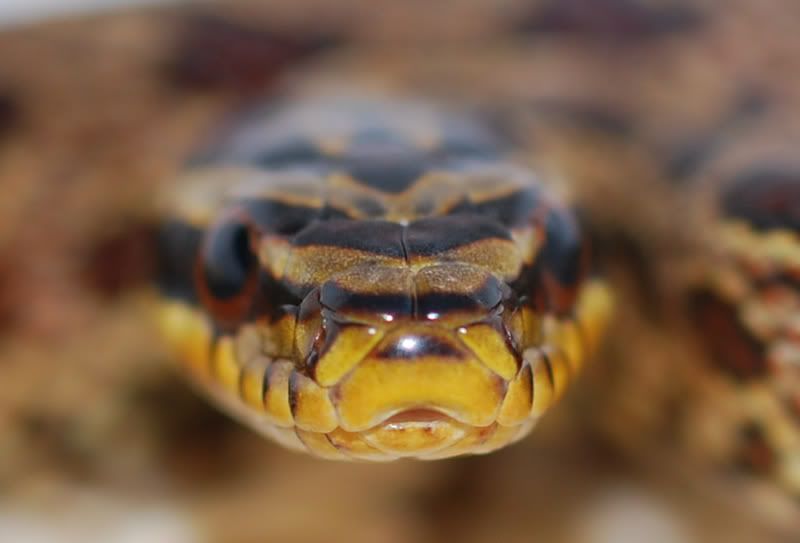
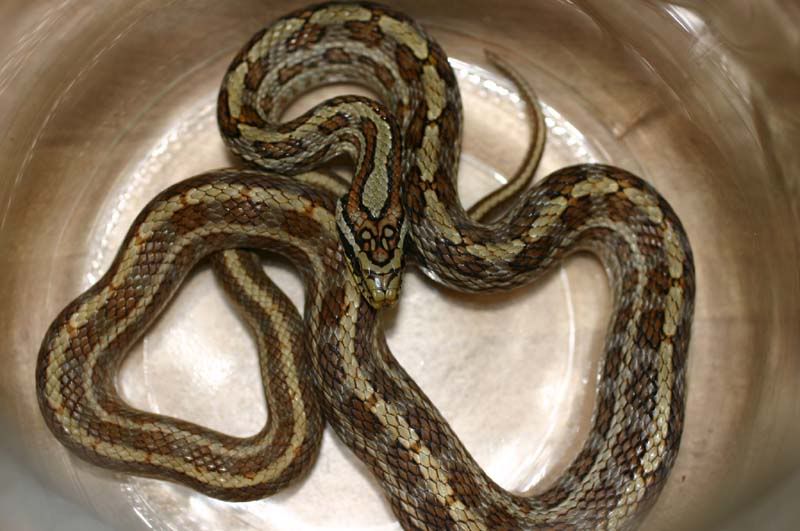
Here's some photos of bimaculata...

This is a bluish phase w/c adult female...

Here's a male I got from another breeder. Nice line, but kinda generic...

One of my original adult females, a blonde phase w/c bimac...

An adult female from crossing two different lines...

A baby bimac from crossing my blonde line with that of another breeder...

A 50% blonde adult male cross....

I could probably dig up some more pics of old bimacs that I've raised, but this should be enough to make some points.

Can we say that any of the bimacs in the hobby are "locality" bimacs? We know they are locality, if they are w/c, but we can't say what locality they are, so we can't really say they are locality snakes for the purpose of sale or trade. Now most bimacs have been crossed with other lines and none are pure locality snakes. I'm always on the lookout for unique imports, because of the locality factor, and with the hopes of getting a mutative morph someday.

I also believe these ideas can be applied to other species. One that I work with, that is similar to the corn snakes being discussed back in October, is the Emory's ratsnake, Pantherophis (guttatus) emoryi. This species is a good species for locality differences, imho.

Have a great holiday week, all. Cheers...Terry

-----
Conserving reptiles by helping to protect habitat...
www.ratsnakehaven.com
www.scenicsantaritas.org


Replies (12)

hermanbronsgeest Dec 23, 2009 02:39 AM

Wow! That blueish one is awesome!
-----
I'm Dutch. Somebody shoot me.

ratsnakehaven Dec 23, 2009 09:15 AM

>>Wow! That blueish one is awesome!
>>-----
>>I'm Dutch. Somebody shoot me.

Yeah, it' hard to go herping in those wooden shoes...LOL!

I'm glad you appreciate a nice speciman. I haven't seen another bluish phase bimac since then, and I sure would like to...

Terry

-----
Conserving reptiles by helping to protect habitat...
www.ratsnakehaven.com
www.scenicsantaritas.org

monklet Dec 23, 2009 10:36 AM

"Yeah, sure their locality snakes...just don't know which;p"

I find the "blonde" especially appealing.

ratsnakehaven Dec 23, 2009 02:44 PM

>>"Yeah, sure their locality snakes...just don't know which;p"
>>
>>I find the "blonde" especially appealing.

Well, that was part of the point. There are locality snakes out there, but finding them is something else too. I don't think most true locality enthusiasts will buy just anything based on the seller saying it's a locality snake. I would hope locality buyers want to find something special, something where they had in mind what it looks like and what that locality animal is all about. Otherwise, sellers are just labeling all their snakes "locality" just to raise the prices up.

In the case of the Chinese twinspots the locality snakes are rare, because snakes aren't i.d.'ed when they are imported. Nobody knows exactly where they're from. So much more could be learned from them if we did have that info. So all the bimacs are sold as generic. You just have to keep an eye out for fresh imports or a really distinct "look," if you want to have a chance at anything close to a locality morph.

Many of the snakes in the U. S. are also hard to find as a "locality" animal, usually because all the U. S. stock comes from just a few snakes, or because they've been crossbred so many times. Take for instance the variable kingsnake, Lampropeltis mexicana thayeri. It's no wonder some folks are so hot to have locality snakes like the graybanded king, L. alterna.

I might add that not all snakes are desireable as locality snakes. For instance, I saw a thread a ways back about desert kings, L. getula splendida, and what we thought was the best look, or whatever. I didn't feel I had anything to add to that thread at the time, but if I did it would have been that I would look for the most representative form, probably from near the middle of their range, as the best look. Of course, I also breed "locality" splendida...LOL!

Sorry for rambling so much, but I know you're a glutton for punishment...heheh!

Happy Holidays...TC

-----
Conserving reptiles by helping to protect habitat...
www.ratsnakehaven.com
www.scenicsantaritas.org

DMong Dec 23, 2009 04:12 PM

Two VERY well-done posts my friend!

Incredible specimen's, and some very good follow up information on them to boot!

And an appropriate cozy "hide" for everyone's snakes this Christmas season!..LOL!

Happy Holidays!

~Doug
Image
-----
"a snake in the grass is a GOOD thing"

my website -serpentinespecialties.webs.com

ratsnakehaven Dec 24, 2009 11:47 AM

>>Two VERY well-done posts my friend!
>>
>>Incredible specimen's, and some very good follow up information on them to boot!
>>
>> And an appropriate cozy "hide" for everyone's snakes this Christmas season!..LOL!
>>
>>
>>Happy Holidays!
>>
>> ~Doug

Thanks, Doug, and a very Merry Christmas to you and yours!

Terry
-----
Conserving reptiles by helping to protect habitat...
www.ratsnakehaven.com
www.scenicsantaritas.org

tbrock Dec 23, 2009 05:49 PM

Nice post, Terry. You've got some interesting observations and ideas concerning localities of bimaculata - good stuff for thought. It would be great if the field collectors would note the localities of the animals they capture.

Here is a mating pair (locked up this Nov. - before cooling) from your blonde line. I think you have called these 75% blonde.

-----
-Toby Brock
Southwestern Center for Herpetological Research

ratsnakehaven Dec 23, 2009 06:21 PM

>>Nice post, Terry. You've got some interesting observations and ideas concerning localities of bimaculata - good stuff for thought. It would be great if the field collectors would note the localities of the animals they capture.
>>
>>Here is a mating pair (locked up this Nov. - before cooling) from your blonde line. I think you have called these 75% blonde.
>>
>>-----
>>-Toby Brock
>>Southwestern Center for Herpetological Research

Thanks, Toby, and you're right. They are siblings of the male I called 50% blonde. I forgot their mother was the blonde female and father was 50% blonde, so they would be 75% blonde. This line tends to develop striping near the tail.

I should also have mentioned that there are striped forms of bimaculata too.

-----
Conserving reptiles by helping to protect habitat...
www.ratsnakehaven.com
www.scenicsantaritas.org

ratsnakehaven Dec 24, 2009 11:45 AM

>>Thanks, Toby, and you're right. They are siblings of the male I called 50% blonde. I forgot their mother was the blonde female and father was 50% blonde, so they would be 75% blonde. This line tends to develop striping near the tail.
>>
>>I should also have mentioned that there are striped forms of bimaculata too.
>>

I've seen photos of albino bimas too, only they're never available to hobbyists like me, at least in the U. S.

Terry
-----
Conserving reptiles by helping to protect habitat...
www.ratsnakehaven.com
www.scenicsantaritas.org

tbrock Dec 24, 2009 11:48 AM

>>I've seen photos of albino bimas too, only they're never available to hobbyists like me, at least in the U. S.
>>
>>Terry
>>-----
>>Conserving reptiles by helping to protect habitat...
>>www.ratsnakehaven.com
>>www.scenicsantaritas.org

Yep, I've seen those pics too, Terry. Wish we could get our hands on one. Someday...
-----
-Toby Brock
Southwestern Center for Herpetological Research

souix Dec 26, 2009 09:16 PM

Hey Terry

Interesting post - I'd like to comment on the bluish phase. About twenty of so years ago, when mostly WC was all that was available, a shipment arrived in the UK that contained a large group of the blue background bimacs, they were a lot cleaner looking than the one in your photo without the dark centers to the scales and had cherry red markings (blotched with no dark striping and mostly dumbbell shaped blotches). The importer told me they were from the Jiangxi province, how true this is, I don't know. These were very popular at the time and for several years whilst bimacs were in favour, and were the main colour available over here. As the 'morph' era ascended on the hobby, they sadly were one of the species that got forgotten and its now near on impossible to obtain any CB bimacs here. I saw a large import of bimacs a few years back and none of them were of the bluish phase. most were pretty generic blotched striped. Last year there were some imported into Europe and some of our friends invested in them, of the photos I saw most were of the blotched variety and had some nicely coloured bold blotches with clean backgrounds, but no locality details. I was really taken with one pair and invested in some of the babies produced from them this year.

Couple of pix of my babies - looking very dull in there juvenile colouration which hopefully will lighten up as they mature.

It would be great to have specific locality lines of Bimacs available in the hobby, and identify unique characteristics in them, like we have with the Diones. The Blues and Blondes are real pretty. But I can't see it happening unless someone collects and exports themselves. But I guess what we could do is line breed for unique characteristics ? The 75% blondes that Toby has, show some of the colouration of the blonde in the background - be interesting to see what the babies of this pair look like, whether any of them have the bleached look of the original.

Slightly off topic - but talking about colouration - I have heard mention that males tend to be more colourful than males - is this an observation that you or anyone else could confirm within the clutches that you've hatched over the years ?

one more thing then I'll stop with the rabbit - on the striped bimacs, I believe there is actually a genetic (simple recessive) stripe in captivity in a private breeders collection in europe - quite different to the wild stripe phase.

Happy New year to one and all - Sue xxx
-----
Junglezone - Webdesign

ratsnakehaven Dec 27, 2009 08:50 AM

>>Hey Terry
>>
>>Interesting post - I'd like to comment on the bluish phase. About twenty of so years ago, when mostly WC was all that was available, a shipment arrived in the UK that contained a large group of the blue background bimacs, they were a lot cleaner looking than the one in your photo without the dark centers to the scales and had cherry red markings (blotched with no dark striping and mostly dumbbell shaped blotches). The importer told me they were from the Jiangxi province, how true this is, I don't know. These were very popular at the time and for several years whilst bimacs were in favour, and were the main colour available over here. As the 'morph' era ascended on the hobby, they sadly were one of the species that got forgotten and its now near on impossible to obtain any CB bimacs here. I saw a large import of bimacs a few years back and none of them were of the bluish phase. most were pretty generic blotched striped. Last year there were some imported into Europe and some of our friends invested in them, of the photos I saw most were of the blotched variety and had some nicely coloured bold blotches with clean backgrounds, but no locality details. I was really taken with one pair and invested in some of the babies produced from them this year.
>>
>>Couple of pix of my babies - looking very dull in there juvenile colouration which hopefully will lighten up as they mature.
>>
>>It would be great to have specific locality lines of Bimacs available in the hobby, and identify unique characteristics in them, like we have with the Diones. The Blues and Blondes are real pretty. But I can't see it happening unless someone collects and exports themselves. But I guess what we could do is line breed for unique characteristics ? The 75% blondes that Toby has, show some of the colouration of the blonde in the background - be interesting to see what the babies of this pair look like, whether any of them have the bleached look of the original.
>>
>>Slightly off topic - but talking about colouration - I have heard mention that males tend to be more colourful than males - is this an observation that you or anyone else could confirm within the clutches that you've hatched over the years ?
>>
>>one more thing then I'll stop with the rabbit - on the striped bimacs, I believe there is actually a genetic (simple recessive) stripe in captivity in a private breeders collection in europe - quite different to the wild stripe phase.
>>
>>Happy New year to one and all - Sue xxx
>>-----
>>Junglezone - Webdesign

Hi, Sue.

Thanks very much for your nice response and interest in bimaculata. This is one of my favorite all-time species to work with. Now to follow up on some of your observations/questions.

Part of my original stock of bimaculata from the late 90's was from the late Lloyd Lemke, a pioneer. Unfortunately, he didn't have very many bimacs, and I was just discovering them as they were fading already in popularity. One of the females was the bluish phase and one female was the blonde phase. I also received several females and males of the brownish phase from him. I never saw another bluish phase bimac for sale and I've only seen one other blonde phase and was unable to obtain it.

With the snakes I did have I tried to breed them, but here's what happened. The blue female only produced one small clutch before I lost her. The babies were rather ugly, since she had crossed with a brown phase male. The blonde female was very hardy and produced several clutches before getting too old. One of her male babies I bred back to her to get the 75% clutch, of which several went to Toby. But I was never able to find a pure blonde male to breed to her to produce a pure line. The blonde trait proved to be just a color phase and not a recessive gene.

From what I can tell of the bimacs available today, they are all generic and variations of the brown phase. I believe the brown phase is the most dominant in the wild, but the other phases seem to have places where they are common. You mentioned Jiangxi and that might be one of them, since many blue phase seem to have come from there. Then again that could be just the shipping location. I also have some ideas about locations, for the blonde phase, for instance, or just locations that seem like they would be good to nurture a certain look.

I'm with you in thinking we'll never get the "locality" info we desire unless we collect the snakes ourselves, which is not likely; but we can line breed a color phase, if we can obtain original stock. Therefore, we have to watch for imports, and I haven't seen any here in the states for a long time.

The look of the blondes when crossed with more common types is somewhat lost, but it does help lighten the color of the type it is crossed with. I'm experimenting with that right now and also with the pattern of the snakes, selecting for the dumbell-shaped blotches with a more symetrical pattern. I'm looking for a snake with a light ground color and bright reddish-brown blotches without too many broken ones. One problem the blonde phase produced was the striping. Some of the babies have developed well defined stripes in the back half of the snake, which includes one of my breeders. However, the lines I'm using to cross with don't have any stripes which helps. I'm raising some of the babies of two crosses at this time.

As for the striped bimacs..I did have a stiped phase early on with obtaining stock. I didn't like the striped phase morph very much, not only for the looks, but because I thought their temperament was different, unfavorable, and they tended to be darker. I decided not to work with them. I do believe a striped bimac could be selected for, however, as well as found in the wild, and an all-stripe line produced. I don't believe this would improve the popularity of the species in the U. S. though. I would love to find an albino or other mutation to help with that. If there is a European striped form, I would be happy to give it a try to see what its behavior is like. If it is a recessive trait, that would be nice.

Thanks for the pics of your babies. All the babies I've produced have been very dark at birth. They tend to lighten up fairly quickly. Maybe I'll find some more pics later to add. Like I said earlier, I'm selecting for the lighter background color too. Your babies look very nice. They should turn out to be good looking adults.

On the question of whether females or males are more colorful I'm not sure I can give a good answer. I haven't seen much difference in any of the babies I've produced, although one female baby from the blonde female was very light colored. This one was pictured along with the blonde female above. Of my original stock, all the best colors were with the females, and in my early breedings I was forced to use a dark colored male, as he was the only one available. If I had had a nice male I would have gotten much nicer offspring from the bluish female and would probably still be working with that line. As of now all my stock is generic, except that I've been selecting for certain characteristics for several generations. I'm always looking for new unrelated stock and other breeders of bimaculata.

Hope you keep up your work with this species, Sue. Stay in touch and maybe someday we can make some exchanges. Hope your new year will be very favorable and give you lots of babies (snakes that is...haha!)

Terry

-----
Conserving reptiles by helping to protect habitat...
www.ratsnakehaven.com
www.scenicsantaritas.org
Site Tools