


Reptile & Amphibian Forums

Welcome to kingsnake.com's message board system. Here you may share and discuss information with others about your favorite reptile and amphibian related topics such as care and feeding, caging requirements, permits and licenses, and more. Launched in 1997, the kingsnake.com message board system is one of the oldest and largest systems on the internet.

Click for 65% off Shipping with Reptiles 2 You
Click for ZooMed
Click here for Dragon Serpents

High Altitude Species Coloration Mystery

Ameron Jan 03, 2010 01:48 PM

We take these comments for granted regarding Black Milks:

"It's easy to understand why black milk snakes hatch as tricolored snakes. The bold red, black and yellow stripes mimic the venomous coral snakes, offering protection to young snakes from would-be predators. It is theorized the reason they turn black is due to the cooler temperatures of their mountain cloud forest homes in Costa Rica and western Panama. They live at higher elevations ranging from 4300 to 7400 feet where the air temperatures are cooler. Because black absorbs the sun's heat, they can warm up quickly."

Okay, so why does this NOT apply to the other two, high-altitude species (Andean & Ecuadorian), one of whom lives at even HIGHER altitudes? In fact, the Ecuadorian & Black ranges overlap, yet the Ecuadorian retains its tri colors? Why, Mother Nature??

Also note the confusion in names, trying to assign according to political boundaries:

Andean (found in Columbia & Ecuador)
Ecuadorian (found in 5 countries, not 1)

Seems like it is more appropriate to name them:

Low-altitude Andean Milk
High-altitude Andean Milk
Black Milk

Still does not explain why only one of three high-altitude species becomes completely black. I shall ponder they mystery with Philosophers...

Replies (14)

KevinM Jan 03, 2010 02:05 PM

Ameron, I believe there is a lot more going on environmentally that influences a species coloration, pattern, and even size than temperature alone. The soil and plant types within their habitats, prey types, and predators probably all have viable influence on why animals from certain areas look the way they do. For the Black milk, this is what works for it where it lives. Andeans and Ecuadorians do get darker as they age for sure as the black tipping increases. It may not be advantageous for them to take on full black coloration because of various ecologicial reasons besides temperature adjustment. Maybe the altitudes they live in provide less canopy and hence more direct sunlight to warm in? It could be retaining the tricoloration blends better in the foliage of that area as well? Who knows? If not mistaken, Andeans and Ecuadorians do integrade, possibly Andeans and Blacks? Maybe your idea of classification of these animals is not far off the mark!!

Jeff Schofield Jan 03, 2010 02:27 PM

Exactly, too many variables to figure especially in a rainforest. I will add the relative derth of black milks specimens could mean that they could be more isolated/more related to each other where a genetically dominant melanism could affect the phenotype. Maybe melanism can be measured from locale to locale at some point...

DMong Jan 03, 2010 03:32 PM

Yes, so many variables for any one person to know for a fact exactly why this "seems" so with the gaigeae vs the other's. But I will say that andesiana can in fact get very heavily tipped, and I had an EXTREMELY dark, heavy-tipped female andesiana many years ago. Also, there probably aren't all that many different bloodlines available in the states either, and most people seem to selectively breed for more striking coloration than the heavily-tipped form as well, so this could also add to this equation. I have a few pics of the more vivid male andesiana, but cannot seem to find any of the dark, tipped up female, as this was quite a few years ago...ARRGH!

Also, andesiana is known to range to about the nine thousand foot elevation, whereas micropholis is a much lower elevation animal.

~Doug
-----
"a snake in the grass is a GOOD thing"

my website -serpentinespecialties.webs.com

sballard Jan 03, 2010 04:52 PM

Actually, L.t.micropholis (Ecuadorian) is not considered high-altitude like L.t.andesiana (Andean). L.t.micropholis is a low elevation-inhabiting subspecies that has been documented at the elevations of 99-4950 feet in Panama and Ecuador along the coastal lowlands. While micropholis has a range comprising the lowland coastal areas of Panama, Colombia, Ecuador, and maybe northern Venezuela, andesiana is restricted to the high Andes mountains of Colombia and Venezuela.

Also, the ranges of L.t.gaigeae (Black) and L.t.micropholis have not been documented to overlap. While both subspecies exist in Panama, gaigeae has been documented in the 4300-6500 foot elevation mountains of western Panama, while micropholis has been documented in the 99-2475 foot elevation coastal lowlands of eastern Panama.

Common names are just that........common. And there can be several common names for one snake, which may or may not be as descriptive as they can be. Using the latin names is usually a more specific way to refer to the subspecies you're referring to.

More high altitude species of Lampropeltis occur more close to home, specifically the mountain kings, L.pyromelana and L.zonata. Both of those species can occur at altitudes as high as L.t.gaigeae (in zonata) and L.t.andesiana (in pyromelana), yet they also remain tri-colored as adults !!

Thanks,
Scott

DMong Jan 03, 2010 05:18 PM

Great post Scott,......

Thanks for chiming in with the additional data.

~Doug
-----
"a snake in the grass is a GOOD thing"

my website -serpentinespecialties.webs.com

Ameron Jan 04, 2010 12:52 AM

You all have contributed significantly to my understanding of this species and their unique traits & habitat. Thanks muchly.

Doug, you amaze me with your tales of having had highly rare species YEARS before anyone else had even heard of them. Are you currently working with a newly discovered Darien Gap Golden-banded pair?? (;

I've had my 2.5-year-old gaigeae male a very short time and already I thoroughly enjoy watching him and learning about his behavior, and how it differs from or is similar to that of my Cal King.

(As I try to discern species-specific behavior of a cloud forest creature, I know that his INDIVIDUAL behavior may differ even from typical behavior. It should be an interesting journey.)

For a ground-dwelling snake he really loves to climb. In the Christmas tree playground, he likes the upper boughs, where he likes to watch the action while mostly concealed.

Ameron

1.0.0 Lampropeltis getula californiae (4)
(Carlsbad Wide-banded morph)
1.0.0 Lampropeltis triangulum gaigeae (2.5)

DMong Jan 04, 2010 02:08 AM

LOL!,...Well, I can't say I'm working with anything undiscovered at the moment, but yes, I had a few Andean's when they were quite rare in the hobby, and hatchlings cost several hundred a piece at the time. I really wish I had a pic of that dark female I mentioned too. She was very dark even as a small youngster!

Glad you enjoy watching and studying your snakes often too, to see some of the interesting things they do during their everyday lives, even if it is from an artificial environment. Many people overlook this about snakes, keep them in a box all the time, and simply "own" them.

~Doug
-----
"a snake in the grass is a GOOD thing"

my website -serpentinespecialties.webs.com

Ameron Jan 04, 2010 04:15 PM

I'm a very uncommon forum poster, I think. I'm not a breeder, and for years I was a one-snake man.

In good weather, I take my snake outside for exercising on small shrubs & the ground. I scope out the region first, of course, and CONSTANTLY monitor. I currently have almost an acre of off-street, quiet yard with full vegetation. (The yard also supports rabbits, salamanders, garter snakes, chorus frogs and roving raccoons.)

I like snakes for their engineering, and that they are living gems. They and other reptiles & amphibians teach me to look with small eyes.

I regard my snakes as animal companions, not really as pets. I guess that I'm trying to reconcile all the Youth, Explorer & Naturalist components in me.

I like my snakes for their behavior and interaction with humans as much, or more, than for their colors & patterns. I'm fortunate to have a larger 60-gallon setup for my Cal King, and a 20-gallon setup for my Black Milk.

Ever forward in the hobby - and in the discovery.

Ameron
Portland/Vancouver

DMong Jan 04, 2010 07:45 PM

That's pretty interesting, because I have always been pretty much the same way, even though I have many snakes. When I used to have a big yard of my own, I would also let certain easy-going snakes crawl around for a good while on their own free will out in the big back yard I had. Many times if I was holding one indoors, and could plainly see it was very full looking towards the rear, I would take them out and place them on the ground, and within a very short time, they would lift their tale and defecate. It saved me from having to clean it out of their cages this way, plus they got out and got a little exercise too..LOL!

Of course I also had a huge male Sunglow corn(before the name was ever coined, circa 1990) that I let crawl around, then I sort of got to cleaning the swimming pool while this was going on, but checked up on it now and then. So after a bit I got a phone call, and then got side-tracked about having it outside. Several hours later, I went into the snake room to do something, and noticed that the lid on the corns cage was completely off, and then it hit me like a ton of bricks!...DHOH!

So by the time I noticed this, it was getting completely dark outside too, so I frantically searched outside with a flashlight all around, in bushes, under stuff, but the yard was just too big, with too damn many places he could have went in that long amount of time. I was REALLY mad at myself for what just happened, but could only accept the cold reality that I had just lost a totally awesome, VERY orange, VERY huge amel breeder cornsnake!..........ARRRGH!!

OHHH!!, the AGONY!!

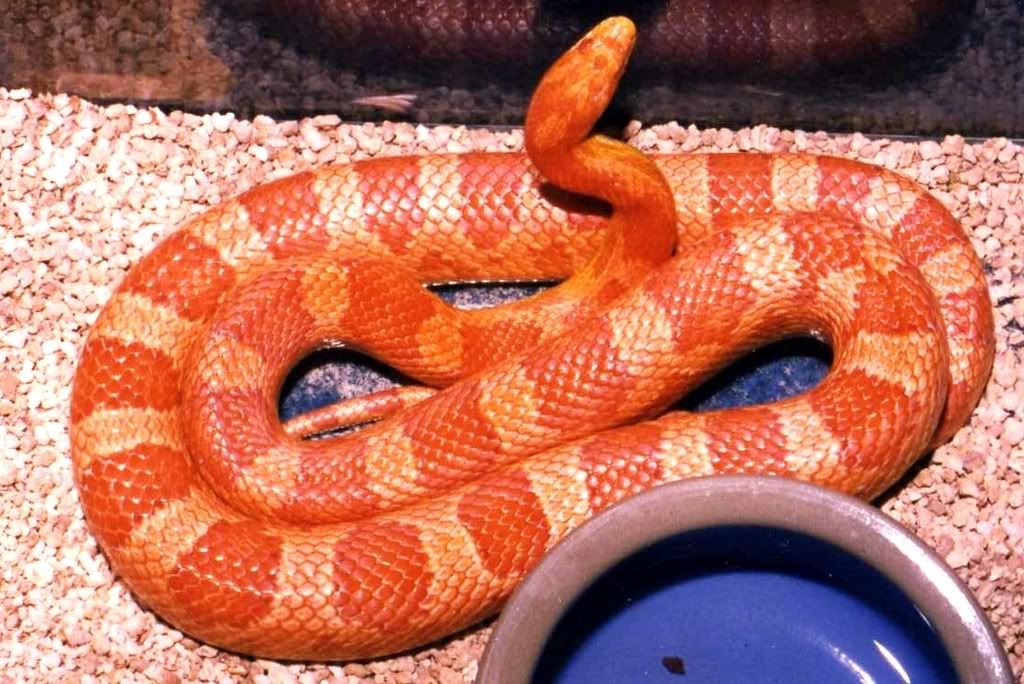
Here is a pic of him. He had ZERO white scales, and was just incredible looking.

~Doug


-----
"a snake in the grass is a GOOD thing"

my website -serpentinespecialties.webs.com

Dan_W Jan 04, 2010 01:41 AM

"It's easy to understand why black milk snakes hatch as tricolored snakes. The bold red, black and yellow stripes mimic the venomous coral snakes, offering protection to young snakes from would-be predators. It is theorized the reason they turn black is due to the cooler temperatures of their mountain cloud forest homes in Costa Rica and western Panama. They live at higher elevations ranging from 4300 to 7400 feet where the air temperatures are cooler. Because black absorbs the sun's heat, they can warm up quickly."

Ameron, who are you quoting here^

Ameron Jan 04, 2010 04:04 PM

It was from one of the Google search "hits" that I recently did. I was searching for both "black milk snake" and by scientific name.

I think that I found this reference from one of the latter searches, but I'm not certain. Now that I try to find the source, I can't quickly find it.

The source seemed to have some good info on the topic, and this was a quote from it.

Sorry.

nategodin Jan 04, 2010 06:16 PM

Interesting... being able to absorb heat from the sun seems like the most obvious answer to the question of why gaigeae turn black, but is but probably not the whole story. In addition to the possibilities others have pointed out, it could be that adult gaigeae are mimicing Mussuranas (genus Clelia). In fact, one of the first gaigeae brought into the U.S. was thought to be a gravid Mussurana, until the eggs were laid and banded, tri-colored hatchlings emerged. Just to make things a little more confusing, there are L.t. gaigeae in Europe (reportedly from Mirimar, Costa Rica) that never turn completely black, but look more like andesiana. So, even within subspecies, there is a great deal of variation with respect to coloration and pattern.

Nate
Burnsy's Gaigeae Page

Jeff Schofield Jan 04, 2010 08:15 PM

Which brings it back around to my thought, that the few specimens that were collected may only be black coincidentally. Due to remoteness, it wouldnt surprise me if a black version of Andean is eventually found. And with the derth of specimens sexual dimorphism is anecdotal at best.

rtdunham Jan 06, 2010 05:32 PM

Just as there's no single "right way" to care for or breed our snakes, there's no single evolutionary path to a successful outcome ("current state" would be more accurate, since it's still changing or subject to change).

Uncountable mutations occur in animals. Sometimes, those which produce an animal better able ("more fit" to survive are line-bred, if you will, resulting in those black montane milks, for example. In one of the other ssp the mutation may never have occurred, or might have occurred but with less transformational power (a mutation that resulted in a snake that got darker, but not black). And in some instances the specimens in which a mutation occurred were eliminated from the breeding pool for entirely unrelated reasons--a fox happened upon them, or they died from eggbinding, or an earthmoving machine crushed them. Not all the "strongest" survive--that is, not always does a mutation that might provide an advantage get reproduced.

And, to go back to my original statement, there could be other factors than dark pigmentation that could enhance an animal's ability to compete and survive.

If these things weren't true, all snakes would gravitate to the same size, same appearance, etc--the "optimal" niche. Instead, some find a niche in which they competed for ant eggs, and some for rabbits; some evolved into animals that could prosper in treetops, and some underground.

Site Tools
