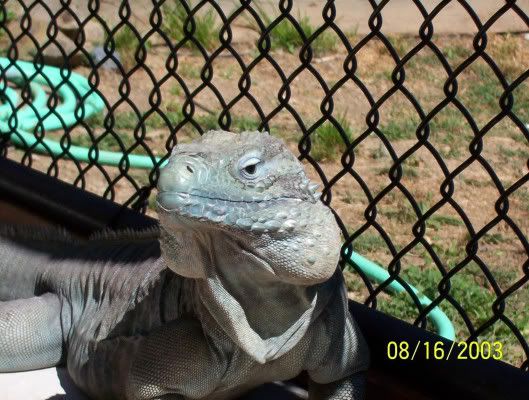
The Lewisi developed blue color to stay camaflaged in the limestone on Grand Cayman. Find a blue limestone area on Hispanola, and there is a good chance of finding blue rhino iguanas. Any thoughts on this ?
Reptile & Amphibian Forums
Welcome to kingsnake.com's message board system. Here you may share and discuss information with others about your favorite reptile and amphibian related topics such as care and feeding, caging requirements, permits and licenses, and more. Launched in 1997, the kingsnake.com message board system is one of the oldest and largest systems on the internet.


Blue Cyclura Theory
cycluracornuta
Jan 18, 2010 06:40 PM
Replies (26)
jf
Jan 18, 2010 07:01 PM
Is that why cornuta have blue on their hips in varying amounts?
There is a book due out from Fred Burton on the biological history of the Caymans.
I dont know but the evolution of the blue color may be addressed in more detail.
jf
TOM_CRUTCHFIELD
Jan 18, 2010 07:08 PM
As you know occasionally you see very BLUE cornuta and in fact I have a couple that when really warmed up are quite blue. I'm not sure of the relationship to rock color however. I have one very RED cornuta now as well. On my website is a pic of an extreme red cornuta I collected in Haiti in the early 70's [West Indian Iguana section]. Makes a lot of sense about the color adaptation to the enviroment....
-----
Tom Crutchfield
www.tomcrutchfield.com
KWE
Jan 20, 2010 01:11 AM
You have a photo of a lewisi in your first group of west indy photos that looks very different than any I have seen, the scaling on the head is very small and it didn't look like they were going to get a lot bigger. The nose scales look smaller too, unlike the usually wide scales across the snout, is she still around? The photo is of her head and torso laying on wood chips. Very interesting animal. KB
Oh ya, no ear spikes.
TOM_CRUTCHFIELD
Jan 20, 2010 06:39 AM
I'm NOT sure which you mean but there's a ricordi labled rileyi that the webmaster made an error on and hasn't corrected yet so possibly there's another error...thanks
-----
Tom Crutchfield
www.tomcrutchfield.com
TOM_CRUTCHFIELD
Jan 20, 2010 07:05 AM
I found it and it is misslabled. That lizard was given to me by Dr. Lewis Ober back in the early 70's. He said it was from Andros Island and the lizard was about 25"-30" long. It was at that time I was working with the Bahama's Natural Trust trying to get folks to stop eating "GUANAS". Because he had said this was from Andros I used this in my talks at schools thruout the Exuma's etc. I also designed a LOT of posters that I put up on all "IGUANA ISLAND GROUPS" and other places as well to discourage this way of life. At the Hope Gardens they had 2 male Cyclura c. cyclura and that lizard was a female so I gave it to Lynn Holowesko the then President of the Trust and a good friend of mine. This was LONG before any AZA member or anyone else was interested[about 1972-73] in the plight of Cyclura. To tell you the truth I'm NOT sure what species that is as it had NO color but what you see...WE BROUGHT HER OVER TO THE BAHAMAS WITH NO PERMITS AND NO ONE THEN CARED IF YOU TOOK THEM THERE OR BROUGHT THEM HERE.John Thomas was the ONLY USFWS Agent and he was called and he always cleared us verbally to pass customs. This was during the time of what many people say was a "big smuggling period" but it wasn't. USFWS just didn't care and we had NO IDEA that we were doing anything wrong....Another story of the past..What do you think the Lizard is? I'm still not sure...
-----
Tom Crutchfield
www.tomcrutchfield.com
cychluraguy
Jan 20, 2010 07:46 AM
can you post a pic of the lizard you are refering to.
Rob
cycluracornuta
Jan 23, 2010 02:29 PM
You have lot of great photos to look at, thanks for suggesting we check it out. I have seen redish cyclura like the one you have. The camoflage adoptation makes sense as there is alot of red soil in various areas of hispanola.
Mark M
Jan 20, 2010 12:40 AM
camouflaged from what? Cyclura were the apex land animal on the islands they inhabited until man arrived. It was probably just a gene a dominant male had millions of years ago that just kept getting passed on. Dominant like this guy -lol
cychluraguy
Jan 20, 2010 07:43 AM
This is a subject I have been thinking on and working on for quite a while and here is my 2 cents.
The Grand Cayman and cayamainsis iguanas evolved from Cuban stock a long time ago (how long I don't know). The fact that even a single iguana landed on the shores of Grand Cayman even once is almost an unbelievable stroke of luck. I would think that the population was started by a single gravid female or possible just 2 or 3 animals (maybe babies who were in a tree hollow) who got washed into the ocean by a storm and clung to debris. with the size and distance to GC is doubtful it would have happened more than once and that is one reason that they are more diverged than the caymaninsis. The caymaninsis is more similar to the Cubans because it is closer and in the same storm if many iguanas were washed into the sea it is more of a chance that more would have landed on LC and CB giving it a larger gene pool and there is the possibility of new animals landing from time to time reinfusing Cuban genes in the population making them continue to resemble Cubans.
Now for the blue part. Blue is a common color among cyclura perhaps 10,000 years ago Cubans were more blue or even if not Cubans have a wide range of color variability many have red bellies but some white and black bellies. Some have dark almost black heads some have brown heads and a very few have slightly blue heads and many of the blue heads have no red in the bellies.
It is my theory that a blue head was the primary originator of GC and over 1000's of years of isolation with no new blood being added the blue jean just expressed itself more and more. Even today the blue in wild Lewisii is not always as pronounced.
This is a many hours discution and the general gist of my idea I will let you all comment and add more as needed.
Rob
TOM_CRUTCHFIELD
Jan 20, 2010 08:20 AM
Actually colonization I think happened from south to north NOT north to south. It is NOT likely speaking from a geological standpoint that these lizards arrived on Grand Cayman via storms. I believe at some time in the past thse land masses were together possibly [I would have to check the geological formation history] and when seperated evolved into something different. All West Indian herps are of South American origin and colonized from a south to north corridor...It is also thought that specialization may happen rather quickly. A modern example is the population of Cuban Iguanas on Mayaguez. In just 50-60 years the social structure is already slightly different from the Cuban population. In 500 or so years we might have a new species there who knows?...LOL
-----
Tom Crutchfield
www.tomcrutchfield.com
cychluraguy
Jan 20, 2010 08:47 AM
Generaly speaking is was south to north but mainly up through the antillies and across the greater antillies and up the bahamas. But the only way for iguanas to arrive on GC would be from rafting because GC is a spec of a mountain that has never been close to another land mass and continental drift would be way to far in the past. It has also never had people on it befor its european discovery. If iguanas were on it from SA they would be far more diverged than they are now. I believe all the cychluras in the bahamas evolved from a cuban island hop also even farther in the past with little additional new jean influx possibly due to the gulf stream blocking any rafts to the bahamas from cuba in more geologicly recent times. I agree that specilization can happen fast ( I look at dogs for that) but 500 years may be a little quick for species divergence. I also have looked at the ocean levals in the past for many of my opinions and many of the islands are surounded by trenches that the only way for jumping is to raft and I would think the most likely reason for being on a raft is a storm.
Rob
TOM_CRUTCHFIELD
Jan 20, 2010 10:30 AM
If one has ever held an Iguana delicatissima[spelling?] you fully understand where Cyclura came from. I have had these Iguanas and an adult resembles a hybrid Green IguanaxCyclura or what I could imagine one looks like.

-----
Tom Crutchfield
www.tomcrutchfield.com
cychluraguy
Jan 20, 2010 02:07 PM
I agree Delicatisima do look like a possible link to cyclura and they are in the right spot the only naturaly occuring green iguanas north of the starting range of dellis is the virgin islands, Saba, and Guatalupe (whitch has both). All of these could have been moved by precolumbian indians. Plus the Island just south of the last delli island in the range St Lucia has a green iguana that almost looks like a cross between a delli and a green. A friend of mine wants to try and cross bred a cyclura and a green and see if it resembles a delli.
cychluraguy
Jan 20, 2010 02:18 PM
Also the delicatissima in the southern end of the range are greener as adults and at the northern end are grey as adults. The greener ones are from the more lush islands (Dominica, Martinique, and Guatalupe) while the northern ones are dryer (Antigua, St Eustatia, St Barths, St Martin and Anguilla)
Rob
cycluracornuta
Jan 23, 2010 02:36 PM
That could be an adaptation to environment or because of more green iguana blood being infiltrated into the population. I think both.
cycluracornuta
Jan 23, 2010 02:32 PM
If your friend wants to try that he should use a female cyclura and a male green, the latter has happened and the gravid green died.
cychluraguy
Jan 23, 2010 04:46 PM
Were have you heard this done befor?
You would absolutely want to uas a female cyclura because egg size is so much bigger in cyclura and and cluch size is so much bigger in greens. Developing babys would likely get to big for the eggs. I don't see why a female green would die tho since the eggs do not begin to develop until after they are layed.
Rob
cycluracornuta
Jan 24, 2010 12:42 PM
It happened on big pine key.
colaris
Jan 21, 2010 04:31 PM
Wow did you kept delicatissima Tom? Are still any held privatly in the states? It would be cool if the native countrys were they are hibridizing with greens allowed the hibrids to be exported, then it would only be a matter of selective breeding. By the way I have a old ig care book (so old it has mainly black and white photos) and in it says many people used to keep galapagos land iguanas! I gess it was really long time ago and that most if not all animals are more then likely dead but anyways do youknow anything about this?
Mark M
Jan 20, 2010 06:20 PM
"I believe at some time in the past thse land masses were together"
That seems to be the theory scientist agree on, that raising oceans separated the islands thus causing the evolution of the different species and sub species. There could however, also have been some rafting colonization that occured around the same time when the islands were closer ....... or not.
cychluraguy
Jan 21, 2010 09:52 AM
Last night I spent a coupple hours reading about about the geologic history of the carribean and it is pretty interesting. There is more than one theory on this subject mostly about whether cuba was attached to the yucatan or not. This would seem like a possible land bridge from central america except that it was something like 80 million years ago and most of the animals in the carribean are not that old. jamaca has been underwater several times and since it has been above this time around it has had no land bridges to any other islands. Hispanola and puerto rico were once attached and hispanola has been cut in half several times (this could be why it has 2 different cycluras on it?) The lesser antillies has never had a land bridge and most of the islands have never been attached. This seems to be the main reason the carribean has so few mamals because they would have crossed land bridges as well if they were there. Alot of people think that islands have had animals evolve on them and then go extinct amd then have new animals arrive and start evolving again, this could be why there are such variations in cyclura. The bahamas was never attached and it was the last to be colonized and has varied in size alot based on sea levals. Ricordi are probobly the oldest of the cyclura and cyclura could be as much as 30 million years old. Given the close relation of the cychluras in the bahamas and the cuban iguanas the GC and the LC must arrived on there island fairly recently and there has been no land bridges from them to cuba in a least 20 million years so it does seem likely that they would have had to raft there. If the bahamas iguanas were rafted and the jamacan iguana rafted it must have been alot longer time ago than the GC or the LC due to the greater genetic divergence from the animals that founded them. It is interesting to think that there could have been long extinct species of cyclura that were unlike any we have today on these islands that have been recolonized by the modern cyclura we have today.
This is kind of a compelation of info I found and is not necessarly 100% agreed apon.
Rob
jf
Jan 21, 2010 10:36 AM
I remember C pinguis on Anegada as being considered the oldest of the Genus.
jf
TOM_CRUTCHFIELD
Jan 21, 2010 12:04 PM
I too, thought pinguis to be the oldest species....
-----
Tom Crutchfield
www.tomcrutchfield.com
cychluraguy
Jan 21, 2010 01:36 PM
I have heard penguis are the oldest but more recenty I heard that richordi was the oldest so I was posting the most recent info I have. I am sure it is still open to debate. If anyone from the scientific comunity that reads this wants to comment and get into this conversation it would be great.
Rob
colaris
Jan 21, 2010 04:23 PM
Ha ha ok you beat me to it, and yes that is the most likely origin of the igs we all love as well as their home lands. I will spice up the mix with this. North and South America untill a very recent past, if Im not mistaken 6 million years ago, were separated from each other witch created a conection bettween the Atlantic and the Pacific oceans. And this leads to a very interesting question about igs. What is the possible relation between Galapagos island iguanas and Carebian island iguanas? Without the barrier of Central America this 2 regions are VERY close to each other or at least within drift reach! From rock studies it is known that Galapagos islands are no more then like 10-12 mllions years of age, wich coincides with the age of the most acient lineage of land igs, to wich the recently discovered Conolophus martae belongs! Are Galapagos igs decendend of long exctinct Cyclura? Did they insted came from the main land and then got exctinct there? Cyclura and Conolophus look ALOT similar! Genetic studies that can figure this out are desperatly needed.
As for the blue in lewisi, it could easily been created by genetic drift alongside with species recognicion.
And yes we can only wander how many amazing igs evolved in the carebian islands only to be exctinct by natural causes and by pre columbian indians
cycluracornuta
Jan 23, 2010 02:44 PM
I think both thoeries hold alot of potential. Who is to say which way the currents ran 500 years ago, I work on ships, and even today, the currents are not always where the pilot charts say they are.
