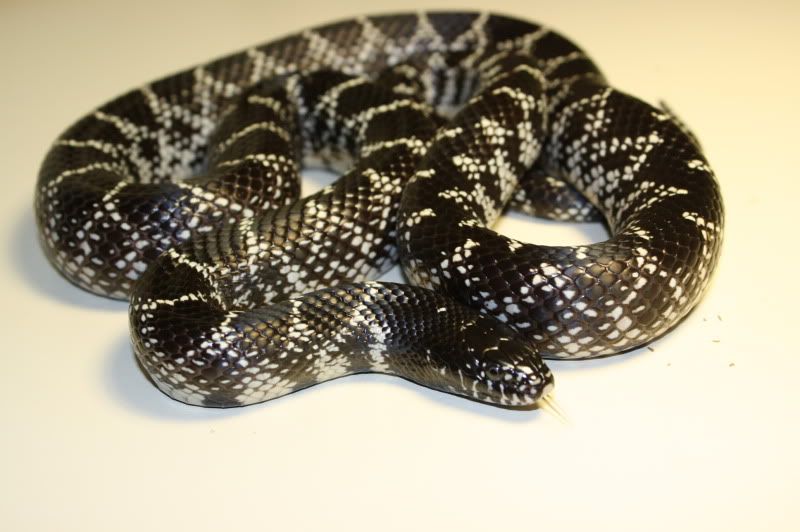
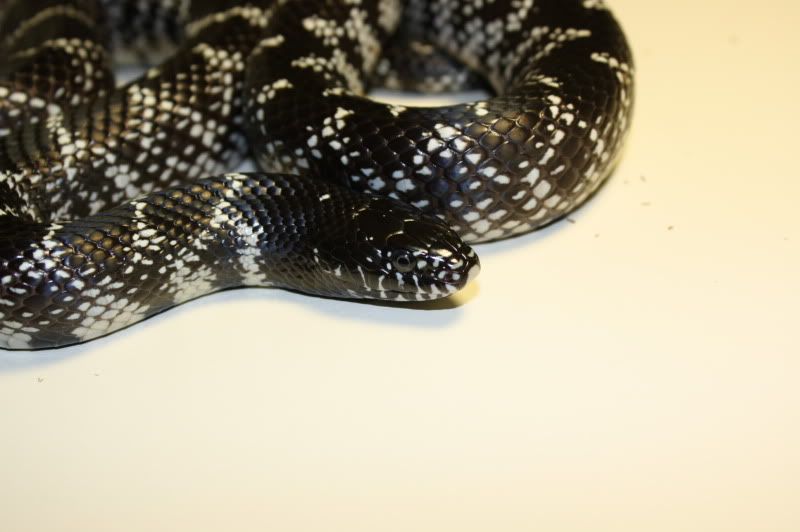
>>I'm gonna go from what I've seen, and I've seen a few, I heard that the original axanthic animal came from New Mexico, I think Don Soderbergs' animals are from New Mexico stock. Also, I really think this is just one morph of splendida, dark with thin webbing, minimal speckling. There are black and white animals both in south Texas and in west Texas, and it is something to be line bred, because all the wild ones I've seen that were white were only mostly white, the very top of the dorsal pattern turns yellow or cream. The Hebbronville male I got from Pastor Pat has got to be an F3 animal and he is 99% white patterned, but his mate is a messy yellow and black animal, typical splendida. They threw one female that turned and is turning solid white more and more as she grows, so this is something that improves with age in this line, and I got another one from last years' clutch that is mostly white. I plan to breed the daughter back to the sire to see if I can throw predominantly all white patterns, I bet it works.
>> I really don't see any cali in that animal, and I'd sure like to see a Cali with webbing that thin, and in the shape of splendida type patterning.
>> That sockhead is nearly totally clean, another trait that is probably line bred as an added bonus, most all the splendies I've seen retain the white labials, and even some of the MBKs' do as well. In a "good" MBK, we look for totally black or only the chin shields to be ...white. That tells me that white and black splendies occur east, south, and as far west as they range. I'm not saying this is the norm, but I have wild caughts from west Texas and south Texas that are white, and super thin banded from south Texas, so this is a great looking snake, most likely splendida, but most probably not Cal king or MBK in it, imo. Regardless, Doug, if you don't want that boy, I'll use him in a separate group to lighten and tighten this morph, lol!
>>
>>-----
>>Todd Hughes
Todd, you said you'd like to see a cali with thin banding. Here's a hypermelanistic one from the LA area that Hubbs posted in the other strand...

In theory this snake could produce something like the dark, axanthic animal when crossed with a thin banded splendy, but just an example of a possibility.
Like you said, however, you don't see any cali in Doug's snake. I'm not sure what it has in it. It doesn't look like pure splendida to me, but maybe that's the result of line breeding. The light banding is very thin, but the snake is also so clean, not the messy lateral speckling of normal splendida. The pattern is very symetrical, so that it looks to be influenced by another morph with a better pattern, possibly californiae.
I don't know what kind of mutation that snake has in it. Doug says it is called "axanthic," but I believe he said it could be anerythristic also. Does that mean the snake has a simple recessive gene, but we don't know for sure what it is? I just threw the "hypermelanistic" in there as another possibility. Is there more info on Don's axanthic line to describe how the mutation/morph actually behaves when bred?
My initial reaction to the strand was that we should be careful about calling it a "locality" snake, at least until there was more info, which Doug also said over and over. I'm mostly interested in how locality snakes get labeled and sold/traded in the hobby. Then we can tie in the idea of the snake also being a mutation or some kind of morph different from other snakes in this locality. One person even suggested this might be an area with a good sized population of this special morph, not to mention everything being an intergrade in the area. Too much going on for me to just be an observer. So, we come up with the questions of what the snake has in it..pure splendy?..axanthic?..something else?
In my opinion snakes from the Nogales area should be splendida, some darker than others..call it splendida/nigrita intergrade if that works. If Doug's snake is an intergrade with californiae that would make a big difference to me. Then there's the question of whether the snake has a mutated gene, like anerythristic, or whatever. I suggested possibly hypermelanism. Maybe the snake is actually from the Don's axanthic line. Whatever the case we need to trace its origins and what it was bred with. What was the original "axanthic" splendy bred with? What does axanthic really mean?
Underlying the whole conversation is the fact that we don't know for sure many of the answers to questions about snakes like this. You can't just take the word of someone saying the snake is a Yuma king, when he has no clue. Then the guessing games begin.
I don't mean to be on the soapbox or playing at being longwinded. I'm also interested in this snake and think there's a chance this could be a pure splendida, and could have a mutated gene that would be worth working with, and might even be a locality snake, although I doubt it's the Nogales locality. I'm interested in finding out more about this snake, and might even check with Don to find out what he's been doing with this line, and some background, etc.
Good luck in your quests, Todd. Your black and white snakes are very nice too. They look a lot different from Doug's snake, however. I wonder what Don's axanthic line looks like?
Cheers...Terry
-----
Conserving reptiles by helping to protect habitat...
www.ratsnakehaven.com
www.scenicsantaritas.org




 ~Eric~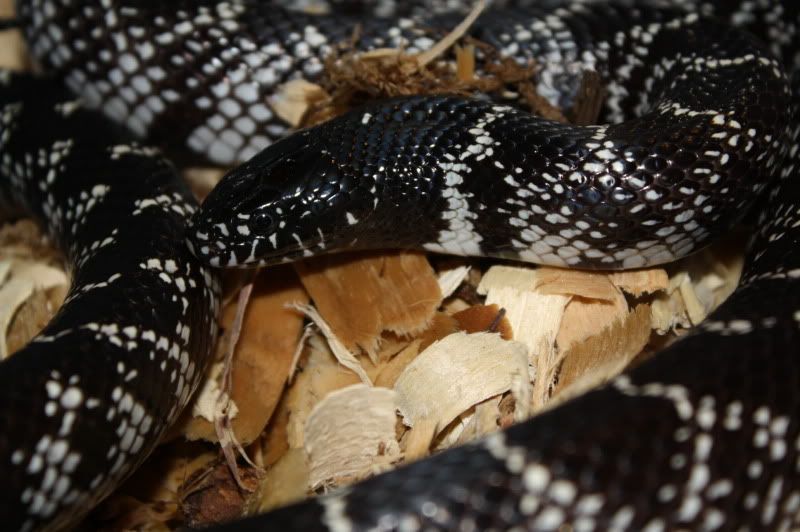


 [/quote]


