Reptile & Amphibian Forums

Welcome to kingsnake.com's message board system. Here you may share and discuss information with others about your favorite reptile and amphibian related topics such as care and feeding, caging requirements, permits and licenses, and more. Launched in 1997, the kingsnake.com message board system is one of the oldest and largest systems on the internet.

Click here for Dragon Serpents
Click for ZooMed
Click for 65% off Shipping with Reptiles 2 You

Meristics of Mostly Micropholis Mutts

nategodin Jan 22, 2010 07:06 PM

Hello,
This post was going to be entitled "Meristic and mensural morphology of much-maligned mostly micropholis milksnake mutts", but I guess that was too many m-words for the subject line input field!

So, a few months ago, I managed to find a reasonably priced copy of the 1988 edition of Ken Williams' Systematics and Natural History of the American Milk Snake, on Amazon. For those of you who don't have this book at home, it's currently the definitive guide to L. triangulum, including information about everything from scale counts and range maps to historical and paleontological data. In a bold move (which may well have been a deliberate attempt to drive taxonomic lumpers and OCD-stricken collectors even crazier than they already were), he divided milksnakes into a total of twenty-five subspecies, based primarily on head and body coloration. At the time, most herpetological taxonomists preferred to use scale counts as the primary basis for subspecies distinction. Unlike Williams, I don't think any of those guys ever tried to examine 2800 different specimens of milksnakes, much less write a book about it (with pictures!), so whether or not you agree with his methods, he has made a significant contribution to the milksnake world, being the first to describe perennial favorites such as hondurensis, sinaloae, and andesiana, in the original 1978 edition.

One of those guys who would rather be counting scales is Bill Lamar. Lamar has his name in the bylines of several books as well, but is probably better known for his extensive field work. After contacting Bill Lamoreaux about some "micropholis" that he had for sale, he was kind enough to share with me some correspondence he received from Lamar regarding the origins of the founding stock of these milksnakes. There have been a few different versions of this story passed around, so I hope this will both set the record straight and start a spirited discussion.


Back in the 1970s I collected tricolored kingsnakes from several locales over
a period of years while I lived and worked in Colombia. The terrain is
unspeakably rugged and the risks then and now of being in that area are also
unspeakable. I also obtained specimens from a colleague in Europe who made
several trips to Colombia and who worked with close colleagues of mine. All
animals had locality data and most of them keyed out to be andesiana. Not all
of them, however, represented that population. Over a period of years I
allowed persons in the private sector to produce and distribute
andesiana...some of these relationships were good and some were not, but such
is herpetoculture.

Late in the game, and working with the highly competent Stan Grumbeck, a
single male micropholis from my collection was bred to an adult female that
was obtained from an entirely serendipitous event. Naysayers will shake their
heads and assume this to be some sort of fabrication but I say to them, if it
were necessary to fabricate a history for a snake, why not simply say it also
was obtained by me or colleagues in Colombia? We received a snake from an
elderly woman from the northwest. It had evidently been suitcased into the
country by her grandson and she had no idea what it was or for that matter
cared. We keyed the snake--the real way--and, to our astonishment, it proved
to be a female micropholis, so we bred it to my male. Her progeny formed the
nucleus of the material presently drawing so much interest.

Like the snakes or not, and personally I find them to be magnificent and
beautiful animals, they key directly and unequivocably to micropholis using Ken Williams' monograph. Sort it out and dicker as you see
fit, but in the case of the snakes in question, there has never been any willful
misrepresentation. Key the shed skins and decide.

So, I decided to do exactly that. For those of you following along at home, please turn to page 159 and refer to Table 24. For everyone else, here's the Cliff's Notes version...

micropholis:
Red body rings (neck to vent): 11-18, average 13.8
Dorsal scale rows: 21-23, average 21.6
Subcaudals: 42-51, average 45.6

andesiana x micropholis:
RBR: 17-25, average 20.9
Dorsal scale rows: 19-21, average 20.7
Subcaudals: 50-53, average 51.3

andesiana:
RBR: 24-37, average 30.7
Dorsal scale rows: 1?-21, average 19.1
Subcaudals: 43-47, average 45.7

As you can see, in terms of number of red body rings and dorsal scale rows, the intergrades are, as you would expect, intermediate between the two "pure" subspecies. The really odd thing is the number of subcaudal scales... intergrades seem to have a significantly higher number. Here's what I found when I keyed a shed skin from the male that I purchased from Don Shores last year:

RBR: 18 - could be micropholis or intergrade, closer to intergrade average
Dorsal scale rows: 21 - could be anything, closer to intergrade average
Subcaudals: 52 - definitely intergrade

So, it would seem that what I have here is a Colombian intergrade. Not that there's anything wrong with that, mind you... I knew what I was signing up for when I bought him, and I have never encountered any willful misrepresentation, either. I know a lot of the regulars here have sold off all of your Colombian milksnakes, but I'd like to hear from people who are still working with them, and wouldn't mind providing scale and band counts for your specimens, as well.

Thanks,
Nate

Replies (29)

DMong Jan 22, 2010 07:25 PM

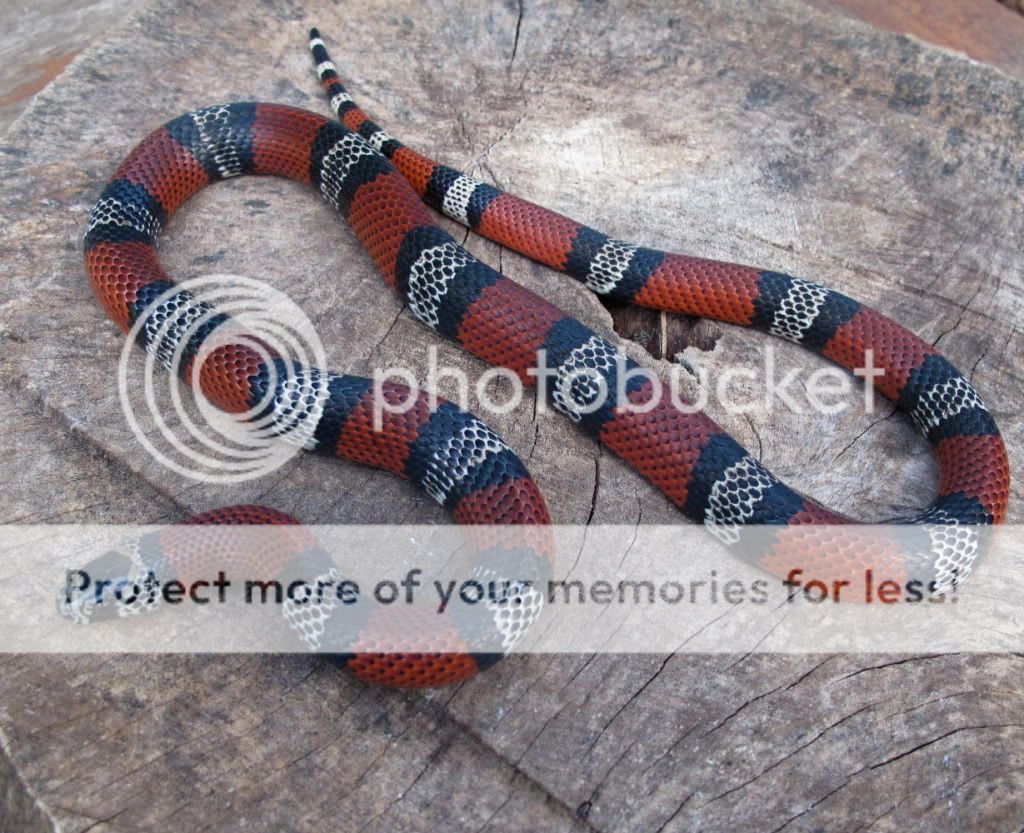
Very nice Popayan Nate!. I have had the "Systematics" revised edition by Williams for many years, and I would LOVE to own one like that orange individual in Glenn Slemmer's photo on page 138. Or any other genuine micro for that matter.

That thing looks very nice and healthy!

~Doug
-----
"a snake in the grass is a GOOD thing"

my website -serpentinespecialties.webs.com

shannon brown Jan 22, 2010 08:04 PM

Yeah, I am with Doug on this one.I would love to own something along the lines of this.

or like this.

or like this.....

but instead we ended up with crap like this.now, dont get me wrong they are still nice milks but don't call them micropholis.
19 or 20 rbr's.LOL........

and we could always dream of a anery I guess.

Like Nate said, some people got rid of there stock (I was one of them)and I will hold out for the real deal if it ever happens.Been waiting 20 years now so whats another 10 or 20.LMAO........

L8r Shannon

bobassetto Jan 22, 2010 09:34 PM

road trip???.....did the slemmer snake come out of ecuador???....i seem to remember something like that????

DMong Jan 23, 2010 10:12 AM

Yeah Bob, the Glenn Slemmer photo is captioned "Ecuador" in the book.

~Doug
-----
"a snake in the grass is a GOOD thing"

my website -serpentinespecialties.webs.com

DMong Jan 23, 2010 10:55 AM

Man!,....some of those other pics are just too killer!!!, like the anery, and the one from Colombia with 11(12 max) RBR!!!!...ARRRGH!!

I would do almost ANYTHING for that specimen..LOL!

~Doug
-----
"a snake in the grass is a GOOD thing"

my website -serpentinespecialties.webs.com

nategodin Jan 24, 2010 11:12 PM

Shannon,
I know it must have been disappointing (to say the least!) to have waited so long for micropholis to become available in the U.S. again, only to acquire them and then find out that they were not quite what you'd been hoping for. If you're holding out for something that looks like that one from Nabuga, you may very well be waiting another 10 or 20 years! In my humble opinion, though, that's got to be the ugliest of the bunch that you posted... except maybe that drab anery... blech! If I wanted black and white, I'd get a kingsnake! I suppose that if locality data and recessive traits are what you like, then you would think otherwise... to each his own. As for the rest of them, I don't really think that this:

... looks so different from this killer Colombian recently posted by Orlando Diaz:

Orlando's appears to have about 16 RBR, maybe a couple more than the one you posted, but still well within the range for micropholis, and just below the range for intergrades. If you look at the head pattern, I'd say that, with that nice solid black "cap" and vertical stripe between the eye and jaw, Orlando's looks more like a micro than the other one, whose head pattern bears an alarming resemblance to that of the andesiana on the front cover of Williams' book... like a black angel. His snake also has that little "moustache" on its prefrontals and internasals, just like the one on the micropholis in the book. So maybe not all of its siblings look so good... a generation or two of selective breeding could take care of that... but it sure looks like the real thing to me.

Quite some time ago, you wrote that unless it's preceded by a locale, any subspecies classification is just a hobby term, and I would tend to agree with that. It seems to me that the situation with these Colombian milksnakes is a lot like the one with non-locale Sinaloan/Nelson's milks. They come from an intergrade zone between two subspecies, and many (considered to be lower quality by many) display traits that are intermediate between the two. Genuine nelsoni are exceedingly rare in the hobby, although their genetic influence is quite evident in many of the intergrades, and the ones that look enough like nelsoni are sold as such. Selectively breed them for fewer, wider, RBRs, and voila, you've got milks that you can sell as sinaloae, and no one's going to call you a mutt-monger for it. But, if you compare those "hobby" Sinaloan to a wide-banded beauty from Cosala... well, there is no comparison, is there? Ditto for locale vs. hobby Nelson's, although I have to say, the real nelsoni are not what I would call beauties! So my point is, these Colombian milks are as much micropholis as generic Sinaloans are sinaloae. If you want to hold out for a milksnake that's as unequivocally a micropholis as a Cosala locale milk is a sinaloae, that is certainly your prerogative, and I applaud your high standards and ideals. It just means there will be that many more mutts on the market for me!

Nate

shannon brown Jan 25, 2010 06:53 PM

Nate,
I agree 100% and I will hold out.With the hondo mess and the siniloan/nelsoni mess it is what it is.But when there are no animals to draw from to start with why not just hold out for the real thing?
Anyway, some day we will see Smithi, Dixoni and Micropholis come into the hobby and that will be a happy day.

L8r
Shannon

SDeFriez Jan 25, 2010 08:10 PM

That will be great when those days are here!

Scott

bobassetto Jan 22, 2010 09:32 PM

that snake came from western zoo in calif., the picture was taken by bob carlson , an employee at the foxchase cancer research facility in philly, he and i were pals of dr. slemmer when he was employed there.....glenn owned the animal....but bob was the photographer....i guess this was around 1975 or so.....glenn later left and moved to the north west.....he was also buds with ernie wagner...

nategodin Jan 22, 2010 10:38 PM

There were some killer micropholis in the U.S. back in the day... and I know it wasn't just because Williams hadn't invented andesiana yet! Did they all just disappear into the woodwork, or what?

Nate

DMong Jan 23, 2010 10:16 AM

Ahh!,...okay, thanks for the the info on that one. What wwere they calling that particular animal, because I see andesiana x micropholois intergrade written all over it.

~Doug
-----
"a snake in the grass is a GOOD thing"

my website -serpentinespecialties.webs.com

nategodin Jan 22, 2010 10:34 PM

Thanks, Doug! I'm not sure we should be calling these Popayans, though, since these are 50% "suitcase" locality, as well. "Colombian milksnake", although less specific, seems like a more accurate common name, ironically enough. I like the look of the one in the book, and the ones that Bill Lamor (too many Bill L.s!) posted on another milksnake forum a couple months ago. Looks aren't everything, though... I bet that with just a generation or two of selective breeding, one could get the band counts down into the teens, and produce their very own line of "hobby micropholis". Hey, why not, it worked for "albino sinaloae", right? As I recall, Nathan actually had a pretty good justification for that, but still... not only is it a slippery slope, but it seems to me that a different standard for purity applies when morphs are involved. Of course, it doesn't help that Williams (who was the first to describe sinaloae and andesiana as separate ssp. from nelsoni and micropholis, mind you) was such a "splitter" that the distinctions between many of the 25 subspecies are questionable at best. Maybe that's why everyone had such beautiful, pure micropholis back in the early and mid 70s... andesiana hadn't been invented yet! Seriously, though, I would like to try to find a low RBR mate for this guy and try to line breed for that trait, hopefully before someone else comes along and rewrites the book on milksnakes again! Even if I succeed, it would be disingenuous to represent them as pure micropholis... unless, of course, andesiana get lumped back into the subspecies. One can hope, I suppose...

Nate

Nathan Wells Jan 23, 2010 01:45 AM

That's nice. Maybe I am reading way too much into it but, your statement regarding me is kind of low don't you think, especially towards someone you don't really even know. Since I never got a response from you though email, I'll now address my question to you on this forum. I am curious to know what you are implying in the statement of " Hey, why not, it worked for "albino sinaloae", right? As I recall, Nathan actually had a pretty good justification for that, but still... not only is it a slippery slope, but it seems to me that a different standard for purity applies when morphs are involved." Are you saying that by applying a different standard of purity I have claimed to produce "albino sinaloans"? Well with setting the record straight, I have never produced or claimed to have produced a "pure" example of albino sinaloae in all my 12 years of working with them. I have never even remotely selectively bred specific animals in attempts to reduce band counts. Nor have I ever advertised any animal as such so I am not really sure where that came from. And my standards of purity are very high; anyone who knows my involvement with field herping for locality specific animals, particularly NA milks and L. alterna will attest. With my sinaloans, in anything I have ever successfully produced, whether it be albino het hypoerythristic, albino hypo-e, albino het splotched, splotched albinos or albinos possible hets, the albino gene present has always originally derived from my albino nelsoni. I have been very clear on this issue here for several years, with posts specifically dissecting the genetics on every special morph I have shared with the members on this forum or in the public eye.. I am not sure why you felt the need to post such a remark but if I am in the least bit taking your comment the wrong way, then my apologies. But when you really look into what was written, how am I think otherwise? That snake you have pictured has really turned out into a spectacular animal. Hopefully, you be able to find an equally nice looking mate. Have a great weekend.
Nathan Wells

nategodin Jan 23, 2010 10:03 AM

Nathan,
There is no emoticon to express how sorry I am if you took that part of my comment personally, or even perhaps too seriously... like a certain other New Englander on this forum, my sarcastic sense of humor (I was at least half-kidding) doesn't always come across so clearly in this format. I don't think it's hyperbole to say that your contributions to milksnake herpetoculture are of the same magnitude as Williams' contributions to milksnake taxonomy. However, just as some of us armchair taxonomists may question Williams' methods or conclusions, there are some folks who see the term "albino sinaloan" as something of an oxymoron. I happen to know that Doug is one of those people, so that line immediately preceding the winky face (meant to express levity) was intended as an acknowledgement of his point of view. Honestly, I can see both sides of that argument, and as I said in my original post, I don't think that there has been any willful misrepresentation on your part. Having said that, though, try searching Google for "albino sinaloan". The top result should look very familiar to you. I don't see anything in that 2006 ad explicitly stating those snakes are anything but sinaloans. Of course, you've always told the truth when asked, but I think that if you were a bit more up-front about it, then you would be completely above reproach.

The point I was trying to make is that I think it's unfortunate that most, if not all of the big names in the milksnake world chose to sell off their Colombian milks after finding out that they were intergrades, as if that somehow makes them damaged goods. What really puzzles me is that the same breeders proudly produce a wide variety of Honduran morphs, whose anery gene most likely came from a stuarti intergrade, whose hypo gene came from a snake purchased as a "coral snake" from a Miami importer, and whose amel ancestors were sold as polyzona in Europe. I just think that maybe if these micropholis x andesiana had some interesting recessive genes, people might not be so quick to write them off as "mutts" or "crap". My fear is that, now that you and the other biggest and most reputable breeders have chosen to divest yourselves of these snakes, they're just going to disappear into the woodwork, just like the pure micropholis did decades ago.

Anyway, thanks for the compliments and for keeping it civil, hope you have a nice weekend as well.

Thanks,
Nate

Nathan Wells Jan 23, 2010 06:56 PM

I thank you for taking the time to respond back to me Nate and please know that I am not angry or upset and my apologies if I initially came across that way. Those that know me in this hobby will attest that I am one who believes only in conducting myself in a civil manner. I am a very-level headed individual and am not and have never been money-driven, caring more about establishing friendships with those who share my passion for these incredible creatures. Thank you for the nice comment and recognition in regards to my many years of contributions to the milk snake hobby.

I guess I was taken back when viewing your post and I may have read into your remarks too much, taking it personally. But I also appreciate you clearing up the fact that your statements were not meant to be malicious in some attempt to slander me. It's important for you to understand, like others will stress, that in through my several years of offering animals to individuals in this hobby I have never nor will I ever at anytime intentionally mislead anyone. Especially someone who is interested in getting sinaloan morphs from me.

True, when one is to google "albino sinaloan" one of my many fauna adds surface. Most that see the animals being advertised will notice them listed as albino splotched sinaloans. Of those, most already understand that the albino genes present have all derived from using albino nelsoni. The ones that show interest that don't quite understand usually contact me, where they then receive a precise run down on the exact genetics used in producing those specific color/pattern morphs. Through the years I have ran many adds, some more descriptive than others but again, never have I ever once claimed to have produced pure "albino sinaloans" and try and sell them as such. Because of the information I provide and my egerness to continually be upfront and honest, no one has ever felt the need to challenge the authenticity of any of my animals.

As far as the micropholis X andesiana subject, you and I have talked in great length about this and there is no reason for us to beat a dead a horse. However, I agree with you, regardless of what they are considered by many, I have always appreciated them. I did enjoy keeping them for the years I had them. And so that you are aware, I was not one who got out of them when questions about their origins surfaced. I simply lost interest and chose to focus on other projects at the time. It just so happens that a short time afterwards, while in the hands of others, the thought of them being something else other than pure micropholis was presented. Hopefully those still interested in getting their hands on some pure animals will one day have their chance.

Again, thanks man for helping me to clear the air on this. I respect the way you handled my response. It's funny that with me being such a sarcastic person that I failed to see your sarcasm in that post. Let's let it rest now.....
Have a great weekend.
Nathan Wells

DMong Jan 23, 2010 10:31 AM

Yeah, I hear what you're saying on alot of that, and the Bill Lamor from the other forum post was actually Bill Lamoraux.

I will say however that if some lower RBR count animals are produced that tend to "key-out" as pure micro's, and sold as such, they can never be the real-deal anyway, as even the lower RBR animals would still produce higher band-count animals that would STILL BE very un-convincing to me..LOL!

One thing about the andesiana's though, is that they never seem to dip down into the lower band-count range of micropholis, but you see the alledged micro's going way up into the andesiana range.

Whenever I see "albino sinaloae" for sale, I just roll my freakin eyes, and go........RIGHHHHT!!..LOL!

~Doug
-----
"a snake in the grass is a GOOD thing"

my website -serpentinespecialties.webs.com

Dniles Jan 23, 2010 07:00 PM

I'll just add my 2 cents on Nate Wells...certainly one of the most trustworthy guys in the hobby and has never tried to mislead anyone with any animals he produces. In my experience, he has gone above and beyond what most do in providing info on his animals to anyone that inquires or buys some from him.

I know this whole micropholis thing has really bummed him out since it was determined they were not pure even though he had no idea at the time he produced some that they weren't. Interstingly enough, he had moved the adults out of his collection before he and everyone else realized what they really were.

Dave
DNS Reptiles

Tony D Jan 23, 2010 09:39 AM

There is a lot of potential overlap there Nate. I don't think you can make any real conclusions without knowing what the counts were on the original two founding animals. If they were both on the high side of average it’s possible that the captive population's counts are a simple reflection of a shift that occurred as it passed through a genetic bottle neck. Two animals are a very small founding population to expect a normal spread of phenotypic expression.
-----
“Nothing is at last sacred but the integrity of your own mind.” Emmerson

DMong Jan 23, 2010 10:43 AM

That is very true Tony, certainly there is individual variation, however, any subsequent clutches of offspring from parents on the high side RBR count would certainly tell the tale as I think you would definitely agree here.

~Doug
-----
"a snake in the grass is a GOOD thing"

my website -serpentinespecialties.webs.com

Tony D Jan 24, 2010 10:35 AM

Depends Doug. Some locals within the larger subspecific group may all lean towards one extreme or the other. We just don't know. IMHO there isn't enought data period to warrent the seperation in the first place.
-----
“Nothing is at last sacred but the integrity of your own mind.” Emmerson

nategodin Jan 25, 2010 09:03 AM

Very true, Tony... I've been in contact with the Bills (Lamoreaux and Lamar) and will hopefully hear back from the latter soon with a little more quantitative information about the founding stock. I was very happy to find out that Lamoreaux is still breeding Colombian micros, as is Jeff Hardwick (man... he's got all the best stuff!) and now we have Orlando Diaz getting started with them as well. So, it looks like my concerns about being able to pick up a female from a reputable breeder were unfounded.

Sunherp Jan 23, 2010 11:25 AM

First of all, I'd like to congratulate the forum members on keeping this this "above the belt" and civil. I suppose that has to do with who the participants are, and the lack other(s).

Next, I'd like to openly express my respect and friendship with Nathan Wells. He's a stand-up guy and I whole-heartedly feel he'd not intentionally mislead anyone, any time. Some folks perhaps just don't buy into the distinction between some of Williams' creations. More on that below.

I started a thread several weeks ago to try to generate discussion on what exactly a "subspecies" is. Things were going well until someone derailed it and began yet another insult war.

Ken Williams' doctoral work on the species Lampropeltis triangulum is the best thing we've got to work with at this point. HOWEVER, it must be noted that in the years since it was completed, we've come a long way in biology. We now know for a fact, for instance, that dermal pigment deposition can be greatly altered through incubation temperatures (perhaps Mitch will chime in with further detail?), that color and pattern are extremely plastic and variable, and that scale counts can also be easily influenced and variable. While some morphological traits are still used in taxonomic work, others have been generally discarded in light of their uselessness. Blotch and ring counts in Lampropeltine colubrids are among these latter traits. This is especially true when exceedingly small sample sizes are analyzed.

Williams described andesiana based on 12 (!!!) specimens he regarded as "pure" and 7 (again, !!!) that he regarded as intergrades with the already described micropholis. Now I'm no statistician, but from my limited knowledge of the subject, I'd strongly argue that such small sample sizes fails to provide the statistical power to show the populations as differing AT ALL. Combine that with the immense overlap in his morphological character counts, and I see really no choice but to toss andesiana until further data suggest otherwise.

As I've alluded to in the past, work is being done on the taxonomic chaos in triangulum, and rumor has it that many of the poorly defined subspecies we're dealing with now will be sunk. Say, "Bye-bye!" to hondurensis, stuarti, sinaloae, taylori, and a host of others! People working outside of various scientific fields tend to divide biologists as EITHER lumpers OR splitters. Well, some folks (lots, actually) fall in the middle and strive for taxonomy to represent biological reality.

-Cole

L. t. multistrata - Yellowstone Co., MT
Image

tspuckler Jan 23, 2010 01:23 PM

"Say, 'Bye-bye!' to hondurensis, stuarti, sinaloae, taylori, and a host of others!"

What is really striking is how many reptiles and amphibians have been "named" based on only a handful of examples. In some cases I can see how this would happen (maybe only 4 or 5 of a certain type of herp have been found and whoever found them wants to classify them).

It fascinating how some folks will find a description in a book written decades ago and cling to that reference as if it's gospel. I think the more we find out information about stuff, the more our understanding about that stuff will change.

Tim

nategodin Jan 23, 2010 10:04 PM

Cole,
The "definition of a subspecies" thread you started was interesting reading (most of it, anyway!), but I refrained from posting partly because of the reason you mentioned, but mostly because I had something very specific to share about one (or two?) subspecies and didn't want it to either get lost in the noise or change the scope of the discussion.

I absolutely agree that Williams' book is showing its age, and am looking forward to the next taxonomic overhaul of the species. There's already at least one published addendum/amendment to his description of South American milksnakes, which you can read here:

Notes on the Natural History of the Milksnake Lampropeltis triangulum andesiana Williams, 1978 in Venezuela

Again, only a small number of specimens were examined, but clearly the Venezuelan population has the high (26-35) RBR count one typically associates with andesiana. The high (44-50) subcaudal count is interesting, too... closer to the range of what Williams described as intergrades. It's interesting to imagine how proto-milksnakes changed and evolved as they came across the isthmus of Panama and spread into northern South America. Hopefully, someone is hard at work on analyzing DNA and will come up with a cladistic diagram something like the ones in these papers:

Phylogeography of the California Mountain Kingsnake, Lampropeltis zonata (Colubridae)

Neogene diversification and taxonomic stability in the snake tribe Lampropeltini

I like the maps in the mountain kingsnake paper; they show how a physical boundary (like the Sacramento and San Joaquin rivers) can separate subspecies and/or clades.

Here's another excerpt from Lamar's statement about the snakes in question... I've refrained from posting the whole thing, partly because I don't have Bill's (either one's) permission to do so, but mostly because some of his... dispariging... comments about the reptile hobby and herpetoculturists in general. But anyway, this chunk of it is pretty G-rated... well, maybe PG.


Since its inception, the herp import
market has largely been a function of a few key export localities in different
countries. While it is true that these localities receive animals from a
radius, it is also true that they form a pitifully inadequate sample for
herpers to use to educate themselves about a snake. That is why so many were
surprised to learn that the most beautiful "Brazilian" rainbow boas come from
Colombia and Ecuador rather than Brazil, etc. For those old enough to
remember state fairs where a child was handed a fishing pole and encouraged to
drop the line over a partition while an unseen person tied a gift to the hook
and tugged on the line, that is a pretty apt analogy of what we have had to
contend with in terms of imports and our perceptions of "species."

Mother Nature could care less about this and geographic variation is a fact of
life. I am tempted to publish a picture I have of a Lampropeltis in Colombia.
It possesses immaculate red rings and pops like a wet dream. The snake was
collected and photographed at an altitude so high it even exceeds that
published as upper limits for andesiana, yet the snake looks like a
micropholis from the coast. And that would be individual variation, which we
see and accept daily where humans are involved yet we cannot seem to
understand that it can and does occur with snakes as well. The late, great
herpetologist L.C. "Pancho" Stuart once commented, speaking about dichotomous
identification keys, that they work best when one already knows that one has
to identify. And that is true. Since the days of Linnaeus, we have
endeavored to construct cubbyholes and then stuff Nature into them for our own
organizational needs. Now that we have moved boldly into the world of
biochemistry we are seeing more and more that Mother nature simply couldn't
care less about our schemes.

Altitudinal morphs such as gaigei in Costa Rica are nothing more than the same
snake taking on melanin and size characteristics better suited for life at
higher altitudes. Go up the slope and get yourself a "pure gaigei;" go down
the slope until you find a stuarti. Ditto that for micropholis and andesiana.
Lowland micropholis populations from Panama look one way; those from the Choco
of Pacific Colombia another; those from the lowlands of Ecuador, still another.
Move into the inter-Andean valleys of Colombia and you get alphabet soup. Once
the sump that currently contains all the tricolored "milksnakes" is better
understood, I have little doubt that the giant milksnakes from Central American
and northwest South America will form what is known as a clade...they are all
very closely related to one another, if not the same thing.

Interesting, although I wouldn't necessarily say I agree 100%... one of his examples strikes just a little too close to home for me. One of these days I'm going to have to sign up for one of Lamar's eco-tours... just getting to pick his brain for a few days would be worth the price of admission. Now, if you'll excuse me, I have to go clean up after a couple of my "adult-onset melanistic polyzona" hatchlings and fix myself a midnight snack. Brave new world, indeed!

Nate

brhaco Jan 24, 2010 09:11 AM

Cole-

Agree wholeheartedly-you've in fact saved me the trouble of posting a long and complex missive. Thanks!

Sometimes I think that some workers are putting more reliance on DNA (particularly mitochondrial data) than is YET justified, but in many cases it is already superior to simple meristics in defining ssp (if you accept that such even exist LOL).....
-----
Brad Chambers
WWW.HCU-TX.ORG

"I am free, no matter what rules surround me. If I find them tolerable, I tolerate them; if I find them too obnoxious, I break them. I am free because I know that I alone am morally responsible for everything I do." - Robert A. Heinlein

Tony D Jan 27, 2010 12:51 PM

Nice post Cole
-----
“Nothing is at last sacred but the integrity of your own mind.” Emmerson

thomas davis Jan 23, 2010 07:45 PM

they are the same snake(micro/andea) taxonomy is/has gotten WAY outta control.
beauties you posted, you can put me down for some! i really like the looks of the ones you posted
,,,,,,,,,,,,thomas davis
-----
Morphs... just like baseball cards BUT ALIVE, how cool is that???

my website www.barmollysplace.com

nategodin Jan 23, 2010 10:12 PM

Thanks! I would love to be able to provide you with one, or even a pair of this guy's offspring. If you'd like to expedite the process, please send a female South American milksnake with 18 or fewer red body rings in an insulated, heated box to: Nate Godin, P.O. Box...

Nate

jawn Jan 26, 2010 10:17 AM

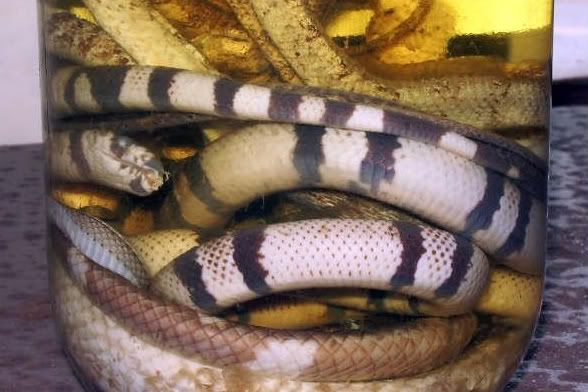
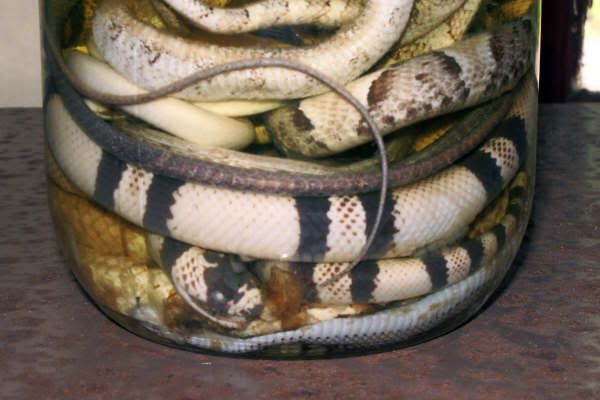
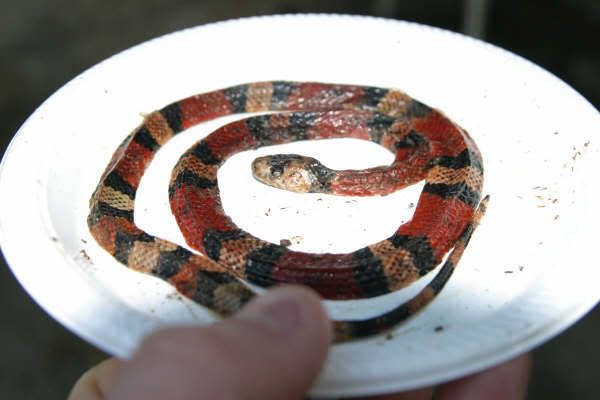
If anybody does go ahead with a DNA study one day it would be cool to see these 3 speciens included, most of you have probably seen these photos before:

I think it was Cole that touched on the low sample size for Lampropeltis in South America and it reminded me of this quote I found in a paper on the internet:

'Notes on Tropical Lampropeltis
Emmet Reid Dunn, 1937'

"Lampropeltis is extremely rare in lowland Panama. I have
received from Dr. H. C. Clark 4196 Panamanian snakes in the
last 4 years. This lot included only 3 Lampropeltis: 1 from
Maddem Dam Road in a collection of 590 snakes from that
area ; 1 from Panama "sabanas" in a collection of 667 snakes from that area; the third from 1700 feet on the Pequeni-
Esperanza divide area in a small collection from many stations.
None appeared in 2654 specimens from lowland Darien."

After 5 herping trips to Panama this is the closest I have come, sorry that it's not a milksnake but you guys should at least appreciate the pattern!

Erythrolamprus bizona

Jon Wedow

Site Tools