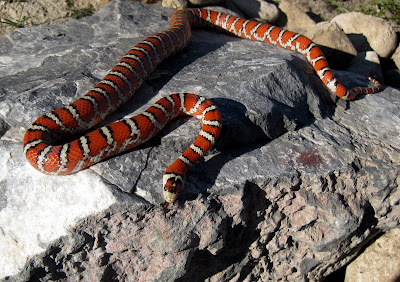
or any king snake for that matter.
Rule #1 to remember is that snakes, even within the same species, are individuals, what works for most will not work for all. Always be ready to tweak your setups.
The absolute minimum cage size for adults should be the average between the cage circumference equaling the snake's length and a square foot for each foot of snake. Example: a four-foot king would need ((1'X1') + 4') / 2 or 2.5 square feet. This is the approximate surface area of a 16" X 23" blanket box.
Cages must be escape proof.
Regardless of the bedding used, a cage does not have the biologic capacity to recycle waste indefinitely therefore, bedding needs to be changed routinely. Ease of cleaning and proper disposal should be considered when selecting a bedding.
Ventilation is important but so is humidity. The two need to be balanced.
Captive snakes can easily stress, provide adequate hide(s).
Humidity hides are helpful especially when in ecdysis.
Save the exceptions of a few desert adapted animals, always provide clean fresh drinking water.
Thermal gradients must be provided and maximized. 90 - 75 is ok, 100 - 65 is better. It can be done.
Gradients do not need to be constant. They can be adjusted for feeding and non-feeding days as well as for day and nighttime highs and lows.
Gradients do not need to always be horizontally. Do not overlook opportunities to establish vertical gradients.
Use of vertical gradients also effectively increases usable surface area.
Lighting is not critical but at sub-optimal temps photoperiods seem to have an impact.
Cages and fixtures, especially electrical, should be inspected routinely.
Remove any damp bedding and adjust environment to prevent recurrence.
Gross fecal matter should be cleaned out ASAP.
Water bowls should be routinely washed and disinfected not just refilled.
Check on and interact with cage occupants between feeding. Monster feeding responses are not always indicative of underfeeding. Sometimes the snake is just habitualized to feed whenever the cage is opened.
Always feed the best quality food you can find.
It doesn't hurt to mix up the diet a little bit. (I feed mine day old quail for a few weeks every spring.)
As long as you don't over due it, mineral and vitamin supplements can't hurt.
The amount of food that can be properly assimilated is directly correlated to the amount of heat the animal has access too.
Over fed snakes get fat and underfed snakes get skinny. Well-fed snakes have good body weight and grow at predictable rates.
If there is a growth / weight issue with your snakes, you need to look at temperature as well as amount fed.
Unless you are a breeder worried about the bottom line, success is not gauged by how fast a snake grows or how soon and how many egg a female throws. Good body weight, muscle tone, resistance to disease and illness and behavior determine basic success.
-----
“Nothing is at last sacred but the integrity of your own mind.” Emmerson