Reptile & Amphibian Forums

Welcome to kingsnake.com's message board system. Here you may share and discuss information with others about your favorite reptile and amphibian related topics such as care and feeding, caging requirements, permits and licenses, and more. Launched in 1997, the kingsnake.com message board system is one of the oldest and largest systems on the internet.

Click for 65% off Shipping with Reptiles 2 You

Northern Green Ratsnakes

tbrock Feb 06, 2010 12:04 PM

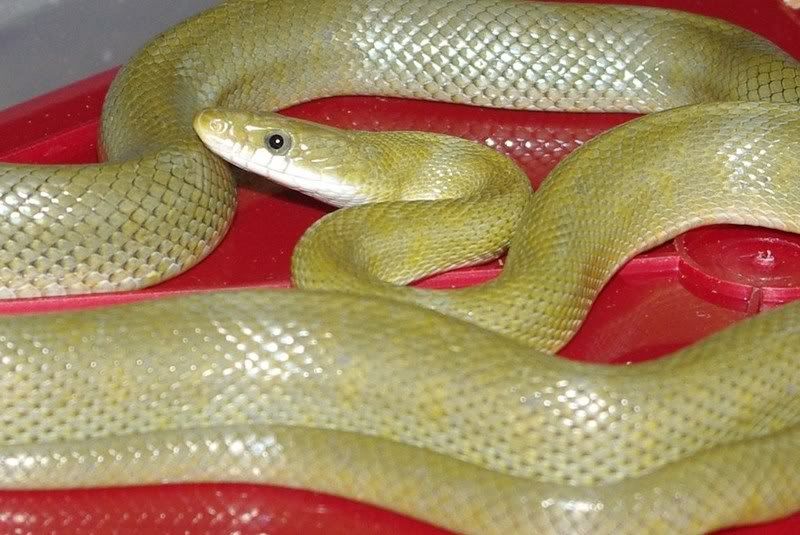
This is the pairing I am most anxious about. These are wild caught young adult Senticolis triaspis intermedia, from Mt Hopkins, in the Santa Ritas. They were given to me by my friend, Diego. I have cooled them, sporadically, this winter - for the first time, since I have had them. The female was smaller than the male, when I got them, but has nearly doubled in size since then - and is now larger than the male.

Male.

Female.

-----
-Toby Brock
Southwestern Center for Herpetological Research

Replies (44)

mattkau Feb 06, 2010 04:23 PM

Those are awesome! Best of luck with that pair. Keep us posted.
-----
Matt Kauffman

tbrock Feb 06, 2010 06:09 PM

>>Those are awesome! Best of luck with that pair. Keep us posted.
>>-----
>>Matt Kauffman

Thanks Matt! Will do!
-----
-Toby Brock
Southwestern Center for Herpetological Research

antelope Feb 06, 2010 07:10 PM

of all the anticipated breedings this year, for me, this is at the top, wishing you the best of luck with those beautiful animals Toby!
-----
Todd Hughes

tbrock Feb 06, 2010 09:03 PM

>>of all the anticipated breedings this year, for me, this is at the top, wishing you the best of luck with those beautiful animals Toby!
>>-----
>>Todd Hughes

Thanks Todd - I'll take all the luck I can get! You know how anxious I am about these, I think - I have been ever since I started cooling them. I think my stress level is likely to go up too, once I start putting them together! LOL

-----
-Toby Brock
Southwestern Center for Herpetological Research

ratsnakehaven Feb 06, 2010 11:39 PM

Toby, I hope you get babies this year. It'll be so interesting to see what happens and who gets eggs first, etc.

Cheers...Terry
-----
Conserving reptiles by helping to protect habitat...
www.ratsnakehaven.com
www.scenicsantaritas.org

tbrock Feb 06, 2010 11:50 PM

>>Toby, I hope you get babies this year. It'll be so interesting to see what happens and who gets eggs first, etc.
>>
>>Cheers...Terry
>>-----
>>Conserving reptiles by helping to protect habitat...
>>www.ratsnakehaven.com
>>www.scenicsantaritas.org

Thanks, Terry!

I hope we both get eggs this year - and I don't care who is first, as long as we get them. LOL
-----
-Toby Brock
Southwestern Center for Herpetological Research

ratsnakehaven Feb 11, 2010 10:44 AM

>>Thanks, Terry!
>>
>>I hope we both get eggs this year - and I don't care who is first, as long as we get them. LOL
>>-----
>>-Toby Brock
>>Southwestern Center for Herpetological Research

Hey, buddy, didn't mean it as a competition. Just very interested in the process, what works, etc. Also, sorry for stealing the strand somewhat, but crap happens sometimes...

TC

-----
Conserving reptiles by helping to protect habitat...
www.ratsnakehaven.com
www.scenicsantaritas.org

Beaker30 Feb 07, 2010 10:16 AM

Toby,

Thats a great looking pair. I have an unrelated pair of Santa Ritas that are at least a year or two away from breeding age. I know what you mean about excited. I am excited about them and still have a breeding season or two to wait.

Craig
-----
God Bless Evolution.

tbrock Feb 07, 2010 10:39 AM

>>Toby,
>>
>>Thats a great looking pair. I have an unrelated pair of Santa Ritas that are at least a year or two away from breeding age. I know what you mean about excited. I am excited about them and still have a breeding season or two to wait.
>>
>>Craig
>>-----
>>God Bless Evolution.

Thanks Craig!

Yeah, I have been excited (and anxious) about them, ever since I first got them.
-----
-Toby Brock
Southwestern Center for Herpetological Research

orchidspider Feb 09, 2010 05:10 PM

I just got a related pair of Mt. Hopkins Green Rats from Ocotillo Herps that were listed on the classifieds back in early December. The babies are neat... seeing those makes me so glad I bought them, and now I really know what I have to look forward to!

ratsnakehaven Feb 09, 2010 07:38 PM

>>I just got a related pair of Mt. Hopkins Green Rats from Ocotillo Herps that were listed on the classifieds back in early December. The babies are neat... seeing those makes me so glad I bought them, and now I really know what I have to look forward to!

Baby green rats are cool little things. Mine are such good eaters too!

PS: Never heard of Ocotillo Herps. Could you give me a link to their site? Thanks...

Terry
-----
Conserving reptiles by helping to protect habitat...
www.ratsnakehaven.com
www.scenicsantaritas.org

CMSMITH Feb 09, 2010 09:25 PM

all the snakes he captures. Mike Welker runs it. He sells any and everything he or anyone he knows finds. Most likely you purchased illegal snakes if you bought green rats from him.

tokaysrnice Feb 09, 2010 11:13 PM

Yeah I'm pretty sure selling WC Arizona snakes is illegal.

antelope Feb 10, 2010 01:06 AM

Ouch!
-----
Todd Hughes

orchidspider Feb 10, 2010 10:49 AM

If I had known, I would not have bought them. They were hatched from eggs from the mother that is for sale on the Classifieds

CMSMITH Feb 10, 2010 12:12 PM

these were captive bred, and given to Welker. Another possibility is Welker or someone from out of state collected a gravid female, and sold the babies. If the later is true, Im not sure about the legalities. I wouldnt worry about it too much. Proving anything would be next to impossible.

orchidspider Feb 10, 2010 12:18 PM

Thanks, they were captive hatched I know that for sure, and I wanted to get captive born, after reading about parasites on wild caught ones. I do notice alot of people talking about their WC green rats so wondering how they got theirs..

ratsnakehaven Feb 10, 2010 12:57 PM

>>Thanks, they were captive hatched I know that for sure, and I wanted to get captive born, after reading about parasites on wild caught ones. I do notice alot of people talking about their WC green rats so wondering how they got theirs..

This brings up some interesting points.

I collected my pair in 2008 from the Santa Ritas as yearlings. I've had them for almost two years and I haven't been able to detect any parasites whatsoever. They are doing very well for me in captivity and this spring I'm going to try to breed them for the first time. Since I'm an Arizonan, however, I won't be allowed to sell any babies by AZ law. I am allowed to give some babies to friends though, and I believe that's how Toby got his pair.

Green ratsnakes aren't "listed" in Arizona, but it is illegal to sell wild caught snakes in AZ. Green ratsnakes are protected in New Mexico and Mexico, so I would think they would be illegal if from any of those localities. That leaves AZ. It is possible that your dealer or any other has purchased their green ratsnake stock, collected their own, or was gifted their stock. If they sold wild caught snakes or babies from wild caught, that might be illegal, the same as here in AZ, but I'm not positive on that since they are out of state. Now where it is really fuzzy is when someone is gifted their stock, raises them up and breeds them, and now sells the babies. I don't think it's legal in AZ, but might be ok in other states.

PS: Green ratsnakes are a quite common snake in their preferred habitat. The reason the prices on these snakes is so high is likely because there aren't really that many in the hobby, yet. Once babies are more readily available the prices are likely to fall faster than a lead balloon.

Cheers...TC

-----
Conserving reptiles by helping to protect habitat...
www.ratsnakehaven.com
www.scenicsantaritas.org

orchidspider Feb 10, 2010 01:34 PM

Sounds like their situation is very similar to those of Gray Banded and the tri color Kings back in the early 90's - they weren't uncommon, just not bred much, now the situation has changed and I can pick up a pair of koblockiis for under 100$. This will never happen to the LA Pine unfortunatly unless more folks work with captive stock, and I hope they do! It is crazy to think however how we think 500 a pair for Greens is a high priced snake when you look at the ads in the Boa constrictor and Ball Python classfieds, and then our snakes look pretty damn cheap!!!
-----
1.0 Boa- Hogg Island
0.2 Bull- yellow
1.0 Bull- Medicine Hat, Alberta, Canada
2.1 Bulls- normal
0.1 Kingsville TX Red Bull
1.1 Corns- Okeetee Area, SC
1.1 Foxes- Western
1.1 Gophers- Sonoran- Cochise Co. AZ
1.1 Kings- Black Easterns (L.g.nigra) Todd Co. KY
1.2 Kings- Coastal CA
1.1 Kings- NC Eastern Chains (M from Union Co. & F from Mecklenburg Co.)
1.1 Kings- Gray Banded 'Blair's'
1.1 Kings- Speckled, Harris Co. TX
1.1 Pines- Carolina Northerns (M from NC, F from SC)
1.1 Pines- Louisiana (pure descendants of Terry Vandeventer stock)
0.1 Pine- Southern: faded pattern
1.1 Pythons- Ball
1.1 Rats- Black, Henderson Co. NC
1.1 Rats- Western Green, Mt. Hopkins, Cochise Co. AZ

orchidspider Feb 10, 2010 01:35 PM

oh yea, the dealer I got my greens from is in TX.

tbrock Feb 10, 2010 06:54 PM

Yes, you are correct about how I got mine, Terry. They were given to me by Diego - and are completely legal. Also, I don't think that there is any law against selling cbb offsrping (outside of AZ), even from wc parents (F1) - that would be a difficult thing to monitor IMHO. Also, I'm not so sure that it is illegal to sell wc Greens in states other than AZ. Here in Texas, only native Texas species are regulated by the state (permits) - and of course, federally and state protected species are illegal to keep and sell (although I think there are permits for certain protected species). Green Rats are not protected in AZ - they just come from a state with strange laws (my opinion)...

Also, my wc pair have done very well for me so far, as well. They were very well cared for and well acclimated to captivity, by their previous owner - and I am sure this is one big reason they have done so well. I have never seen any indication of either one having parasites of any kind.
-----
-Toby Brock
Southwestern Center for Herpetological Research

ratsnakehaven Feb 10, 2010 08:21 PM

>>Yes, you are correct about how I got mine, Terry. They were given to me by Diego - and are completely legal. Also, I don't think that there is any law against selling cbb offsrping (outside of AZ), even from wc parents (F1) - that would be a difficult thing to monitor IMHO. Also, I'm not so sure that it is illegal to sell wc Greens in states other than AZ. Here in Texas, only native Texas species are regulated by the state (permits) - and of course, federally and state protected species are illegal to keep and sell (although I think there are permits for certain protected species). Green Rats are not protected in AZ - they just come from a state with strange laws (my opinion)...
>>
>>Also, my wc pair have done very well for me so far, as well. They were very well cared for and well acclimated to captivity, by their previous owner - and I am sure this is one big reason they have done so well. I have never seen any indication of either one having parasites of any kind.
>>-----
>>-Toby Brock
>>Southwestern Center for Herpetological Research

Well, I agree, Toby. I guess I was playing devil's advocate a little bit to get a response. Hey, guess what? Haha!

AZ laws apply to Arizonans and not necessarily to other states, which have their own laws. This has always seemed a little weird to me, but I've never heard of a state pursuing someone selling in another state any kind of snake that was unprotected, and in some cases even protected ones. On top of that, most breeders probably collected their own snakes, which is perfectly legal with an out of state hunting license. Arizona likely doesn't care much if someone takes the legal number of snakes, as long as they pay for the privilege, and probably doesn't feel they have jurisdiction in any other state.

I think one of the things that bugs those of us living in AZ is that some folks come here, collect, and go home and sell the wild caughts. We can't do that and it seems like "in bad taste" when others do. When I've had this conversation before on other forums many of us have felt it should be illegal for anyone to sell wild caught herps from a state that prohibits the practice. Also, I think that when there is a demand for wild caughts, it could be lessened whenever there is a good supply of fairly priced captive born young. Hopefully, that is the way the hobby is headed in this case, imho.

Regards....TC

-----
Conserving reptiles by helping to protect habitat...
www.ratsnakehaven.com
www.scenicsantaritas.org

CMSMITH Feb 10, 2010 08:49 PM

because theyre tough to breed. Im sure there are some people whove had some luck, but the majority have a hard time. Even very experienced, intelligent, and creative breeders have had problems. My fist foray into these snakes was when I was about 22. I collected several females over the course of a few years and was given a male. I was careful not to get them too cold during brumation, and kept them alive, but got dud eggs. I had these for a few years and got complacent about how delicate they are. After putting them down for the winter I checked them about a month in and most were dead, some close to dead. The story I told is similar to so many others that I know. There seems to be a very fine line between too cold/not cold enough, and get good eggs/have dead snakes. The snakes I have now are all wildcaught save a pair that I hatched from a WC gravid female. I am super dilligent with their care, which is likely why theyre in great shape, but I know that this could change overnight. If you think youre trying something new with these snakes, think again. Intermitent cooling hasnt worked for me or anyone else that I know of. Short brumation, long brumations, etc, etc, its all been done before. If someone out there has figured them out theyve done a good job of keeping their recipe for success quiet. All my experience and most of whats been related by friends is with WC snakes. CB snakes may prove to be much easier to breed. So be careful with them, and good luck.

ratsnakehaven Feb 10, 2010 09:49 PM

>>because theyre tough to breed. Im sure there are some people whove had some luck, but the majority have a hard time. Even very experienced, intelligent, and creative breeders have had problems. My fist foray into these snakes was when I was about 22. I collected several females over the course of a few years and was given a male. I was careful not to get them too cold during brumation, and kept them alive, but got dud eggs. I had these for a few years and got complacent about how delicate they are. After putting them down for the winter I checked them about a month in and most were dead, some close to dead. The story I told is similar to so many others that I know. There seems to be a very fine line between too cold/not cold enough, and get good eggs/have dead snakes. The snakes I have now are all wildcaught save a pair that I hatched from a WC gravid female. I am super dilligent with their care, which is likely why theyre in great shape, but I know that this could change overnight. If you think youre trying something new with these snakes, think again. Intermitent cooling hasnt worked for me or anyone else that I know of. Short brumation, long brumations, etc, etc, its all been done before. If someone out there has figured them out theyve done a good job of keeping their recipe for success quiet. All my experience and most of whats been related by friends is with WC snakes. CB snakes may prove to be much easier to breed. So be careful with them, and good luck.

That sounds like some very good advice and I appreciate it.

I've been very careful brumating my snakes, and haven't cooled them very much, yet, as I don't know the limits either of how cold for how long. I was planning on going with the intermediate temps this first winter for just a short amt of time, maybe six to eight weeks, but I have no idea if I'm going to get any good eggs. My experience so far has been with keeping them healthy, not breeding.

What do you think are temps that are too cold? Right now the mtns here, the Ritas, are covered in snow and are pretty cold. I have to imagine that the snakes are enduring a pretty long and chilly brumation. Then again I feel that these snakes are opportunistic during the winter. I think there are times when it gets much warmer and they have chances to thermoregulate to some extent.

My brumation room is usually bt. 50 and 60*F, but changes from night to day. For most of the winter the air temps have been around 55*F, but warm up to about 60*F. by late morning. It is perfect for most of my snakes. Would it be asking too much for green rats to endure these kinds of temps for any length of time, in your opinion?

Cheers...TC

-----
Conserving reptiles by helping to protect habitat...
www.ratsnakehaven.com
www.scenicsantaritas.org

CMSMITH Feb 10, 2010 11:37 PM

get pretty cold. I, unfortunately dont have the answers. Im still trying to figure them out as well. I do know that an 8 week brumation in the mid sixties will keep your snakes alive, but you might not get good eggs. This year I kept mine in a room with an ac set to 62. I open the window at night, which drops the temp in the room to the upper 40s/low 50s. I keep a heat tape under the GR tubs set to 68. Typically Ill find them in a hide on the tape, but not always. Ive checked their body temp when theyre on the cold side, and its been around 55 on occasion. Im going to keep them down a full 3 months this winter also. They all have excellent body weight, so well just have to see what happens.

ratsnakehaven Feb 10, 2010 11:57 PM

>>get pretty cold. I, unfortunately dont have the answers. Im still trying to figure them out as well. I do know that an 8 week brumation in the mid sixties will keep your snakes alive, but you might not get good eggs. This year I kept mine in a room with an ac set to 62. I open the window at night, which drops the temp in the room to the upper 40s/low 50s. I keep a heat tape under the GR tubs set to 68. Typically Ill find them in a hide on the tape, but not always. Ive checked their body temp when theyre on the cold side, and its been around 55 on occasion. Im going to keep them down a full 3 months this winter also. They all have excellent body weight, so well just have to see what happens.

Sounds pretty good. I might keep my male a little cooler than the female, however. Also, with a UTH, they'll have a warm spot as well as access to room temp conditions. They'll be able to choose their brumation temps to some degree. I'll monitor them closely for any signs of stress. The male goes in soon, but the female needs a couple more weeks to clean out her digestive system.

TC

-----
Conserving reptiles by helping to protect habitat...
www.ratsnakehaven.com
www.scenicsantaritas.org

tbrock Feb 11, 2010 07:41 PM

>>because theyre tough to breed. Im sure there are some people whove had some luck, but the majority have a hard time. Even very experienced, intelligent, and creative breeders have had problems. My fist foray into these snakes was when I was about 22. I collected several females over the course of a few years and was given a male. I was careful not to get them too cold during brumation, and kept them alive, but got dud eggs. I had these for a few years and got complacent about how delicate they are. After putting them down for the winter I checked them about a month in and most were dead, some close to dead. The story I told is similar to so many others that I know. There seems to be a very fine line between too cold/not cold enough, and get good eggs/have dead snakes. The snakes I have now are all wildcaught save a pair that I hatched from a WC gravid female. I am super dilligent with their care, which is likely why theyre in great shape, but I know that this could change overnight. If you think youre trying something new with these snakes, think again. Intermitent cooling hasnt worked for me or anyone else that I know of. Short brumation, long brumations, etc, etc, its all been done before. If someone out there has figured them out theyve done a good job of keeping their recipe for success quiet. All my experience and most of whats been related by friends is with WC snakes. CB snakes may prove to be much easier to breed. So be careful with them, and good luck.

This has turned into a long, and interesting thread. Thanks for the experienced input on Green Rats.

I have cooled mine sporadically, this winter, mostly due to my brumation conditions - which are challenging. I live in coastal south Texas, which tends to have very mild winters, and I have resorted to refrigerating some of my snakes (temperate zone Asians), which do well this way. I certainly was not going to put the Greens in the fridge, so tried cooling them at unheated room temps, with a warm spot. This only seemed to work well if temps were 60 degrees F, or lower - at warmer temps they seem to become very active, and I worried about them losing weight. So, during warm spells I have warmed them up and fed them - wait a couple weeks (for voiding the bowels) and cool again. They are very active, have good weight and muscle tone - but I am now certain that this is not how things happen in the wild (or at least not at these temps). I have been able to maintain temps in the refrigerator mostly at 50 - 55 (occasionally dropping to 47 F on cold nights), by using a strip of heat tape down the back wall, which also creates a warm spot in each tub. I am very reluctant to try cooling them this way, but I am also thinking that it might be closer to what they go through in the wild than my current approach.

My main concern, this year, was to keep them alive and healthy - but sometimes chances must be taken to learn things.
-----
-Toby Brock
Southwestern Center for Herpetological Research

antelope Feb 12, 2010 04:03 AM

This is how we learn. I think you did good and also think you may be pleasantly surprised for your efforts this year. Toby, I'm gonna buy you a beer!
-----
Todd Hughes

CMSMITH Feb 13, 2010 10:18 AM

year. I had 1 pair of adults, both WC. I would keep the room cold, anywhere from 48-64 for 3 months, but provided heat to the GR's. Every 2 or 3 weeks Id turn the heat up to 75 or so and offer food. The male never ate, but the female ate every time. I did the same thing you did and waited for her to defecate, then turned the heat tape down to 66. My female dropped 4 duds. The really interesting thing is, I used a freshly caught male, and my male, to breed to her. The male that was collected the first week of May should have been good to go, so I can only assume that warming and feeding screwed up the female.

tbrock Feb 13, 2010 12:54 PM

>>year. I had 1 pair of adults, both WC. I would keep the room cold, anywhere from 48-64 for 3 months, but provided heat to the GR's. Every 2 or 3 weeks Id turn the heat up to 75 or so and offer food. The male never ate, but the female ate every time. I did the same thing you did and waited for her to defecate, then turned the heat tape down to 66. My female dropped 4 duds. The really interesting thing is, I used a freshly caught male, and my male, to breed to her. The male that was collected the first week of May should have been good to go, so I can only assume that warming and feeding screwed up the female.

That is interesting. I will still pair them up, and see what happens - although I won't hold my breath. At least they are healthy, even if they are not fertile. Both of mine eat every time they are offered food, and have seemed hungry during much of cooling. I am sure that the cooling I have given mine has been too warm, short and sporadic. I am seriously considering trying them in the refrigerator, with a warm spot, next year. It still seems odd to me, that a semi-montane snake should need a warm spot during brumation.
-----
-Toby Brock
Southwestern Center for Herpetological Research

ratsnakehaven Feb 13, 2010 09:05 PM

>>That is interesting. I will still pair them up, and see what happens - although I won't hold my breath. At least they are healthy, even if they are not fertile. Both of mine eat every time they are offered food, and have seemed hungry during much of cooling. I am sure that the cooling I have given mine has been too warm, short and sporadic. I am seriously considering trying them in the refrigerator, with a warm spot, next year. It still seems odd to me, that a semi-montane snake should need a warm spot during brumation.
>>-----
>>-Toby Brock
>>Southwestern Center for Herpetological Research

Every time I think they are too sensitive for a cold brumation, we get a big storm and I think they must be pretty cool under all that snow. Then it warms up, like today, and I think, it must be nice up in them thar hills now. Today it got over 60*F, and the snow was pretty much gone in the lower elevations. In other words, there were thermoregulating oportunities for the greens in the wild.

Tomorrow it's supposed to get up to 70*F. I think the greens probably have to endure some cold weather for short periods and then have fairly warm temps for other lengths of time; but overall, I think their brumation in the wild must be fairly long, like about five months. That doesn't mean they don't eat, or are subjected to cold temps for that long, of course, but the fact that they might be active at temps from 60 to 70*F, could be a big factor in the reproductive readiness of this species.

Just some thoughts...TC

-----
Conserving reptiles by helping to protect habitat...
www.ratsnakehaven.com
www.scenicsantaritas.org

ratsnakehaven Feb 11, 2010 11:03 AM

Toby, I may have been putting you on the spot a little before and I didn't realize that at first. Hope you didn't take offense. There is absolutely nothing wrong with the way you got your pair of greens or what you're doing. Diego was forced to give up a nice pair of snakes and what you're doing with them is great, as far as I'm concerned. I do think we need more captive born snakes in the hobby.

The frustration I mentioned had to do with those quick hitters who venture in and take everything they find and then start selling everything as soon as they get home. That's what causes most of the herpers in AZ to be so close-mouthed about the good hunting spots, although word always seems to get out anyway. I think folks who truly want to work with the greens should be able to produce babies from their WC stock and sell them if they want. It's a little frustrating that we can't do that when we live in AZ, but I don't think it would be a problem for anyone outside of this state.

I just wanted to make sure I didn't sound like I was pointing fingers at anyone. This has always been an important topic here in AZ.
-----
Conserving reptiles by helping to protect habitat...
www.ratsnakehaven.com
www.scenicsantaritas.org

tbrock Feb 11, 2010 10:07 PM

>>Toby, I may have been putting you on the spot a little before and I didn't realize that at first. Hope you didn't take offense. There is absolutely nothing wrong with the way you got your pair of greens or what you're doing. Diego was forced to give up a nice pair of snakes and what you're doing with them is great, as far as I'm concerned. I do think we need more captive born snakes in the hobby.
>>
>>The frustration I mentioned had to do with those quick hitters who venture in and take everything they find and then start selling everything as soon as they get home. That's what causes most of the herpers in AZ to be so close-mouthed about the good hunting spots, although word always seems to get out anyway. I think folks who truly want to work with the greens should be able to produce babies from their WC stock and sell them if they want. It's a little frustrating that we can't do that when we live in AZ, but I don't think it would be a problem for anyone outside of this state.
>>
>>I just wanted to make sure I didn't sound like I was pointing fingers at anyone. This has always been an important topic here in AZ.
>>-----
>>Conserving reptiles by helping to protect habitat...
>>www.ratsnakehaven.com
>>www.scenicsantaritas.org

Terry, I have taken no offense at anything you've said, which has been good, intelligent, and honest commentary. I know that you knew my snakes were legal - I just wanted it to be clear to others reading, that they are.

Also, I agree with your thoughts on those people who thoughtlessly harvest and sell anything can catch, and I don't blame any herper for being secretive about good spots.
-----
-Toby Brock
Southwestern Center for Herpetological Research

antelope Feb 12, 2010 04:05 AM

I agree, good spots are to be shown, not told!
-----
Todd Hughes

ratsnakehaven Feb 10, 2010 08:30 PM

Hey, Toby, how do the Texas laws work? Can I come to Texas and collect, let's say, a Baird's ratsnake? If I collect one, can I then take it back to AZ and sell it there? Just curious...
-----
Conserving reptiles by helping to protect habitat...
www.ratsnakehaven.com
www.scenicsantaritas.org

tbrock Feb 10, 2010 10:03 PM

>>Hey, Toby, how do the Texas laws work? Can I come to Texas and collect, let's say, a Baird's ratsnake? If I collect one, can I then take it back to AZ and sell it there? Just curious...
>>-----
>>Conserving reptiles by helping to protect habitat...
>>www.ratsnakehaven.com
>>www.scenicsantaritas.org

Hmm - not sure Terry, but I "think" that would be legal, as long as it is legal to sell snakes from other states in AZ. You would have to have a nongame permit along with a hunting license, and collect it legally from private property (no road crusing). Well, actually, in TX - you can only sell a native Texas snake to the general public if you have a dealer's nongame permit. With a regular nongame permit, you can only sell to someone else who also has a permit (in TX). So... I'm really not sure. LOL
-----
-Toby Brock
Southwestern Center for Herpetological Research

ratsnakehaven Feb 10, 2010 10:20 PM

>>Hmm - not sure Terry, but I "think" that would be legal, as long as it is legal to sell snakes from other states in AZ. You would have to have a nongame permit along with a hunting license, and collect it legally from private property (no road crusing). Well, actually, in TX - you can only sell a native Texas snake to the general public if you have a dealer's nongame permit. With a regular nongame permit, you can only sell to someone else who also has a permit (in TX). So... I'm really not sure. LOL
>>-----
>>-Toby Brock
>>Southwestern Center for Herpetological Research

We can sell non-native snakes in AZ. As a matter of fact I have several different groups of Emory's ratsnakes from Texas, not that I have sold any, but it would be legal, I'm sure.

Texas seems to have some weird laws too, even moreso than AZ. At least we're allowed to collect within limits and keep some natives. Texans are allowed to sell some natives, but sounds like it might be a bit of a hastle getting licensed to do so.

Cheers...TC
-----
Conserving reptiles by helping to protect habitat...
www.ratsnakehaven.com
www.scenicsantaritas.org

orchidspider Feb 11, 2010 02:12 PM

seems to me being a pit and ratsnake fan, that folks in Tex and in the US need to focus on producing pure leagal Lousiana Pine Stock and the folks in AZ who potentially have access to the pick of wild Green Rats and those in the rest of the US, who have Green Rat pairs need to work on producing good stock to reduce presure on wild collected animals.

I have been afflicted with Orchid Growing fever long before I really got into snakes, and in our groups we are racing to produce greenhouse bred and raised stock before the wild populations either are reduced to near extinction due to habitat loss or illegal poaching for the black market- this has been a huge success story for the Asian lady slipper species of Paphiopedilum rothschildianum and P. sanderianum but Paph druryi is now extinct in the wild. (Google pics of these and youll know why every orchid grower wants one)

The newly discovered and greatest sensation to hit the Orchid world in the last 100 years Phragmededium kovachii- from Peru with purple flowers and a purple slipper the size of a golf ball, has been severly poached despite very strong steps taken by the Peruvian govt and selected groweres who have been granted permission to produce captive bred plants for the trade.

We have to put forth the same vigorous effort to produce good captive bred stock of our own US and state species of note so that more hobbyists will have access to them at lower prices. I know low prices are not a good thing for us trying to make a living, but its better for the snake, as it would hopefully encourage less illegal poaching. The more these animals are availible at "recession" prices, the safer the wild populations might be, and being a conservation minded person myself, thats really the key thing. We want to be able to take our children up to the San Ritas or the Pine forests of TX and LA and find these awesome things.

Just my thoughts. Obviously there is a good and healthy passion for Green Ratsnakes on here and that makes me feel really GREAT! You all have been giving me such good advice on how to raise my pair.

Thanks!

Alex

monklet Feb 12, 2010 10:02 AM

n/p

tbrock Feb 11, 2010 09:58 PM

>>We can sell non-native snakes in AZ. As a matter of fact I have several different groups of Emory's ratsnakes from Texas, not that I have sold any, but it would be legal, I'm sure.
>>
>>Texas seems to have some weird laws too, even moreso than AZ. At least we're allowed to collect within limits and keep some natives. Texans are allowed to sell some natives, but sounds like it might be a bit of a hastle getting licensed to do so.
>>
>>Cheers...TC
>>-----
>>Conserving reptiles by helping to protect habitat...
>>www.ratsnakehaven.com
>>www.scenicsantaritas.org

LOL! Yeah, I agree that we have weird (and bad) laws in Texas. Worse than the dealer's permit (which is a hassle - in more than one way) is the road-collecting ban, which is a result of a crooked politician's abuse of the legislative process (but you've already heard all about that).
-----
-Toby Brock
Southwestern Center for Herpetological Research

BillMcgElaphe Feb 15, 2010 06:05 PM

Interesting and great reading... All.....
Just curious….. Folks, have any of you tried a small focused area of dorsal heat instead of ventral (heat tape) during brumation?
I mention this because I had a few animals, a few years ago, die coming out of brumation with ataxia type symptoms. All my animals were brumated at 58 – 60 F.
.
I started warming to 65F for a day after 1 month, then again 4 weeks later.
.
I noticed some subtropicals and westerns, when warmed mid-winter, drank huge quantities of water. It was almost like they weren’t capable of getting to the water when they were too cool.
.
This year, I started putting a spot light on a timer (on from 11AM to 4PM) in the western rat cages. The spot light was over a hide and a pile of rocks and several times mid winter, animals like SUBOCS were basking on the rocks.
The SUBOCs particularly were quicker to shake off brumation and start eating…

-----
Regards, Bill McGighan

ratsnakehaven Feb 15, 2010 06:38 PM

>>Interesting and great reading... All.....
>>Just curious….. Folks, have any of you tried a small focused area of dorsal heat instead of ventral (heat tape) during brumation?
>>I mention this because I had a few animals, a few years ago, die coming out of brumation with ataxia type symptoms. All my animals were brumated at 58 – 60 F.
>>.
>>I started warming to 65F for a day after 1 month, then again 4 weeks later.

>>Regards, Bill McGighan

Bill, are you saying you warmed them every four weeks and they still died?

Terry
-----
Conserving reptiles by helping to protect habitat...
www.ratsnakehaven.com
www.scenicsantaritas.org

BillMcgElaphe Feb 15, 2010 07:15 PM

... I'm getting cabin fever so bad, TC, that I'm incoherent!!!!

.
What I meant is that since I gave them a warmer day every 4 weeks, all the eastern Rats, including north and south animals, got up and moved around their cages and found water bowls.
The animals with spot lights (westerners) seemed well hydrated all winter long.
If this is what is really what is happening here(this part is not conclusive or proven), being better hydrated seemed to bring them out of their winter stupor faster and none have been lost to ataxia.
An added dimension to this is that my snake shed normally hovers around 40 to 50% humidity, but drops down to 25% during brumation because of the increased heater usage.
-----
Regards, Bill McGighan

ratsnakehaven Feb 16, 2010 12:13 AM

>>... I'm getting cabin fever so bad, TC, that I'm incoherent!!!!
>>.
>>What I meant is that since I gave them a warmer day every 4 weeks, all the eastern Rats, including north and south animals, got up and moved around their cages and found water bowls.
>>The animals with spot lights (westerners) seemed well hydrated all winter long.
>>If this is what is really what is happening here(this part is not conclusive or proven), being better hydrated seemed to bring them out of their winter stupor faster and none have been lost to ataxia.
>>An added dimension to this is that my snake shed normally hovers around 40 to 50% humidity, but drops down to 25% during brumation because of the increased heater usage.
>>-----
>>Regards, Bill McGighan

Bill, thanks for the clarification. Yes, we do try hard to keep them hydrated too. I check their moist hides and change water every two weeks, at least.

Regards...Terry
-----
Conserving reptiles by helping to protect habitat...
www.ratsnakehaven.com
www.scenicsantaritas.org

Site Tools