I homeschool my 4 younger kids. They LOVE animals, especially amphibians and reptiles. We have a tree frog, and 2 rather new corns. We spend hours at the zoo, attending classes, asking questions, and learning. We also have a home in the boondocks and take wild hikes when we get out there.
So.... now that you have a history, what is the best way to enjoy our corns? I'm thinking about timers on the lights, so their "dusk" is earlier and we can watch. Besides after feeding, are there any other times we should never handle them? We are anxiously awaiting the first shed to look at a scale using our microscope. (not excited enough to examine poop yet, but that may be in our future) If you had a captive audience to teach/show corns, what would you say, do, show? What shows, books, websites are musts for kids to read on? anything else you would share with a child who wants a future in herps?? Thanks in advance.
Reptile & Amphibian Forums
Welcome to kingsnake.com's message board system. Here you may share and discuss information with others about your favorite reptile and amphibian related topics such as care and feeding, caging requirements, permits and licenses, and more. Launched in 1997, the kingsnake.com message board system is one of the oldest and largest systems on the internet.


educational questions from homeschoolers
Replies (9)
I was homeschooled from 4th grade through graduation. Just wanted to say, it's great that you spend so much time teaching your kids about nature. Coming from someone that's been in their shoes, it feels good to get outside and away from the books.
There are tons of herp educational websites, and here on kingsnake.com is a great place to start. Look into Reptiles magazine. They also have a website and kid friendly areas that are supposedly interactive and more educational oriented. I would also suggest you check out some of the old school books by Kaufield at your local library. These were the books some of us older herpers read that got us hooked. They were written pre-internet, computer, etc., so are more narrated and engaging to read like an entertaining book should be.
Good luck!!
Encouraging children to read books and learn what has been written about animals is always good. The internet is a good resource too though not everything on every website is correct and there will be variations as many people have slightly different methods to ensure an animal meets its needs.
For corn snakes there really isn't any need to have bright lights in their cage to observe them moving about during the evenings. Corn snakes are more dusk/dawn active, than full nocturnal and any clear sided container/tank will allow people to observe them moving about.
Short handling times are also good to get a feel of how snakes move and explore their environment. Observing them feed is good as well (still best to use frozen thawed though...most corns will strike and coil a frozen thawed mouse dangling on tongs to give it movement. Even when the snake strikes and starts to coil, wiggle the mouse still which will encourage the snake to coil tighter to subdue their prey. Unless you have a lazy corn like I do...she won't coil at all, or very little..just grabs the rodent and starts eating it, even if I wiggle it. The one time I decide to feed a live rat fuzzy...she didn't really coil around it...just tried to eat it live...after a minute of hearing the poor thing squeak in protest I used pliers to sever the spinal cord...and never fed live to her again. She's just not good at killing. (though I wonder if its partly due to her particular genetics, I think she's rather inbred as she's smaller than most corn snakes (though still in the range cornsnakes can be in, at just a little over 3' long. Either way I have personally decided not to breed her, and just keep her as a pet.)
Weighing and measuring the length of your snakes can be an experience as well. Recording days fed etc. is a good way to teach kids how keeping track of bi-weekly or monthly growth compared to amount of food fed (could weigh prey items as well) will teach importance of accurately recording data. You can even put the weight and growth changes in a graph using MS Word or other similar program (I think Excel allows the creation of graphs) or just doing it on paper.
Youtube has all kinds of educational videos on corns and other species..such as how to properly sex snakes using the 'popping' method or 'probing'. Though be aware that there are alot of crazy stuff people put on youtube...such as feeding live, or feeding anything that can be tossed into the cage...often inappropriate to dangerous to feed things.
websites like this one and www.reptilechannel.com and many others, have tons of general information about many species. (the Reptile channel also has a kids section with games and stuff...and downloadable images to color...) Doing a google search on education reptiles may bring up other activities one can do with their children.
Buying books of your local reptiles and taking your kids out to find them is also another great activity. Joining a local reptile club and going to meetings/events with your children is another way to expose them to herps and give them the opportunity to talk to other reptile enthusiasts. It is also a great way to network and you may find out there is more available about reptiles in your area than you currently realize.
With alot of big bills being proposed to restrict or outright ban the keeping of various reptiles, it would be beneficial to teach your kids how such laws can be very harmful and most are based on very little fact, and are fear driven (or purely money driven). Have your children write letters to your congressmen etc...asking not to ban larger snakes (these snakes are no where near as dangerous or environmentally impacting than a feral cat or dog, and often no more dangerous to young children than out of control dogs.)
Plenty of things to teach children...even something as simple as to not approach a strange animal and always handle animals with care. Being observant to the warning signs in animals is also very important, even with small snakes. A snake drawing back his head and forming a 'S' with its neck is a classic sign of uncertainty and fear in a snake. It is going into a defensive posture. It may not bite even if picked up but knowing its being defensive is a good time to approach more slowly or just give it a moment to relax, if you opened the cage or removed a hide suddenly. With corn snakes the vibrating tail (corns and many colubrids do this to imitate the sound of a rattle snake's rattle to scare off a potential threat. Against dry leaves or even the side of a plastic cage, the sound of the vibrating tail is pretty close to that of a rattle snake.
One thing you could try is ask your children if they could have any reptile or any animal in the world...what would they choose to have? Have them research it online (with supervision of course) and write down everything they need to care for it (what kind of food it eats. How big the animal gets, how big of a cage would it need. etc.) Depending on what they choose as their 'dream' animal they may realize (maybe with guidance from you) how difficult it would be to keep that animal.
I know for myself, when I decided I wanted to buy a reptile as a pet...many years ago now. I wanted a green iguana. I had always thought they were fascinating and get so big and seem so calm etc. But after spending some time researching, I realize there is alot more to properly caring for a green iguana than just a cage and giving it food. I knew they grew large but I didn't think much about big a cage they really needed, or the special heating/lighting. The diet though not difficult in itself, but adding the fact they need very nutritious greens, vegetables and fruit and fed quite a variety daily, plus giving supplements etc. would also be a challenge. (at the time where I lived, didn't think I could find all the fancy greens recommended for green iguanas). Then I learned about their dispositions. Some are quite laid back but mature males can get very aggressive and moody around breeding season to the point they will attack males of other species (even human men) and a 5' lizard with a powerful whip like tail, jaws and claws having a bad day...seemed far too much for me, a novice reptile keeper who is only 5'3" herself.
Needless to say I settled on buying a bearded dragon as I my first reptile pet. (once I researched them thoroughly as well). Besides, I liked the idea of owning a 'dragon' (being an avid fan of mythical dragons all my life). Since then I have owned many other reptiles, from geckos and skinks to various species of snakes all of which I have enjoyed having as pets.
-----
PHLdyPayne
I'm homeschooled as well as my three siblings, My older sister is now in college (and is laughing at how much better shes doing then the public schoolers LOL!) 
I've always been crazy about animals and started getting really into reptiles, My mother has always encouraged me to research animals I'd like to have and just research to do so LOL she used to think I didn't like to read but the issue was I didn't like to read the book's she thought girls my age would like and was far to busy devouring my encyclopedias 
I was looking into leopard geckos when my cousin (also homeschooled) was re homing some reptiles of his because he no longer had the time to care for them because of school and other things, and he gave me my first crested gecko.
I later got a leopard gecko from someone in my homeschool group that was moving out of state and didn't want to stress the gecko out bye moving it too.
But though my having to research things before my mother would consider them I found that there might be something I couldn't provide for them and what might be another animal I'd rather have, I wanted a mac man frog for a while but learned that once they were older ate pinkies and at the time that wasn't for me haha, and that they don't do well with being hold and I wanted something i would handle.
I've now raised from a baby a leopard gecko and have a baby crested gecko.
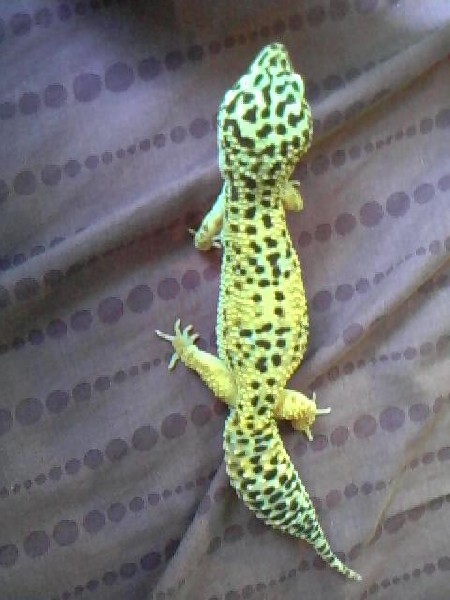
She looks MUCH better then my first pre-owned leo 
-----
1. Leopard Gecko: Cort.
1. Crested Gecko: Fender.
1. African Dwarf Frog: no name yet.
3. Cats: Midnight, Tiger & Fluffy.
RIP.
Leo: Larry.
Crestie: Tuki.
Marbled Salamander: Ibanez.
I'd Rather Be Hated For Who I Am, Then Loved For Who I'm Not - Kurt Cobain.
You asked other than feeding, when not to handle. I don't know if this was answered already, but they shouldn't be held during shedding because they can't see well and can get stressed easily during this time.
He currently has a male/female pair of cornsnakes and a Eastern Kingsnake.I made him do a report on cornsnakes before I bought him the pair for his birthday, basically if he really wanted one he had to write out all the facts and care and he did a great job.He has helped me with my reptiles for years now and with all the other pets.Out of 4 boys(three grown but also were homeschooled) he is the only one that really loves animals like me.
Here is a site that I discovered and wish my son were older so we could do this but maybe in a few years.They have a whole section on genetics and cornsnakes for middle or high school science lab.They also have a dvd you can buy
http://mrskingsbioweb.com/index.htm
I dont know if you do Unit studies but reptiles sure would make a great one.You could cover science, geography, language arts and history in one go.Anyway have fun.
I use a core curriculum for math and spelling. For everything else, I use everything else. We do unit studies, lap books, notebooking, co-ops, classes,brain-pop, child led learning, daily themes, current events, etc. whatever meets our needs.
My son was showing learning problems, so at age 7 (8 in 2 weeks) his classes are more like college - career specific. Every class he does pertains, in some way, to his love for reptiles and amphibians.
I think I'm going to let them keep each shed, with the date of the shed, in a folder. I can remove loose scales, or one or two for viewing under a microscope.
I will check out the website - I have an older child.
Thanks.
This might not pertain to your question about corns, but see if there's a local herp society you can join.
Found one and already planning events with some members - thanks!
