Hi- Wanted to know if there is any different patterns on the splendidas?? I know some are killer looking and some are not. The reason i am asking is i have a female that was given to me and went to the narbc summit show feb. 13 and 14 th and was looking for a male and found one from reptiles by mack and the snake person assured me that he is pure with no other snake breed into it as he has a patterened belly as the female is solid. He has more of an open pattern and very little or no speckled pattern , i mean he is a real nice and clean male just not what i am used to seeing. Any help will be helpful.... thanks
Reptile & Amphibian Forums
Welcome to kingsnake.com's message board system. Here you may share and discuss information with others about your favorite reptile and amphibian related topics such as care and feeding, caging requirements, permits and licenses, and more. Launched in 1997, the kingsnake.com message board system is one of the oldest and largest systems on the internet.



Splendida Question ??
wine2
Feb 16, 2010 02:05 PM
Replies (11)
brhaco
Feb 16, 2010 06:14 PM
shows the usefulness of locality breeding. Here are two snakes with rather wide disparities in pattern, yet both represented as "pure" splendida. It's therefore an almost impossible question to answer. If we knew something about the general geographic origin then we could say more. The desert king is especially problematic since it shares very broad areas of intergradation with no less than three other getula subspecies.
Pics would also help 
-----
Brad Chambers
WWW.HCU-TX.ORG
Breeder of:
Green Tree Pythons
Jungle Carpet Pythons
Pastel, Pinstripe, FIRE, Piebald, Clown, Lavender Albino, Leucistic, and Spider Ball Pythons
Striped Colombian Boa Constrictors
Kenyan, Rufescens, and Conicus Sand Boas
Red Phase Western Hognose Snakes
Spider Western Hognose Snakes
Albino Western Hognose Snakes
Locality Trans-Pecos Mexican Hognose Snakes
Southern Hognose Snakes
Eastern Hognose Snakes
Tricolor Hognose Snakes
Hypo Checkered Garter Snakes
Eastern Blackneck Garter Snakes
Stillwater Hypo Bullsnakes
Patternless Bullsnakes
S. GA Eastern Kingsnakes
Locality Desert Kingsnakes
Albino Desert Kingsnakes
Hypo Desert Kingsnakes
Mexican Black Kingsnakes
Desert Phase, Striped Desert, Newport, and Coastal California Kingsnakes
Locality Mexican Milksnakes
Spotted Mexican Milksnakes
Tangerine Mexican Milksnakes
Locality Alterna
Abbott Okeetee Cornsnakes
Mexican Baird's Ratsnakes
Cape Housesnakes
Tangerine Albino African Fat -Tailed Geckos
Locality Spotted Turtles
antelope
Feb 17, 2010 10:44 AM
agreed, pics would help, but there are many intergrade zones as currently known. here's a couple to scratch your head over...


-----
Todd Hughes
antelope
Feb 17, 2010 10:45 AM
couple more...


-----
Todd Hughes
DMong
Feb 17, 2010 11:21 AM
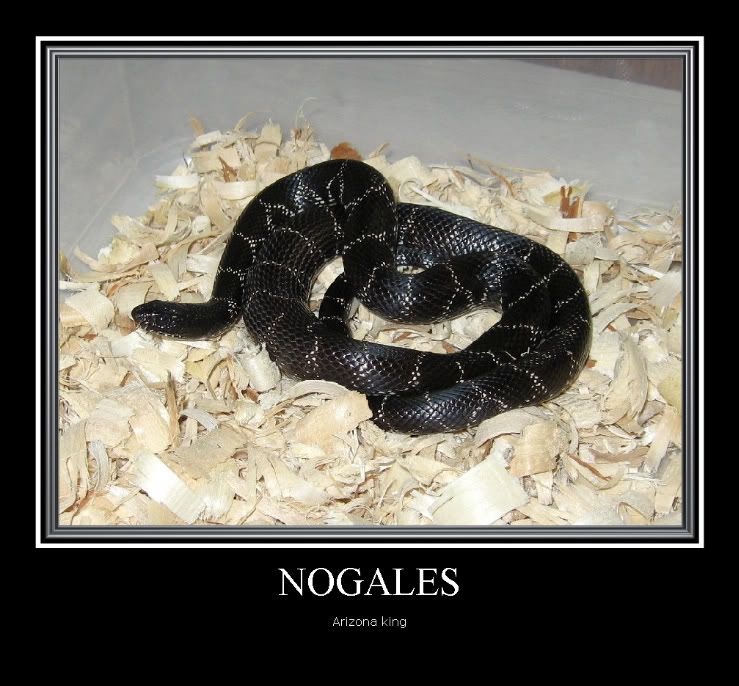
Welcome to the world of splendida, and all the different influence(s) they can have from several other subspecies.
Especially from southern Arizona!
~Doug
-----
"a snake in the grass is a GOOD thing" 
my website -serpentinespecialties.webs.com
antelope
Feb 18, 2010 12:18 AM
I swear I'm gonna bug ya' for that one for a LOOONG time Doug! Killer!
-----
Todd Hughes
DMong
Feb 18, 2010 12:52 AM
LOL!,...Glad you like him Todd!. Who knows, you might just own him one day, but not any time real soon though, as I have to try my best to find him a well-matched female from that area, or one of his sibs from somewhere.
I will definitely keep you in mind if I should ever part with it though.
~Doug
-----
"a snake in the grass is a GOOD thing"
my website -serpentinespecialties.webs.com
antelope
Feb 18, 2010 10:12 PM
thanks Doug, yeah, I suspected a nearly all black venter, all around great looking king! I'll be keeping my eyes peeled too!
-----
Todd Hughes
antelope
Feb 18, 2010 12:19 AM
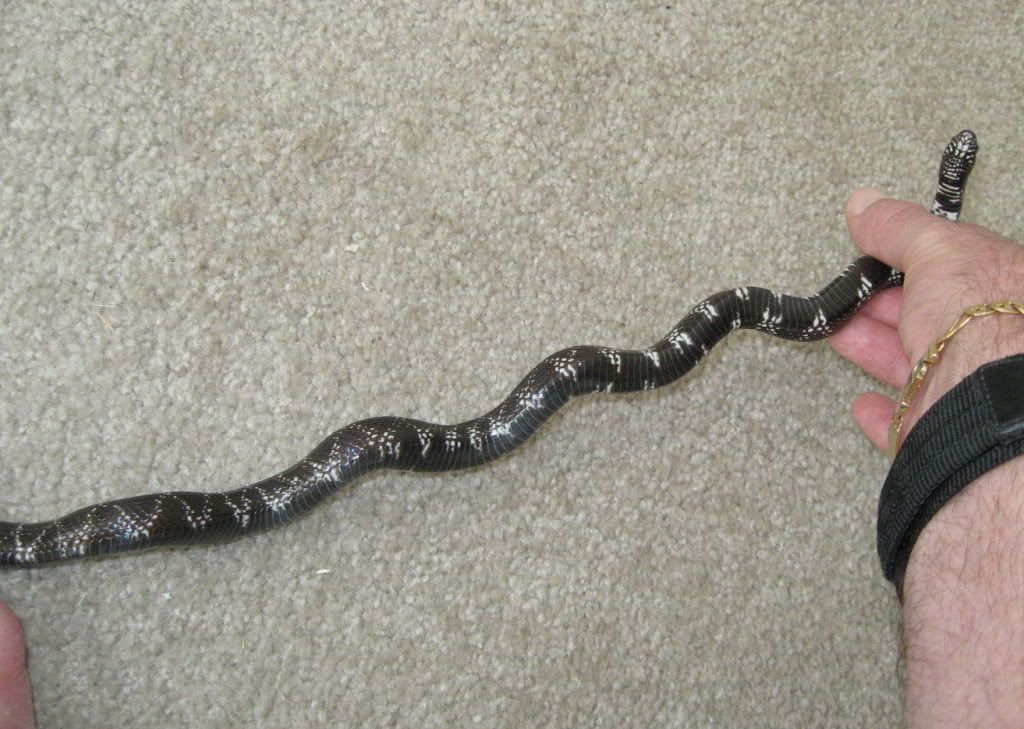
can I get a belly shot on that one Doug? The curiosity is killin' me!
-----
Todd Hughes
DMong
Feb 18, 2010 01:11 AM
Here is a crappy pic I took of his venter shortly after I got him a while back. I will ALSO say, that the guy who showed me pics of one he personally captured less than a half-mile from the Nogales/Mexico border looked identical to mine in every single aspect, very thin chain/net pattern, black ventrolateral triangles, same exact chin/throat coloration and pattern, incomplete broken white ring remnants on side of venter,....the whole nine yards!
I'll try to get a better pic of his entire belly sometime soon, but you can get a very good idea with this one still.
~Doug
-----
"a snake in the grass is a GOOD thing"
my website -serpentinespecialties.webs.com
antelope
Feb 18, 2010 10:12 PM
thanks Doug! see above message!
-----
Todd Hughes
DMong
Feb 19, 2010 12:10 AM
Right on bro!,......exactly,....I wouldn't expect to see a whole lotta white on it's belly judging by its dorsal phenotype either, so yes, good call there!
~Doug
-----
"a snake in the grass is a GOOD thing"
my website -serpentinespecialties.webs.com
