Reptile & Amphibian Forums

Welcome to kingsnake.com's message board system. Here you may share and discuss information with others about your favorite reptile and amphibian related topics such as care and feeding, caging requirements, permits and licenses, and more. Launched in 1997, the kingsnake.com message board system is one of the oldest and largest systems on the internet.

Click here to visit Classifieds
Click for ZooMed
Click for 65% off Shipping with Reptiles 2 You

Lineage and Locality - What and Why?

Sunherp Feb 24, 2010 11:33 AM

The post below regarding the pricing of two breedable, locality-specific female “temporalis” got me thinking that it might be time for a discussion on locality and lineage, and their value to us as hobbyists and naturalists (armchair or professional). Though this post is somewhat self-serving, I want to be up front about that and state that this is NOT a commercial for my stock. Instead, it’s a public statement about why some of us do what we do. I’ll start with my views and thoughts on the subject, which I’ll punctuate with photos to keep things from being too boring, and then hope some others will chime in with their thoughts. I’d like to keep this as civil as possible, so if you ain’t got something nice (civil) to say, don’t say anything at all! The milk forum is NOT the getula Octagon…

L. t. gentilis – Golden, CO stock (F3)

Lineage is important. Knowing and being able to trace the genetic history of your animals is an invaluable asset. Why and what does it give us? Buying from a breeder who can provide lineage information often means buying from an attentive breeder who cares deeply for the animals he/she works with. This attention to detail often carries over into husbandry, suggesting healthy, well cared for stock. It also means knowing which other animals are part of a given animal’s genetic heritage, shedding light on any crosses or impurities. Additionally, lineage information can help prevent repeated inbreeding and help isolate and eliminate genetic defects.

Now, let’s move on to locality which is sort of a nebulous concept that gets a lot of attention and is the next level of information above lineage. Without getting into a deep discussion of the mechanics of evolution, let’s suffice to say that over time, populations of animals adapt to local environmental conditions in ways that allow them to best survive and reproduce. That’s pretty simple and I think (=hope) just about everyone can agree on that level. In a broader picture, this can be extrapolated to subspecies and their formation due to environmental pressures. My thoughts on subspecies can be found here: http://forums.kingsnake.com/view.php?id=1774427,1774427 if anyone’s interested in how this all fits together.

So, what does that locality jib-jab mean and how does it matter to our snakes? People interested in locality-specific snakes place a high priority on the subtle nuances and variations between animals originating in different areas, and thus slightly different environmental conditions. It means that the animals’ lineage can be traced back to wild animals with a particular set of in-born characteristics. It means that you have a significant piece of knowledge about the animals’ natural history and provided clues as to why they are the way they are (food preferences, brumation requirements, ect).

Case in point, I keep milks from Carbon County and Stillwater County, Montana. The counties are adjacent to one another, but differ greatly in an ecological sense. Carbon County is very arid, has a scant rodent population, and many Sceloporus lizards. Stillwater County receives much more precipitation and has a considerably more dense rodent population. The milks inhabiting Carbon County are smaller, thinner, and have thinner saddles than the larger, more robust, and wider-banded Stillwater County animals. Carbon County animals show a marked preference for lizards or lizard-scented food items, as well.

Carbon Co., MT habitat – intermountain semi-desert.

Carbon Co., MT L. t. multistrata (photo credit: Jose Ole)

Stillwater Co., MT habitat – rolling, pre-montane plains (with friends for effect)

Stillwater Co., MT L. t. multistrata

How “tight” of a geographic region must be identified before an animal can be called “locality-specific”. That’s something that must be left up to the individual enthusiast. For me, at least, county designation is sufficient. For some alterna gurus, opposite sides of a ridge may be too far apart. In my opinion, there becomes a point when a locality is too narrowly defined that it is no longer valuable in preserving the wild-type genetic variation in the given population.

Solid locality information is not a common thing these days. It takes some extra effort to make locality-specific pairings (searching out mates, etc.) and maintain the pedigree. That extra effort to be able to provide a significant amount of additional information about the animals is worth LOT to some people. That’s why you see higher prices on animals with good locality data.

So, what about a breeder who has generic (or mixed locality) stock, but has great lineage information? I say, “awesome!” If keeping animals that represent what could be found in the wild in a specific location isn’t a person’s goal, this situation is absolutely ideal. There is a forum member, for example, who breeds amazing generic “temporalis” and maintains impeccable lineage information. He’s the kind of guy I’d buy from if I was looking for such an animal.

Now, let the fun begin!

-Cole

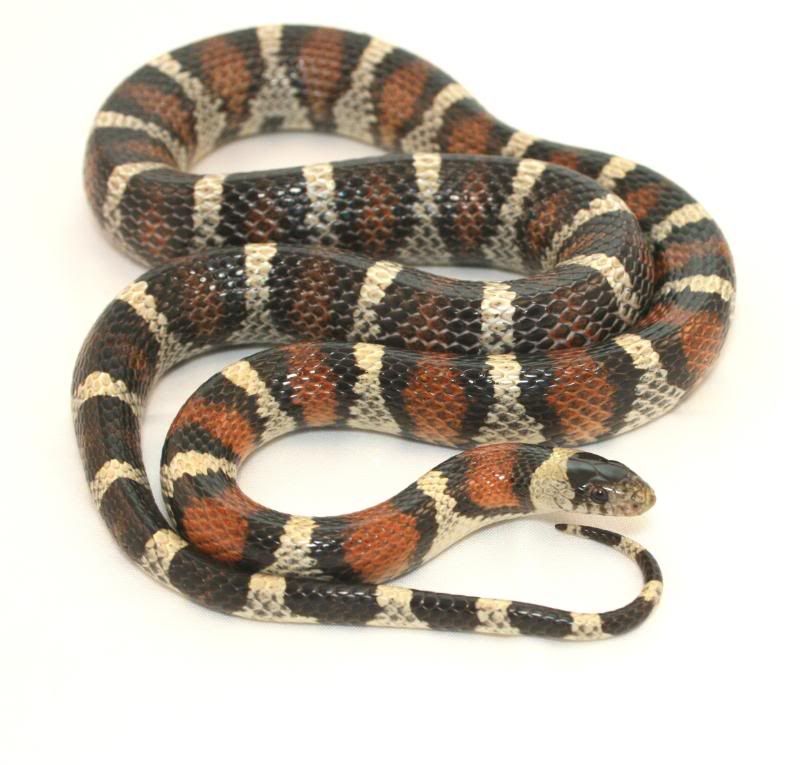
L. t. multistrata – Pennington Co., SD

Image

Replies (137)

Jeff Schofield Feb 24, 2010 01:16 PM

What got me into milks was the sheer variation of color and pattern even within a locality. Now I have been breeding long before the internet and the use of the term locality has changed dramatically. When I started there was a field guide but not much more, and the variation of milks simply cant be covered in something that simplistic. I dont want to go through this history again here, but suffice to say that the availability of digital pictures changed EVERYTHING. You dont have to buy on reputation alone, it is still important. But....
Striking animals, picks of the litter, needle in a haystack type specimens kind of throw rules out the window for me. They are so hard to come by, I have purchased whole collections just to get 1-2 animals I really wanted. Would I buy em without locality?? SURE! Would I buy em without lineage?? Most likely. My experience can key out to at least STATE locales 98% of the time, and thats good enough for me. Can I be fooled by someone misrepresenting or cross breeding? Yup. But that is balanced out by....
My resistence to most's definition of locality. See, I think locality is LOST beyond F3 because a decade of selective breeding WILL change any snake. I still collect from the field, and that term should be reserved for those who put in that hard work to keep their bloodlines "current". I'll compare it to a newspaper: I'm in Boston and I love the Boston GLOBE, but today's GLOBE is going to be much different than one of 10 years(3 generations)ago!
To me, all these things are interlaced. Would I let a pretty female go without love in the springtime because her date wasnt from X locale? NOPE. At what point would I not? Well I think ssp. designations are too much to begin with, if a naturally occuring intergrade exists why should WE choose against them? Honest representation is everything, be it locality or hybrids. But I always try and think of where the offspring will go before I breed, I think this is the most responsible way to breed. On this I think we can all agree!

Sunherp Feb 24, 2010 04:48 PM

See, I think locality is LOST beyond F3 because a decade of selective breeding WILL change any snake.

I'm intrigued by this statement, and it's something I've heard anti-locality guys say over and over. Not everyone breeds the best of the best to the best of the best, hopeing to get super snakes. Some of us keep plenty of less attractive animals around to ensure a healthy and diverse gene pool with our captive snakes. There are, believe it or not, those of us who maintain not just a pair or two of each given locality, but actual colonies (not housed together, of course).

To me, all these things are interlaced. Would I let a pretty female go without love in the springtime because her date wasnt from X locale? NOPE. At what point would I not? Well I think ssp. designations are too much to begin with, if a naturally occuring intergrade exists why should WE choose against them?

Hmmm... You do understand that the term "intergrade" is a direct refernece to the biological phonemon of primary intergradation, correct? An example of a primary intergrade would be the zone of non-differentiation between L. t. triangulum and syspila in IL. That is a much different concept than breeding a L. t. triangulum from Maine with a L. t. syspila from eastern Kansas.

Honest representation is everything, be it locality or hybrids. But I always try and think of where the offspring will go before I breed, I think this is the most responsible way to breed. On this I think we can all agree!

Totally. I tried to make that apparent in my original post by strongly suggesting that keeping records of which animal was bred to which other animal, and where they both came from, is all part of the honesty of disclosure.

-Cole

Jeff Schofield Feb 25, 2010 10:33 PM

Time, it changes everything. You think not? I pose the example of the Everglades Ratsnake. In the 70s if you collected a ratsnake at X locality in the Glades it would look different from the 80s, 90s and today! Now this is a simplistic and dramatic and obvious change to habitat, but I assure you such changes in microhabitats that these snakes live within change equally as quickly with the addition of a road or elimination of predators. A F1 animal is more "valuable" than a F21, on that we can all agree. At F21 I wouldnt feel comfortable talking about locality, not many would. So at what point is locality lost? And if you admit is does get lost, what is the true value of it to begin with beyond the individual that found the snake to begin with??

Sunherp Feb 26, 2010 10:41 AM

You bring up some thought-provoking ideas, Jeff. Nice work! Again, this is the type of post I was looking for.

First, I agree - as habitat changes, so do the animals. That’s a given. However, if we avoid selective breeding for certain characteristics (red head caps without markings, for example), we essentially keep a “snap-shot” of what the animals were like at that locality at the time of collection. Regardless, if the lines are kept “pure”, we maintain the genetic integrity (here, the set of genes present in the wild population) of given local populations. Would you disagree?

-Cole

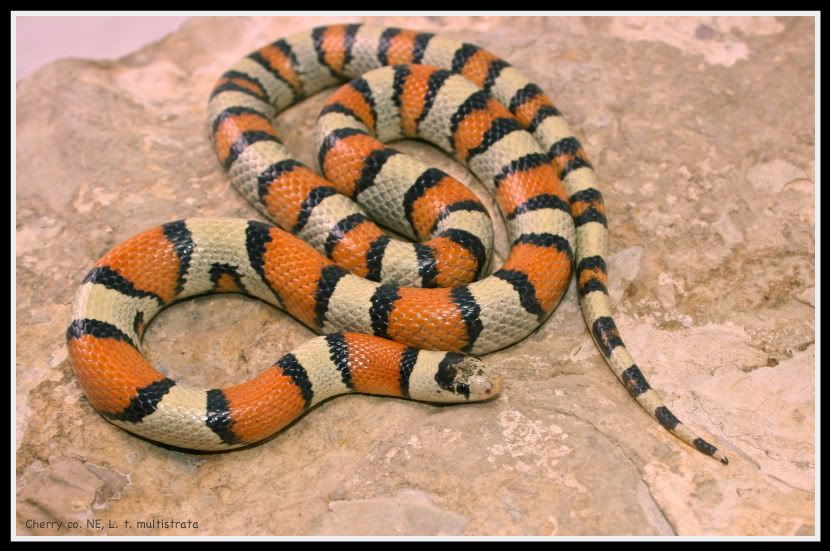
L. t. multistrata - Cherry Co., NE (Photo credit: Dell Despain)
Image

Jeff Schofield Feb 26, 2010 11:57 AM

Locality is a term that should be reserved pretty much for those who catch or at least possess the wc animals. We can mostly agree that its a NA thing. You catch pales so obviously you know the difference as I do with Easterns or Coastals. I think its out of respect to each other that we maintain these lines.

Example: if you accept the time-line theory then you breed 1990s coastals and I find and breed 2000s...and in 2010 someone breeds these together and passes them off as LOCALITY, you lose even the timeline and taint both timelines as much as some look at ssp..

And this doesnt even consider selective breeding which we all do. While I cringe at the idea of someone tainting my MONSTER ISLAND line, I know it will happen. So I will make sure "pure" animals are available as long as I can then pass them along to someone who would do the same. Are these animals "worth more"?? If I will likely have to GIVE my breeders away at some point to insure their integrity how can they be??

I still fall back on digital pics eliminating the "locality" mandate. But I think its also time we accept more variability within these outdated lines to be progressive rather than regressive. While I long for the days where Coastals were easy to come by and variable, I would never assume inbreeding a line for 20 years would be true to any locality.

Sunherp Feb 27, 2010 11:51 AM

I still fall back on digital pics eliminating the "locality" mandate.

Why? How does that matter? A digital photo of an animal in a tub doesn't provide any information regarding the localized conditions that the animal (or its parents, grandparents, etc.) adapted to.

Here's an example:
Let's say you were in the market for some gentilis. You contact a breeder who sends you photos of some of his available stock. You pick out a nice female and don't ask any lineage or locality related questions. You decide you're going to search out a male from another breeder that catches your eye better than the males the first breeder had. You find a male, and again don't ask for locality or lineage information. As the snakes reach adulthood, you decide to brumate them in preparation for their first breeding. What would be the outcome if your female was from a line of gentilis originating in Central Kansas at an elevation of 1,500 feet asl, while your male was from a line originating in the intermountain valleys of north-central Colorado at an elevation of 7,000 feet asl? Would you not expect the animal from Colorado to have a different reproductive strategy than the plains animal?

The reason I bring this up is that this phenomenon is widely known in other herps. Why should we not expect it to be the case with milks?

-Cole

Jeff Schofield Feb 27, 2010 08:31 PM

Cole, you make this too easy. THEY ARE ALL SNAKES IN TUBS. It doesnt matter if I found it in my crack, I put it in a tub, feed it, keep it alive and happy. Do you think its harder to a 7000ft elevation milk to adapt to a tub than a 700ft one? Once its in captivity...well, its in captivity. The natural laws no longer apply. A cb snake that has never seen the outside, and you are trying to tell me that I cant MAKE it adapt to living in a tub for a couple years before attempting to breed it? Phooey.
I find your first point particularly entertaining. I was the LAST guy in the classifieds to post pics, for years I would sell on my reputation alone....locality milks. If locality is soooo important now, more important than looks, try selling one in the classifieds without a picture. I dare you,LOL. Tell you what, I'm so sure its impossible I will do it for you! Its so frowned upon that the ad might even be pulled simply because there isnt a pic! Side bet, I'll price it too low so as to get plenty of inqueries. Better than 90% will "need a pic" despite locale.

Joe_M Feb 28, 2010 09:50 AM

Jeff, I don't understand all this fuss about people needing a picture. Just take out the camera, take a picture, and press send. It's really not that difficult. It's not the 70's or 80's. You don't have to go buy film, take a picture, bring it to be developed, place it in a envelope, and put it in the mail, wait for delivery, etc.

I, as a consumer will not buy anything of any value to me without seeing it first, be it a snake, a puppy, a car, a house, or anything. In this day and age it's just not necessary to buy anything without seeing it first if you want to. That is unless the seller may be keeping something from you that he/she might want you to see. Again, just my opinion here.
-----
Joe

Jeff Schofield Feb 28, 2010 01:48 PM

Joe, my pic problems aside, no one buys anything sight unseen and I get that. My pics arent the best but even I take em. My point was that if the locality matters more than the looks of a snake why do we need a picture at all? If it were true people would buy locality milks sight unseen...but they dont....because its not true! I'm just going the extra mile here to make it obvious that people simply arent abiding by the stringent rules anyways. I may be a contrarian, but I do have a pretty obvious point. Until that point can be debunked I'd have to say I win the arguement, correct?

Sunherp Feb 28, 2010 02:37 PM

an argument that nobody's disagreeing with. There are a range of looks from every locality. Beauty is in the eye of the beholder. Just because I think a particular animal is attractive doesn't mean that the next guy will. Photos are essential in just about every case.

-Cole

DMong Feb 28, 2010 04:06 PM

Jeff,......is it so wrong or abnormal of someone to want to see if the animal they are spending money on isn't just skin and bones first, or have a giant lump sticking out of it's back...LOL!.....geeezus man!,...what the hell is all the silly hubbub about here??..HAHAHAA!

As much as I was all about having snakes in the late 60's and 70's, today(most of us)can now take a half-decent digital pic of anything at the drop of a hat, and I for one would seriously have to wonder why the heck someone was too lazy to throw a pic in with their internet add when all the countless other hundreds of people were able to find a moment to do it,..simple as that...LOL!

I'm quite sure there are a significant number of people out there that try to be deceptive by not adding a pic of the animal they are selling, in hopes to get rid of it, what's so hard to understand about this??.

I'm not ever buyin SQUAT! that I don't see first, unless it's from someone I know and trust real well, and they say....."you are gonna REALLY like this one bro, just wait and see!". That's all there is to this as far as I'm concerned.

Isn't there some better Hondo topics you can think of to harp on??

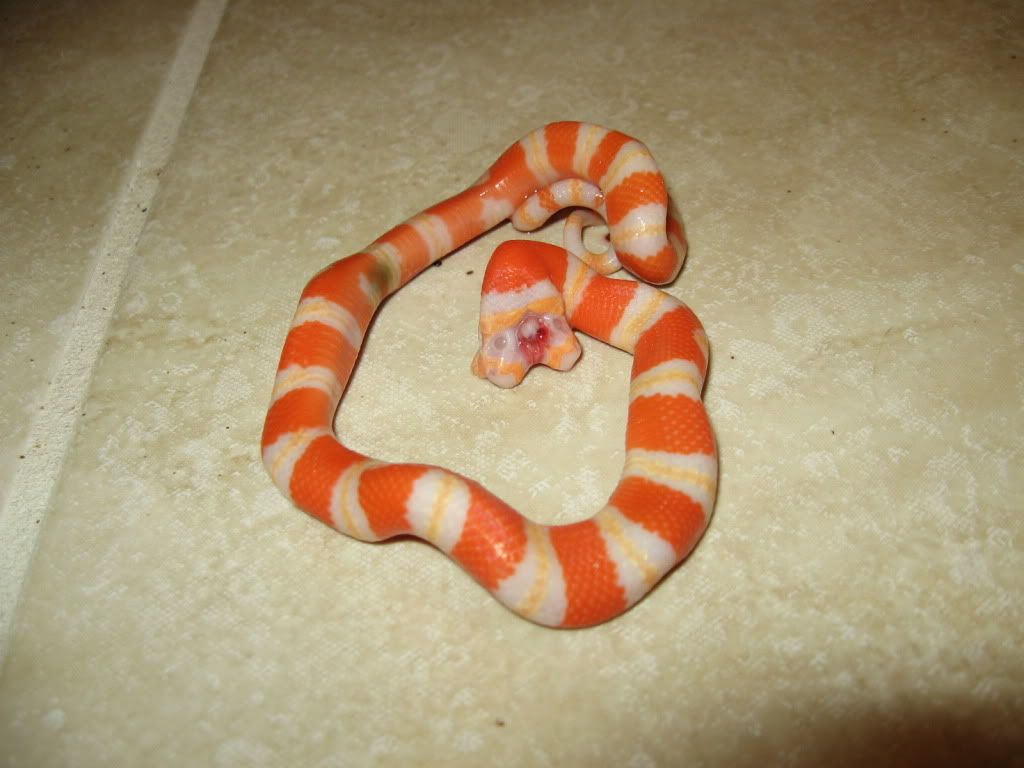
I could have tried to sell this dead two-headed albino Honduran without a photo, but I'm thinking the buyer would be very disappointed after opening the box..HAHAHAA!

~Doug

-----
"a snake in the grass is a GOOD thing"

my website -serpentinespecialties.webs.com

HondoAberrant Mar 01, 2010 01:31 PM

I would buy from some breeders sight unseen, like Shannon Brown and Bob Applegate. Jeff, not so much...

I was trying to buy a group of high-end Sinaloans a few months ago but just could NOT get the guy to send me a pic to save his life. He is a good guy and well known here, so I wont go any further, but pictures could have made him a few thousand dollars.
-----
Scott MacLeod
2.6 Snow Hondurans
1.1 Aberrant Snow Hondurans
2.4 Aberrant Hondurans
1.3 Aberrant Tangerine Hondurans
1.2 Aberrant Hypo Hondurans
0.1 Aberrant Hybino Honduran
1.3 Extreme Hypo VP
1.1 Tricolor Hypo VP
0.1 Hypo E Sinaloan
1.0 Het Hypo E & Amel
0.1 Amel het Hypo E and Splotched
1.1 Albino Striped Sinaloan
2.7 Striped Splotched Sinaloan
1.2 Poss Het T pos Sinaloan
1.2 T pos Sinaloan

JYohe Feb 26, 2010 06:55 PM

.....and that pic is just a normal example of a Cherry pale...

Yea....right......

I have 3 cherry pales....mine read alot of newspapers in the rain....yours was washed in Mr Clean ........

....so the "locality " issue has reasons.....looks.....yet....the look will vary greatly....

...........locality......when able to....only the best of the best will be kept...then that look will become the standard every will want, deserve,pay for...strive for....

(okeetee corns...it is now a LOOK...not a locality....)
(the locality that took over are refered to as "Haphazard Road" or "Jasper Co" corns.....and they vary.....ALOT....

...
-----
.......
.......
......JY

Jeff Schofield Feb 26, 2010 07:02 PM

Problems occur here when even the "ugly" cb babies are kept,bred,and "prized" over better looking specimens! So I will ask you the same question I just asked Joe...which do you prize more....ugly locality snakes or pretty generics??

JYohe Feb 26, 2010 11:43 PM

both........they are mine?

I have generic pueblan ...they looked good...and 3 for 100$
I have generic sinaloans...they looked good...and got on a trade
I have generic hypo hondos...they were cheap and still look good
1.2 cherry pale
1.1
1.1
1.1
1.0 local reds....4 locals
1.1 striped line OC NJ temps
1.1 St Mary
1.0 calvert 09
1.0 tyrell's
cave rats ,choco rats, Korean rats all generic...
all corns are generic and rare colors even...
balls,all generic..only 1.1 wild..YB..(36 fem bred this yr)
amel house snakes....said to be "Zululand" wtf

....I want amaura,anulata,celaenops,gentilis....they can be generic........but perfect a banding as possible....

....get it....it don't matter.....personally...I am just writing about stuff......I have both types....

...
-----
.......
.......
......JY

Sunherp Feb 27, 2010 11:58 AM

It depends. Typically, I'd choose an ugly locality animal over a pretty generic any day of the week. I've proven this to myself time and time again. However, there are times when I'd pick a nice generic hands down. Bright red amazon tree boas are one such example. Hypo "honduran" milks are another. I've got generic syspila, too (parts of the hypo project).

-Cole

Tony D Feb 24, 2010 06:27 PM

I don't think that it need be lost beyond a few generations but natural distictions often are.
-----
“Nothing is at last sacred but the integrity of your own mind.” Emmerson

Sunherp Feb 26, 2010 10:47 AM

Tony,

I believe what you're saying is, once selective pressures are gone the animals are not necessarily representative of their wild counter-pats. However, they could still be genetically representative of the wild population at the time of collection of the founder stock. Is that correct? I could not/would not argue that.

-Cole

L. t. multistrata - Cherry Co., NE (photo credit: Jose Ole)

Image

Tony D Feb 26, 2010 11:18 AM

I would say they are somewhat representative of the founding animals. Whether the founding animals were representative of the population they came from is another matter. For one thing you’re creating a pretty severe genetic bottle neck when you isolate a few animals from a population in captivity. Further, artificial selection pressures generally don’t start with the first cb generation. The eye candy criterion often starts in the field when we determine which animals to bring home and which to let go.
-----
“Nothing is at last sacred but the integrity of your own mind.” Emmerson

Sunherp Feb 26, 2010 11:24 AM

I would not argue any portion of your post. There will always be some artifical selection. I think we can, however, minimize the amount by NOT always pairing the nicest looking animals with the nicest looking mates.

Thoughts?

-Cole

Jeff Schofield Feb 26, 2010 07:13 PM

Sure, stop breeding the ugly animals!! This isnt rocket science. In captivity we shouldnt look to reinvent the wild, we should be looking to improve it! Our snakes will be more in demand the prettier they are....not because its the 1000th baby produced from Cherry county! If its a "rare" locality, fine, but how many babies have to be cb from a locality before its generic to begin with?? Maybe thats the more appropriate question!

Sunherp Feb 27, 2010 11:35 AM

This isnt rocket science.

Correct. It's actually a small-scale trial in population biology. To maintain the look and feel of a particular "locality", a breeder must be careful not to intentionally eliminate characteristics inherent in the population. Isn't this your biggest gripe about today's locality temporalis? You can't have it both ways, Jeff!

-Cole

Jeff Schofield Feb 27, 2010 06:40 PM

Cole, THIS IS NOT small-scale pop bio. You are removing an animal from its environment and changing just about everything in its life cycle!! To YOU it is the same, to the SNAKE its not even close. You intentionally bring all these other artificial selection opportunities to the table but you remove the idea of actually trying to make a better snake?? Makes no sense. Once you aknowledge that YOU and the rest of us are alike in this regard it makes it easier to approach the subject of building a better milksnake.
To be clear, my "gripe" about coastals is "it was better in the old days". More collectors, more snakes, more breeders, more DIVERSITY. Back then Pales were rare, it was a big deal to have a Cherry co. after Walt Deptula did his article. He placed an artificially high price on them....and because of the article and that high "investment" price they got popular. They arent exactly rare in the field ya know. Relative prices of NA milks around 1990 for cb babies:

Eastern-25
red-40
gentilis-25
taylori-300
annulata-50
NM-100
Coastal-100
Pale-40 before the article....300 after the article!!
I remember John Fraser breeding them, 1 clutch, and Walt and I fighting over who got em for $40ea. He won, and went out the next year and found a bunch on his first ever collecting trip for em... published the article and raised the price. It has been high ever since. Just in case you didnt know....

Sunherp Feb 27, 2010 06:52 PM

History is history, Jeff. Eastern Milks still go for $25-50 in spite of the prices of everything else going up. Is that because they're undesirable? To the average keeper, yes. Not to us who find them interesting, though. I sure enjoy my nominate triangulum. We're a specialized group, Jeff. As soon as you can accept THAT, we'll be closer to seeing eye-to-eye.

-Cole

Jeff Schofield Feb 27, 2010 08:04 PM

Cole, do you know the real reason why easterns price is relatively low? Simple, where they are found(WC in the NE) has the highest population of milkheads. PERIOD. There is the cynical thinking that "I can go out in my backyard and find something like that"goes along with it. There is the inherant fear that you are buying WC not CB, and they are difficult to work with.
Now do you think having multiple morphs available as well as the potential for a marked size increase available could affect your thinking? The hobby's? The public's? Everything is cyclic, and I have tried not to jump around and chase the rabbit when I know its running in a circle.

"We're a specialized group, Jeff. As soon as you can accept THAT, we'll be closer to seeing eye-to-eye. "

Cole, I dont see a specialized group, I see a group of very individual people wasting alot of time and energy marching in line instead of blazing a trail. I see a group of people wanting to feel special but not contributing their share to the common good. Slackers,lol. Dont get me wrong, I am a field guy and we could have a blast on a beer fest/collecting trip. But like a shark I cant stand still or I will die. Lets all do different things, even if some are wrong! Learn from the experience and come here with results not theories!
If you are a locale guy there are no new locales to find. Adapt. And how about this, lets not all be so judgemental of the "generics"...lets come up with a catchy name("nominate",LMAO)and praise those of us who drive fast and take chances!

terryd Feb 28, 2010 01:49 AM

"Simple, where they are found(WC in the NE) has the highest population of milkheads. PERIOD."

:Are you making this up as you go?

"I have tried not to jump around and chase the rabbit when I know its running in a circle."

:That's what its like trying to read one of your posts.

"If you are a locale guy there are no new locales to find."

:BS Jeff. You'd find new locales if you would get off your ass and go look.

"But like a shark I cant stand still or I will die."

:Hahahahaha, whew, good one Jeff.

"praise those of us who drive fast and take chances!"

:Thank you Mario Andretti.

"Maybe you dont know alot of things because you havent been around long enough or smart enough to either ask or look at historical posts."

:Can you be more condescending? Look below you can.

"But if you want a direct answer come to me Cole, and I will help you with what I know"

:Speak oh fountain head.

I haven't heard this much blabber from one person in a long time. Schofield you sound like an over done commercial. bla bla bla bla bla bla bla bla

"and all the pretty little hatchlings have grown into drab colored newsprinted snakes."

:Jeff your right, this adult sure is ugly. Why do I even like these?
Image

Jeff Schofield Feb 28, 2010 02:28 AM

"Simple, where they are found(WC in the NE) has the highest population of milkheads. PERIOD."

:Are you making this up as you go?

FACT-the northeast part of the country has the most people per square mile than anywhere else. That means it also has the most milkheads.

"I have tried not to jump around and chase the rabbit when I know its running in a circle."

:That's what its like trying to read one of your posts.

Dell-try to save your joke til the end so you have a punch line!

"If you are a locale guy there are no new locales to find."

:BS Jeff. You'd find new locales if you would get off your ass and go look.

Dell-welcome to 2010. There isnt a "new" spot for milks within 500 miles of Boston. I have milk spots in every state between here and NC....but I guess I dont get off my ass...

"But like a shark I cant stand still or I will die."

:Hahahahaha, whew, good one Jeff.

Dell-Thanks!

"praise those of us who drive fast and take chances!"

:Thank you Mario Andretti.

Dell-keep going with the jokes, it makes me forget what you look like!

"Maybe you dont know alot of things because you havent been around long enough or smart enough to either ask or look at historical posts."

:Can you be more condescending? Look below you can.

Dell-The recent history of LTM has been well documented. I dont see how anyone with as much interest in them doesnt know it. You dont wake up to find the local milksnakes are $300ea without someone else doing the work for you.

"But if you want a direct answer come to me Cole, and I will help you with what I know"

:Speak oh fountain head.

Dell-you have helped this thread so much, how did we get along without you? I'm a helper, thats what I do,lol.

I haven't heard this much blabber from one person in a long time. Schofield you sound like an over done commercial. bla bla bla bla bla bla bla bla

Dell-this was a civil discussion from the start, please read it from there.

"and all the pretty little hatchlings have grown into drab colored newsprinted snakes."

:Jeff your right, this adult sure is ugly. Why do I even like these?

Dell-a broken clock is right twice a day. I take that back, that is a fine example of LTM, wish they could all look like that. Oh ya, maybe they could....if you could find another one like that and breed em to TRY and make em look like that! But you would rather breed em to the ugly bucktooth crackhead newsprint locality match....well, thats why you live in Montana I suppose!
PS-now there is a funny joke to end on! All in good fun man!

DMong Feb 28, 2010 10:10 PM

HAHAHAHAAA!!!

funny stuff man!

~Doug
-----
"a snake in the grass is a GOOD thing"

my website -serpentinespecialties.webs.com

Sunherp Feb 28, 2010 10:38 AM

lets not all be so judgemental of the "generics"...lets come up with a catchy name("nominate",LMAO)and praise those of us who drive fast and take chances!

First of all, did you even read my other posts (first one, included)? I in no way bashed generics. Not even a little.

As for the use of the word "nominate" when referring to L. t. triangulum, I'm not even sure what to say. The word "nominate" denotes the first form of a species described by science. The nominate form has its specific epithet repeated as its subspecies denotation. I thought you had a biology degree?

I dont see a specialized group, I see a group of very individual people wasting alot of time and energy marching in line instead of blazing a trail.

Well, then we live in very different world.

-Cole

Jeff Schofield Feb 28, 2010 02:02 PM

Its called SARCASM Cole. Please dont take this seriously. PS-I never ruined no Hondo post.

KevinM Feb 24, 2010 02:33 PM

This always appears to be an "exciting" topic on the forums LOL!!

I quess my concept of locality has more to do with geographic isolation than location. If the animals are from different "localities" that are in communication with each other and it is feasible and likely for the animals to migrate to each other, than I can't see how their "locality" designation could hold up IMO. To set a locality at a County level would be hard to hold up as well. What about identical looking animals found adjacent on either side of a County line in similar habitat? Or even adjacent to one another right across a State line in similar habitat? Then there is the situation of finding non-identical animals in the same county, maybe even with a few miles or less of each other, but in differing habitat. I feel it is the isolation factor that influences population differences and expressions in phenotypes that spurs most herpers concept of locality, not the arbitrary lines on a map.

Sunherp Feb 24, 2010 04:21 PM

I quess my concept of locality has more to do with geographic isolation than location. If the animals are from different "localities" that are in communication with each other and it is feasible and likely for the animals to migrate to each other, than I can't see how their "locality" designation could hold up IMO.

I think there are very, very few cases where your definition of “locality” would hold up, since most populations are not geographically isolated from one another. My definition, on the other hand, simply consists of data regarding the collection location of the founding stock. In some areas, ecological conditions don’t vary much from one county to the next. In others, though, it can make a huge difference. To me, “locality” is NOT a designation of distinctness, but a set of data that provides some information regarding the founder stock’s natural history.

What about identical looking animals found adjacent on either side of a County line in similar habitat? Or even adjacent to one another right across a State line in similar habitat? Then there is the situation of finding non-identical animals in the same county, maybe even with a few miles or less of each other, but in differing habitat.

As I stated in the previous paragraph, I’m not suggesting that providing locality data with animals means they’re distinct from neighboring animals with which they readily exchange genetic material. I’m simply suggesting that locality data provides some insight into the ecology of a particular group of animals in their natural habitat.

I feel it is the isolation factor that influences population differences and expressions in phenotypes that spurs most herpers concept of locality, not the arbitrary lines on a map.

I would argue that “most herpers” have a skewed and invalid concept of what “locality” is, in that case. I don’t feel this is the case, however. I don’t avoid breeding Bighorn Co., MT pales with Yellowstone Co., MT pales because they’re distinct entities (they’re not – that’d make them distinct species…), but because the natural history information surrounding the founding stock would be lost.

Thoughts?

-Cole

KevinM Feb 24, 2010 05:55 PM

"I think there are very, very few cases where your definition of “locality” would hold up, since most populations are not geographically isolated from one another. My definition, on the other hand, simply consists of data regarding the collection location of the founding stock. In some areas, ecological conditions don’t vary much from one county to the next. In others, though, it can make a huge difference. To me, “locality” is NOT a designation of distinctness, but a set of data that provides some information regarding the founder stock’s natural history."

Thats part of my point. If Locality X is not separated or different from Locality Z, then IMO they are not different Locality animals just because they were not collected at precisely the same location, or within a designated area identified by the herper. For instance, I do not consider speckled kings I collect in Picayune, MS to be distinct locality animals then specks I would collect in New Orleans, LA. They are basically the same animals IMO. If I HAD to put a locality on them, then I quess it would be the areas I collected them from. I think this is what you are getting at. I could describe offspring produced by them as a "Picayune, MS x New Orleans, LA" animal and leave it at that. By your definition, I may be able to expand that to a "Pearl River County x Orleans Parish" animal. Still, I would consider it pointless to consider them different "Locality" animals and would probably just call them southeastern or southcentral specks.

"As I stated in the previous paragraph, I’m not suggesting that providing locality data with animals means they’re distinct from neighboring animals with which they readily exchange genetic material. I’m simply suggesting that locality data provides some insight into the ecology of a particular group of animals in their natural habitat."

I agree to a degree. However, this information would be critical ONLY if it does indicate significant differences in habitat and ecology.

"I would argue that “most herpers” have a skewed and invalid concept of what “locality” is, in that case. I don’t feel this is the case, however. I don’t avoid breeding Bighorn Co., MT pales with Yellowstone Co., MT pales because they’re distinct entities (they’re not – that’d make them distinct species…), but because the natural history information surrounding the founding stock would be lost."

Once again, I would disagree to a degree. If the YS Co. animals look, act, and live in the same habitat and ecology as the Bighorn Co. animals, then can you really consider them to be "Locality"?

Please understand I am not bashing your concepts and opinions on locality. However, using alternas as a case example, when I buy an animal that is a Juno Rd. locality, I expect it to look a certain way and distinct from an animal that is say a Hwy 277 locality animal. They are geographically, phenotypically, and probably ecologically different to a degree to constitute the use of a "Locality" designation for these animals.

Sunherp Feb 24, 2010 06:09 PM

Intereting. Thanks for the input.

Regarding the alterna, it should be noted that the animals are not any more geographically isolated from one another any any of the populations of milks I listed. The animals collected at Juno Road had gene flow with animals throughout the range, as the animals are more or less continuous throughout the area. Certain habitats select for certain characterists.

True Biak Morelia viridis would be one example that'd fit your definition (and mine).

-Cole

Sunherp Feb 25, 2010 09:42 AM

Kevin,

I had a super busy afternoon/evening, yesterday. Sorry I didn’t get to write more until now. I’ll address just a couple of your statements here, and I think you’ll see that we only differ in our definition of what “locality snakes” are. These kind of discussions are fun for me, especially when they remain civil. Thanks for getting your ideas out there!

If Locality X is not separated or different from Locality Z, then IMO they are not different Locality animals just because they were not collected at precisely the same location, or within a designated area identified by the herper. For instance, I do not consider speckled kings I collect in Picayune, MS to be distinct locality animals then specks I would collect in New Orleans, LA. They are basically the same animals IMO.

I think part of the “disagreement” here is that you’re seeing the need for some distinct biological uniqueness between localities, where as I’m providing a definition of locality that simply states that the founding stock of a given line originated in X location. Sometimes there is an ecological difference between the animals in one locality and the animals in another, but sometimes there is not. For example, a Pale Milksnake from the sandhills of Thomas Co., NE is a very different animal than one from the arid canyon lands of south central MT.

L. t. multistrata – Thomas Co., NE

L. t. multistrata – Yellowstone Co., MT (photo credit: Dell Despain)

However, this information would be critical ONLY if it does indicate significant differences in habitat and ecology.

The locality information is not critical, in my book. It’s something that’s nice to have, and it’s important to some people (not all).

If the YS Co. animals look, act, and live in the same habitat and ecology as the Bighorn Co. animals, then can you really consider them to be "Locality"?

Yes, in my book. They are “locality”, but not discretely isolated units. Again, I think we’re at a semantic issue.

-Cole

KevinM Feb 25, 2010 03:58 PM

No problem Cole. I actually think we agree more than originally suspected. Having the locality data the animal was collected from is cool, no doubt. However, I associate the term "locality" with a specific look or trait that is prominent and well expressed in animals from a certain area. Pretty much like your pale milk example. So, if I buy a Locality X animal, its for a trait I like from the species in that area (ie, Christmas Mtns. alterna, Devils Garden corns, etc). Based on your further post and providing the pale milk examples basically gives me the impression we are on the same page for the most part. Its nice to know an animal was collected in Picayune, MS, even if it looks just like the animals collected in N.O. LA. I am not that picky using the term locality in such an instance.

Sunherp Feb 26, 2010 10:23 AM

We're just looking at the issue from two different angles. Have a verbal exchange in this manner is a pleasure, Kevin. Thanks for that! We don't see exactly eye to eye on what a "locality" is, but we're able to maintain civil and friendly discourse. There's no name-calling or brow-beating. This kind of stuff is really fun for me. I like to be challenged on my ideas. It makes me re-think and re-evaluate my positions on things.

Milksnake Habitat – Yellowstone Co., MT

KevinM Feb 26, 2010 11:35 AM

I agree with the fun involved in these discussions. I learn alot about how other herpers view things and why. I am not a biologist, and to be REALLY honest the minute aspects of taxonomy and classification do not interest me to a great level. I respect the work involved and the reasons, but at my level of herpetoculture, its not that uber important LOL!! Maybe if I kept more discerning subspecies I would. I did get a bit nuts about locatily when I had a decent alterna collection several years ago. The driving factor was the differences in phenotype several of the localities represented to me. However, I started waning when I noticed certain traits I admired the most could be seen in more than one locality and decided to keep what was visually appealing to me regardless of locality as long as the animals were not hybrids.

antelope Feb 25, 2010 11:01 PM

again, spot on with my thinking of locality Cole, it is information used for the sole purpose of telling a buyer where the animals came from. For myself, though, I don't yet work with several localities of milks, rather several locality subspecies as of now. When I finally find mates for all the damn county anulatta males I have, I might have to rethink this, as all the counties I hunt are adjacent and all of the surrounding habitat is virtually the same with no barriers to flow, just distance. The Freer animals are the oddballs as that is where the morphs are coming from for this sub. Supposedly.

-----
Todd Hughes

KevinM Feb 26, 2010 09:47 AM

Hi Todd, please see my last post to Cole. I am NOT disagreeing that the collection site information is usefull, but EACH location/county/city/hammock of grass they were collected from does not justify calling an animal "Locality X" to me. You bring forth another case example that shows this with the annulatas. Now, I would say those phenotypically same animals within that area amongst the counties you collected them in could be considered "Locality X" animals because they all express the same traits representative of the same type habitat and gene flow capability. I quess I am not going to buy an animal labled as "Locality X" thinking its better or more unique than someone selling the same animal as "from S. Texas stock", if they are basically the same animals, same genes, from the same habitat. Putting that specific "Locality X" moniker on them doesnt make them more special in my eyes.

antelope Feb 28, 2010 01:23 AM

and it shouldn't! It is for those who have spent time in the area, can appreciate when there is a difference, and what that means to them. I have a few snakes that aren't locality animals and I enjoy them for what they are, animals I didn't collect myself but have a visual appeal to them, much likr the alterna you keep now versus then. When you collect in an area that has many different landscapes in a small area, things change, sometimes subtly, sometimes dramatically. As for the anulattas, well, they don't change much because the area is vast and the same for more miles than some states are in total size, lol! I guess for me, with the landscapes changing with encroachment, it is vastly important to me to keep a locality line from where they are quickly disappearing. I like to say, I caught some neat milks snakes here about 12 years ago.....
-----
Todd Hughes

KevinM Feb 28, 2010 06:35 PM

Todd, I do not disagree with you wanting to preserve certain animals from a certain area that is destined to become condos, shopping malls, etc. They do represent a specific genetic pool within that area that will never be duplicated in other areas, regardless of how large or small that pool may be. I quess I feel some folks take the locality moniker a bit too far, and it appears to be overused to me at times. It imparts less value to me if I cannot see HOW the locality moniker affects said animal.

Tony D Feb 24, 2010 04:01 PM

Well....if for whatever reason locality is important to you it is, if it is not important to you it isn’t. To that simple axiom I'd like to add two thoughts:

1 – not caring about locality and providing good care for one’s stock are not mutually exclusive concepts.

2 – caring about locality does not automatically confer “stand-up guy” status for all the points you’ve brought to bear. The simple fact that locality stock can demand double the price of generics cannot be overlooked as a corrupting factor.
-----
“Nothing is at last sacred but the integrity of your own mind.” Emmerson

Sunherp Feb 24, 2010 04:28 PM

not caring about locality and providing good care for one’s stock are not mutually exclusive concepts.

I never said anything of the sort, Tony. I actually made an effort to give you some props in my post, but take from it what you will. You've got quality stock and know which animals you've bred to which, so are thusly able to provide good lineage info. That was sort of my point...OK, almost totally.

caring about locality does not automatically confer “stand-up guy” status for all the points you’ve brought to bear. The simple fact that locality stock can demand double the price of generics cannot be overlooked as a corrupting factor.

I couldn't agree more. Verifiable locality information (or that from a trusted source) is all that can be counted upon.

-Cole

Tony D Feb 24, 2010 06:16 PM

Cole I wasn't taking any of this personal but it can not be denied that it is frequently infered that locality guys are more trustworthy, more into the snakes and more appriciative of their animal's natural history. People who do not see things the same way are frequently targeted with snide remarks as if to further infer that the opposite must also be true. Call them on it and they back down but they come back and pull the same mess later.

I think its useful to note this behavior because the guys how do locality for the love of the animals don't worry about what others do. They understand that the destiney of their collections in in their hands alone. Its generally the guys who are using locality as a marketing tool that have something to say about what other's do.
-----
“Nothing is at last sacred but the integrity of your own mind.” Emmerson

Sunherp Feb 25, 2010 09:54 AM

Cole I wasn't taking any of this personal but it can not be denied that it is frequently infered that locality guys are more trustworthy, more into the snakes and more appriciative of their animal's natural history. People who do not see things the same way are frequently targeted with snide remarks as if to further infer that the opposite must also be true. Call them on it and they back down but they come back and pull the same mess later.

I hope I haven’t offended you in the past in some way. I also hope you don’t see me as fitting the description you posted above. Somehow, I get the feeling you’ve read more into my original post than I ever intended. My object was NOT to offend anyone, but rather to explain a little bit about why I do things the way I do. I also mentioned that it was a self-serving post, and that I wanted to openly announce that I knew that.

Note, I own plenty of generic snakes – syspila, getula, Amazon Tree Boas, Rubber Boas, etc. Do I like them less because they don’t have locality data? Nope. However, my locality animals mean something different and special to me, because that’s where my main interest lies. Do I think your “Northern Type” temporalis are worthless because they don’t have a specific locality tied to them? Not in any way. I hope I didn’t imply that by giving you recognition for doing things the “right way”…

-Cole

thomas davis Feb 26, 2010 08:09 AM

ahh yes i have been targeted as "not" trustworthy by this SAME crowd of whineybabies because i openly hybridize ssp, sp,etc. and i dont fall inline with traditional taxa thinking, of course i have many true projects as well but i stop calling locality after a couple of generations anyway, see THE FACT is when you remove natural selection you remove locality from the equation, cry as you might it,they are then simply a pet snake.
it is complete BS to attack someones credibility on such grounds or build up someone else but sadly its done all the time ESPECIALLY on this forum! if you want locality go collect what you want, dont listen to marketers justifying their petty subtle little tales of trust.

,,,,,,,,,,,thomas davis
-----
Morphs... just like baseball cards BUT ALIVE, how cool is that???

my website www.barmollysplace.com

Jeff Schofield Feb 26, 2010 12:07 PM

Thomas, I think its used too often out of respect and not because its wc. If only wc animals held the loality title it would change the way everyone looks at that breeder too....both good and bad.

Tony D Feb 26, 2010 11:10 AM

Cole you have not offended me and I didn’t describe the “group” above with anyone in particular in mind.
-----
“Nothing is at last sacred but the integrity of your own mind.” Emmerson

Sunherp Feb 26, 2010 11:28 AM

I'd always thought we had a cordial and friendly internet exchange, but was a little worried that you viewed it differently.

On a semi-related note, are your breeders up? I assume I'm not alone in thinking we need so see more temporalis photos on the forum...

-Cole

Tony D Feb 26, 2010 11:38 AM

I'm about 3 weeks behind in bringing them up because I've been working on my garden project which is also behind because of all the rain and cold weather we've had.

My camera was long lost but is now found so more pics are a possibility. As you know they are not exactly cooperative subjects.
-----
“Nothing is at last sacred but the integrity of your own mind.” Emmerson

Sunherp Feb 26, 2010 11:42 AM

I've all but given up on taking photos of my animals, anymore. I rely on Dell to come over and photograph them for me!

-Cole

thomas davis Feb 26, 2010 07:54 AM

amen tony, tell it like it is

,,,,,,,,thomas davis
-----
Morphs... just like baseball cards BUT ALIVE, how cool is that???

my website www.barmollysplace.com

antelope Feb 25, 2010 11:19 PM

Tony, I think a keeper that catches their own stock has a lot more in it than just money, and with specific data, that makes the animal worth more, in my book. I also believe such persons would try to care for their animals better than generic animals. I can only speak for myself in saying the time spent accruing, acclimating, and other aspects of caring for w.c. stock makes it almost inevitable that one would spend more time, money, etc. than on normal generic animals. For me, I'd prefer locality specific animals, whether they look exactly like others 200 miles away, that's just how I roll. I like the snapshot of it, these animals came from exactly HERE, this is what they look like from HERE.
and another locality factor, most Langtry alterna look like this, but there are a few other looks that are less common but blended in with the whole population. That's where it really gets hairy, lol. Not all localities have "a" look, but can contain a few.

-----
Todd Hughes

Sunherp Feb 26, 2010 10:32 AM

Good stuff, Todd! It is posts like yours and Kevin's that I was hoping for. I'm not asking everyone to agree with my ideas and become a locality nut. Instead, I'd rather hear why people are into what they're into.

Let me know if you start pairing up those South Texas annulata. Are you producing any barrier island critters this year?

-Cole

L. t. gentilis – Central Kansas

Tony D Feb 26, 2010 08:57 PM

"Right on"? Come on Cole let it all out and just shout out a good ole southern "Amen Brother"! Just kidding but this type of locality guy back slapping kinda gives me a gag reflex.

I've been reading Todd's post for a long time. My genreal impression is that he would take good care of whatever he kept. It just so happens he's into locality.

Think the one thing that keeps me from coming onboard with the locality thing is that I see wild pops and captive herps completely differently. Wild herps and pops rock. Captive ones though neat and interesting are really little more than expressions of my ego. Time was I thought it was important work to be breeding snakes and relieving pressure on wild populations. After 20 plus years I not so sure that view is as valid as I once thought.
-----
“Nothing is at last sacred but the integrity of your own mind.” Emmerson

Sunherp Feb 27, 2010 11:30 AM

It makes you sick when people feel a sense of fellowship with others who have a similar interest?! Tony, come on! LOL

I also didn't say that "locality dudes" take better care of their animals. What I said was, people who pay attention to the details in their collections are likely to pay better attention to their animals' husbandry needs. A meticulous nature is a meticulous nature. Would you not agree?

-Cole

Jeff Schofield Feb 27, 2010 06:18 PM

And I can make the arguement that if you charge someone $1000 for a snake they will take better care of it than if you charged em $20. Record keeping and snake keeping are not even close to the same thing....

Sunherp Feb 27, 2010 06:34 PM

Record keeping and snake keeping are not even close to the same thing

In what universe? Sure, good records aren't a necessity for good husbandry practices, but it's a well known fact that tendencies in one part of a person's life generally carry over to other aspects of their life. No?

-Cole

antelope Feb 28, 2010 01:37 AM

I said that, and if it weren't for market value of morphs, I'd be right I think. For me, it's just a love of herping, and if I decide to keep an animal from the wild, I try my damnedest to keep it healthy and thriving. I may have said it wrong. I meant for me, it is worth more to put MY time and energy and money into my w.c. animals, it cost me more so I take care of it the best I can.
-----
Todd Hughes

Tony D Feb 28, 2010 07:22 AM

It makes you sick when people feel a sense of fellowship with others who have a similar interest?! Tony, come on! LOL

This is going to sound bad but to some extent yes. It’s not like you’re brothers in arm in hostile territory. The similar interest here is a methodology in snake breeding. It’s not substantive enough to warrant the fervor. You might as well be waxing poetic on the glue you use for scrapbooking.

I also didn't say that "locality dudes" take better care of their animals. What I said was people who pay attention to the details in their collections are likely to pay better attention to their animals' husbandry needs.

Given that locality and lineage are the details being discussed here I’m not sure there is a distinction there.

A meticulous nature is a meticulous nature. Would you not agree?

Yes I would, that is why I said what I did about Todd. If he were a multi morph guy my guess he would know exactly what potential any given multi possible het you got from him might produce. If you want to look at keeping lineage info as evidence of a meticulous nature that is all well and good. I’m not sure it’s the best evidence but its better than nothing. Score one for team locality.
-----
“Nothing is at last sacred but the integrity of your own mind.” Emmerson

Jeff Schofield Feb 28, 2010 02:07 PM

"You might as well be waxing poetic on the glue you use for scrapbooking"--I love this line...as many of you thought I would LOL.

Sunherp Feb 28, 2010 02:45 PM

It’s not substantive enough to warrant the fervor.

That's totally subjective, is it not? I've got lots of friends who do things differently than I do. What's wrong with applauding Todd for his efforts? Even he does things a little differently than I do.

-Cole

Tony D Mar 01, 2010 01:31 PM

"That's totally subjective"

Praise Jebus Halleluiah! Why yes Cole it is. This whole issue of locality being important is completely and totally subjective.
-----
“Nothing is at last sacred but the integrity of your own mind.” Emmerson

terryd Mar 01, 2010 04:36 PM

Tony D wrote:
"This whole issue of locality being important is completely and totally subjective"

That being said doesn't make it any less important to Cole.

You'v stated that if locality is important to you it is, if it's not important to you it isn't. Then I don't see why you've felt a need to continue on posting in this thread, because for me that said it all.
I don't think you'll ever get Cole & I to admit that locality doesn't matter because it matters to us, and a large number of like minded people that keep locality animals.

-Dell

Tony D Mar 01, 2010 07:40 PM

"I don't think you'll ever get Cole & I to admit that locality doesn't matter because it matters to us, and a large number of like minded people that keep locality animals."

That was never the intent but admitting to the fact that liking, or being indifferent to locality is totally subjective is exactly what I was going for.
-----
“Nothing is at last sacred but the integrity of your own mind.” Emmerson

terryd Mar 02, 2010 01:06 AM

"That was never the intent but admitting to the fact that liking, or being indifferent to locality is totally subjective is exactly what I was going for."

And why is that what you were "going for"?
Because if your implying or inferring, and I believe you are, that I/we admit to now being indifferent to keeping locality animals you didn't achieve your goal.

If this was a long way around for you to find out that I/we agree w/ you that keeping locality groups of animals is subjective for a given keeper then congratulations you've found your answer.

-Dell

Tony D Mar 02, 2010 10:07 AM

"Because if your implying or inferring, and I believe you are, that I/we admit to now being indifferent to keeping locality animals you didn't achieve your goal."

I was not implying that at all, I'm not even indifferent. My goal was to get one of you guys hard core guys to admit that the importance of locality breeding is largely subjective, a simple personal preference.
-----
“Nothing is at last sacred but the integrity of your own mind.” Emmerson

terryd Mar 02, 2010 11:25 AM

"My goal was to get one of you hard core guys to admit that the importance of locality breeding is largely subjective, a simple personal preference."

Oh, this is the long way around to finding your answer, and redundant. Because that was already "inferred" in Coles original post and I also stated in my first post to this thread that a generic animal would be more important to ME if it had locality information tied to it.

"Generic animals are fine even great but if the generic animals had locality information it would make them even more important to me. "

I specifically put "important to me" because I know some keepers are not "hard core locality guys" and that I'm not dogmatic in my opinion of keeping locality animals.

-Dell

Tony D Mar 02, 2010 12:19 PM

I see a distinction here even if I have failed to articulate it.
-----
“Nothing is at last sacred but the integrity of your own mind.” Emmerson

terryd Mar 02, 2010 07:11 PM

"I see a distinction here even if I have failed to articulate it."

Maybe so Tony, but what I like is that you phrased it in that manner to make your point.

-Dell

Jeff Schofield Mar 02, 2010 12:20 PM

Dell, I am in the middle(as many are)between hard-core locality and Tony's view. What I'd like to stress to you hard-core guys is that you have some spectacular animals, and we(the hobby)would also appreciate your use of these in non-locality breedings in a attempt to create better looking lines. There is NO STIGMA for people doing it both ways, its not black and white. You wont taint your lines by creating a new one. And trust me if you do produce non locality animals because of selective breeding you will find a market for those too. So if you have a real super pair, take one year and make non locales. There will be plenty of seasons to produce locale animals.

terryd Mar 02, 2010 07:07 PM

Jeff after some of the things you have printed in this thread and others I hesitate to continue in dialog w/ you. But as I have thrown a few low blows at you myself, I'll answer a few things, but lets agree to keep it above the belt.

You wrote:
"we(the hobby)would also appreciate your use of these in non-locality breedings in a attempt to create better looking lines."

I don't think speaking for the hobby is what you mean, but I get what your asking.
Let me start by saying that we (Cole & I) have only sold a few choice animals over the years, and that I have never used the classifieds to sell an animal (I'm not opposed to it, just haven't used them), a few have been given away, but not many.
In all these transactions we are fully aware that the person taking the animal could do what ever they wanted w/ the animal once it was in their possession.
We would hope that the person would keep the animals true to locality, but it's not a prerequisite.

Jeff also wrote:
"You wont taint your lines by creating a new one."

I'm just not going to do that, for a number of reasons that are to many to name here. But suffice it to say that I just don't choose to. You could if you like, but I'm not and I'm pretty sure Cole wouldn't either.

" you will find a market for those too."

I don't really care to finding a market, it's not about the money end for me. Do I enjoy a sale or two, sure. But a milk snake market sounds scary to me.

Hope this clears up a few questions for you. Maybe not.
Let me end by saying that I have a number of non-locality milks that I enjoy. I wish they had locality work w/ them but they don't.

-Dell

Jeff Schofield Mar 02, 2010 10:56 PM

Dell, You get my point. The fact that you have some killer animals cant be argued. I dont speak for the "hobby" but you understand what I mean when I ask some someone to break the logjam and do something different. You have to understand that there are people beyond us, beyond what we want to "idealistically" produce. Producing "pretty snakes" may not be your thing, but understand it can be done with the best of intentions.
You can argue best x best does not equal 2x best babies. But I can assure you overproducing individual localities is no better. You guys are all over the Pales, so you must be as sick of "Cherry co." locales as the rest of us. Sure there are some hot ones, but they are "too common" for most localities' taste right? My bet is that you two are only into what you can find, fine. But you guys are active, intelligent, and besides your hatin on me well balanced,lol. You guys are "leaders" as I am, and can try and build not only "your" locales but something more. If you were to set aside 1 pr a season to do something different then maybe the people responding to your posts could do the same. Results may vary, but the idea would be in a better place.

terryd Mar 03, 2010 02:23 PM

"you understand what I mean when I ask some someone to break the logjam and do something different."

I don't understand why this is a sticking point for you. There are plenty of people that could choose to breed their locality animals to non-locality animals. But I choose to not do that.

" You have to understand that there are people beyond us, beyond what we want to "idealistically" produce"

That's not my responsibility.

"Producing "pretty snakes" may not be your thing"

Should I be offended by that statement?

"But I can assure you overproducing individual localities is no better. You guys are all over the Pales, so you must be as sick of "Cherry co." locales as the rest of us."

First Jeff we haven't over produced any localities in my opinion. Keep an eye on the
classifieds over a given year and I'll bet you don't see more then a dozen multistrata offered in that year. They are not that common.
I'll speak for Cole here too: We are not sick of Cherry county multistrata one bit.

"But you guys are active, intelligent, and besides your hatin on me well balanced,lol."

We don't hate you Jeff, frustrated by you, sure. I mean really Jeff I wish you would reread your posts before you post them, and you might stop yourself from bringing the sh!t storm down on yourself. Your "NA milksnake improvement society" thread is just the tip of the iceberg. Just post a little nicer, and a little more humble. Please.

"You guys are "leaders"

Oh come on Jeff, now your just being silly.

"If you were to set aside 1 pr a season to do something different"

See the above first response to this. This is a good stopping point, because we have come full circle.

-Dell

Jeff Schofield Mar 03, 2010 08:29 PM

Dell, you help me make my point more clear. If there are a dozen multistriata in the classifieds every year
how many of those do you think are generic?
How many are Cherry county?
How many are something ELSE??
If there are no generics than its impossible to work with a non locale line to try and improve the overall looks.."clean up the newsprint type". Of all the counties that Pales are found, I wont hesitate to say that Cherry Co.'s are seriously over-represented dont ya think? Does it diminish their beauty? No. But if 90% of them "newsprint"....that does. Do 90% of all Pales live in Cherry Co.? Is it ok that 90% of all Pales in captivity are "Cherry co. locale"?? I say no. Am I alone?

terryd Mar 04, 2010 12:42 AM

Jeff these harmless scenarios you keep coming up w/ are a little fun but don't be bummed when I stop playing.

"If there are a dozen multistriata in the classifieds every year how many of those do you think are generic?"

More then likely none would be generic.

"How many are Cherry county?"

More then likely all would be Cherry county stock.

"If there are no generics than its impossible to work with a non locale line"

Hey a guys gotta start somewhere. Look Jeff if a person really wanted to start a generic line of multistrata (which I seriously doubt) he could find different localities in the trade to do that, it wouldn't be that hard. But what would be the point, Cherry co. is so big this generic guru could work a locality line of Cherry co. to the same results and keep locality tied too.

."clean up the newsprint type".

I don't view newsprinting as a serious negative like you do. It's part of their phenotype and I can live w/ that. I do like clean white Pales too.

"I wont hesitate tosay that Cherry Co.'s are seriously over-represented dont ya think?"

Nope. They are the most offered in the classifieds for sure.

"Is it ok that 90% of all Pales in captivity are "Cherry co. locale"??"

Is it okay that 90% of Black milks are Porto Limon, Costa Rica locale?
It is what it is, and if I want to add new locality to my black milk project then I'll do the work or take the opportunity to add that new locality, If someone really wanted to add a new locality to a generic line of multistrata it wouldn't be that hard to do. But I'll be damned if I'll dump my locality animals into a generic project. Someone else can do that but it won't be me.

"Am I alone?"

You might be.

I think what your missing here is that I'm fine w/ the way Pales look and I don't think there is a good reason to change them much if at all.

A number of years ago Cole and I brought in probably the darkest pair of Cherry counties I've ever seen. Brian Hubbs asked me if they were really Cherry co. animals when he saw them, because he'd never seen Pales so dark.
They were true F1 Cherry co. animals bred by Todd Akranra (spelling?). We were happy to see them. Here they are.

Female

Male

We still like these Pales, Cole more then me. These milks don't come easy to find in a year of herping. Why wouldn't I respect them enough to keep them somewhat phenotypically pure?

What is your first impression of this Cherry co. female? (From Brian Mason stock)

I know your a cynic, but you can't tell me it's not a nice looking snake. The full head cap the bright terra cotta saddles, love it.
In hand this female can look every bit as newprinted up as the first two, and then change again in your hand to one of the nicest looking Pales you've ever come across.
Newsprintings not all bad.

-Dell

Tony D Mar 04, 2010 07:59 AM

The thing that gets me most about captive breeding (any method) is that we're so good at selecting for what "we" like that much of the diversity is lost and as the prettier specimens become more and more common we get jaded to them.

Thayeri are a classic example. Used to be the thrill there was variability but every now and then a truly unique and stunningly beautiful leonis was thrown. They were once treasured but are now so common we hardly give them a second look.

I like it when locality guys work with phenotypes that fall outside of the general aesthetic norm. My thayeri (far from locality) have been crossed to maintain a bit of the wild look. They aren't visual 10s but I'm pleased with them. To me a bit of newsprinting adds interest.

-----
“Nothing is at last sacred but the integrity of your own mind.” Emmerson

antelope Feb 28, 2010 01:32 AM

I hope to, Cole! I'm not jumping on the locality bandwagon, I'm drivin' it, lol! Seriously, I'd keep c.b., generic, even hybrids if I liked them, but truth of the matter is, I'm a hunter and lover of the outing, and as such, when I see an animal in the field, I wonder at all the clean looking animals I see for sale, I know their line bred, I know they are mostly fed f/t animals so show no scarring, no "tattoos" of life, and while knockouts, they just don't seem to compare to the reality. I hope I don't offend anyone, I know any animals I produce from the w.c.'s will be c.b. and will start to trend toward a look because I don't have seven pairs of w.c. locality animals. But for a few years I expect two things, to see something of the parent reflected and to expect to see things I didn't expect, after all, I have 2 w.c. morphs already, you never know what your gonna get!

-----
Todd Hughes

fliptop Feb 28, 2010 10:10 AM

" I don't have seven pairs of w.c. locality animals. "

When we pick and choose which ones we are breeding from the wild, our slice is based on (again) OUR choice. I've seen wc corns from Miami-Dade county that don't look like Miami "phase" corns. Bet a collector wanting pure Miamis would pass them over (imagine trying to convince others those specimens really are from Miami).

It seems to me the suggestion is that "locale" people would have to completely extirpate every specimen from an area in order to maintain a stock to truly represent that locale. And for what? Our self satisfaction?

How 'bout just leaving some specimens in the wild for others to enjoy viewing? Why deny nature the chance to utilize them?

antelope Feb 28, 2010 01:10 PM

Fliptop, my acquisitions used to be from roadways, a dangerous habitat, and most recently, from land slated to be cleared. When I go ahead and choose to keep a specimen from a locale, I go right back and pair up the animal with the first available animal from that locale, not choose the best from said locale. It is what it is, and more often than not, I find a pair or reverse trio under a board line. That sets in motion something that may or may not have happened, if I find a pair, a pair they remain, if I find a single, the first available mate from that exact locale becomes the mate.
Also of note, there are way more snakes than anyone realizes in most areas. I leave plenty to the field, and I usher a few off the road when I come across them. I don't know about you, but I sleep pretty well at night, when I sleep at all! Most of what we do as breeders is as Tony says, it is for us first. The snakes don't benefit from us keeping them, unless they were slated for death by plowing or becoming road jerky. In these cases, if you can provide for its' maintainence, I see no problem with keeping said animals. maybe you should walk a mile in my area before running a marathon here. While Texas has banned roadhunting, I do find myself utilizing their prescribed method of legally acquiring my animals on private property utilizing my hunting license and non-game collecting permit. This thread was about why you do what you do, not what you don't like about what others do.
-----
Todd Hughes

Sunherp Feb 28, 2010 01:29 PM

I rarely collect anything at all from the field.

-Cole

antelope Feb 28, 2010 01:46 PM

heheh, and I am the opposite, I rarely buy c.b. snakes for the purpose of propagation! I have some, because I like their looks, but I don't go out to catch snakes for the sole purpose of keeping them. I really dig seeing where they live, what they are doing in that moment of time, and if the species or sub strikes me, I collect a pair or two. I only have 3 ssps. of North American milks. It's not a Pokemon game, I don't gotta have 'em all, lol!
-----
Todd Hughes

fliptop Feb 28, 2010 02:31 PM

I think you took my comment as an affront to you. Your comment about seven pairs just triggered a thought/response: I was just trying to point out that to truly mimic a natural "locale", let it do its job. And I might consider it a stretch to assume by collecting a pair from the same area, your manufactured coupling is the exact one nature would have done.

Kinda reminds me of a comment Stephen Wright (sp?) made about have a seashell collection: he keeps it scattered on beaches all over the world.

This quote from your post sums up my sentiments:

"Most of what we do as breeders is as Tony says, it is for us first. The snakes don't benefit from us keeping them, unless they were slated for death by plowing or becoming road jerky."

It IS for us first, and we choose our position, choose our method of justification, and serve ourselves.

No offense was intended.

antelope Mar 01, 2010 01:48 PM

None taken, just was trying to answer why I do what I do, doesn't matter to me what anyone else does, as long as it makes them happy, and they obey the law. I like snakes, period. I like to see some of the whacky crazy morphs, I like seeing hybrids found in nature, I just don't do that myself. I like most getting out, seeing a snake doing what it does in its' natural habitat, found some doing some pretty cool things out there, normal, but cool.
-----
Todd Hughes

terryd Feb 24, 2010 04:23 PM

Interesting post Cole, and well thought out. I think you have defined what & why it means to keep locality snakes.
I also liked the last paragraph statements about generic stock quite well too.
Generic animals are fine even great but if the generic animals had locality information it would make them even more important to me.

Jeff I don't fully agree w/ your F3 statement:
"See, I think locality is LOST beyond F3 because a decade of selective breeding WILL change any snake."

With this above statement you just devalued why we keep locality stock.
I do agree that a breeder holding back the best stock and breeding that stock to each other can and does change the look of a wild type animal, but not all selective breeding has this affect. I have some F3 and F4 animals that still have every bit the phenotype look that its original wild caught founding stock did.

And I hope this doesn't sound like I'm attacking you but this statement really stunned me."
"Would I let a pretty female go without love in the springtime because her date wasnt from X locale? NOPE."

So I've gotta ask. Are you saying that you'd breed your Monster Island milks to t. triangulum not from your Monster Island line?

I do agree honest representation is everything. Keep it honest.

KevinM wrote:
"I feel it is the isolation factor that influences population differences and expressions in phenotypes that spurs most herpers concept of locality, not the arbitrary lines on a map."

I agree w/ you Kevin, but the counties and lines on a map, make it easier to tell others where the said animals came from.

-Dell

Sunherp Feb 24, 2010 04:55 PM

I know you and I are on the same page and we talk this stuff out quite a bit. It's nice to have somebody to bounce ideas off of who won't get offended, isn't it?!

I'm glad to hear you read into the post exactly what I'd intended - nothing more. I suppose it helps to know me...

In no way was I trying to brow-beat generic animals. Quite the opposite, actually. I simply said that generic animals are fine, especially if the breeder can provide some info as to which of his/her animals produced the clutch and, if asked, where their stock came from The basic sharing of this type of information could have prevented the issues we now see with origins of various milksnake morphs.

Good smoke-out, by the way. I felt solid about that. I don't drink nearly enough gin.

-Cole

JYohe Feb 27, 2010 07:55 AM

locality....

that brought to mind....

remember named critters not local...they still demanded more cash and respect...like "Norm Damm" hondos....they were perfect....before all the morph hondo crazes.....(when I opened the wooden box at the airport I screamed...my wife tought I was nuts....I drove home fast and opened them up....NICE...I didn't want to run back to work...and I paid double normal generic value and was happy to do it...Norm is great also...still is)...

Love okeetees
Love classic corns
guess we have 'Hardwick' all kinds of stuff....
Bell line this and that....etc etc etc...

....I have told people that asked..."what local" I told them Columbia Pa ,my basement.......!
-----
.......
.......
......JY

Jeff Schofield Feb 24, 2010 09:33 PM

Dell, we have had a few posts in the past "at what point is locality lost?". Continued inbreeding within a time capsule is not locality to me. For example, 15 years ago St Marys co Coastals had very little head pattern..I would estimate only 10-20% had any. Calvert Co right next door it was almost 100% head pattern(mostly spots over eyes). Skip forward only a few years and now the % of head pattern has gone up dramatically(pics of specimens online anyways)to maybe 50-60% head pattern. Natural or man-made? Locality or interbreeding?? See, there is no way to compare a time capsule to what is actually happening at that same locale now.So you and I can have animals from the exact same locale but because they were collected at different times they actually look different. So I ask you what value is that name?? At some point locale is lost, without question. When its lost varies from keeper to keeper I believe.
Now to the other question, would I breed my Monsters with other milks?? It is a case by case basis....let me explain. I think the most interesting part of these is the locality...til I found morphs. I think morph breeding removes all locality relavence. To reproduce morphs you HAVE to inbreed, to keep what I consider locality stock you have to continue to add new blood(outbreed). If I have a albino from there and no mate I would certainly breed it rather than risk losing that gene forever. Joe has an albino, and breeding that to a Monster could help increase the size of hatchlings and adults...so I'd say yes to that too. Would I breed a Monster to a "normal" mainland E.milk? No, when establishing this population it took me years to get both sexes established and I was never tempted to taint them because I do value locality. Now having bred them several times, having a established population their uniqueness I have covered. Now lets say I have an exceptional female "green" E. milk from the mainland, I might be tempted to breed them to my Green to see if its genetic. If I had a green version of a red milk without a mate, I would have to seriously think about it. Would I breed them with a red or coastal to incorperate the size into other lines, no. But others would.
So you can draw your line in the invisible sand at a different spot, no one is right. But as long as the locale is available, why not? I mean, Cherry co. pales are everywhere...some of em are REAL nice. If I had a REAL nice Gentilis without the hope of a mate....I might be tempted to breed them. But that is also why its important to communicate, to make available our unused breeders to others. Remember this is how we got the hypo line of red milks. Am I right or am I right??

JYohe Feb 27, 2010 07:51 AM

...I read most of it really fast....

would you breed monster Is milks to mainland and other ssp?...Yes ....(you said no....)

same as breeding goini to brooksi....took thousand years to seperate the differences...took one year to screw it all up....

....correct?......

(I don't care if you mix corns x king x milk x pituophis x elaphe x boa.........I don't mind ....)....

....
-----
.......
.......
......JY

Jeff Schofield Feb 27, 2010 10:20 AM

If I said no I meant no. I have never bred a goini to a brooks. I do like em so I bought some babies from someone that did. Small but significant difference.....

JYohe Feb 27, 2010 10:41 AM

bought them made them still end result is have them make more sell them.....

same thing...
..

...and ONLY locality is the ones caught IN the wild F1 F2 F3 are not locale's....not really...they are decended from stock from same locale.....another small but significant difference...

....Jack Russel terrier.....most are not ....yet are....

...Scottish Highland cattle.....

...belted Gallaway cattle.....

...evrglade rat

...this will never end , never make total sense......doesn't matter.....just like hypo monster Is milks.....when they make them.......they....
-----
.......
.......
......JY

Joe_M Feb 27, 2010 01:46 PM

Excellent points here JY.
-----
Joe

antelope Feb 28, 2010 01:42 AM

but you will eventually, right?
-----
Todd Hughes

Jeff Schofield Feb 28, 2010 01:57 AM

Todd, there are many different people breeding many different snakes for many different reasons. I'm not sure why continuing a line like this should bother anyone. Surely many have done worse right? Do you pretend to pass judgement?? Given that level of scrutiny you wont find yourself with many friends here. These are very attractive snakes.

antelope Feb 28, 2010 02:02 AM

I agree they are attractive snakes, Jeff, I have enough friends, and I'm not passing judgment, I was just asking a question. I know many people personally working with these animals, I'm gonna stick to the boring old patternless, striped and blotched goini, and locality eastern kings though, if that's ok, lol! Most don't care for the angle I'm working, that's ok, it won't put off my field herping one bit!
-----
Todd Hughes

Joe_M Feb 27, 2010 01:44 PM

Jeff, please help me understand your thinking a little better. I think this has been a very interesting discussion by all parties, and I am enjoying learning from different perspectives here. I don’t think anyone is necessarily right or wrong on their views on “locality”. I hate to digress here, but you have brought up some interesting points which have led me to thinking a little deeper.

You said, “Now to the other question, would I breed my Monsters with other milks?? It is a case by case basis....let me explain. I think the most interesting part of these is the locality...til I found morphs. I think morph breeding removes all locality relavence. To reproduce morphs you HAVE to inbreed, to keep what I consider locality stock you have to continue to add new blood(outbreed).”

I do agree with most of what you said here. What morphs did you find? I understand from discussions with you and a few that I've seen that you have found “green” eastern milks, a few that had darker black/gray coloration where they are normally red/orange/brown, and one of these was hatched out of a gravid WC that appears to be turning green as it ages. Are these proven genetic morphs? I guess the better question may be what is your definition of morph? Is it a color variation, or a genetically proven (recessive, co-dom, dom, etc) trait? I’m not saying the ones you’ve found are just color variations, or genetic morphs, just searching for the truth. It is out there somewhere; I am just anxiously waiting for it to be revealed.

You then said, “Now lets say I have an exceptional female "green" E. milk from the mainland, I might be tempted to breed them to my Green to see if its genetic. If I had a green version of a red milk without a mate, I would have to seriously think about it.”

Obviously you can do whatever you want with your snakes. My choice would be to prove it’s genetic, and predictably reproduceable within its own population of “genetically isolated” eastern milks first.
-----
Joe

Jeff Schofield Feb 27, 2010 05:43 PM

Joe, first let me say its a interesting subject and by no means is it an arguement...but it makes sense to try and be logical right? That said:

I have been hunting my island spot for about 20 years and have found what I would consider to be piebald(2),green(about 10),and anery(about 6)morphs. I have simply not gotten to F2 to prove out these morphs for many reasons. Life has thrown me some curve balls for sure. Does that mean they arent morphs? Nope. Am I a reliable and impartial observer? Of course. I have had the benefit of sharing my spot and finds with Carl Bartlett who has had his own challenges with raising this locale. He currently has what I consider a Anery(which may or may not be turning green) from a wc gravid female, I have a couple normals from that clutch(poss hets). These are exceptionally difficult to work with, and its my hope that the F2s not only reveal the predicted results based on what I've seen in the field but are easier to raise for the hobbyist.
As far as the outcrossing question, Greens in particular, I'm trying to figure out if its genetic. Due to the problems getting to F2 within this line it would be a smart move to breed it non-locale. If it turns out to be a morph we should know, and if it turns out to just be a color phase I will save about 6-8 YEARS of breeding these to F2 to find out there is nothing there....get it? Why keep an extra 4-6 snakes raise em to F2?? If its a morph I can always
1-prove it and sell those babies as non locale
2-produce hets and have locality morphs in F2(if you believe in that--LMAO!).

See, I can easily and scientifically justify these pairings locality or not. I think its very shortsighted of locality nuts to not try harder to produce more "smokin hot/picks of the litter types" instead of "newsprint specials". Nothing crazy like cal king x fl. king, but few can argue that breeding intergrade morphs hasnt produced more better looking kings than either of the lines remaining "pure". I have seen some extremely nice red milk/eastern milk intergrades....but not in many many years. Some annulata can key out as Celaenops, and the gentilis/multistriatas have lost their luster.
I have been the biggest NA supporter on the forum for years(ask any Hondo guy,LMAO!)but this locality crap(even if I believe it)has not helped in more people gaining interest in these wonderful animals! Its time we tried new tactics, and following the leader is pretty frikin old.

Jeff, please help me understand your thinking a little better. I think this has been a very interesting discussion by all parties, and I am enjoying learning from different perspectives here. I don’t think anyone is necessarily right or wrong on their views on “locality”. I hate to digress here, but you have brought up some interesting points which have led me to thinking a little deeper.

You said, “Now to the other question, would I breed my Monsters with other milks?? It is a case by case basis....let me explain. I think the most interesting part of these is the locality...til I found morphs. I think morph breeding removes all locality relavence. To reproduce morphs you HAVE to inbreed, to keep what I consider locality stock you have to continue to add new blood(outbreed).”

I do agree with most of what you said here. What morphs did you find? I understand from discussions with you and a few that I've seen that you have found “green” eastern milks, a few that had darker black/gray coloration where they are normally red/orange/brown, and one of these was hatched out of a gravid WC that appears to be turning green as it ages. Are these proven genetic morphs? I guess the better question may be what is your definition of morph? Is it a color variation, or a genetically proven (recessive, co-dom, dom, etc) trait? I’m not saying the ones you’ve found are just color variations, or genetic morphs, just searching for the truth. It is out there somewhere; I am just anxiously waiting for it to be revealed.

You then said, “Now lets say I have an exceptional female "green" E. milk from the mainland, I might be tempted to breed them to my Green to see if its genetic. If I had a green version of a red milk without a mate, I would have to seriously think about it.”

Obviously you can do whatever you want with your snakes. My choice would be to prove it’s genetic, and predictably reproduceable within its own population of “genetically isolated” eastern milks first.

Sunherp Feb 27, 2010 06:41 PM

gentilis/multistriatas have lost their luster.

For who? You? Why? You're not the be-all and end-all. You like to argue and throw jabs. That's fine. I've never knocked down the animals you enjoy. If it makes you feel better to brow-beat someone else, well... go for it.

As for why you've been keeping your Monster Island animals for 20 years and haven't been able to get to F2... well...

-Cole

Jeff Schofield Feb 27, 2010 07:01 PM

Just because someone doesnt agree with the way you think. I never put down YOUR animals, I never put down any animals. Losing luster just means they arent the "rare and pretty snake" that no one had seen til Walt did that article on them about 15 years ago. They were rare, mostly because no one cared for em enough to travel to where they are found to catch em.
Skip forward a decade and you are one of the few that actually live where they are endemnic. Congrats! But in the meantime they are no longer rare, and all the pretty little hatchlings have grown into drab colored newsprinted snakes. Almost all of em. Worse, everyone knows it. Brian Mason had a great collection til his fire. NA milksnake guys generally dont hang around 20 years, they either get out of snakes completely or they smarten up and breed something they can make $$ on.
You can call me dumb for sticking with NA milks, but maybe you dont know anything about the island I hunt. Maybe you dont know how difficult they have been to find, establish, raise to breeding size,etc.(Consider I have been the only one to find any there in maybe 35 years). Maybe you dont know my whole collection was stolen back in 2002 only to have me find my snakes for sale on tables in Daytona. Maybe you dont know alot of things because you havent been around long enough or smart enough to either ask or look at historical posts. Thats ok, I dont hold it against you. But if you want a direct answer come to me Cole, and I will help you with what I know, which is not near everything.

Joe_M Feb 28, 2010 09:01 AM

Jeff, I understand the hardships you have had over the past 20 years. You said, “Consider I have been the only one to find any there in maybe 35 years.” Maybe I've taken this out of context, could you please elaborate a bit.

Since renewing my interest in milks over the last few years I have read many articles about L.t.t. From what I understand milks are extremely common throughout their range. Many of the articles I’ve read have made reference to the milks of the cape and the islands. Here’s an excerpt from one written in 2008. I’ll replace the “secretive Monster Island” with an "XXX" to protect it.

“A boldly patterned and quite beautiful snake, the milk snake (Lampropeltis triangulum) has a light gray to tan body covered with reddish-brown blotches bordered in black. Larger blotches on the back alternate with smaller ones on each side. The head is patterned, usually with a light colored "Y" or "V" within a reddish-brown patch. Smooth scales give this attractive snake a shiny or glossy appearance. The belly is patterned with an irregular checkerboard of black on white. Similarity of patterns causes some people to confuse it with the copperhead; however, the copperhead lacks any pattern on the head. Tail rattling may also lead some to mistake milk snakes for rattlesnakes, although the two species look very different. Neither copperheads nor cottonmouths are on "XXX".
Milk snake mating generally occurs in May, with females depositing 3-24 eggs in June and July. Eggs are deposited under rocks, boards or other debris, in rotting vegetation, stumps or logs, or small mammal burrows, and usually hatch in August and September. Woodlands, fields and borders of wetlands provide natural habitat for milk snakes. They are also commonly found around houses, barns and outbuildings. As mentioned above, milk snakes eat small rodents like mice and they also will eat other snakes, bird eggs, frogs, fish, earthworms, slugs and insects. Although they are not very aggressive, milk snakes will bite and spray musk if handled.”

What I have quoted is all very common information found in most field guides. There is also a lot of other interesting information about studies on the island mentioned in the article. I find it a little hard to believe that someone would write about the snakes of “Monster Island” and include the very secretive milk snake if they have only been found by one person in 35 years.
-----
Joe

Sunherp Feb 28, 2010 10:49 AM

Just because someone doesnt agree with the way you think.

If you think that's what happened, you need to work on your communication skills.

Maybe you dont know alot of things because you havent been around long enough or smart enough to either ask or look at historical posts. Thats ok, I dont hold it against you. But if you want a direct answer come to me Cole, and I will help you with what I know, which is not near everything.

The condescension in your writing reeks. You have NO idea what I know about "milksnake history" and obviously have a very limited understanding of what was happening in the 80's and 90's. Walt was certainly not the only guy making trips to NE, nor was he the first. Get your facts correct before you try to school me. I suggest you avoid insulting my intelligence.

You also repeatedly use the names of people I consider personal friends as though I'm not aware of who they are or what their contributions are. Be advised that portions of their collections now live here, with me.

-Cole

Joe_M Feb 28, 2010 10:58 AM

Thanks for the explanation Jeff. As I said, I am anxiously waiting for you to come here with, as you said "results not theories".
-----
Joe

JYohe Feb 24, 2010 05:55 PM

.....as you said...it's used because we want what we want...no tipping,less triads,wider spacing, no newspaper smear, eats mice pinks, eats period....etc etc etc....

....a friend......bred pygmy rattlers...2 kinds from 2 states...they happened to be different sized babies and different sized adults...also the one happened to eat...and mice...not salamanders..!!!..guess which ones he sold out and which he kept more of.....correct...

...calvert md temps...wider whites...
...st mary's temps...deep red...nice white....
...ocean co temps...orange with orange heads...

...multistrata,celaenops,anulata, and all other stuff can be separated like this too....(like your pics don't help...man...!!!LOL)...

....want real example............sinaloans......yea...you know the ones......we all want them......!....even if they do get 5 1/2 foot.....6???....

.....I prefer locality....I don't insist on it if I know around here I am only going to get less money for certain species no matter what they are....been there many times many genus...)///..

(sucks to set $500 corns on a table and NOONE looks at them.......)...

....
-----
.......
.......
......JY

Sunherp Feb 24, 2010 06:01 PM

Good points, Jeff. Thanks for the input!

-Cole

Tony D Feb 24, 2010 06:24 PM

I agree that distinctiveness of a given population lends a lot of credibility to locality breeding. Thing is I generally don't see a significant enough cross section of any population to really get a handle on it. This might not be true of say, eastern kings but temporalis is another issue all together! I would be interested in how many wild temporalis from the localities you listed you've seen. Are the numbers sufficient to validate your observations?
-----
“Nothing is at last sacred but the integrity of your own mind.” Emmerson

JYohe Feb 25, 2010 06:29 PM

temps....yes you can tell county by looking at them (usually)...none are perfect....example of that...are the St Mary's with a tinted orange to the white...I have one...her mother has it and I didn't want it....I wanted dark red and pure white...but you cannot tell at birth.......the male is screaming dark.....

.......they just look cetain ways usually......can't explain it......is it due to the fact that alot are related in captivity?....heck yea.......but 20 years ago I saw my first glimpse of St Mary's at SerpenCo in Baltimore...he had screaming temps......white!....then I see them at the MARS show like 15 years ago...saw a bunch...you could tell Calvert's...wider spacing and banding......I see alot at Susquehanna Ectotherms......mary bands more II II calvert's more V V ....tapered....LOL....

the Ocean Co Jerseys are orange....I like them anyways....the striping adds something....I am not into striped stuff usually....but they are cool....(like sinaloae or anulata...I want perfect bands...and when I had striped hondos in like 95? I sold them to Bell...didn't make anymore after that)...

....rambling.....at MARS like 15 years ago....we tried to talk to Markel about adding the temps back into subspeices list....(I asked why people like Ken W couldn't help) (he said..." he took it off"...)...Markel did say that "today I did see many fine examples of the differences in temps and all..and why they should be seperated"...(like that not -for word)......there was more around back then....

.....western guys can tell you what state pales are from , reds....celaenops.....I got 4 red locals.....they are all the same yet all different....and cute......wish they grew a little faster.....man....and I fed twice or three times a week....

...on the no way different hand...I have seen eatern milks from the same county with like 5 different color types....all you gotta do is drive a couple miles at the one place....they turn orangey....

...
-----
.......
.......
......JY

Sunherp Feb 26, 2010 10:24 AM

Good post, Jeff! There's some interesting insight and observations in there.

-Cole

JYohe Feb 26, 2010 11:07 AM

I thought it was a mess...LOL..anyways.....I been around 20 years...bred stuff before that when I was a kid...and ownded snakes between it all that isn't counting in this 20 years....

my goal once was to own all 26 ssp of triangulum....till I found out some you cannot get....so I gave up and went to corns...then gave up and went to balls...then got more corns also with the balls...and with corns wholesaling at $3 last summer...what do you think I wanted to do with the breeders tomorrow...but I will not go to the show...screw it....snow and wind....can't sell enough on a good day....rather give them away....!!!Ha...

(corns...sad when I cleaned and fed today I had 2 dead...and was actually happy about it....THAT is a sad market)....

......I am lucky enough to live close to MD and Ted Thompson also....so I saw lots of temps during the 90's uprising in snake breeders......TED still has ALOT of temps...(and everything else)...someday I gotta count....we just tell people ...the guy has 600 snakes...freaks them out.....(you know non-snake people suck like that)....

.....if I wasn't limited by space I would probably own a pair of everything..........

.............I NEED to get a camera out.....

...
-----
.......
.......
......JY

Tony D Feb 26, 2010 11:33 AM

Had a bit of a time following that but am pretty sure you didn't answer the question. How many wild temps have you seen from those localities? Most NJ lineage temps I've seen are orange too but they've also been spotted or striped. I wouldn't assume that most wild NJ temps are like patterned and I'm wondering why you would think most are orange? Not saying they aren’t just wondering if there is any objective reason to think your observation is valid.
This is the thing about locality breeding. Someone catches a few distinctive (better than average color and pattern) and starts a project. After a couple generations of selective breeding (artificial selection) those characteristics are refined and exaggerated and suddenly everyone thinks they know what that local looks like when in fact most have never been there or laid eyes on a wild and typical specimen from the area.
-----
“Nothing is at last sacred but the integrity of your own mind.” Emmerson

Jeff Schofield Feb 26, 2010 12:21 PM

Tony I agree. Few have seen the variability of individual locales. Those of us that were into coastals in the 80s and 90s long for the old days for good reason! I had a pr of BLACK AND WHITE coastals that from 5' away looked like chain kings! Never produced any like that...but didnt know enough to try F2 back then...der. But the key to variability is fresh blood and the elimination of line breeding...lets face it, how many people have ANY wc in their collection any more?? Bring back commercial collectors!! LMAO, kidding of course.

JYohe Feb 26, 2010 07:07 PM

.....wild....Jersey....maybe not....MD wilds....a few...and they actually fell into the same color and patterns already in the collection.....cool huh...NO.....wild stuff not alot....

...I agree...as I said above somewhere....3 critters are caught and it becomes the norm....okeetee corns are a color not a place.....place is Jasper Co and Haphazard Rd corns now....

....as Zuchowski said 20 years ago albut....

...Okeetee corns....you catch one on the road coming OUT of the hunt club...is it still an okeetee....?...you catch one going across the road going IN to the hunt club....is it still an Okeetee?..........NO an okeetee is a bright orange corn with wide black borders and redder saddles).....not a locality....

....same with milks etc.....they vary ....

look at blairi and alterna.....locality vary bigtime....yet they all know which type they want from where....

.....Markel's book...the one pic we all want....damn I CANNOT remember at this momment what ssp it is....the orange cheeked tipped...man...it'll hit my brain a second after I hit post....
anyways...it is what we want...we can all buy a pair of locality from the same area...but till we get that one look....we all are still in want and need....

...
-----
.......
.......
......JY

antelope Feb 25, 2010 10:50 PM

Very nice summary Cole, I couldn't agree more. I am that specific locality guy. The Island form of the milks I work with here in Nueces county appear to be an intergrade between anulatta and amaura, but no good forms of either are found on the island, and only anulatta being found west of my location a county away. So these are truly their own form without gene flow except perhaps from a hurricane event. Then the west of Sanderson celaenops are very bright animals with a lot of red on the heads, but again, a bit far west of good anulatta range, IMO. I olike these animals very much for what they are and I need to get some more pics as soon as everyone's up, eating, and shed. Here's the tired, old pics of:
1. '08 c.b. anulatta from the Freer, Texas area
2. probably '08 Island form from Nueces county, Texasanulatta/amaura
3. old w.c. male from McMullen county, Texas

-----
Todd Hughes

Sunherp Feb 26, 2010 10:01 AM

Thanks for the input! I agree - the "snap-shot" is what it's about for me, too.

-Cole

Joe_M Feb 26, 2010 11:08 AM

Thanks for sharing you thoughts Cole. I understand that my thinking up here in the northeast may be a little different than others in other places with a much greater herp diversity, but here are my simplistic thoughts on locality.

I believe that "locality" only applies to wild caught specimens, period. F1, F2, F3, or even F21 can be "descendents" of X locality, but not truly locality animals. Once an animal is taken out of the wild we have basically removed it from its natural choices, including breeding pairing. I also believe that the term defines where a specimen is found, and not a "look". Sure many individual ssp. have a distinct look from a distinct location, but as previously mentioned many ssp. vary significantly from the same hillside.

Example from here in the great northeast: These four adult L.t.t. were all found and photographed on the same hillside within 100 feet of each other throughout the year last year. They are all very different in color and pattern.

Are they all "locality" animals from the same county? Sure. Could anyone pinpoint the locality based on any one specimen??? Maybe...

Now all that being said, I do appreciate and understand the many different stances people have on "locality" and why it is important to them. If one has a specimen from X locality I truly appreciate trying to pair it up with another from that same location, be it a WC (what I would consider locality) or a descendent of a WC from the same area.

In my little triangulum breeding project, my goal has always been to find a mate from the same area. I have, and hopefully this year I will be successful in passing on the amel gene so that it is not lost. I'm sure somewhere down the line this gene will be used in other specimens from other locations, and I don't have a problem with that in this case (morph). I personally would never breed a normal WC specimen from one location to one from a significantly different area, but that's me, and my choice.

It comes down to integrity and truthfulness. To market "locality" for financial gain to me is ridiculous, but obviously it does happen. Just be honest if you know where an individual (or its ancestors) came from. Unfortunately there are many that are not!

-----
Joe

Sunherp Feb 26, 2010 11:21 AM

Fantastic stuff, and well-written, too. I agree with the idea that locality is a location, not a particular "look". I also agree that some localities do have a particular "look".

I've never been to New England, but sure would like to see some of the local stuff in your area. Maybe some day...

-Cole

Jeff Schofield Feb 26, 2010 12:50 PM

Joe, I accept most of what you said but not that last statement. As a example, my Monsters come from a very distinct locale. It has taken me thousands of dollars(literally) and decades of work to establish this line. I dont put a higher price on them based upon this but on its uniqueness as a locale and my small attempt to keep this locale isolated from mainland milks at least until other breeding colonies are established in captivity(backups). I have known breeders to hold a much higher price for OBX kings than Chain kings and have resolved to releasing hatchlings rather than lower their pricing for their animals to sell. If not held unique I would bet OBX/eastern "intergrades" out there "tainting" "pure"lines.
I consider it my responsibility as this lines' founder to uphold its uniqueness(and I get to define it!)....its how anything "new" is priced...its not always supply and demand. As a example, your albino bred to your locale and(for giggles)say mine. YOU might want to differentiate the line....you can put any price you want on a deli cup. The locality nuts might pay you more for such data....are you not going to tell the truth/take the $$?? I think that answer is obvious. There might be nuts like me that would prefer the non-locale/cheaper animals. Does that make them worth less? Bottom line, as responsible breeders we should hold our own integrities and respect differences. But as the person holding the keys to the car you can decide who gets to drive it first.

Joe_M Feb 26, 2010 01:49 PM

Good points Jeff, but I don't think you interpreted my last statement as it was meant to be. My point, clarified with made up #'s to exaggerate:

Let's say you breed "locale X" and market them for $1,000 each. I know it's not always supply and demand, but if that's the market price that keeps supply = demand, Great. Ultimately any snake is worth what someone will pay for it, right.

Let's say, again exaggerated for effect, that the going rate for that ssp. without the same "locale X" data is $25 each.

The point I was making is that there are dishonest people out there that will try to mislead uninformed potential buyers by marketing the $25 individual as rare "locale X" to make a buck. From what I've seen, some locales of GBKs seem to be a great example of this.
-----
Joe

Jeff Schofield Feb 26, 2010 02:42 PM

Joe,I get you. What you are saying is that a good reputation is worth money in the marketplace,most will agree. But we digress from the locality arguement. Locality by reputation is a farce, but many times its breeders just carrying on the way it used to be prior to the internet. I just dont understand breeders that only buy cb LOCALITY stock...Locality with CB animals should be an afterthought after the reputation of the breeder and the looks of a animal. We selective breed for looks to make better looking babies, as we should know they arent for repopulation of any kind.
Question: If you found male X from one breeder and female Y from a different breeder, if they looked like a matched pr, at this point would locality matter??

Joe_M Feb 26, 2010 04:27 PM

"Locality by reputation is a farce, but many times its breeders just carrying on the way it used to be prior to the internet."

Jeff, I don't want to digress further from the original topic, but the internet isn't going anywhere. I think it's time to adjust accordingly, lol.

"Question: If you found male X from one breeder and female Y from a different breeder, if they looked like a matched pr, at this point would locality matter??"

Answer: To me, if you are looking for "locale", Yes, absolutely it matters. Looks do not define locale to me.

If male was from "locale" X and female was from "locale" Y, I personally would feel no need to, and wouldn't pair them. I simply would look for a location match of either X or Y if I wanted to breed them. As I mentioned my definition of "locale" is location and NOT look. If someone else wanted to pair the two, I don't have a problem with it, just market them as generics and not either "locale" X or Y. Therein lays the whole problem/confusion though, imho.

If male X was from unknown location and female Y was from unknown location, I would have no problem pairing them and marketing them as generics if I felt a need, i.e. demand, to pair them. I wouldn't pair them just to pair them.
-----
Joe

Jeff Schofield Feb 26, 2010 06:51 PM

Joe, First you said "I believe that "locality" only applies to wild caught specimens, period". So I asked you if you were purchasing a new breeder pair what would be more important looks or locality and you answered "locality". So I will ask you again if you were buying cb babies (lets assume breeding), what is more important to you....nicer looking non-locality or "locality"(which you said you dont believe in)?? You seem to want it both ways,lol.

Joe_M Feb 26, 2010 09:48 PM

Jeff, this is a little difficult to follow so I’ll put your statements in bold and mine in plain type.

"Joe, First you said "I believe that "locality" only applies to wild caught specimens, period"."

Yes, Jeff I did make this statement and I do believe that beyond WC it is difficult to call and market anything a “locality” specimen. Descendants from a “locality” WC specimen from a know location, yes.

"So I asked you if you were purchasing a new breeder pair what would be more important looks or locality and you answered "locality"."

No Jeff, you did not ask me that question and I did not answer it that way. The question you asked me was "Question: If you found male X from one breeder and female Y from a different breeder, if they looked like a matched pr, at this point would locality matter??"

And I answered that question with two separate scenarios. Sorry for the confusion, please assume "locale" here means location.
“If male was from "locale" X and female was from "locale" Y, I personally would feel no need to, and wouldn't pair them. I simply would look for a location match of either X or Y if I wanted to breed them. As I mentioned my definition of "locale" is location and NOT look. If someone else wanted to pair the two, I don't have a problem with it, just market them as generics and not either "locale" X or Y. Therein lays the whole problem/confusion though, imho.

If male X was from unknown location and female Y was from unknown location, I would have no problem pairing them and marketing them as generics if I felt a need, i.e. demand, to pair them. I wouldn't pair them just to pair them.”

"So I will ask you again if you were buying cb babies (lets assume breeding), what is more important to you....nicer looking non-locality or "locality"(which you said you dont believe in)??"

No Jeff, you're not asking me again, you're asking me for the first time, this much more specific question. I agree it is difficult to answer this question as posed by you with my thoughts on locality and WC specimens. For sake of argument I will assume the definition of "locality" in your question to mean location.

Neither is "more important" to me. I think they are two completely separate entities very similar to the two separate scenarios I mentioned above.

If given the choice and I had an individual of known location (WC, or known descendant of WC), again LOCATION and not LOOKS, I would try to pair it up with another from that same location. I don’t completely follow the thought process that “locale” has anything at all to do with the nicer looking appearance of an individual. I’ve seen what I would consider some pretty ugly individuals in the field which are still “locale” to the area they were found.

"You seem to want it both ways,lol."

It may seem that way to you, but as I mentioned previously, I believe they are two completely separate issues, and I have no problem with either. I just prefer pairing “locale” (location, WC, descendent, etc.) when possible over just pairing to make babies, lol.

Bottom line: Just be honest!

-----
Joe

Jeff Schofield Feb 26, 2010 11:03 PM

Joe, your words are dichotomous! "Locality" and "locale" for our intents are the same meaning. I think you fall into that catagory of not wanting it to matter but doing it anyways, why else would you say "I believe that "locality" only applies to wild caught specimens, period"?? To me this means that even F1 milks should be generic and should lose locale status. You then tell me that you would choose these same snakes(that you just debunked)over "generics" when by your definition they ARE generics?? Either they are locale/ity or they arent, and we can each have our own opinion. I think I have a pretty good arguement as to "why locality is lost", and I am trying to understand your view....its a bit cloudy still. Sorry I dont know how to highlight(and I got a chuckle over the internet joke ya bastard,lol)and my space bar needs a good whack every few words.....but maybe someone else reading your posts can lend us a hand.

Sunherp Feb 27, 2010 12:07 PM

I think I have a pretty good arguement as to "why locality is lost"

How so? You suggest that we [=me?] stop breeding "ugly" animals into the locality groups, but then get flustered about the fact that the locality temporalis you see today look nothing like what was available in the 1990's or before. I think YOU want it both ways! LOL

-Cole

Jeff Schofield Feb 27, 2010 04:54 PM

How so? You suggest that we [=me?] stop breeding "ugly" animals into the locality groups, but then get flustered about the fact that the locality temporalis you see today look nothing like what was available in the 1990's or before. I think YOU want it both ways! LOL

Cole, I'm exaggerating for a point: a locality X glades rat today-2010 looks different from a locality X glades rat from 1975....not much arguement. It matters WHEN they are collected. And I can wax nostagically about ghosts of Coastals past...but I realize what's past is past,time of the internet et al. So why do you give a F29 Cherry co. Pale locality status when the truth is they will look/act/be nothing like the milks that area holds that many years from now?? Are you not holding onto the PAST(time of collection)instead of incorporating new blood outcrossing? The term should only be used for wc animals, as Joe and I agree.
I think its nice that some people work with them,wc especially. But because you produce babies from your spots, your locales, doesnt mean you are adding to the hobby as a whole if pressure exists(and it does!)for others to comply to such standards. In fact I can make an arguement that continued breeding of inferior stock just to claim "locale status" does negatively impact the availability of nicer looking NA milks(time and space).
I dont want to cover everyone with the blanket of hypocrisy, but why hold NA milks to standard B and hold the rest of your collection to standard C??? This makes absolutely no sense to me. Its normal, natural to want to produce better looking/feeding/acting snakes in captivity. Why does everyone with NA have to comply with a standard?? Why dont more guys take their best animals and breed them together(within ssp)like they do with their boas, pythons, lizards,etc?? Only this way will we start to refine NA milks to where they will be wanted by non-milksnake geeks. There is no reason for a kid in a city with no access to find milks....to feel compelled to produce locality milks in order to fit in or to sell his babies is there?? I think we should start thinking about people besides ourselves! Do you have to only be locality or non-locality??? Absolutely not! And just because I can make an arguement for it doesnt mean a thing as to how and why I breed my stock.

Sunherp Feb 27, 2010 06:28 PM

Only this way will we start to refine NA milks to where they will be wanted by non-milksnake geeks.

I think you're hoping for something that'll never happen. North American forms don't have the "whiz-bang" factor of the Latin American forms, are more difficult to deal with as neonates, and have more needs as adults. What we like is a niche interest, no two ways about it. The North American milks will never be "main stream" in the way that the larger, more colorful, and easier to deal with tropical stuff.

Also, I get what you're saying about the Everglades Rats. However, it's a fallacy to assume that every habitat is/has been degraded with the same speed and severity as the 'glades.

-Cole

Jeff Schofield Feb 27, 2010 07:25 PM

First, the reason NA forms dont have the whiz bang is because not enough time has spent "refining" them....too much has gone into "preserving" them as a whole(individual populations aside). More breeders means more specimens, more ideas, more options, more solutions. If peromyscus mice, african pygmys were more widely available....if we made an artificial scent...there are alot of these what ifs that could be figured out instead of reinventing the wheel(CA milks). Just because its hard doesnt mean it cant be popular.
Not all habitats are like the glades for sure. Some are eliminated completely. Remember milks are fossorial, and its not just habitat(that we can see) but microhabitat(that we cant see)that can change. We modify and by definition change the social dynamics, food chain, and the chemicals in the water and soil daily. Subtle changes in PH for example, can affect microhabitats dramatically. I only pointed out a dramatic and obvious ssp. to make a point, smile and say you understand now Cole.LOL.

Sunherp Feb 28, 2010 02:49 PM

First, the reason NA forms dont have the whiz bang is because not enough time has spent "refining" them....too much has gone into "preserving" them as a whole(individual populations aside).

In your opinion. I'd counter by saying that not enough has been done to preserve them. You think you can do a better job of "refining" than 3.5 E6 years of natural selection? That's egotistical...

-Cole

Sunherp Feb 28, 2010 02:54 PM

Remember milks are fossorial, and its not just habitat(that we can see) but microhabitat(that we cant see)that can change. We modify and by definition change the social dynamics, food chain, and the chemicals in the water and soil daily. Subtle changes in PH for example, can affect microhabitats dramatically. I only pointed out a dramatic and obvious ssp. to make a point, smile and say you understand now Cole.LOL.

Understand what? That you used a sensationalist example to illustrate your point? OK, I understand. As for microhabitat dynamics, soil and water chemistry, and other ecological subtleties... trying to explain that to me is akin to when you suggested to Vinny Lynch that he must not understand genetics, only to find out he's a geneticist...

-Cole

antelope Feb 28, 2010 02:09 AM

"We" aren't all in the same boat Jeff. I don't agree with we all want to make better looking snakes, I want to make healthy snakes whose parents are from locality X, I won't cross localities for my marketed as locality animals. The only other animals I work with are animals I can't collect, such as tahyeri, Mexican bairdi, and a pair of whitewall specks. If I COULD catch my own legally, I would, and the morphs? well, I just like those whitewalls, what can I say?
-----
Todd Hughes

Jeff Schofield Feb 28, 2010 02:43 AM

Todd, plenty of room for everyone at the table. We all want healthy snakes, we all want em honestly represented. I have locality milks too, and I still get into the field. Each winter we hash out these fun threads, some people think its a pecking order, but really its just a place at the table. I think when any side starts getting to monopolize the market we need these discussions to keep minds open. Newbies and stalkers reading this thread and think we are fighting, we're not. I happen to think there arent enough breeders working with "generic" NA milks and this has something to do with the relative lack of striking specimens that last few years. So I will volunteer to start the "improving the looks of NA milks" society, and as speaker I will ask all locality breeders to forfeit all their attractive specimens because they dont need them, they are just as happy with the unattractive locality animals. Look for my new thread! LMAO

Sunherp Feb 28, 2010 11:03 AM

I think when any side starts getting to monopolize the market we need these discussions to keep minds open.

Is THAT what this is about?! Seriously? What are you jealous of?

-Cole

antelope Feb 28, 2010 01:18 PM

wow, I had no idea there was a market and I was part of a monopoly! Seriously, Jeff, I just breed my snakes so that others that want to be certain of a locality can have them, I don't even work with common localities, lol! Certainly I cornered the market on locality possible intergrade anulatta/amauras though, but the world certainly ain't beating my door down for a better milk, lol! Thanks for a place at the table, and if I produce any pretty milks, you'll be the first guy I call!
-----
Todd Hughes

JYohe Feb 26, 2010 07:24 PM

there are mixed lies in every snake section...period...

we cannot tell always and we cannot stop it...

$$$...do I buy locality for $....yes and no....yes I hope it will at least sell my babies....at times you cnanot give stuff away around here....over breeding and too too many shows...I quit milks long ago also due to the fact that at $20 I still could not sell sinaloan,campbell's,anulata,thayeri///etc etc etc.......they wanted them for $10...screw them...gone....

.....locality may help me sell babies...it also helps me buy that "look" from the start.....do I buy less look and cheper locality?....yes....I got pales pretty cheap....why?...well....why not...they are cherry co...so all I gotta do is breed for a few years and cull the babies I want from them???...that is at least the plan....let's hope ugly parents can make pretty babies....(I see it in my town...cute little blonde kids...from big ugly buffaloes...LOL)....

....most locality I get are not TOP TOP dollar...I have friends too....and you can also buy them out of egg.....cheaper at times....some people still do it.....(and I raise peromyscus here so it helps....well...usually....last year...pair...calvert's...male ..taken home chopped pink...ate...female....tried it all...even tail forced...died fast)...
-----
.......
.......
......JY

Tony D Feb 27, 2010 05:12 AM

I AM NOT WORTHY I AM NOT WORTHY I AM NOT WORTHY I AM NOT WORTHY

Excellent post Joe. Simply excellent!
-----
“Nothing is at last sacred but the integrity of your own mind.” Emmerson

ecdysis Feb 27, 2010 02:52 PM

That is a beautiful snake from Golden. I live in Arvada which is neighbor to Golden. My friend caught a gentilis on the south mesa years back. They look much different when you get out east like Weld co,Morgan co etc. I think multistrata and gentilis integrade. Whats your opinion on how far west multistrata go?

Ryan....

Sunherp Feb 27, 2010 03:53 PM

Animals from Garfield County, CO south are typically considered to be "pure" taylori. Animals from Moffat and Rio Blanco Counties, though, are considered to be taylori X multistrata intergrades. I'd say that multistrata influence is seen throughout the northern tier of counties in CO, and gentilis and taylori influence is seen across the southern tier of counties in WY. Of course, that follows the assumption that multistrata is a "valid" subspecies - a question that is subject of considerable debate.

I hear good things about Arvada. I used to use a laboratory there several times per week.

-Cole

Site Tools