Reptile & Amphibian Forums

Welcome to kingsnake.com's message board system. Here you may share and discuss information with others about your favorite reptile and amphibian related topics such as care and feeding, caging requirements, permits and licenses, and more. Launched in 1997, the kingsnake.com message board system is one of the oldest and largest systems on the internet.

Click here to visit Classifieds
https://www.crepnw.com/
Click for 65% off Shipping with Reptiles 2 You

Cherry County Awesome

Sunherp Mar 19, 2010 01:14 PM

That’s right, Cherry County AWESOME. Just about anyone who’s had even an inkling of an interest in North American Milksnakes has heard about the magic and wonder of a place called Cherry County, Nebraska. Dell Despain and I have been talking about a post like this to pay tribute to that place. Animal photos were taken mostly by Dell and Jose Ole, with a few of mine thrown in. Habitat photos are borrowed from Google Earth, since I can’t seem to find mine. Please feel free to add your own photos or comments, as I’m sure we will over the coming days.

-Cole

Cherry County consists of ~6,010 square miles of Sandhills habitat in north-central Nebraska.

The Nebraska Sandhills are a beautiful, yet desolate and lonely landscape. They’ve formed from millions of years of erosion of the Rocky Mountains, and consist of rolling sand dunes stabilized by the roots of a variety of grasses (Poaceae), Yucca (Yucca glauca), Prickly Pear Cactus (Opuntia polyacantha), numerous wildflowers, and the occasional Juniper (Juniperus spp.) and Ponderosa Pine (Pinus ponderosa).

The undulating, sand-dune landscape in Cherry County is punctuated by the Niobrara River, which cuts a green gash through its northern reaches.

Other water features are present, too, and include numerous permanent and intermittent “Prairie Pothole Lakes”.

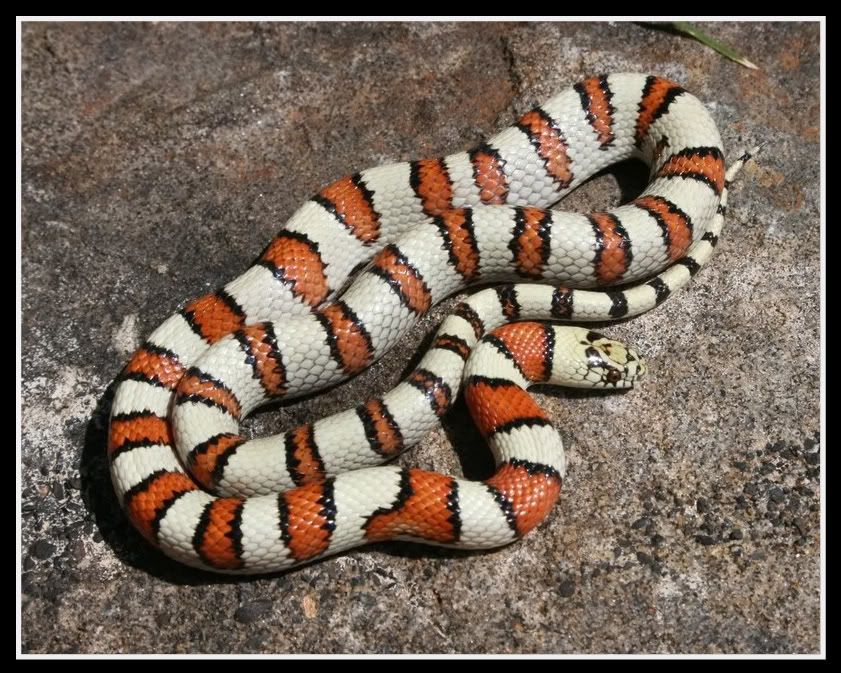
Cherry County is home to the Pale Milksnake (Lampropeltis triangulum multistrata), which as some of you know, is a passionate interest of Dell’s and mine. The snakes inhabiting this ruggedly serene habitat are quite varied in appearance, yet most can be fairly easily labeled as “Cherry County multistrata” by the experienced eye.

They can have clean, creamy background coloration with orange saddles

Or a wheat tan/gray background with red saddles and moderate news-printing

Or a stark-white background with no news-printing

Or a greenish background coloration with heavy news-printing and red saddles

Other animals show a heavy suffusion of melanin that, in our opinion, creates a very unique animal

Head patterns vary considerably, too. They range from solidly capped with black to intricately mottled, through speckled to nearly stark white, and may include some red or orange coloring.

Image

Replies (27)

RG Mar 19, 2010 01:58 PM

Cherry!

I love the post man...well DONE!

OK...when I get off my Hondo kick...I know where I'm headed!

Great FREAKIN pictures!

-Rusty

Sunherp Mar 21, 2010 03:38 PM

Thanks, man! You've got some great animals, so it's little wonder you've been on the "hondo kick"!

-Cole

terryd Mar 19, 2010 03:05 PM

I'll add a few more photos to a cherry county thread, but wish I'd taken more/some habitat photos when I was there last. -Dell


.
Image

Sunherp Mar 19, 2010 03:12 PM

We'll really need to work on the habitat shots next time. Some of those photos are the ones I hoped you'd post. Killer stuff.

-Cole

JKruse Mar 19, 2010 03:33 PM

....now that I've gotten up from falling out of my chair, I have to say that I absolutely loved the thread and the pics. Naturally...how could you not?!?!?

Keep making posts like this and I will have to up my life insurance premiums.....
-----
Jerry Kruse
www.zonatas.com

And God said, "Let there be zonata subspecies for all to ponder..."

Sunherp Mar 21, 2010 03:40 PM

Thanks, buddy! It's always nice to hear positive responses - especially when they come from folks with outstanding animals and a good head on their shoulders!

-Cole

flavirufa Mar 19, 2010 03:48 PM

"Outstanding posts you guys".Always look forward to seeing more of the milks your'e working with.I really dig the w/c animals and the habitat photos.The captive born ones with the super white bands are superb!Great work!!! Alan

Sunherp Mar 21, 2010 03:42 PM

Much appreciated! Those elapsoides you posted below are outstanding, man. Really nice stuff.

-Cole

DMong Mar 19, 2010 04:17 PM

Dang man!!,......gorgeous milk OVERLOAD!!!!!

~Doug
Image
-----
"a snake in the grass is a GOOD thing"

my website -serpentinespecialties.webs.com

RG Mar 20, 2010 03:19 AM

That second one is my favorite!

Nice Dell!

-Rusty

Nathan Wells Mar 19, 2010 03:27 PM

Now this is what I truly enjoy seeing on this forum! As much as I take pride in sharing with all you what Texas has to offer from a field herper's point of view, I equally enjoy seeing what you northern guys experience as well.
Great report as a whole and I appreciate the habitat shots as much as seeing the animals from the given areas.
Again awesome job! As bad as you and Dell have it to come down here, seeing this really gets me excited about one day paying a visit to you guys too.
Nathan

Sunherp Mar 21, 2010 03:44 PM

Thanks, amigo! Hopefully we'll get to come explore your neck of the woods in the near future. I just got an e-mail from Tom Sinclair the other day that makes me drool. You're welcome up here, anytime!

-Cole

Joe_M Mar 21, 2010 06:15 PM

I agree 100% Nathan. Field herping and habitat shots can't be beat!


-----
Joe

DMong Mar 19, 2010 04:10 PM

That was one awesome post Cole!. Both landscape AND specimens!.

All are definitely great looking, and some downright EXTREMELY unique, but those pure white's with zero news-print are just freakin incredible!!

thanks for the great post Colester!

~Doug
-----
"a snake in the grass is a GOOD thing"

my website -serpentinespecialties.webs.com

Sunherp Mar 21, 2010 03:46 PM

Thanks, bro! Dell and I had been really talking about doing a post like this for a month or better. It just takes a little spare time to get it done!

Thanks again,
-Cole

zonatahunt Mar 19, 2010 06:02 PM

Still to this day, my favorite pale I've ever seen was the first and only triangulum I've found in the field. I love multistriata.

Mitch

Sunherp Mar 21, 2010 03:49 PM

Mitch,

I hear ya, man. There's nothing quite like seeing the animals in their element, is there?!

You love multistriata, I love multistrata...

Looking forward to having you up here!
-Cole

chris_harper2 Mar 19, 2010 07:33 PM

Just when I'm getting myself convinced that four locales of Pale Milks is enough for me you have to come along and post this. I'm trying to cut down you know.

Very nice post regardless.

You two need to get all this photo documention on a website.

Sunherp Mar 21, 2010 03:50 PM

Thanks, buddy! Just so you know, we should be able to feed that little addiction of yours for years to come...

-Cole

jeff schofield Mar 19, 2010 08:01 PM

Thats quite a range of phenotypes. Not to be nit-picky, but I'd have liked em sorted--adults and young seperated. There were duplicates of some of the nice babies werent there(with Dells post)?

chrisdrake Mar 19, 2010 08:14 PM

Great post Cole. After seeing this thread I can't understand why I had not been interested in NA milks before now. The syspila ate by the way. Thanks again for the advice. Cherry County might have to be a new herp destination for me this year. It seems like there are a good group of guys on this forum.

Chris Drake

jeff schofield Mar 19, 2010 08:31 PM

The guys posting here can be too...but it helps if you have thick skin and glasses! Dont forget a decent sense of humor, you'll need it!

Sunherp Mar 21, 2010 03:57 PM

There are plenty of good guys on this forum. Glad to have you aboard, too!

Feel free to post or e-mail anytime with questions. I got your e-mail and will respond under the appropriate thread.

Thanks again for the kind words!
-Cole

Sunherp Mar 21, 2010 03:54 PM

I can see your point in wanting to have the animals sorted by age class. A guy's only got so much time, though! There was only one repeat animal in the series - a female from Brian Mason's stock that was shown as a juvenile, subadult, and adult. She got quite a bit nicer looking as she aged.

Thanks again
-Cole

jeff schofield Mar 21, 2010 04:10 PM

Cole, do you remember the "milksnakes of North America" poster from about 20 years ago?? There was a incredible Pale on there(from John Fraser I think)adult, clean, WHITE. Clean adults should definately be cherished, and I understand about the "time" problem. Jeff H. has some nice before and after shots of his Pales too! What I meant was didnt yours and Dell's post include some of the same specimens? Thanks again, and you are certainly welcome.

Sunherp Mar 21, 2010 04:15 PM

There was only one repeat from our series of photos. Several of the animals look similar, but I believe only one animal was posted more than once.

Clean animals can be stunning, no doubt. I've gotta say, though, some of my favorite animals are heavily news-printed and grayed laterally. I suppose that just adds credence to the old adage that "beauty is in the eye of the beholder", huh?!

Take care
-Cole

cn013 Mar 21, 2010 04:31 PM

.... As per the usual....

Site Tools