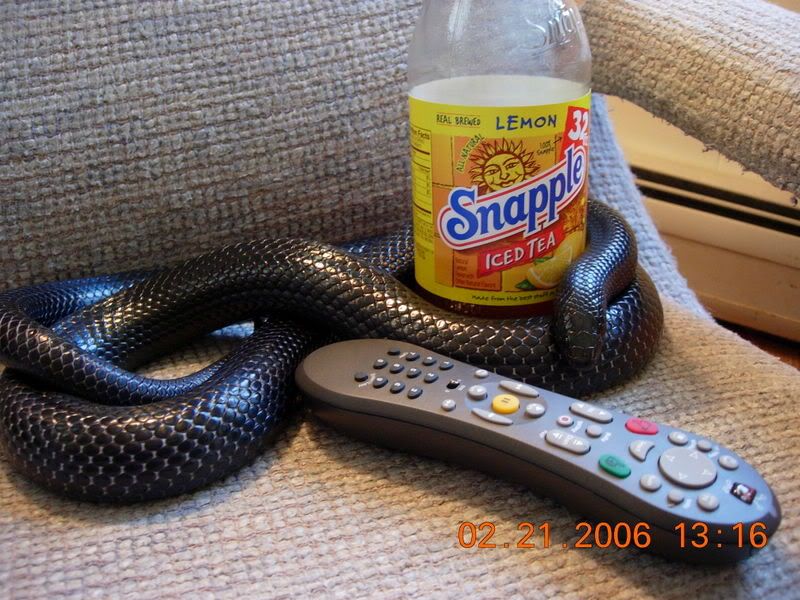
Hello Nate, your quote below got me to thinking about my male Black Milk.
“…Take L. t. gaigeae, for example... as unique as they seem to be, it's entirely possible that they're nothing more than a melanistic form of stuarti, polyzona, or even andesiana. Lamar mentioned finding several milksnakes in South America (andesiana/micropholis country) that were so dark dorsally, that he had to flip them over to be able to detect the slightest hint of red/white banding. I guess my point is that it will be interesting to find out how the differences in phenotype relate to the differences in genotype.”
My male did not complete his color change (to my satisfaction  , he is about 5 years old and around 4’ or a little more. He is mostly black if you look at him from the top but retained some very muted banding on the sides and more visibly on his belly. How often do you think Black Milks retain banding? Is it more common than is presented here on Kingsnake? My female that is almost 3 years old is completely black and just as thick as my male and just as long (so why is he not well over five feet for his age?). The male was purchased from a well respected breeder. I guess my question is do you think the retained banding is a sign that he/all Black milks are just melanistic form or the species you listed above? I know that is not a proven fact but again your comments made me wonder. Also, I would like to breed my female to him but don’t want to risk babies that won’t complete their color change.
I am not a “breeder” and not as literate on the history of milk snakes in general. I am just someone who likes snakes and is baffled by the lack of a complete change in color by my Black milksnake.
Regards,
Miller
-----
1.1 Pituophis lineaticollis lineaticollis
1.1 Black Pine
1.2 Still Water Hypos
0.0.1 Possibly stillwater x Red Bull
1.2 N. Pinesnake
1.0 Eastern Kings
1.1 Black Milksnake
0.0.1 Plains Garter
1.0 Chow Chow(2003 Papi)
0.1 Cat(Shug