Reptile & Amphibian Forums

Welcome to kingsnake.com's message board system. Here you may share and discuss information with others about your favorite reptile and amphibian related topics such as care and feeding, caging requirements, permits and licenses, and more. Launched in 1997, the kingsnake.com message board system is one of the oldest and largest systems on the internet.

Click here to visit Classifieds
Click for 65% off Shipping with Reptiles 2 You

Gulf Hammock.........follow-up

Steve G Apr 18, 2010 08:42 PM

Being a Florida resident, plus having observed in the field, collected, and bred this obsoleta variety for many years........here's my 2 cents:

There is notable variety in coloration in these guys. That said, they still more resemble grays from the Florida panhandle than the yellows from peninsular Florida. The two pics are of specimens collected less than a mile apart. Now you can see what I'm talking about. I'm kind of partial to the ones that have those salmon pink highlights on their dorsal surface. I don't know where that trait comes from, as I've never seen this coloration on the spiloides to the north. I have family that recently moved to west Marion County, Fl. My brother-in-law sent me a pic last year of a yellow that he found on his property. This was a typical quadrivittatta......four bold stripes on a greenish-tan background. This locale is less than an hour's drive from prime Gulf Hammock locale. I suspect that that the cedar swamp river drainage habitat in Levy county may have something to do with the distinctive look of "williamsi".

On a side note, this past fall I placed a lot of tin on my relative's property. They have found coral snakes, crowned snakes, and worm lizards(Rhineura floridana)there, as well. I'm hoping to turn up a Short-tailed snake which would be a lifer for me, as I think the habitat may be good for them.

Replies (10)

DMong Apr 18, 2010 09:44 PM

Very cool post!,....and some sweet looking specimen's to boot too!

~Doug
-----
"a snake in the grass is a GOOD thing"

my website -serpentinespecialties.webs.com

Elaphefan Apr 18, 2010 10:46 PM

Great post, and great pictures also. Do you breed these animals? If so, do they breed true? Do all their offspring have the stripes and saddles?

I saw an intergrade of a Yellow and a Black Rat, and the young showed a yellowish tinge on their belly scales. That is something I did not see on my Gulf Hammock when I first got it as a pup. Certainly, I think that if one were to cross a Yellow with a Gray, you would not get such consistenty fine animals.

Another question. In that area, have you ever found normal Grays? Yellows?

Steve G Apr 19, 2010 08:17 PM

Even in the same clutch of neonates, there is always some variety in looks. Some are darker/lighter than others. A few will have bold striping on the anterior third of their bodies from the get go. Like yellows, the striping between blotches fills in as the snake matures. If someone offers you one of these........buyer beware if they have any orange on the tongue or in their eyes. Every "williamsi" that I have seen in the field has a black tongue and silvery colored eyes. While Gulf Hammocks don't have big market value, I have always kept a few in my collection. They have a much more laid back disposition than any of the other native Florida rat snakes. The big male on the towel rack is right at 7 feet.

monklet Apr 19, 2010 09:41 PM

7 Foot? Awesome! I'd love to see a pic with someone holding it for scale.
-----
Have a nice day

Website: SerpenTrack

hermanbronsgeest Apr 19, 2010 02:32 AM

Beautiful specimens. I especially like the 2nd one.
-----
I'm Dutch. Somebody shoot me.

BillMcgElaphe Apr 19, 2010 10:07 AM

Beautiful animals, Steve…
.
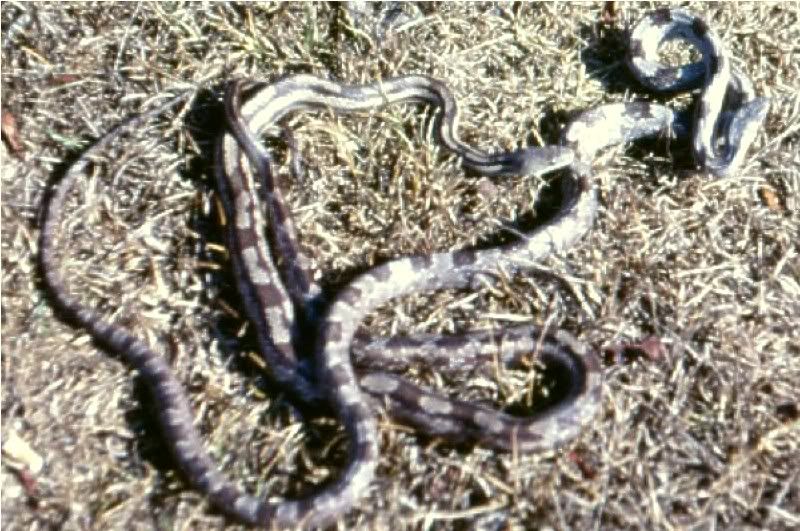
Very nice Eastern Rat Snakes, and if you use the range map in the ’58 edition of Conant’s field guide, the variation of the GHs is very wide. So wide, in fact, that this was a major reason they were discounted as a subspecies in the late ‘60s or so.
.
.
“There is notable variety in coloration in these guys. That said, they still more resemble grays from the Florida panhandle than the yellows from peninsular Florida.”
.
This is true, but between Williston and Bronson, the Live Oak Islands just east and west of the “cemetery” boundary, and again Crystal River, they get yellowish and can be “faded” as adults.
.
.
These two were taken less than 100 yards apart, from what would have been the northern part of the “range”, approaching classic Grays.
.
(scanned instamatic slide)
.
.
“I suspect that that the cedar swamp river drainage habitat in Levy county may have something to do with the distinctive look of "williamsi".
.
Absolutely… Habitat, habitat, habitat…. I suspect the sand hill highlands provided a significant gene barrier at one time or another.
What makes this animal and a few other Florida animals (e.g. “Goin’s/Blotched/Lower Apalachicola/Mean’s” King) so problematic is that the habitat has gone through so many changes in recent geologic times with sea level variations during and between ice ages, etc.
.
.

PS
Crown snakes are the first step in finding Short tails…
The two areas where I found them in Marion County are both now large subdivisions… Go figure.
-----
Regards, Bill McGighan

jhnscrg Apr 19, 2010 06:39 PM

I like snake #2! Looks almost like a White-oak phase spiloides to me.
Beautiful animal!

Matthew

foxturtle Apr 20, 2010 02:22 PM

This is one from salt marshes near Inglis.

Note the yellow on the belly:

And the pinkish eyes...

monklet Apr 20, 2010 06:40 PM

n/p
-----
Have a nice day

Website: SerpenTrack

Kevin Saunders Apr 24, 2010 10:04 AM

Great stuff-I've been interested in Gulf Hammock Rats for a few years now and always enjoy seeing pictures of nice specimens. I sent you an email Steve, let me know if it didn't go through.

Site Tools