Reptile & Amphibian Forums

Welcome to kingsnake.com's message board system. Here you may share and discuss information with others about your favorite reptile and amphibian related topics such as care and feeding, caging requirements, permits and licenses, and more. Launched in 1997, the kingsnake.com message board system is one of the oldest and largest systems on the internet.

Click here to visit Classifieds
Click for 65% off Shipping with Reptiles 2 You
Click here to visit Classifieds

Special Sierra zonatas ..............

JKruse May 11, 2010 12:30 AM

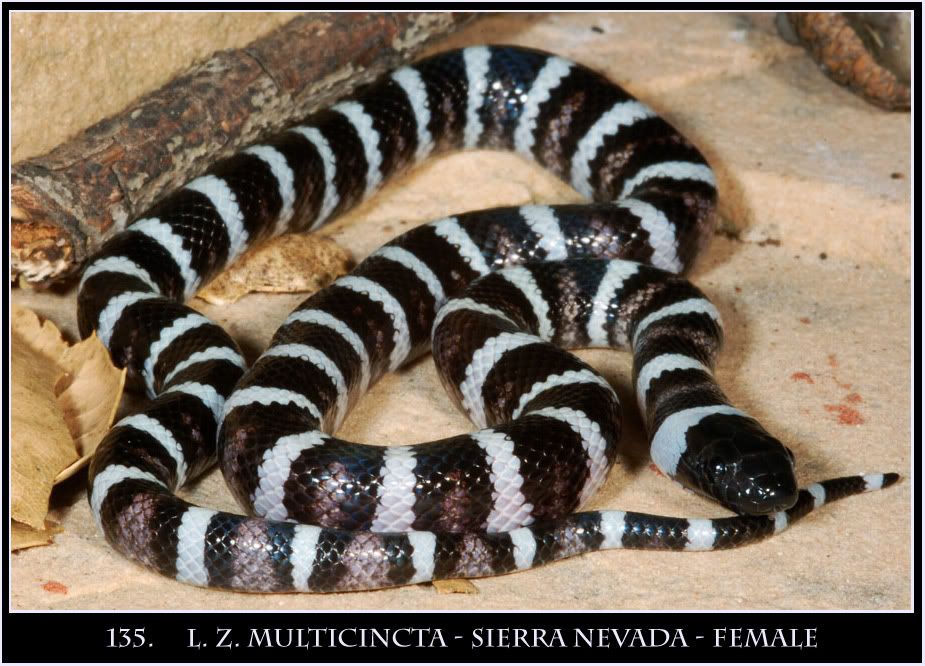
It seems both females have bred well over half a dozen times and are starting to swell nicely.......here is what i'm hoping half of the clutches will look like aside from some normal-colored heterozygous clutchmates. The "anery" babies tend to completely blacken by the end of their first year:

photo by M. Mulks

Image" alt="Image">
-----
Jerry Kruse
www.zonatas.com

And God said, "Let there be zonata subspecies for all to ponder..."

Replies (24)

fauxsanity May 11, 2010 02:53 AM

nice normal looking cali king ya got there Jerry...why would you breed it to one of your zonatas?..LOL..J/K..
-----
Richard Evans

no not THAT one

BobS May 11, 2010 10:34 AM

Jewel. Thanks for sharing the pic. It's things like that though that make it hard to keep some discipline and maintain a smaller collection these days as I get older.

I'm finding it nicer in some ways to keep snakes like the more slender Pyros because it allows to give them more spacious accomadations if you choose without breaking the bank.

Good luck with them.

Bob.

thomas davis May 11, 2010 12:32 PM

anery is a reccesive genetic trait that lacks red pigmentation. snakes that are red when hatched and then fade to black&white are not anery jerry, try to keep up.

,,,,,,,,,thomas davis
-----
Morphs... just like baseball cards BUT ALIVE, how cool is that???

my website www.barmollysplace.com

Bluerosy May 11, 2010 02:47 PM

Jerry,
Those are not "anery" in the typical fashion we use the term. it is a high black. The area near Yosemte valley produces zonata with a high percentage of black crossover. I know some spots and maybe next year we can go out there and find some.

In your case this can be selectivly bred to better the amounts of black by holding onto the ones with the highest black crossovers.

recently i saw that JTColubrids has tricolor hogs with a lot of black. It is the same thing with them. Maybe he can post a pic here of them(?).
-----
www.Bluerosy.com

JKruse May 11, 2010 03:00 PM

It's not the same think Rainer....for once maybe you are not aware of something that might be different. I can assure you it's not the same thing. But you are always right, so have at it.
-----
Jerry Kruse
www.zonatas.com

And God said, "Let there be zonata subspecies for all to ponder..."

Bluerosy May 11, 2010 04:07 PM

I am not always right. But you seem to think that I am that way.

I was hoping you would give me a reason of why you think there is something going on with your black seiira that is different. Maybe i did miss something. But by your response i will never know.

I am open if you want to share.
-----
www.Bluerosy.com

JKruse May 11, 2010 04:27 PM

Rainer, i do indeed have localities of and know of Sierra snakes from additional localities that are naturally selected for higher black crossover. Indeed I know there is not just one specific location that this phenomena occurs.....there is great research being done out west that encompasses this very subject and will likely be published in the next few years. Wish i could say more but can't. But this Sierra variation have patterns that are stationary/constant and DO NOT CHANGE over the course of time.

These Sierra snakes I'm showing are different in that it is not about selecting for higher amounts of black......females generally hatch "anery" (no one knows why there seems to be a sex-linked phenomena going on with this phenotype) and then undergo (much like gaegeae) a GRADUAL ontogenetic CHANGE whereby the melanin completely suffuses (except for the ice-white bands). So a baby that has the lavender body rings, after about a year, will no longer have (save for a few scales possibly here and there) any color left. The few scales that may show through are lavender, NOT red.

The Sierra snakes that are "high-black" hatch out with the bright red lateral slivers and KEEP THEIR PATTERN over time...it's UNCHANGED.

What's even more interesting is that the tri-colored males do not have normal skin color under the scales, but rather their skin is black despite being a tri-colored snake. I can not explain what is going on, much like the few others that are working with this really unusual natural variation of Sierra zonata. But what i do know is that there are not the typical high-black variation you're thinking of. They are indeed different.

I'm anticipatory of at least one good clutch from my two females this year, and I'm looking forward to sharing this unique phenotype change over the course of a hatchlings' first year as I intend to keep at least one for myself.
-----
Jerry Kruse
www.zonatas.com

And God said, "Let there be zonata subspecies for all to ponder..."

Bluerosy May 11, 2010 10:26 PM

See that wasn't so hard.

I am in agreement with you is that nobody can tell you about YOUR snakes. You are the one working with them and can see first hand these differences. I have been through much of the same scrutiny with the Peanut Butter and other morphs. So i know how it feels like. Nobody knows about these snakes better than you Jerry. If you say these are something different, i beleive you and am in agreement with what they are and that they are not just black Yosemite area "line bred" animals.

I hope to see more of these and some pics of offspring when they hatch! I am sure over the years and as test breeding and results prove out what is going on. They are and act what you are saying. The name assigned to the trait is not importatnt (hyperythristci, hyper this and Anery that). Not all recessive traits fall under the same catagory as something that existed beforehand.

One thing though. Since these are morphs. That also makes you a morph guy. Something you have accused me and saying something to the effect of "at least I ain't makin no Peanut butter and Jelly samwiches"....

"For a Covetous Man to inveigh against Prodigality... is for the Pot to call the Kettle black."
-----
www.Bluerosy.com

JKruse May 12, 2010 07:11 AM

I think there's a certain distinction.......I'm not breeding to CREATE a morph per se.....but rather perpetuate what nature created but doing it in the confines of my very un-natural home. SO if I may, I'm breeding a naturally-occurring morph in captivity.........these are found this way in the Sierras............I've never heard of anyone going into the field and pulling out a snow brooksi or Honduran.........those are man-made creations.

So therefore i don't think it's accurate to necessarily tag me as a "morph guy"..........not that it's such a bad thing....but I just wanted to get the distinction across. Yes I have a natural variant of Sierra zonata and am breeding them to like animals, but I'm not looking to crete anything else from it thus a man-made/created "morph". Hope we can agree on the distinction.
-----
Jerry Kruse
www.zonatas.com

And God said, "Let there be zonata subspecies for all to ponder..."

Bluerosy May 12, 2010 08:43 AM
JKruse May 12, 2010 08:56 AM

Only we Germans can get a good belly laugh like this......that was funny.......LOL........but I stand my ground on the distinction as I laugh even harder at those clips. And that bottom one....WOW......she's hot.
-----
Jerry Kruse
www.zonatas.com

And God said, "Let there be zonata subspecies for all to ponder..."

JKruse May 12, 2010 02:59 PM

I don't know why I keep going back to look at this post -- it's either for the laugh or the hot chick....maybe a little of both......but funny as hell man.......
-----
Jerry Kruse
www.zonatas.com

And God said, "Let there be zonata subspecies for all to ponder..."

Bluerosy May 14, 2010 01:13 PM

I don't know why I keep going back to look at this post -- it's either for the laugh or the hot chick

I knew we had the same tastes.

She is definetly a morph.


-----
www.Bluerosy.com

Jeff Schofield May 12, 2010 01:50 PM

Jerry, I gotta side with Rainer on this one. "Anery" as we use it, is way different than whats going on with your stuff. Its acting more like reverse vanishing pattern or something like that. It is a morph, and if you breed for a RECESSIVE trait you are a "morph guy"....and as funny as it is you dont get to say PB sammiches any more. Time to name the new morph Mr Z.

JKruse May 12, 2010 02:48 PM

SHUT UP JEFF!!!!!!!!!!!!! LOL.

In my book, and there is also a distinction possibly on what each one thinks a "morph guy" would be. In my opinion it's someone who promotes morphs by creating new ones that might never occur "out there".....I mean really....what's the liklihood that a creamsicle-dulce-de-leche-cinnamon extravaganza corn would ever wind up crawling around.....that's created in captivity brother....and THAT to me is construed as a "morph guy".

However I have in my possession a naturally-occurring variation (and a hot damn cool one at that), and I breed it to like specimens, without looking to enhance it or blend it to make a new look. I'm not adding ingredients or playing mad scientist to create new things...THAT (to me) is what a "morph guy" is.....for example, that cat down south with the Polish last name who creates oodles and oodles of corn snake morphs (what the hell was his name -- I heard he got outta the game last year).....THAT is a morph guy. It's a fine line....but it's my fine line to defend and I'm laughing while I'm doing it because I KNOW I'm the minority in this one. LOL!!!!
-----
Jerry Kruse
www.zonatas.com

And God said, "Let there be zonata subspecies for all to ponder..."

Bluerosy May 14, 2010 01:16 PM

Okay so no double dippers for you.

BY the way. the peanut butter is a single recessive trait morph. Just like you say. It could Peanut butters are crawling around out there.

Don't be sidelined by the names!
-----
www.Bluerosy.com

JKruse May 12, 2010 02:50 PM

.
-----
Jerry Kruse
www.zonatas.com

And God said, "Let there be zonata subspecies for all to ponder..."

Jlassiter May 11, 2010 08:24 PM

Cool stuff Jerry....
I have one question though....
No arguement....just a question....
If these Sierras hatch with some red pigment (lavender/salmon/pink) then why aren't they called Hypoerythristic?
Anery is a total lack of red pigment.......Just like the Anery Hondos should have been called Hypoerythristic......

I see that they lose nearly all of their red pattern, but if there is a remaining "red" scale it is still lavender in color......Very strange.......

We are seeing something similar but different with Mex Mex.
Hypoerythristic hatchlings have bright red saddles that fade to Pink then to almost non existence as they mature......

Another strange Mex Mex phenomenon is the fact that the Black phase specimens hatch out with a gray ground color almost indistinguishable from normal phenotyphic Mex Mex.....

This makes it hard to sell them at such a young age because as a breeder you cannot tell which ones will turn black and which from the Hypo-E line will lighten to pink as they mature......
But I sure would like to see one do both....LOL

Then there are other snakes that go through pigment ontogenesis.
Some amelanistic tricolors have white bands that turn yellow with age.......I think the same thing has happened with that yellow Amel Speckled King I have....the white area saturated with yellow much like an Amel Ruthveni or Sinaloan.......

Just my couple cents....
-----
John Lassiter
Poor planning and procrastination on your part does not constitute an emergency on my part...
www.coastalbendcaptivebreeding.com


JKruse May 11, 2010 08:40 PM

Hey John,

I really don't care if we call them anery, hypo-E, or axanthic....LOL.....the important thing is that they are SPECIAL and NOT the other high-black crossover multicincta that we see in various populations.

As for the areas lacking red -- if there were no encroachment of black over time, these would be very anerythristic in appearance. The remaining color is a lavender/purple. What are your thoughts on that hatchling shot I posted?? That doesnt look red to me...(?)....and thanks for the appropriate delivery buddy.....glad we can have a normal conversation.
-----
Jerry Kruse
www.zonatas.com

And God said, "Let there be zonata subspecies for all to ponder..."

Jlassiter May 11, 2010 10:21 PM

>>Hey John,
>>
>>I really don't care if we call them anery, hypo-E, or axanthic....LOL.....the important thing is that they are SPECIAL and NOT the other high-black crossover multicincta that we see in various populations.
>>
>>As for the areas lacking red -- if there were no encroachment of black over time, these would be very anerythristic in appearance. The remaining color is a lavender/purple. What are your thoughts on that hatchling shot I posted?? That doesnt look red to me...(?)....and thanks for the appropriate delivery buddy.....glad we can have a normal conversation.

I agree with you 100% that they are SPECIAL and that they are different than the High-Black crossover Multi's we see in the hobby and in the wild......

My point is this.....And it is merely my observation and opinion.
If a snake is truly anerythristic the "red" would be absent totally and replaced with the absence of color = WHITE. Exactly like the Anery Alterna Mike Russo and others have. I think if there is some degree of erythrin (IE: purple/lavender/salmon/pink) then the snake is Hypoerythristic.

Then there is the argument about pattern encroachment or loss. This doesn't always exemplify a genetic morph.....

I have thayeri from Bob Applegate lineage that have no black borders around their saddles....this does not make them Hypomelanistic nor Amelanistic...The black they do have is PURE black.....I/We call them "NO Black" Thayeri.....Much like the Candy Cane Knoblochi and the Applegate Special Pyro.......I can even go out on a limb and say that even Hypo Brooksi/Floridana are something different than hypomelanistic because the black they do have is black....Not a reduction in pigment but a reduction in pattern. Hypo cornsnakes are not hypomelanistic either......They merely have reduced to no black pattern......

LOL......Enough of my rant.....

I REALLY would love to see all that you hatch this season....I am interested in the unseen Pyromelana morphs and all these Zonata that I have yet to own......

I really appreciate the looks of that hatchling Sierra.....
-----
John Lassiter
Poor planning and procrastination on your part does not constitute an emergency on my part...
www.coastalbendcaptivebreeding.com

JKruse May 12, 2010 07:18 AM

I was looking again (as this conversation propelled me to do so, LOL) at one of my female "anery" Sierras which doesnt have black suffused in some areas on her laterals......she looks alot like a Todos Santos animal actually. The scales are practically without color..........what I will do is snap a couple photos in the coming day or so and post it. In certain light it is the faintest lavender-ish you cna imagine, but is almost white. Again, I will photograph it to the best of my ability for all to see. But I do hear what you are saying about the distinction of course, and agree about the differential regarding amount of erythricites. More on this to come.....
-----
Jerry Kruse
www.zonatas.com

And God said, "Let there be zonata subspecies for all to ponder..."

Joe Forks May 12, 2010 08:52 AM

John,
There are so many variations or combinations of these morphs that are both poorly understood and inconsistent from species to species it is nearly impossible for us to be 100% accurate with our labels. I agree anery might not be the best label for that mutant or morph, but I certainly don't have any suggestions or a better term for it.

On a semi related note, I can tell you that these pigments go down in layers, and that there are at least two layers of melanin. Melanistic thayeri is a classic example and there are plenty of others. That's not to say that I completely understand it, I just know that it is.

The possibilities for color mutations are exponential so it's no wonder we are inconsistent and constantly misunderstanding them.

Even for Hypos, simply defined as reduction of dark pigment compared to a wild specimen. It doesn't have to have dark pigment expressed as purple or lavender to fit that description. Another no wonder we are inconsistent and confused.
-----
Herp Conservation Unlimited
Conservation through captive propagation
Mexicana Group Directory
Photography by Joseph E. Forks

JKruse May 12, 2010 09:00 AM

Well said...(but I'm sure you knew that already....lol....)

I'm curious to see what is thought when I grab a couple photos as I'd stated earlier......it's really close to white but there's something there wayyyy down. Until then.....
-----
Jerry Kruse
www.zonatas.com

And God said, "Let there be zonata subspecies for all to ponder..."

Jlassiter May 12, 2010 06:37 PM

>>Well said...(but I'm sure you knew that already....lol....)
>>
>>I'm curious to see what is thought when I grab a couple photos as I'd stated earlier......it's really close to white but there's something there wayyyy down. Until then.....

I agree Jerry.....Joe said it best....
We REALLY don't know what is going on with the layers of pigment...

And....I look forward seeing the up coming pics.......
-----
John Lassiter
Poor planning and procrastination on your part does not constitute an emergency on my part...
www.coastalbendcaptivebreeding.com
Site Tools