Reptile & Amphibian Forums

Welcome to kingsnake.com's message board system. Here you may share and discuss information with others about your favorite reptile and amphibian related topics such as care and feeding, caging requirements, permits and licenses, and more. Launched in 1997, the kingsnake.com message board system is one of the oldest and largest systems on the internet.

Click for 65% off Shipping with Reptiles 2 You
Click for ZooMed
Click for 65% off Shipping with Reptiles 2 You

Accidental breeding?

varanid May 11, 2010 10:27 AM

I got a female sub-adult BP in Oct 09. She's like 1600 grams. She's also a biter, so while cleaning her cage I put her in a separate container to avoid bloodshed. The critter keeper I use got broke (the wife's cat did it), so last time I just put her in with my male. Anyhow, cleaned the cage, went to bathroom, came back to move her back and they were locked up. That was 2 or 3 weeks ago and I thought nothing came of it but she got a bit swollen looking and she's in blue...

I can't decide if, provided she lays fertile eggs, I want to incubate them or destroy them. I just have them for funsies--I plan to maybe breed my woma ball eventually but this gal was an impulse that I just got because I like balls.
What do ya'll do with unplanned eggs? I'm torn on trying to incubate them versus not.
-----
We wouldn't have 6 and a half billion people if you had to be beautiful to get laid.
6.6 African House snakes
3.2 reticulated pythons
.1 corn snake
4.2 Florida Kings
1.2 speckled kings
1.2 ball pythons
0.0.1 Argentine boa

Replies (22)

mikebell May 11, 2010 11:14 AM

No such thing as accidental breeding, they did it on purpose.
If you get eggs and don't have an incubator, let mom do it herself. If you like snakes, you can't help but like eggs and baby snakes hatching.

prestigepythons May 11, 2010 12:28 PM

Were the snakes drinking? I know liquor has caused a few of us to have "accidental breedings", or at least regrettable.

I agree let her incubate them

Bob O'Brien

varanid May 11, 2010 12:30 PM

I know liquor has caused a few of us to have "accidental breedings", or at least regrettable.

I plead the 5th on that one :D Thank God it didn't take.
I'll toss in a lay box after her shed and see ifanything happens. Hell maybe it's a false pregnancy...I'm just a bit worried cause she's still on the small side from what I've read.
-----
We wouldn't have 6 and a half billion people if you had to be beautiful to get laid.
6.6 African House snakes
3.2 reticulated pythons
.1 corn snake
4.2 Florida Kings
1.2 speckled kings
1.2 ball pythons
0.0.1 Argentine boa

anthony james mc May 11, 2010 12:55 PM

If you ever plan on breeding anything of value then I would treat the clutch like it was a 10k clutch of eggs so you learn how to do it.. The eggs all have the exact same requirements so in my mind it would be foolish not to take the time to incubate them . If you don't and just destroy them thinking you will wait till they are worth more to bother karma may bite you in the well you know and the future clutch of value will persish as you won't know what your doing because you gave up the shot to learn with the inexpensive eggs you killed (if you even get them) and you will have horrible luck when that time comes no matter what you do. But feel free to not listen to my advice thinking I'm joking on this one!

She may be building follicles too FYI and this is actually her preovulation shed . If so she will ovulate in 5-7 more weeks and at that point she will swell up twice as much as what you recently seen (or more) when the true ovulation actually sets in. Try feeding her after she sheds if she eats then I doubt what you saw was ovulation as they usually won't touch anything after they have ovulated and mainly just sit on the warm side of the cage and do little other than bask..

Anthony McCain

varanid May 11, 2010 02:50 PM

I'll give her a go feeding her after shed. It should be soonish now. That may answer the question.
Most of what I want to work with are kingsnakes and retics. I'm a fan of ball pythons as a species (they're neat) but I didn't want to mess around with breeding/selling them. If I incubate and hatch them, what do I do with the offspring though? I have no desire to have an extra 2-5 balls floating around, and the market for normals is so crappy that it's a losing proposition to take out ads etc to sell them looks like. Then again, I always know some kid that wants a snake *shrug*
-----
We wouldn't have 6 and a half billion people if you had to be beautiful to get laid.
6.6 African House snakes
3.2 reticulated pythons
.1 corn snake
4.2 Florida Kings
1.2 speckled kings
1.2 ball pythons
0.0.1 Argentine boa

anthony james mc May 11, 2010 04:52 PM

Well you never know maybe you will make something really cool with that clutch if you get one! I really would incubate them , the mom can do it but it's tough sometimes to keep the humidity just right so they don't dry up and die in her cage. Also sometimes the temps get to high too if she moves the clutch to close to your heat source, yes it can be done but I stopped doing it that way years ago , better to control as many variables as possible to get the highest hatch rate. Just find a good, well run pet shop, within driving distance and they will glady buy them from you if they feed well. You won't get rich on normals I know but you just may make someone really happy down the road with those captive bred babies anyway and that is worth something in itself!

Anthony McCain

amcroyals May 12, 2010 03:44 AM

....local pet stores and reptile stores(if you have them) will gladly take your CBB BPs! No ads needed!

Best regards,
Alan Cole

WALL2WALLREPTILE May 11, 2010 05:14 PM

Hello,

I will agree that every clutch of eggs you get (regardless of their value) provides you with practice for your incubation techniques. Take advantage of this potential opportunity to get a little practice hatching the eggs.

Keep in mind that you will need to construct or purchase an incubator. Although maternal incubation is an option with certain python species....it will not work with Ball Pythons. Ball Pythons do not engage in thermo-regulatory twitching which is required to raise or maintain proper egg temperatures during the incubation period.
In the wild, female Ball Pythons select an oviposition site (usually a burrow) that will naturally maintain stable temps and humidity levels which are conducive to proper embryonic development. Perhaps they did not evolve or develop the ability to maternally incubate ova because of the lack of necessity?
Anyway, you will need an incubator.

As for the potential offspring....it should not be difficult to find homes for the babies. You might be able to sell them or use them in trade for a species that does interest you. If not you can always let your other reptile buddies know about them and see who is interested in taking them.
Good luck with your clutch of eggs.

Your friend,
Harlin Wall - WALL TO WALL REPTILES!
970-245-7611
970-255-9255

Shadow4108 May 11, 2010 07:54 PM

well, child support payments for 6 kids could get pricey.. GOOD LUCK and I agree as well, hatch them out, even if just for the experience.
Ps: not to be rude, but what were you expecting when you put a male and female in together?
-----
This is courage.. to bear unflinching what heaven sends. -unknown

1.0 Basset Hound (Capone)
1.1 cats (San Quinton and Gracie)

varanid May 11, 2010 09:18 PM

Well, I hadn't done anything to cycle 'em and they were together less than 20 minutes. Must be teenagers.
-----
We wouldn't have 6 and a half billion people if you had to be beautiful to get laid.
6.6 African House snakes
3.2 reticulated pythons
.1 corn snake
4.2 Florida Kings
1.2 speckled kings
1.2 ball pythons
0.0.1 Argentine boa

RandyRemington May 12, 2010 01:37 AM

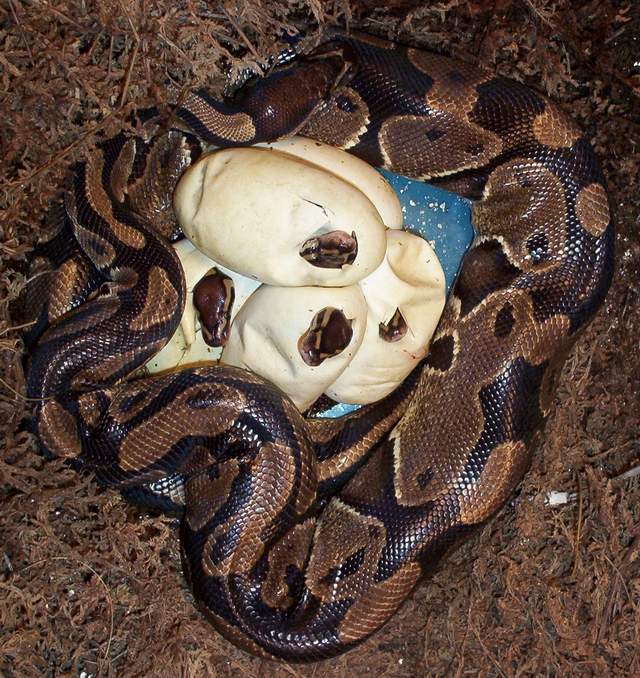
As an equatorial species it makes sense that ball pythons aren't particularly gifted at regulating the temp of their eggs or even themselves against cold. However, for the record, some do maternal incubation with ball pythons. Perhaps by the time you provide enough regulation of the background temp it's no less easy than just going all the way and making an incubator but it is fun to see.

100% hatch rate and produced again the following year.
Image

WALL2WALLREPTILE May 12, 2010 12:38 PM

Hello Randy,

Great Photos and interesting info.
However, to clarify....

Allowing a female to stay wrapped around the eggs (brooding behavior)is NOT maternal incubation.
Ball Pythons are not capable of true maternal incubation.
The successful hatch rate can be explained by the artificial temperature and humidity levels which were maintained by human activity...not maternal thermo-regulation ability.

Essentially what you have created is a cage sized incubator...and allowed the female to remain with the eggs.
If your temperature/humidity levels happen to fall below the required range for development...you will lose the eggs.
The female has no ability to control the egg temps...therefore it is not maternal incubation.

Like you said....for all the trouble...and to prevent egg death...you might as well just construct an incubator.

Another advantage of manual/artificial incubation (in any python species) is that you are able to remove the female...and begin feeding her up, to replenish the weight she has lost due to the stresses of egg production. This will give you better chances of having your female reproduce again the next season.

As for true maternal incubation...
Other species of Pythons (not including Ball Pythons) are actually capable of creating a rise in temps by utilizing muscular contractions. You can easily test this by placing a probe inside the snakes coil with the eggs.
If you momentarily increase the temperatures slightly above the proper incubation range, the female will loosen her coils to allow the trapped heat to dissipate.
And like wise, if you momentarily lower the temps slightly below the proper incubation temperature range...the female will tighten her coils and begin consistently twitching to create heat.
The tight coils will trap and help hold the heat.
It is sort of like rubbing your arms when you feel chilly.
The friction and muscular activity helps to increase the temperatures...causing you to feel less chilly.

True maternal incubation expends a lot of energy. Females will not generally feed during true maternal incubation...the lack of food intake, combined with energy expenditure, equals more stress and weight loss for the female.

I have successfully used maternal incubation in several species of Pythons, such as Burmese Pythons and Macklot's Pythons etc. However, given a personal preference...I would always rather choose artificial incubation techniques for them.
Take care.

Your friend,
Harlin Wall - WALL TO WALL REPTILES!
970-245-7611
970-255-9255

zippy00_99 May 12, 2010 01:33 PM

WOW!! What an awesome pic!!

anthony james mc May 12, 2010 04:12 PM

Agree 100% with your reply Harlin.

Anthony McCain

WALL2WALLREPTILE May 12, 2010 09:15 PM

Thanks Anthony,

The difference might seem only slight to some...however in certain light, it could be quite an important distinction.

In a wild setting...
Burmese Pythons would have an ability to slightly raise the intra-coil temperatures to protect their eggs...should the ambient temperatures drop slightly below optimum incubation temperature ranges. This might allow their clutch of eggs a slightly better chance of survival in an area where the temperatures are not quite perfect. If the ambient temperatures drop further than their capability to heat the egg mass....The eggs will die.

I suspect this to be the case in the vast majority of the clutches laid by introduced Burmese Pythons. Nevertheless, the ability to raise the intra-coil temps allow a percentage of the eggs to hatch.

The same could NOT be said of Ball Pythons. Because they do not have the ability to physically raise the intra-coil temperatures, they would not be to offer their eggs the same margin of protection from sub-optimal ambient temperatures.
And because of this...they would be far less likely to be able to maintain a foothold as an introduced species....Even in South Florida. The majority of their (already relatively small) clutches of eggs would be lost due to temperature fluctuation.

In my mind, the distinction between the true maternal incubation and merely brooding behavior is an important one.
Take care,

Harlin Wall - WALL TO WALL REPTILES!
970-245-7611
970-255-9255

RandyRemington May 12, 2010 10:59 PM

Where do retics fall regarding ability to actively increase egg temp? They also have a pretty equatorial distribution and apparently not a lick of sense about cold weather, right? I know a loose ball will go straight for a hiding place behind the insulation and freeze.

I did observe the mother ball opening and loosening her coils from time to time presumably to passively regulate temp the little possible. It would be interesting if the widely expected lower hatch rate and lower next year production rate could be confirmed with an actual experiment or not. Maybe there are factors we don't foresee and the numbers would surprise.

anthony james mc May 12, 2010 11:27 PM

Other than the hatch rate seeming to be better under artifical incubating I think the time the female is coiled and protecting the clutch is time she won't feed . That time (55-57 ish days) is in my mind 55 days she is still off feed and that time could make or break her shot at getting enough weight back to produce the next coming season. Granted some don't feed right away after you take the eggs away but a percentage of them will feed within a few days/week if the cage is cleaned , the snake is washed up good to remove the smell of the eggs off her body , etc. Alot of them do want to eat as they are hungry after the clutch has been laid and removed as it's been awhile off feed anyway during the last stages of breeding/gravidness (think that's a word lol) . It's just getting them to break that instinct of wanting to stay with the clutch for that duration and not eat for that entire time that your trying to overcome to get them back on feed I think. I think once it registers in their brain the clutch is no longer with them that breaking that instinct becomes possible and feeding resumes hopefully soon afterwards.

Anthony McCain

WALL2WALLREPTILE May 13, 2010 01:51 AM

Hey Anthony,

Yeah, you hit the nail on the head.

I remember during that experiment above, I had constructed a fancy egg laying box for one of the Burmese Pythons.
She had laid in the classic "inverted position" while inside of the box for a few weeks prior to oviposition...but, on the day she finally laid the eggs....she crawled outside the box and laid the eggs on the cage floor. lol.

After the temperature experiment, I removed this female's eggs for artificial incubation. (I allowed another female Burm to continue with maternal incubation.) Anyway, after removing the first female's eggs...that Mama would continue to visit the oviposition site and begin to try to thermo-regulate the cage floor! I removed the paper and scrubbed the cage. I washed the female too. Finally, about 2 weeks later, she accepted her first post-oviposition meal....a small rabbit.
I usually start them out with a smaller first meal...and then get them back into the swing of things, once their digestive system seems to be ready to rock and roll.

Take care,
Harlin Wall - WALL TO WALL REPTILES!
970-255-9255
970-245-7611

WALL2WALLREPTILE May 13, 2010 01:33 AM

Hey Randy,

I believe Reticulated Pythons are capable of true maternal incubation.

Back when I was in college studying Herpetology, under resident Herpetologist Dr. Steven Werman, I wrote a paper concerning maternal incubation.

I actually used Burmese Pythons and Ball Pythons as my subjects.
It worked well...because, having read about each of these species, I already knew what should be the outcome. My results were similar to those who had studied this subject long before I came along.

Since I had gravid females of both species I thought it would prove to be an interesting experiment...(as well, I hoped it would make a decent grade)

Basically, I took readings of the ambient temperatures and the intra-coil temperatures. I also recorded the humidity levels, both ambient and intra-coil.

Then I manipulated and recorded the new ambient temperatures variations and took note of the maternal subject's posturing. (loose or tight wrap around the ova).

Next, I took note of the onset, duration, and frequency of thermo-regulatory activity. All the while, I recorded the comparative temperature readings, both intra-coil and ambient.

The Ball Pythons would sometimes loosen or tighten their coils.
However, I was not able to draw a correlation between their posturing and the temperature readings. Perhaps they do engage in passive thermo-regulation...perhaps not. The results were just too inconclusive for me to make a real distinction.

The Ball Pythons never displayed any of the true maternal incubation thermo-regulatory twitching activity.

On the other hand, the Burmese Pythons reactions to the temperature manipulation were quite obvious.
(I used to bake Burm eggs artificially at about 90 degrees F.)
After seeing a female Burmese Python's maternal incubation responses, I was inspired to lower my artificial incubation temps and I began cooking my Burmese Python eggs at about 88 degrees F.

Females displayed very obvious posturing as well as pronounced thermo-regulatory activity. On average they seemed to maintain the egg mass at 88.4 - 88.8 degrees F.
Outside of these temp ranges they begin to loosen up the coils (when temps are raised)...or tighten coils and begin to twitch...(when temps are lowered).
Neither species seems to be as good at controlling the humidity as they are at controlling the temperatures.
I have witnessed snakes leaving a clutch (or extending from the clutch) to drink.
I have read that they will sometimes expel water (urinate) on the surrounding incubation substrate when the humidity is low...however, I have not actually witnessed this.
(I did not continue the experiment from oviposition until hatching.)

Anyway, I did get an "A" on the paper.
Funny thing...I was more excited about doing the experiment and getting the data, than caring about what grade I received. Someplace, I may still have that paper. That was years ago...now I wish I had it! LOL. (It was fun but...but I'm glad college days are behind me!)

It might prove to be a fun project to see how your Ball Python hatch rate would be affected by allowing the temps to drop during the female's brooding behavior. However, I hate seeing eggs go bad...and I think I already know the results on this one....I will let you, or someone else play with that.

If you do decide to risk a clutch or two, record the temperature ranges throughout the incubation period...and let me know how it turns out.

Meanwhile, hatching out live babies is fun enough for me...So I guess I will stick to that.
Good to hear from another Colorado Boy!
Take care Randy....Are you going to attend the Rocky Mt Show?
Unfortunately, I will not make this one.
Later buddy,
Harlin Wall - WALL TO WALL REPTILES!
970-255-9255
970-245-7611


RandyRemington May 13, 2010 06:48 PM

I should make it to the show.

I've heard good hatch rates reported by the few people who regularly use maternal incubation. I wasn't suggesting trying to stress them, just maybe checking if our believe that we can do better artificially are correct. I'd have to get a better snake room/rack setup but ideally maybe randomly distribute half my females each year to either my best attempt at artificial and best attempt at maternal and then see which has the better hatch rate and which has the better next year production. I understand it doesn't make much sense but maybe there are optimal variations in incubating temperature over time or hormonal effects on the mothers we don't know about and would never find without letting the numbers tell us to look for them.

kingofspades May 12, 2010 04:25 AM

Pic up a Reptipro 5000 or even a Hovabator and incubate them. That way you get the practice, you have the incubator for later, and you get baby snakes.
Trust me...hatching baby snakes is an awesome and addicting feeling.

Ps: If you get the Reptipro 5000...you can use it as a mini-fridge during the off season. Haha.
-----
"What is man without the beasts?
If all the beasts were gone,
men would die from great loneliness of spirit.
For what happens to the beasts,
soon happens to men.
All things are connected."

-Chief Seattle (Duwamish Tribe)

varanid May 12, 2010 09:44 AM

Hmm, mini fridge :D I already keep my booze in the same freezer as my feeder rabbits. Nothing like Stoli next to dead bunnies.
I've been planning to buy one of the larger ones (Maybe AP's) for my kings next season. But I think I'll make due with a smaller one for now like that reptipro. I checked it out on LLL and looks all right.
-----
We wouldn't have 6 and a half billion people if you had to be beautiful to get laid.
6.6 African House snakes
3.2 reticulated pythons
.1 corn snake
4.2 Florida Kings
1.2 speckled kings
1.2 ball pythons
0.0.1 Argentine boa

Site Tools