Reptile & Amphibian Forums

Welcome to kingsnake.com's message board system. Here you may share and discuss information with others about your favorite reptile and amphibian related topics such as care and feeding, caging requirements, permits and licenses, and more. Launched in 1997, the kingsnake.com message board system is one of the oldest and largest systems on the internet.

Click for 65% off Shipping with Reptiles 2 You
Click for ZooMed
Click for 65% off Shipping with Reptiles 2 You

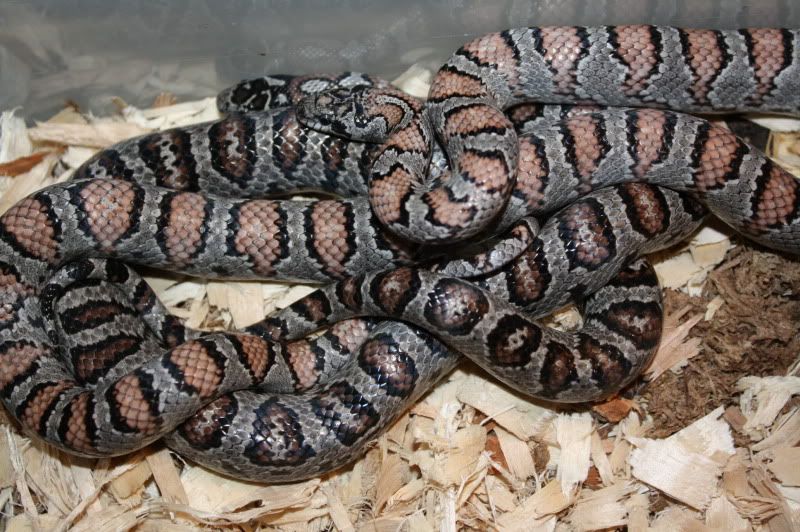
"Anery" black/white Sierra zonata saga..

JKruse May 13, 2010 12:44 AM

Okay, for my anerythristic autistic comrades, i offer thee several photos to peruse and decipher your thoughts. Looks anery to me guys.

I realized i don't have my macro lens as I lent it out to Shannon when we got together in Cali......bes I can do for now but I think it's pretty explanatory....

(NO FLASH)

(WITH FLASH)


Image" alt="Image">
-----
Jerry Kruse
www.zonatas.com

And God said, "Let there be zonata subspecies for all to ponder..."

Replies (26)

Jeff Schofield May 13, 2010 02:13 AM

Jerry, many times if a gene doesnt act as or look like its "supposed to" some people just cant see it. In person, in hand is all that really matters. How many doubters have I had on these "green"(hopefully Anery)Monsters of mine? I hear ya bud! By the way, it might be better if its not the "typical" Anery anyways. It might look nicer! Applegate's pyro bears his name instead of the "over used" HYPO term and its commonly accepted now. Maybe you can call em J(er)K Mt. Kings!
Image

Jlassiter May 13, 2010 10:50 AM

>>Jerry, many times if a gene doesnt act as or look like its "supposed to" some people just cant see it. In person, in hand is all that really matters. How many doubters have I had on these "green"(hopefully Anery)Monsters of mine? I hear ya bud! By the way, it might be better if its not the "typical" Anery anyways. It might look nicer! Applegate's pyro bears his name instead of the "over used" HYPO term and its commonly accepted now. Maybe you can call em J(er)K Mt. Kings!

LOL.....
But...Applegate Special Pyros are not Hypo.
I don't commonly accept it....

If so the many thayeri out there with reduced black pattern are hypo....I don't think so....The black to they do have is 100% Melanin...not reduced melanin....

They have reduced pattern not reduced pigment....
Maybe you are eluding to this in your statement "over used".....

BTW...I always like seeing pics of your green monsters....Great looking snakes....
-----
John Lassiter
Poor planning and procrastination on your part does not constitute an emergency on my part...
www.coastalbendcaptivebreeding.com

Jeff Schofield May 13, 2010 01:01 PM

Yes, I think HYPO is over used. I mean the definition is "reduced black pigment", you can throw it on any snake you want really. Most of us accept this as a recessive gene eliminating black and replacing it with a brown/lavender mix. But if you look at some of the morphs its attached to it simply doesnt apply(red milk, coastal plains milk).

Joe Forks May 13, 2010 10:45 AM

are they purple/lavender as hatchlings and this is what you get when mature?

I still don't have any clue, I certainly don't care if you call them anery (like you would care if I care lol), I'm just saying it's weird, or unusual.
-----
Herp Conservation Unlimited
Conservation through captive propagation
Mexicana Group Directory
Photography by Joseph E. Forks

JKruse May 13, 2010 02:24 PM

I do care what you think Joe (i just don't like outrageous hybridization). So please don't say that.

As for the hatchlings, this will be my first time producing any with two clutches expected. The babies hatch out varying between lavender and sometimes with a slight touch of pink w/in the lavender. I don't believe these are 100% anery, but most of the hatchlings I've ever seen (maybe 5?) all tend to be more purple/lavender and ALL turn out like the adults I've shown that express this phenotype (what's weirder is that nearly ALL males hatch tricolored and nearly ALL females hatch "anery" which turn black/white -- I've only heard of a single male hatch "anery" and a single female hatch tri-colored --- it's just very unusual what this population of Sierra zonata are expressing).

My anticipation is throught the roof as to what will hatch, sex ratios, variations, etc.
-----
Jerry Kruse
www.zonatas.com

And God said, "Let there be zonata subspecies for all to ponder..."

JKruse May 13, 2010 02:27 PM

As for the rationale as to why I've seen only so few is because there are so few. To my knowledge there are only a couple fellas working with these with less than 2 dozen babies hatched? I'm not sure of the exact numbers, but it's very few indeed.
-----
Jerry Kruse
www.zonatas.com

And God said, "Let there be zonata subspecies for all to ponder..."

Joe Forks May 13, 2010 06:04 PM

outrageous hybridization! - I said it

Alright, I get what you are saying, I'll just read the rest of the posts and wait for the babies.
-----
Herp Conservation Unlimited
Conservation through captive propagation
Mexicana Group Directory
Photography by Joseph E. Forks

Bluerosy May 13, 2010 06:48 PM

Jerry,

Not trying to bust your chops here but 2 dozen is a lot when it comes to new morphs. That means there are 24 of these out there already.

I would consider 2 or 3 in existence rare when it comes to morphs. Twenty four doesn't even make them new anymore.
-----
www.Bluerosy.com

Jeff Schofield May 13, 2010 02:56 PM

Jerry I think the sample size would be far too small to figure anything sexually dimorphic at this point. And in my best Tony Saprano/NY accent....Good luck with those JerKy boys kings! Very proud of ya!

Jlassiter May 13, 2010 10:47 AM

Jerry...
Looks Anery to me too, but what did it look like as a hatchling?
Was it Hypoerthristic?

The only reason I brought this up is the similarities I am witnessing with my Hypo-E Mex Mex.....They hatched with red saddles and now has pink saddles. Their mother has lost all the red pigment as an old adult and looks anerythristic now.

I'll post pics when I get home....
-----
John Lassiter
Poor planning and procrastination on your part does not constitute an emergency on my part...
www.coastalbendcaptivebreeding.com

Boneyard May 13, 2010 12:03 PM

It seems that where the red should be would not be solid black. By looking at the pictures it's easy to see there is no red but when you remove the erythrophores it doesn't make sense that it is "replaced" by melanin. On red animals such as corns, anerys are grayish where the red should be with black patterns and sometimes hints of yellow. It would make more sense to me that an anery zonata would have more the coloration of an anery corn just with the zonata pattern. I'm sure there is something going on, I'm just not sure anery is the right term.
Any thoughts anyone?

Karl
-----
Boneyardreptiles.com

JKruse May 13, 2010 02:15 PM

Although I do not understand, nor does anyone else, the increase of melanin over time it's something that has been naturally-selected for....whether it be evolutionary anomaly in response to a high-elevation population, we can only speculate. But here is a response I gave to Rainer (Bluerosy) from down below indicating these are NOT the typical "high-black" variant of Sierra zonata:

"Rainer, i do indeed have localities of and know of Sierra snakes from additional localities that are naturally selected for higher black crossover. Indeed I know there is not just one specific location that this phenomena occurs.....there is great research being done out west that encompasses this very subject and will likely be published in the next few years. Wish i could say more but can't. But this Sierra variation have patterns that are stationary/constant and DO NOT CHANGE over the course of time.

These Sierra snakes I'm showing are different in that it is not about selecting for higher amounts of black......females generally hatch "anery" (no one knows why there seems to be a sex-linked phenomena going on with this phenotype) and then undergo (much like gaegeae) a GRADUAL ontogenetic CHANGE whereby the melanin completely suffuses (except for the ice-white bands). So a baby that has the lavender body rings, after about a year, will no longer have (save for a few scales possibly here and there) any color left. The few scales that may show through are lavender, NOT red.

The Sierra snakes that are "high-black" hatch out with the bright red lateral slivers and KEEP THEIR PATTERN over time...it's UNCHANGED.

What's even more interesting is that the tri-colored males do not have normal skin color under the scales, but rather their skin is black despite being a tri-colored snake. I can not explain what is going on, much like the few others that are working with this really unusual natural variation of Sierra zonata. But what i do know is that there are not the typical high-black variation you're thinking of. They are indeed different."

It's anyone's guess, but it's a very unique variant.....almost the same effect of what black milks go through however the white bands remain unaffected. Just plum weird.
-----
Jerry Kruse
www.zonatas.com

And God said, "Let there be zonata subspecies for all to ponder..."

Boneyard May 13, 2010 02:32 PM

Thanks for the info. I was not aware that they changed color as they matured. Do you have a pic of a baby you could post?
Killer snakes by the way!!!
Thanks
Karl
-----
Boneyardreptiles.com

JKruse May 13, 2010 03:23 PM

Sure...look down a bit below for ,my original pior posting and you will see one photo of a representative hatchling under a couple pics of adults (male het and female "anery"/black & white/OREO -- whatever the hell we wanna call 'em I suppose)...
-----
Jerry Kruse
www.zonatas.com

And God said, "Let there be zonata subspecies for all to ponder..."

Jeff Schofield May 13, 2010 08:04 PM

Jerry, I'm thinking that these mt. kings are reading the Kingsnake.com classifieds and see that they are worth about 10x more than regular black and white banded Cal kings. So, being the convicts they are, they go through this god awful color change in an effort to lower their own value. What self respecting Mt. king wants to spend its life in a sweater box in Jersey after all?? It only makes sense right??

JKruse May 14, 2010 04:26 AM

*SIGH*

(death stare.....)
-----
Jerry Kruse
www.zonatas.com

And God said, "Let there be zonata subspecies for all to ponder..."

JYohe May 13, 2010 12:11 PM

Call them what YOU like Jerry....they are yours.....(does anyone else do them,? same strain/line?)

.personally...when I saw them /see them...and other black and white zonata.....I actually never thought of them as anerythristic or axanthic....I think of them as black and white....with TOTAL lack of red pigment at all....as in their coloration and pattern NEVER even thought of adding red to itself....

.....know what I mean.....another person wrote same line I think....they started as the red area....would look different....

yours have no red area at all....not even a thought of it...

and personally ,,,I would NOT buy an anery....and I would pay more for black and whites.....

aaaaaah......Good luck...breed the snot out of them and prove how well it runs in the line.....

!
-----
.......
.......
......JY

markg May 13, 2010 01:32 PM

Background:
Black and white California kings, though appearing anery, are not as far as recessive inheritance goes.

Black milks start out with red. As the snake ages, more of the surface area of the scales is overcome with melanin.

Problem solved:
So, what you have is a B&W Cal king x Black milk (j/k)

OK really this time - the babies do look anery or hypo-erythristic. But perhaps the best title would be Black & White Strain Sierra Mtn kings
-----
Mark

Bluerosy May 13, 2010 03:37 PM

Black & White Strain Sierra Mtn kings

1 on the name.

Mr. Morph guy, I mean Jerry , it seems what people are questioning is the name "Anery" you are attaching to these. Like another posters said as i did as well- They are your snakes. You know that there is something different going on. Why not apply a different name (for now) until the sex link thing and other stuff is worked out?

Sometimes we get traits from nature that are just different and don't fall under any catagory. I recall the peanut butter brooks. When i first posted these here I asked the forum what to call this "hypo' type snake. Since the name hypo was already taken people voted on Peanut butter. Turns out, in later breedings, that the Peanut butter is a unique trait as it shares an allele on a single locus with the T negative albino. I am glad now that the name peanut butter was chosen for this weird trait. because it is just so different and behaivs so different. Also the Jelly name.. which the PB and T neg created in the first generation, was a natural succession. It is unique and deserves a unique name.

BTW.Regrading the whole morph guy comment from you on a thread below. When i got the peanut butters i knew the locale it came from and bred them back to each other. So they were locale specific. Then when i bought out the new t negative strain i decided to breed the PB and T neg togther. I expected hets but got a real surprise intead.

It is likely that you may do the same if another trait pops up with these seirras. You just never know what the future might hold Mr. morph guy.

You may think it is unlikely that an albino (or some other trait) may pop out of some seirras. But that is how morphs sometimes get discovered. Through captive propogation and breeding back brother to sister. In the wild they may not be found , but who is to say that other hidden traits aren't floating around out there. Maybe there hasn't been enough zonata being bred back to discover these trats yet?

Oh, I have a final question. Sorry if i did not play close attention to the history on these. but did you prove these out to be a reccessive trait yet? I mean, have you bred brother to sister? If so, how do you know for sure this is a sex linked trait??

When i first bred the peanut butters i could not get a female from mutiple breeding over 3 years. All of a sudden i got female peanut butters. But what really happened is the females were a bit lighter than the normals. Then when they grew up they took on an obvious recessive look. I did not know this at the time and sold off a few females as normals.

below is a pic of the first PB's i produced. The black one is a normal. The light one is a male PB. And the medium colored is a female PB.

I am sure you will figure this thing out. That is part of the fun. just be careful labling anything to soon. That is why i like the term B&W strain Sierra Mtn kings.


-----
www.Bluerosy.com

zonatahunt May 13, 2010 03:59 PM

First, this 'morph' is a little more common than most of you think. I've been working with this morph for almost a decade now, and know of multiple others working with them as well.

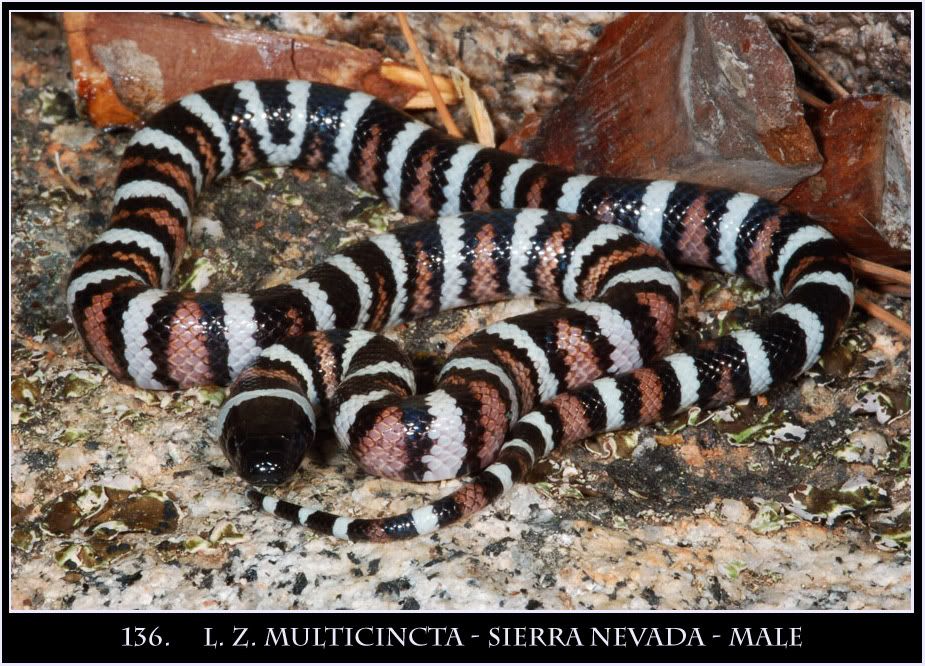
The original female from whom the first 'anery' morphs came from was a standard wild-type zonata. It had a lot of black, but its red was red. When it was bred to another snake from the same locality two 'anery' female snakes were produced. During the first few years of breeding, the same pair only produced female 'anerys' (this was simply due to low sample size; at first it was thought it was a sex-linked trait, but that has since been proven untrue as multiple male 'anerys' have been produced). While the trait is apparently a simple-recessive, it does manifest itself differently within the sexes - but only in the red rings. Females tend to be born with lavender-gray rings instead of red. By most females third shed they are almost completely pure black and white (with the white in both males and females having a purplish-blue hue). Males, on the other hand, are born with pinkish rings instead of red, and tend to retain some of the ringing as adults (the pink slowly turns to a gray).

These are NOT your typical anerythristic animals. I don't know what they are, but I do know they are unique. Some populations of alterna are born tri-color and ontogenetically change to a bi-color animal in a very similar fashion (but the white in alterna is normal, where it is not in these guys).

Everyone that has these is highly secretive about their animals. But they are a lot more prevalent in collections than they might appear.

Below are examples of a typical male and female of this morph:

Male

Female

Mitch

JKruse May 13, 2010 04:28 PM

Thanks for the clarification Mitch. I'm a bit "iffy" on the word "prevalent".......there's not a ton of these out there either. And it's difficult to be secretive as they're so unique.

These have never made it to the forums until I believe I began talking about them. But it's about time.

Glad to be pimpin' 'em a lil' bit from da right coast...LOL.
-----
Jerry Kruse
www.zonatas.com

And God said, "Let there be zonata subspecies for all to ponder..."

JKruse May 13, 2010 04:34 PM

are you saying these do not exist as such in the wild? I can fathom the whole captive thing, but was under the pretty solid impression that these are minutely found as "anery" in a limited # of "pocket" populations......help me wrap this around my head now.....
-----
Jerry Kruse
www.zonatas.com

And God said, "Let there be zonata subspecies for all to ponder..."

zonatahunt May 16, 2010 02:16 AM

Jerry,

Sorry for not responding to your questions sooner, but I've been hitting the field pretty hard the past two days looking for z's. Now that I've got a few minutes before tomorrow's field activities I'll do my best to answer your inquiries.

As far as I know, there has only been one true 'anery' found in the field. It was collected almost eight years ago from a locale about 150 miles north of where your stock originates from. It is actually pictured in my book in the multicincta section. Sadly, the animal died in it's water dish after emerging from hibernation (that's why I NEVER do damn breeding loans!). I believe the gene for this phenotype can be found throughout the central Sierra Nevada, but 'hotspots' or 'pockets' of 'anery' populations may be a little much (I don't think purifying selection will act to strongly to remove this gene from populations, as it's phenotypic expression may not really be that maladaptive - black-and-white patterns are considered to be highly cryptic!).

As for the prevalence of this morph in private collections, as I said before, the people who have this morph prefer to remain unnamed and are highly secretive of their collections. Trust me, since their emergence nearly ten years ago, they have been gifted to multiple people, all of whom who have adult snakes that are breeding annually. Remember, people in California with the proper permits are not allowed to sell their animals (regardless of permits noone in CA is allowed to sell their snakes) so they simply gift them to close friends or other people who want to work with this morph. But, you are correct, considering how many people are into herps, the number of people who work with this morph are readily in the minority.

I said in the previous post, this morph is unique. I'm glad we both have the opportunity to work with them, as they're really kick ass! Good luck with your clutches and I wish you better than 50% 'anery' hatching success (if I remember right both of your males are het, correct?)!

I'm off to sleep now, as the field is calling me for a coast return tomorrow. =)

Mitch

JKruse May 16, 2010 08:19 PM

My cell has been down Mitch, so if I havent responded to any emails/texts I apologize. Just email me at mbshop@aol.com and we're all good. I should have my phone up in a week or two.
-----
Jerry Kruse
www.zonatas.com

And God said, "Let there be zonata subspecies for all to ponder..."

Jlassiter May 13, 2010 06:53 PM

Great Info Mitch....
Something very similar but different is occurring with some Mex Mex that originated in El Valle de los Fantasmas, SLP, Mexico.

These originated from a founding stock that Bob Applegate acquired years ago. Bob sold offspring from these but I don't know if he ever line bred them. Due to some line breeding a strange phenomenon has occurred.

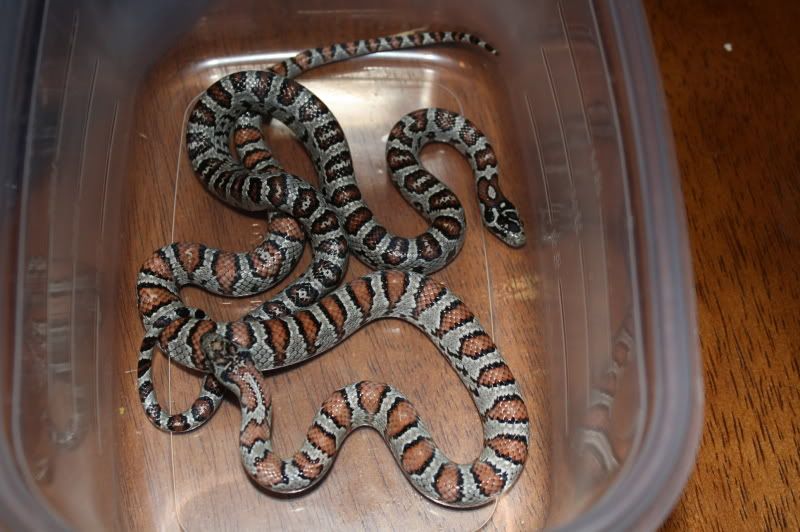
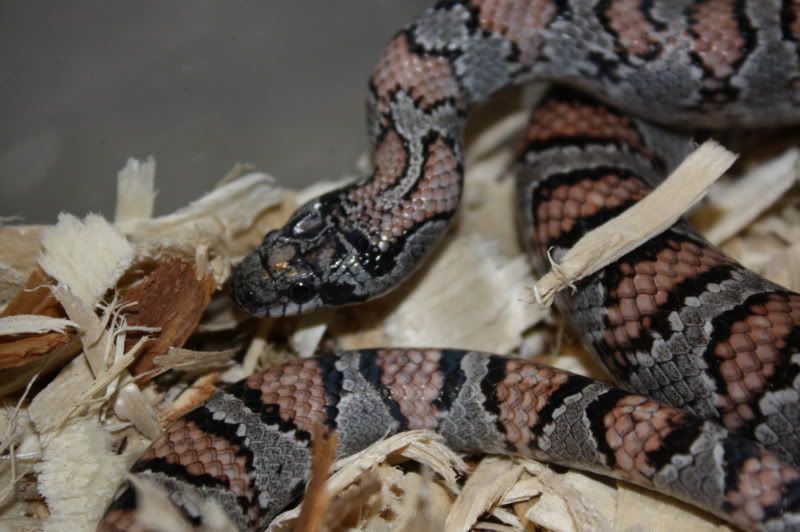
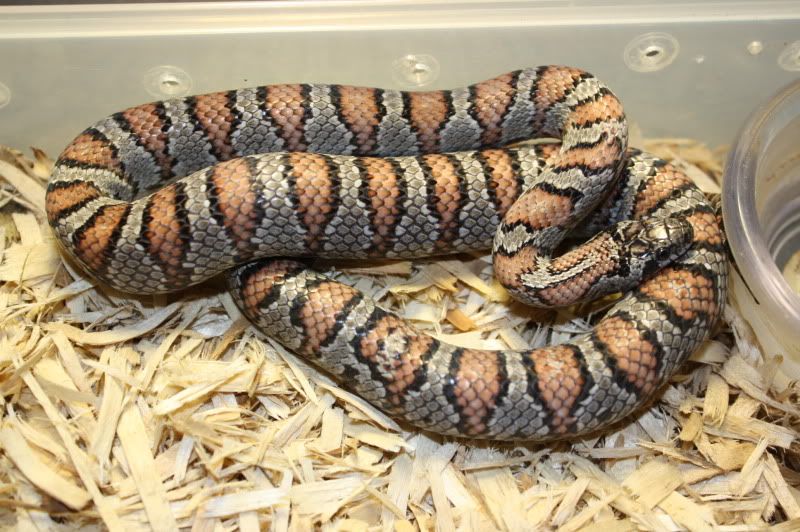
I believe them to Hypoerythristic. They hatch out with red saddles and loose their red PIGMENT over time. Some even lose all their red pigment with age and look Anery. The males seem to be more pink and the females seem to be more lavender.....

Here are some photos:

Around 6 months old....

Current Pics....
The Male....

The Female....

Together....

Their Mother.....

-----
John Lassiter
Poor planning and procrastination on your part does not constitute an emergency on my part...
www.coastalbendcaptivebreeding.com

Jlassiter May 13, 2010 06:32 PM

This is what I question.....

If a hatchling snake is born with reduced red pigment (NOT PATTERN) wouldn't you call it Hypoerythristic?

And if this same hatchling looses its reduced red PATTERN would you then call it Anery?

Any way you answer it they are cool Zonata and certainly "different" than any I have seen......
Maybe I should get a pair.....LOL
-----
John Lassiter
Poor planning and procrastination on your part does not constitute an emergency on my part...
www.coastalbendcaptivebreeding.com

Site Tools