Reptile & Amphibian Forums

Welcome to kingsnake.com's message board system. Here you may share and discuss information with others about your favorite reptile and amphibian related topics such as care and feeding, caging requirements, permits and licenses, and more. Launched in 1997, the kingsnake.com message board system is one of the oldest and largest systems on the internet.

Click for 65% off Shipping with Reptiles 2 You
Click for ZooMed
Click for 65% off Shipping with Reptiles 2 You

Green eggs, but no ham!!!

tbrock Jun 20, 2010 07:02 PM

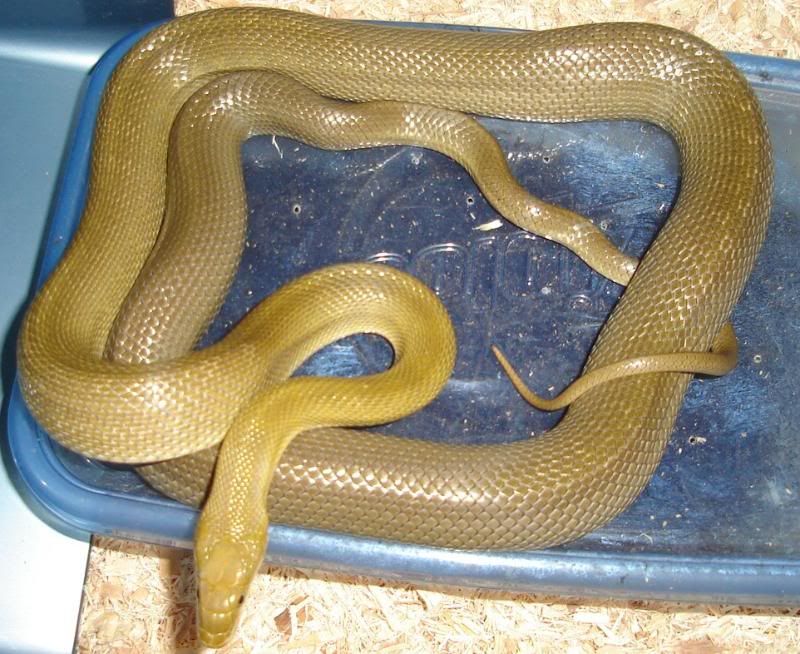
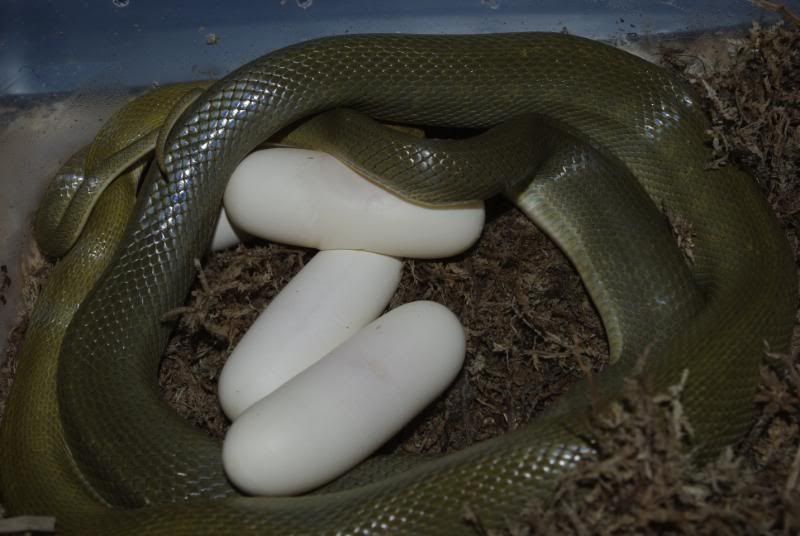
It was a great Father's Day for me! When I checked on my female Green Rat, this morning, she had two eggs out and more on the way! She ended up with a clutch of five, which surprised me very much, as this is her first clutch! I expected maybe three eggs at the most, for her first time.

She is part of a true locality pair from Mt. Hopkins in the Santa Ritas, given to me by my friend, Diego Ortiz.

Here she is before her pre-laying shed, which happened about ten days ago.

After the fourth egg was laid.

The final count. She vacated the nesting box as soon as I opened her tub - and did not seem tired at all!

Happy Father's Day to all the other dads out there!
-----
-Toby Brock
Southwestern Center for Herpetological Research

Replies (14)

BillMcgElaphe Jun 20, 2010 09:47 PM

Good Job...
The "proof in the pudding" that you are keeping Greens well is seeing that female and eggs!!!
Thanks for the pics.
-----
Regards, Bill McGighan

tbrock Jun 21, 2010 07:00 AM

>>Good Job...
>>The "proof in the pudding" that you are keeping Greens well is seeing that female and eggs!!!
>>Thanks for the pics.
>>-----
>>Regards, Bill McGighan

Thanks Bill!

I have not found them to be overly demanding, so far - although I did give them an odd, sporadic brumation. The fact that it worked for them makes me wonder some things about some species which have been more challenging for me. I may try a new approach to brumating a couple Old World species this year...
-----
-Toby Brock
Southwestern Center for Herpetological Research

randywhittington Jun 21, 2010 06:59 AM

Very nice Toby. Congrats.
-----
Randy Whittington

tbrock Jun 21, 2010 07:02 AM

>>Very nice Toby. Congrats.
>>-----
>>Randy Whittington

Thanks Randy!

Now, the real long wait...
-----
-Toby Brock
Southwestern Center for Herpetological Research

viborero Jun 21, 2010 04:00 PM

She looks great, Toby! So much thicker than when I last saw her.

I don't know that this species goes through a very long brumation most years, considering the mild climates they come from.
-----
Diego

SWCHR

tbrock Jun 21, 2010 08:45 PM

>>She looks great, Toby! So much thicker than when I last saw her.
>>
>>I don't know that this species goes through a very long brumation most years, considering the mild climates they come from.
>>-----
>>Diego
>>
>>SWCHR

Thanks Diego! Not only thicker, but just over-all BIGGER!

Well, that's the theory I'm coming around to also - sort of. However, the winters where I live are at least somewhat milder than the foothills that they come from.
-----
-Toby Brock
Southwestern Center for Herpetological Research

mattkau Jun 22, 2010 12:25 AM

That is awesome. Best of luck with the clutch. I know you were worried that you could get them to breed or not. Great job.
-----
Matt Kauffman

tbrock Jun 22, 2010 07:06 AM

>>That is awesome. Best of luck with the clutch. I know you were worried that you could get them to breed or not. Great job.
>>-----
>>Matt Kauffman

Thanks Matt! Now for the long wait, where I worry for the next 70 - 85 days! LOL
-----
-Toby Brock
Southwestern Center for Herpetological Research

mattkau Jun 22, 2010 08:52 AM

Yeah, I hear ya. That's were I am with my situla and rossalleni clutches. It's been years since I incubated a clutch of eggs. I just got back into the hobby in '08 and now I'm finally starting to get pairs old enough to breed. Hope all goes well this year because next year I will have many more of age. I didn't really want the trial run to be with my striped situla though.
-----
Matt Kauffman

mattkau Jun 22, 2010 08:55 AM

One more thing, I'd love to hear about your brumation techniques for the Senticolis. I'd like to work with them one day, when I have a bit more experience.

-----
Matt Kauffman

tbrock Jun 25, 2010 09:17 PM

>>One more thing, I'd love to hear about your brumation techniques for the Senticolis. I'd like to work with them one day, when I have a bit more experience.
>>
>>
>>
>>
>>-----
>>Matt Kauffman

Hey Matt, sorry for the long response time - just saw this.

Well, I can go into lengthy detail on it, via email, if you want - but basically I tried to emulate Gerold Merker's take on brumation. I cooled them with a warm end, using heat tape, and kept the snake room unheated. This past winter was a bit cooler than usual, for south Texas - but with the usual warm-ups too, which could last a week or more.

I fully warmed them back up during three separate warm spells, and fed them, due to them being very active and slender, racer-like snakes. I would let them digest for two weeks and cool them down again - depending on weather. I really did not expect them to produce fertile eggs with this brumation, and especially since this was the first time for the female, and first time cooling them in captivity as well. The female was a juvenile when I got her, too. The fact that they did is causing me to re-think some of my brumation techniques for some of the Old World rats which have not produced for me yet (situla and bimaculata). Speaking of Leopard Snakes, I'd like to pick your brain about getting eggs from them...

Coldest temps in the snake room were probably in the mid 50's during a brutal (for south Texas) three day freeze. Warmest temps were up to the high 70's. Like I said, I can go into more detail via email, and will have to look at my notes to come up with actual duration of cooling, etc.

-----
-Toby Brock
Southwestern Center for Herpetological Research

mattkau Jun 30, 2010 09:21 PM

Thanks for the reply Toby. I just saw it, so I guess we were both late in replies. I actually brumated my situla pair in a similar way, minus the heat tape and feeding. The winter temps. here in SW LA are probably similar to yours in south TX. I simply brumate all my snakes by moving them to a small extra room in my house. I close the air/heat vents and open the single window about half way and close the door. I also close the blinds, but enough light gets in so there is a natural photo period. I haven't bred a lot of snakes yet as most are not quite large enough yet. Besides the situla this method has worked well for corn snakes, everglades rats, speckled kings,and bairdi.
-----
Matt Kauffman

tbrock Jul 02, 2010 07:13 AM

>>Thanks for the reply Toby. I just saw it, so I guess we were both late in replies. I actually brumated my situla pair in a similar way, minus the heat tape and feeding. The winter temps. here in SW LA are probably similar to yours in south TX. I simply brumate all my snakes by moving them to a small extra room in my house. I close the air/heat vents and open the single window about half way and close the door. I also close the blinds, but enough light gets in so there is a natural photo period. I haven't bred a lot of snakes yet as most are not quite large enough yet. Besides the situla this method has worked well for corn snakes, everglades rats, speckled kings,and bairdi.
>>-----
>>Matt Kauffman

Your method of brumation is the same I have used for my corns, meahllmorum, and bairdi, for years. I have been cooling most of my Old World ratsnakes, including the situla, in a refrigerator - for at least the last three years. This has worked well for my Chinese Beauties and Diones, but I still have yet to get a good clutch of eggs from my Twin-spotteds and situla. Schulz recomends a long, cold brumation of something like 3 - 4 months at 50 degrees F, I think. This is what I have strived to give them, but maybe I will try them in my subtropical New World ratsnake brumation.

Also, another factor which may make some difference between our situla, is locality of origin. Schulz and other authors have said that situla from Greece are probably the easiest to keep. Mine are descended from Croatian animals - so may be a bit more difficult to keep, or more particular about their conditions. Just some thoughts...
-----
-Toby Brock
Southwestern Center for Herpetological Research

mattkau Jul 06, 2010 12:31 AM

Yeah, Toby mine are from Greece, as I beleive all the striped specimens are(mostly the many islands). I think Randy Whittingtons situla are from Croatia and he uses the same method, but it gets a bit colder in NC.
-----
Matt Kauffman

Site Tools