I live in texas and keep my Adult beardies in a huge outdoor screen enclosure with half of it shaded and a large shallow water pool that they bathe and soak in voluntarily. But after hearing about the one that overheated and died in the post below im second guessing myself. They seem alot more colorful and very happy outside. Am I screwing up by doing this?
Reptile & Amphibian Forums
Welcome to kingsnake.com's message board system. Here you may share and discuss information with others about your favorite reptile and amphibian related topics such as care and feeding, caging requirements, permits and licenses, and more. Launched in 1997, the kingsnake.com message board system is one of the oldest and largest systems on the internet.


outside enclosures
mapplegate
Jun 21, 2010 06:50 PM
Replies (21)
PHLdyPayne
Jun 21, 2010 07:12 PM
It is fine to keep dragons in outdoor enclosures, as long as you provide sufficient areas for them to retreat too if they get too warm. Provide hides as well as shaded areas and monitor the temperatures to make sure the areas that are shaded don't get too hot themselves.
-----
PHLdyPayne
angiehusk
Jun 21, 2010 07:24 PM
It's absolutely fine...they can really blossom outside,as you mentioned their real color comes out,and as PH mentioned,provide plenty of shade.
dragonzncornz
Jun 21, 2010 08:56 PM
do you have to worry about mites and bug infestation when keeping them outside? I would love to keep our breeder dragons outside, but am to afraid they will get bugs!
DreamWorks
Jun 21, 2010 09:02 PM
Before outting them outside for some time pretreat them with mite off.
Be mindful of bugs that may venture into the outdoor enclosure and get eaten. Wasps and such.
Pre treat them with might-off right before you have them outside.
I had my dragons outside to take pics awhile back like 6 months ago and a couple of then got mites. You may want to respray the might off and scrub a little with a tooth brush if they are under trees. Typically that is where I have found issues with the tics.
Under trees and heavily wooded areas.
dragonzncornz
Jun 21, 2010 09:05 PM
OH! I hadn't even thought about them eating bugs that come into the enclosure. I think I will keep mine inside. 
DreamWorks
Jun 21, 2010 09:31 PM
Well if the screen mesh is small enough you will have no issues.
And unless they are kept outdoors for a long time they usually are so enamored with being outdoors in general that they are not typically in hunting mode.
But there is always that chance. Get a small enough screen mesh and it will prevent that.
BDlvr
Jun 22, 2010 08:03 AM
I've put my animals outside well over 100 times without a problem or infestation. Pretreating a dragon for mites is just silly. Fireflies are instant death to dragons so don't leave them out near dusk or later if you live in an area with them.
pdragon1
Jun 22, 2010 12:51 PM
Just make sure the beardeds can get away from the heat. You can run diagonal, cut in half, pvc tubes into the ground, so that the beardeds can retreat where its cool/humid.
In texas, uromastyx would do great. They are much more heat tolerant than beardeds. The only problem is that they are very good at making tunnels. The sides of the pen must be sunk pretty deep.
P. henrylawsoni would also do well where you live.
Most people would be surprised of what outdoor beardeds can eat and get away with. I have wittnessed them eating bees, wasps, velvet ants(flightless wasp), and black widows without any issues. I don't reccomend intentionally feeding any of these insects(or any ??? insect). Dragons will also eat edible plants around the non-edible ones. They are true survivors.
I have never seen any mite on outdoor dragons here. Im willing to bet the dragon mite is species specific.
Josh
angiehusk
Jun 22, 2010 01:15 PM
I have also witnessed my dragons eat bugs such as bees,or yellow jackets [ and these were 7-8" babies !!] that I thought would be the end of them. They weren't even stung ! And in 16 years,not ONE mite. I don't raise them outside but I take them out daily in spring,summer,fall, weather permitting. In large plastic toters or kids pools with plenty of artificial shade. We rarely have temps. in the 90's. Then I don't bother taking them out.
pdragon1
Jun 22, 2010 01:58 PM
Hahaha! Last year I had a mud wasp fly into the dragon room and a baby snatched it out of the air and ate it. Same thing...not even stung. It ended up being the biggest out of the clutch!
Josh
angiehusk
Jun 22, 2010 02:12 PM
That's what mine did...the first time I saw a bee hovering down,closer closer,all little beardie heads following it...and I was ready to sacrifice my arm trying to shoe it away. But one athletic leaper jumped,snatched and swallowed it,and I was AMAZED.I thought for sure it would writhe in pain and swell up or die. He just smacked his lizard lips and gazed up for another.Haha !!
PHLdyPayne
Jun 22, 2010 04:43 PM
Fireflies are toxic to bearded dragons, and there are some other bugs that are considered toxic even to birds. Many beetles have a foul secretion (ie stink bugs) which make them unappetizing...but for the most part, as long as the cage has screening similar to window screen, there isn't any real worry about the dragon eating something toxic.
I do not think mites on native reptiles are inclined to attach to dragons...mites are usually pretty species specific.
-----
PHLdyPayne
angiehusk
Jun 22, 2010 04:47 PM
Yes,I should have mentioned the fireflies being toxic...sometimes I just forget and take it for granted that everyone knows that. Good to bring it up as often as possible.
DreamWorks
Jun 22, 2010 07:02 PM
I had my dragons out in the trees when I was taking photos back about six months ago.
I didnt notice it right away but shortly after I noticed a red small mite on one of my dragons.
I started to investigate and realized they were all infested with these little red mites.
They were soft bodied and if sprayed with mite off would almost instantly let go and then were easy to get off. Otherwise without the mite off... they would stay pretty well attached and if scrubbed hard enough they would burst. They were about the size of the tip of a number two pencil led if sharpened to a fine point.
They would go mostly into the armpits and tail region and neck also. I had to scrub everything and bleach all the furniture for weeks to finally rid my dragons of them.
If your working with an enclosure of some sort I dont think its as big of a deal but when you let them scamper around under or in trees it could be an issue and if I ever do that again I will pretreat with mite off first.
They may be regionally specific to Florida.
I only had small amounts like 5 or six on each dragon.
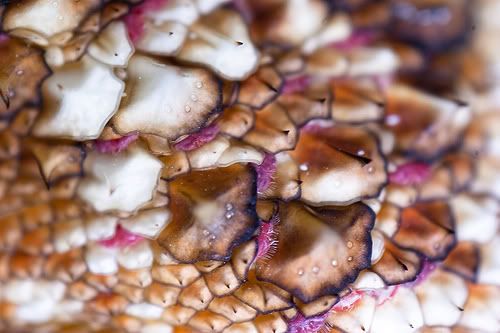
here is a dragon infested with red mites:
angiehusk
Jun 22, 2010 07:50 PM
Yeah,you might be right about where they live geographically and also what they live on in the wild. Speaking of wild,those pictures are really something. Great magnification.
DreamWorks
Jun 22, 2010 08:17 PM
They are not species specific either.
Lots of reptiles get these red mites.
Leaf tailed gecko with red mites.
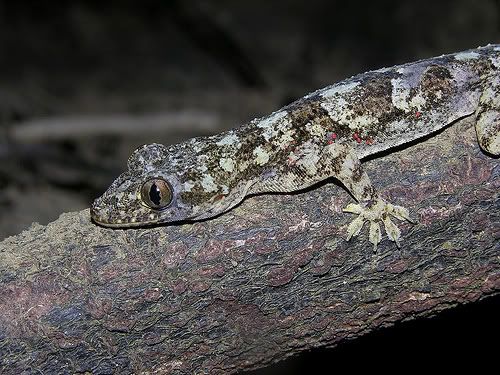
Lots of ticks down here in Florida too actually.
herpenthusiast
Jun 22, 2010 04:08 PM
Reptile mites are not species specific, but they are reptile specific. If there are a lot of wild reptiles in your yard, then your beardie may pick up mites. They can't travel very far without eating. Here in south florida there are cuban anoles literally swarming most backyards, so mites are an issue. I used to keep an iguana outside and it would pick up mites, but it had access to a small pool where it could completely submerge, so they never became an infestation. Wild herps are able to control mites because they have a broader range of temps, humidity, diet, etc. available to them. Captive herps depend on us to keep the parasites at bay.
-----
Jake
1.1 het clown BP
0.3 pastel BP
1.0 bumblebee, 50% het hypo BP
0.2 normal BP
1.1 sulcata tortoises
pdragon1
Jun 22, 2010 11:28 PM
Interesting information. It seems weird that after 25 years or so in captivity, we start seeing mites.
I love hearing people personal experiences. This is how we learn Thanks
Josh
txdragons
Jun 24, 2010 06:23 PM
We took this idea from Gus Rentfro.... when I first visited him over 8yrs ago he housed his uros, beardies, and chucks outside. Those must of been the happiest lizards I've ever seen. I have used this setup on our beardeds and a few other lizard species. It works... I never had to cover mine with a top, but its better to be safe, than sorry.
http://riobravoreptiles.com/howto_outdoor.htm
pdragon1
Jun 25, 2010 12:31 PM
Just had a flashback of days in the hot sun patching holes in that corrigated plastic, lol.
Thanks, Josh
horsema
Jun 22, 2010 01:49 AM
I was the one that had the post about my dragon that died from being overheated outside. I had put her in a box with a screen cover DIRECTLY IN THE SUN. Sounds like you have your setup with the important things in mind......shade to cool off in and a source of water. Her being in the box amplified the heat even though there was a screen cover. I didn't think about the usual set up we all do for our dragons.........a basking spot, AND A COOL SPOT. I ASSUMED that just because she sometimes lays under her basking spot for hours, that she would be ok. I live in Arizona, one of the hottest places in the country. I ASSUMED that just because she was a desert dweller by nature that she would be ok .I must also say that, I noticed in her aquarium she would often kinda put herself just outside the hottest spot in her cage. Looking back, I think she was one that didn't like the 105-110 degrees which is what we think of as the typical basking spot temperature.....if that makes sense. I think dragons can vary in what is comfortable for them just like people. My advice.........just don't ASSUME anything. If I had really thought about how she was in her cage, and really watched what her habits were, I would still have her today. Like I said, I had noticed that she stayed just outside the hottest spot in her cage quite often (which I kept between 105-106).
