I am curious to get others feedback on chicks as feeders. I bought a bag of these and fed those to just three of my rat snakes as a trial run. I typically only feed mice and rats but thought I would change things up a bit so I fed chicks every other feeding and rodents every other feeding. What I have noticed is explosive growth on the snakes that ate them in just 6 weeks. I have to wonder if it is just fat they have gained as I assume chicks don’t have anywhere near the muscle content or protein an adult mouse would have. It appeared as though the rat snakes would digest these chicks in less than a day and appeared hungry within two days. I think I might continue to use chicks as they are incredibly cheap to purchase but use them more as treat than a consistent source of food. Does anyone else here use chicks?
Reptile & Amphibian Forums
Welcome to kingsnake.com's message board system. Here you may share and discuss information with others about your favorite reptile and amphibian related topics such as care and feeding, caging requirements, permits and licenses, and more. Launched in 1997, the kingsnake.com message board system is one of the oldest and largest systems on the internet.


chicks as feeders
Replies (15)
I've used chicks for a Leucistic rat that would only eat 2-3 months a year. At first she devoured them, but then she grew tired of them. So now I'm giving them to my Mexican Black King. As far as growth is concerned, it was about the same with mice or rats. However I would have to give at least 3-4 chicks to suppress their appetite. From this point forward, I'm going to stick with rats and mice.
I haven't used them but I do remember others commenting that the snakes poop is smellier. Is that even a word? Anyway you get the idea.
-----
King Snakes! Who can make a better mouse trap?
J Sierra
I used to feed adult chickens to my retics and burms and that would smell up the entire house as it is by far more smelly and disgusting. However I do not notice a difference with rat snakes as the chicks are about the size of mice anyway. I guess not enought of it to make a difference
I like your idea of chicks as a treat... 
All kinds of ratsnakes eat birds, as well as mammals, in the wild. They sometimes eat the eggs too. Some take birds more often than others, but most all will take them at least part of the time.
My adult female Senticolis triaspis loves small birds, nestlings. I feed her mostly f/t mice, but the birds really get her going, especially in the spring when it's time to bulk up a little and she's eating a lot. I think the variety is good too, as they get variety in the wild. Also, there could be some nutrients in birds they don't get as much of in mammals, although I'm sure the mammmals provide more protein.
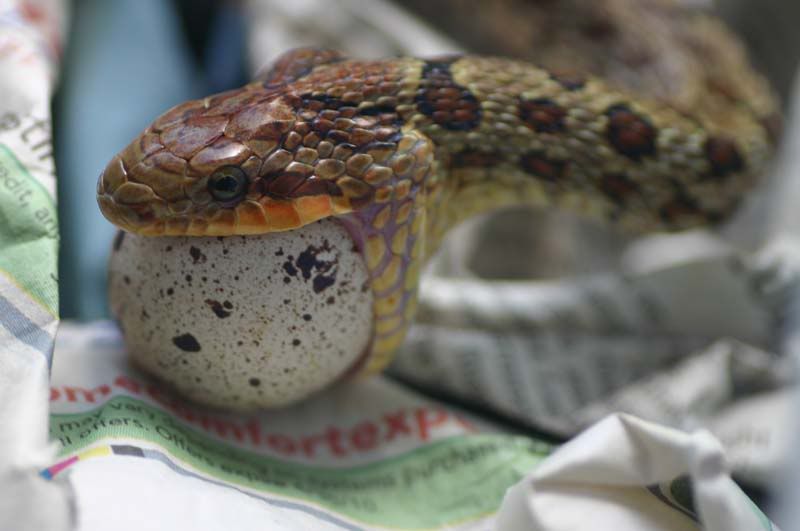
This is a South Korean Dione's ratsnake eating a quail egg this spring...
TC
>>I am curious to get others feedback on chicks as feeders. I bought a bag of these and fed those to just three of my rat snakes as a trial run. I typically only feed mice and rats but thought I would change things up a bit so I fed chicks every other feeding and rodents every other feeding. What I have noticed is explosive growth on the snakes that ate them in just 6 weeks. I have to wonder if it is just fat they have gained as I assume chicks don’t have anywhere near the muscle content or protein an adult mouse would have. It appeared as though the rat snakes would digest these chicks in less than a day and appeared hungry within two days. I think I might continue to use chicks as they are incredibly cheap to purchase but use them more as treat than a consistent source of food. Does anyone else here use chicks?
-----
Conserving reptiles by helping to protect habitat...
www.ratsnakehaven.com
www.scenicsantaritas.org
That is a cool picture. I will have to try the egg thing when I can come across them.
Thanks.
We have a problem with too many doves nesting on our property, so I act as a predator to try to keep the population in check. I'm finding that some ratsnakes like birds and some will eat the eggs too. I believe the eggs are benficial to some females when they are ovulating, etc, to help with calcium requirements.
Gopher snake taking some squab...

TC
-----
Conserving reptiles by helping to protect habitat...
www.ratsnakehaven.com
www.scenicsantaritas.org
cheap?........LOL......used to get thousands of them....free....then it went to $20 for a thousand.....now the hatchery near here won't deal with them due to morons doing stupid things with them....(like PeTa type idiots setting them free in the wild type stuff...or an idiot dumping 1000 into the woods to feed the wild stuff)......
actually I know a guy that used to pick thousands up a week and the hatchery would pay him to take them....long ago....
......anyways...back to chicks....most people don't prefer to use all chick diets...even birds of prey rehab clinics....
....
-----
.......
.......
......JY
I used chicks successfully and extensively in the '80s for Rat Snakes, King Snakes, Pits, and an occasional Boid.
I did it mostly because I was poor, and could raise a few chicks to larger size for larger animals.
.
I stopped for a few reasons: smell and nutritional value based on weight.
.
Try this for some good info.
www.rodentpro.com/qpage_articles_03.asp
.
I do used quail chicks as an appetite stimulant to picky feeders.
-----
Regards, Bill McGighan
I have raised generations of ratsnakes (Pantherophis obsoletus) almost exclusively on chicks.
-----
I'm Dutch. Somebody shoot me.
Most of my adult snakes eat chicks. Everything from corns to cobras. They seem to prefer them. The poo isn't really stinkier, but it is sometimes messier
I used to use them to supplement the rodents, worked great.
I did have a cornsnake that was raised exclusively on rodents until she was about two, then she went off feed & wouldn't take rodents - tried a chick on her & she never went back to rodents - probably had her for 10 years.
-----
"There's a fine line between genius and insanity. I have erased this line."
Oscar Levant
Myself and a few other guys are trying a chick-only diet for our Gonyosoma and my Boiga collection. Both arguably feed more on an avian diet in the wild. Both experience high full-term mortality rates in eggs wherein fully formed embryos fail to exit the egg for some reason.
In both species eggs from gravid wc imports do not manifest this problem. When acclimated and fed a primarily rodent diet the situation reoccurs.
We are hypothesizing that rodents, with their higher bone density, result in a higher calcium intake for the females which may end up resulting in egg walls that are too thick for the babies to break through. Manual pipping is often necessary for the babies to successfully emerge.
Purely an unscientific theory based upon a few guys "shooting the bull" so-to-speak. All my female Boiga and Gonyosoma are currently being fed a 90% chick/quail diet and I'm anxious to see if this has any beneficial effects on future clutch-success rates.
Bill
Bill, that's a great theory. I've worked on this problem before myself, only with Chinese red-headed ratsnakes and Chinese stripe-tailed ratsnakes. It seems they lay eggs with tough eggshells and the babies have a hard time breaking through. I used to open the eggs as soon as I saw the first pip. I also had a theory, that in the wild eggs incubated at lower temps, so for a longer period of time, and the shells lost some rigidity with the longer inbubation. I failed to prove that conclusively as I had to part with the snakes after just a few breedings.
TC
>>Myself and a few other guys are trying a chick-only diet for our Gonyosoma and my Boiga collection. Both arguably feed more on an avian diet in the wild. Both experience high full-term mortality rates in eggs wherein fully formed embryos fail to exit the egg for some reason.
>>
>>In both species eggs from gravid wc imports do not manifest this problem. When acclimated and fed a primarily rodent diet the situation reoccurs.
>>
>>We are hypothesizing that rodents, with their higher bone density, result in a higher calcium intake for the females which may end up resulting in egg walls that are too thick for the babies to break through. Manual pipping is often necessary for the babies to successfully emerge.
>>
>>Purely an unscientific theory based upon a few guys "shooting the bull" so-to-speak. All my female Boiga and Gonyosoma are currently being fed a 90% chick/quail diet and I'm anxious to see if this has any beneficial effects on future clutch-success rates.
>>
>>Bill
-----
Conserving reptiles by helping to protect habitat...
www.ratsnakehaven.com
www.scenicsantaritas.org
This is just an annecdote.
Take it for what it is worth...
.
In the '80s I incubated my first Mexican Milk snakes and my first batches of Grey-band Kings.
I incubated them in the same plastic containers as NA rat snakes with a damp medium varying from shredded newspaper to sphagnum, to vermiculite, with all eggs half buried.
Never a problem with the Rats.
Temps were in the mid 80s.
Both the annulatas and the alternas had the same problem: about 4 out of 5 babies were stillborn and fully developed. Over the course of 3 or 4 years, I tried more humidity, less humidity, lower temp (82F- was a little help)…, split the cltches up, etc.
I thought about the wild clutches I had found over the years of Pits, rats, one king, and several Ring-necked and realized they were usually piled into cavities, not buried in the medium, and thriving on the air humidity.
.
I switched to keeping the eggs on top of the medium, not half buried, and had 100% hatches of both kings.
.
Since then I switched to perlite, 50/50 perlite to water (by weight) and sit all eggs on the surface, not half buried, and temps averaging about 79F.… result: 100% hatch of every fertile egg, regardless of species.
.
A friend on the Grey-band forum also suggested laying a damp paper towel on top of the cluth when the eggs indent to pip. This seems to soften the top of the eggs.
.
I always wondered if it was thicker shells, shells that needed softening, or, since the eggs breath, the hatchlings at the end of incubation needing much more oxygen through the shell than freshly laid eggs, with different genera at different temps.
.
Just food for thought.
-----
Regards, Bill McGighan
Thanks, Bill. Very similar experiences to what I've had. Now I keep mostly just ratsnakes, although I do have a clutch of desert kingsnakes this summer.
Terry
-----
Conserving reptiles by helping to protect habitat...
www.ratsnakehaven.com
www.scenicsantaritas.org
