Why did my vet say pinworms ok when the numbers are under control. I think it's a parasite that can infect others shouldn't it be treated just like any other parasite?
Reptile & Amphibian Forums
Welcome to kingsnake.com's message board system. Here you may share and discuss information with others about your favorite reptile and amphibian related topics such as care and feeding, caging requirements, permits and licenses, and more. Launched in 1997, the kingsnake.com message board system is one of the oldest and largest systems on the internet.



vet says pinworms natural and ok
dragonzilla
Jul 06, 2010 06:34 PM
Replies (27)
robbeardies
Jul 06, 2010 07:49 PM
I would say YES it should be treated just like other parasites, but with panacur, and would could infect other cagemates as well. It is a common parasite because it comes with crickets which is of course a primary food for beardies..hope i helped..
BDlvr
Jul 07, 2010 08:03 AM
Low levels of coccidia are common and not problematic. The treatment is also harsh.
Pinworms are treated with Panacur without issues so I would treat for them.
DreamWorks
Jul 09, 2010 10:42 AM
I have used Albon for coccidia.
It works well and is not harsh at all.
Use lots of probiotics with sulfur drugs such as Albon.
Much less harsh than panacur.
Your dragons should have no coccidia... at all.
No oocysts (eggs)... no live coccidia swimming around.
None!!
BDlvr
Jul 09, 2010 11:08 AM
So you say in your infinate 6 months of experience. Mine and many others say different.
BDlvr
Jul 09, 2010 06:19 PM
In his book Reptile Medicine and Surgery,
"An example of coccidaisis is seen in the Bearded Dragons. It is not uncommon to find coccidia in clinically healthy Bearded Dragons on routine fecal examinations. Many healthy individuals shed large numbers of Isospora amphiboluri oocysts. These animals are infected, not diseased. There is no reason to treat these animals."
He actually has the last 2 sentences in BOLD.
chris allen
Jul 09, 2010 08:39 PM
That you were treating coccidia with panacur?
I'd like to know what makes you say that panacur is a much harsher drug?
chris allen
Jul 09, 2010 08:44 PM
contradicts what you are saying about dragons normally having amounts of coccidia in them. Why suggest people to read something if you do not agree with the article?
DreamWorks
Jul 11, 2010 03:07 PM
It is a good article to inform people about use and importance of probiotics with medication. That is the most useful aspect of the article.
I never said that the animals "dragons" aren't rife with parasites. In captivity...
they most certainly are.
You could have an animal with a very good immune system that is docile and not easily stressed. The animal could live it's entire life cycle without any issues. (although I doubt it) I have had a very mature vibrant healthy robust animal that was diagnosed with internal parasites and saw first hand what it did to her. As well as another big mature 24" male that started acting lethargic and was diagnosed with internal parasites.
Just like dogs with worms, coccidia, and various other parasites... they need to be treated and eliminated.
Here is what I have noticed:
The dragons I have kept with parasites have reduced appetites and often have inconsistent stool samples.
For example: runny wet, extremely smelly, non frequent
The dragons with no parasites have the following:
More consistent stool samples. Tighter, less smelly/watery, more consistent stool samples with heartier appetites
The dragon should have no internal parasites. And provide clean fecals.
Im sure...
I could find literature from both sides of the issue.
My vet found coccidia in one of my dragons "Aurora" and immediately told me to treat with panacur.
At the time I did not know that Albon was better to treat coccidia with. She also said it was good for deworming etc.
If your comfortable keeping dragon colonies rife with parasites and coccidia and want to allow your dragons to naturally fend off these internal parasitic vermin that is fine.
IMPORTANT...
HERE IS SOMETHING TO CONSIDER:
The parasites of course do not want to kill off the host!!
They would in turn kill themselves. They are all about self preservation. If they killed off the host their own life cycle would end. They are happy dwelling in the host.
By doing so they have the opportunity to infest many other creatures that way. Intermediate hosts, dead end hosts, etc. Several types of hosts. When in the dragon the dragon is an intermediate host where they will spread it to others. Typically if a human is infected, we become dead end hosts and will not spread the parasite to others.
Including humans.
Yes... coccidia and internal parasites can be spread to humans.
If you have parasites in your animals. The best remedy is to kill them. Best case scenario. Fond it early while the animal is healthy, use lots of probiotics with the medication.
Why wait until the animal slips into an outward sign of hosting the parasite.
With some stress or any number of external factors the dragon could have an infestation and potential life threatening issue.
Take your animal to a vet... if they find traces of any internal parasite. They are going to identify the parasite and help you eliminate the threat.
They are not going to say... "oh it's ok for the parasite to be there. Let their immune system handle it."
that's a laugh
They should carry no parasites. The fact that they do and can live with them, hardly makes it ok... or a safe practice.
Panacur is more harsh than Albon. I have found articles that talk about the adverse reaction in some animals by vets of animals treated with panacur. It kills most if not all all internal gut flora and natural bacteria etc.
Use panacur less often as it is more toxic and needs to be used in higher strength doses to be truly effective.
Albon is a sulfur drug and panacur I'm not certain but I dont believe it's a sulfur drug.
If your content allowing your animals to host these parasites... so be it. Good luck.
When you have some rescue dragons where most of them are deformed and norms I guess it is worth running the risk.
Me personally, I have some rather expensive dragons which I dearly love. These creatures carrying parasites in any capacity is something I will not tolerate.
I dont care what some outdated reptile book says.
I have said my peace on this issue. You know where I stand.
enjoy
BDlvr
Jul 11, 2010 03:19 PM
More long winded meaningless blather.
You take every side of the coin to cover that fact that you really don't know. And when someone infinitely more knowledgeable like Dr. Mader renders his opinion you dispute it just to be contrary.
chris allen
Jul 11, 2010 06:25 PM
because you keep saying that dragons should have no coccidia...period. You say it should be treated immediately and it's a laugh to think that a vet may not treat for something right away, yet that is why the original poster was here, because their vet made that decision.
This is the section of the article I was referring to, that contradicts what you suggest, but yet you think people should read this.
"Coccidia is a microscopic parasite that all dragons normally have in their intestinal tract, in small amounts. This is a normal occurrence, both in the wild, and in beardies being kept in captivity. A minimal coccidia count is usually not troublesome in a healthy dragon. Their immune systems are able to keep the amount of coccidia in their systems in check, so that they don’t become sick from them.
However, one of the things that can cause a dragon’s immune system to stop working properly is stress. And, unfortunately, when you bring your beardie home with you, no matter where you get him from, or how much you fuss over him, he is going to suffer from relocation stress for at least a week or two. Bearded Dragons are creatures of habit, and are very sensitive to changes in their environment. Nearly all of them suffer from relocation stress, to some degree, and as a result, their coccidia counts will become higher than normal. This is why you should give your dragon a couple of weeks to settle into his new home, before having his stool sample checked. Once the stress disappears, and he begins to relax and feel at home, his immune system will kick into play again, and, if coccidia is the only parasite present, his immune system will bring the coccidia levels back down to a normal level without having to medicate him. "
So do you agree or disagree with the section of article I quoted, and why?
One other question. Why the need to put down other people for having rescues, or "normal" type dragons? Is it the dragons fault for not having nice color, or being a fancy morph? Does it deserve any less care than your "expensive" dragons? I have my preferences, and obviously you do as well, but shouldn't it be "to each his own".
DreamWorks
Jul 12, 2010 10:28 AM
Thanks for the well written response.
Honestly, I read that article awhile ago Chris.
I knew it had some good information about the importance of treating animals with medication and using lots of probiotics. But it has been awhile and I have learned a lot since reading it. I forgot the minute details, but remember the lady treating with lots of probiotics. It's a fine science becasue she talks about using them in conjunction with the medication also which will dilute the medication. I use the medication and skip a day on the skip day I use probiotics and alternate. Not probiotics and medication on the same day. It defeats the purpose.
If used properly, with probiotics, and on more mature good sized dragons. I have found a great deal of success with using medication (panacur and Albon for coccidia) when dealing with parasites.
Coccidia is an internal parasite and will eventually attack intestinal walls and cause an infestation.
I had a dragon named Aurora. She was thee most ravenous eater and healthiest dragon I have ever owned. All of sudden she started having runny stools, and blood in her stool. Her ravenous appetite (she would literally run along the glass back and forth until fed ever day and I would feed her 20-30 roaches a day if not more) I will post a pic of her. She was huge and super healthy.
I took her to the vet. The vet diagnosed her with coccidia. I treated her with panacur. She got worse. I used the medication with limited amounts of probiotics and could not get her to recover. Had her back and forth to the vet 4 times. I also did not have a microscope and I believe the infestation was pretty far along before she was treated.
But needless to say...
from what I have read... yes, you're right some animals (cows large grain eating animals, grazers) can carry coccidia and live a normal healthy lifestyle. They (the parasites) will typically be content to eat the plant and food matter in the animals intestines colon stomach etc.
On smaller animals the risk of them harboring these internal parasites is greater.
So why run the risk? If you can identify them... using a microscope doing floats or at the vet. Then get the proper medication (aldon for coccidia and panacur for worms and other parasites) and treat them.
I have treated a couple animals now using lots of probiotics and properly identifying the parasites. I have had great success.
Coccidia is not good for them to harbor. It rapidly spreads and infects other animals within your dragon colony. The parasite will rob your animal of nutrients, cause them to become lethargic, etc.
Not to be a jerk... but I am going off of what I physically saw happen to one of my healthiest dragons. Physical proof of what coccidia can do to a dragon.
I dont care what any outdated dragon keeping book says about the animals carrying the parasite. Coccidia
They contradict each other. And even vets have contradictory opinions about the issue.
In the book that I have, the Bearded Dragon in Captivity, by Allen Repashy... on page 50 it specifically talks about an animal being infected with coccidia. It says the animal needs to be quarantined away from any other dragons or it will spread the DISEASE to other healthy dragons.
Sure doesn't seem like a malignant non issue to me.
When I make comments about the norms and rescue dragons these comments are directed at one person only... who I find obnoxious.
Other than that, Im being facetious. I love and respect all animals. Big or small sic lame or lazy
It doesnt matter to me.
I'm an animal lover.
Hope this clarifies things for you.
Aurora
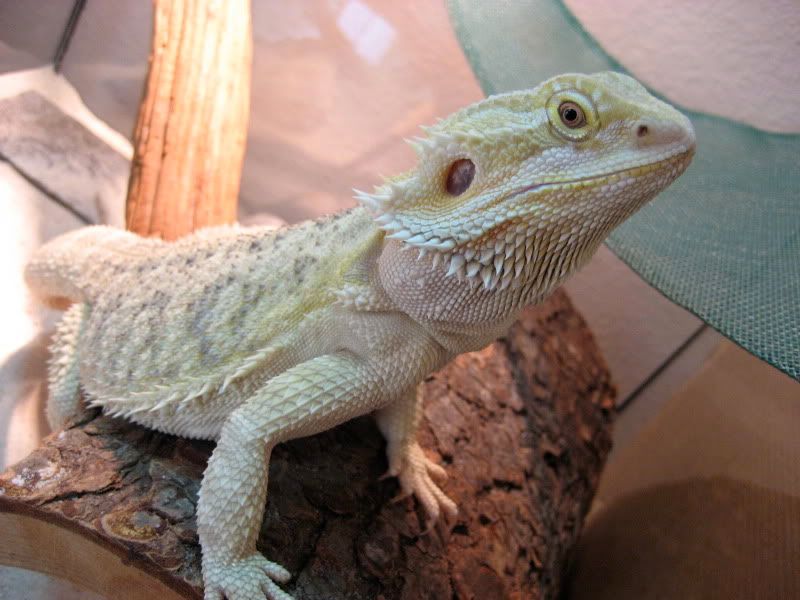
RIP
She never came back after her coccidia infestation.
That is why I make ever effort eliminate it.
BDlvr
Jul 12, 2010 11:38 AM
She didn't die from the parasites. The parasites took over as a progression to another problem.
DreamWorks
Jul 12, 2010 03:56 PM
She died from the internal parasites attacking her intestinal walls causing her to bleed from the colon and me dumping too much panacur into her.
The vet recommended every day doses for 7 - 14 days.
This is far too much panacur as I have stated.
Keeping and raising bearded dragon for the past 6 years has taught me a lot.
All through trial and error.
BDlvr
Jul 12, 2010 04:46 PM
I guess you've said it enough that you actually believe it now. But there is a difference between a month and a year. If you've kept dragons for 6 years and just now figured out what treats what your pretty slow. But then they say "those that can't do, teach"
DreamWorks
Jul 13, 2010 01:26 PM
Bdlvr you make me chuckle, and tickle the very chuckholds of my heart.
thank you for the...
endearing sentiments
DreamWorks
Jul 13, 2010 01:49 PM
The vet prescribed me the panacur for the coccidia. She obviously made the mistake.
I already posted pics of that.
You keep twisting the various BS around and you have me confused as to what your talking about.
I was prescribed from my vet panacur for coccidia. Then I used Albon after doing some reading shortly after and had success with both for different reasons.
I still use both (panacur and Albon) for treatment of worms and coccidia.
Catch it early and treat properly using probiotics.
That is what I have said from the getgo.
once again sir, thank you
Moonstone
Jul 07, 2010 09:04 AM
There are always pin worms present in dragons that eat crickets. Crickets carry pin worm. The question is, is there a few or is the dragon infested. Panacur is a simple easy treatment, but I don't think it is without side effects or issues. When ever you wage "chemical warfare", there are issues. If your vet is a qualified reptile vet, do what they say.
-----
www.moonstonedragons.com
DreamWorks
Jul 09, 2010 10:45 AM
Panacur is harsh... use it once then skip a few days and use lots of probiotics.
Ideally use it once a week for three to four weeks.
You will need to use lots of probiotics or the natural gut flora and bacteria will be killed off.
PHLdyPayne
Jul 07, 2010 07:22 PM
I don't think pinworms are 'naturally' present in dragons, they get infected with them by eating contaminated food or licking areas with worms and or their eggs. Crickets seem to be a natural carrier or intermediate host. If your dragon has pinworms, even low levels, I think it should be treated.
A dragon with low levels can easily have them increase if they become stressed or are exposed to the pinworm eggs etc. from either food or contaminated cage substrate. Better to treat for the worms and clean the cage completely to prevent re-contamination. Cage mates, if any should also be treated.
-----
PHLdyPayne
DreamWorks
Jul 09, 2010 10:48 AM
Your dragons should carry no worms or parasites and should provide clean fecals with no parasites whatsoever.
Worms are horrible in any animal.
They can attack the lungs and other organs asside from just dwelling in the colon.
They will eventually attack the lining of the colon and internal tissue as well.
A small amount is indicative of an eventual infestation.
Better to catch it early and treat properly.
DreamWorks
Jul 09, 2010 10:53 AM
Here is a nice article for treating animals with drugs for parasites.
I suggest anyone who is going to treat for parasites read the article.
http://www.beardeddragon.org/articles/parasitecare/
chris allen
Jul 09, 2010 08:47 PM
If you are going to treat for parasites, do your research and then go to a qualified vet. Don't listen to what any one person says over the internet.
horsema
Jul 11, 2010 10:34 AM
I am a new dragon owner, in just the short time I have been on this forum, and Fauna for that matter too, I keep hearing that crickets seem to carry quite the risk of parasites. I have been feeding my dragon worms and crickets, but I am at the point of wanting to feed my dragon only worms (as far as protein goes). Between the parasite issue and the fact that I think crickets are just a pain in the butt. My question to you all is......what are the risks of parasites or disease with worms?
robbeardies
Jul 11, 2010 01:16 PM
I'm with you. I have had dragons now for about 7-8 years now, currently have 6 adults and 33 babies. I have always given them crickets and worms off and on and give mine veggies every morning but now with the cricket virus and carrying pinworm besides being a pain i switched to superworms and mini and reg. mealworms for the hatchlings. I think the worms carry a less risk of parasites besides being easier to contain and keep alive and dusting issues.
BDlvr
Jul 11, 2010 01:42 PM
Parasites are all over the environment. They are not confined to a specific bug or just bugs in general for that matter. I treated my Iguana for Pinworms 6 months ago and he only eats salad.
I have 25 beardies here and parasites are an extremely minor issue. With proper husbandry it is unlikely that you will have illness resulting from them. Just like all pets including mammals it is a good idea to have a fecal tested at least once a year, twice would be better.
DreamWorks
Jul 11, 2010 02:27 PM
I have been keeping reptiles all my life.
I have had snakes since I was a very little kid. In upstate NY, I caught garter snakes in my backyard, sexed them and then mated them. They bare live young. I was 10 years old and would dig worms to feed to my baby garter snakes.
Later on I started keeping a number of different boas and pythons. Different Rat snake morphs etc all my life. I have always had reptiles.
I have kept iguanas, Savannah monitors, several species of turtles, arachnids, and elaborate fish colonies also.
Additionally, I have kept a number of poisonous snakes. I have caught them on my property or others... dusky pygmy rattlers and eastern diamond back rattlers. These were live caught "by hand" by myself and relocated.
When I say by hand... I mean literally: "with my bare hands."
One rattler was over 4 feet long.
Never been bitten. But now that I'm older... I am a little more reluctant to put myself at risk of being bitten and take better precautions.
I have been keeping bearded dragons since 2003 when I lived in Tennessee. I bought a norm at a local petstore. Shortly thereafter I kept numerous other dragons. Some I kept and sold once bigger. Some I gave away. Back when I first started I even traded off snakes I had for dragons.
So...
Just because I started posting on this forum 6 months ago does not mean that is when I started keeping reptiles.
BDlvr
Jul 11, 2010 02:53 PM
No. It's the misinformation in your posts that make your inexperience stand out.
