I bred my Male Sunglow Motley Corn to my Female Normal Corn. I got 13 eggs and all 13 hatched out last week. I got all Normal Corn Snake babies. My question is.. If I buy a Female Sunglow Motley & breed her to my Male Sunglow Motley will I get Sunglow Motley Babies?? Will they ALL be Sunglow Motley Babies or just 1 or 2 and the rest normal?
Reptile & Amphibian Forums
Welcome to kingsnake.com's message board system. Here you may share and discuss information with others about your favorite reptile and amphibian related topics such as care and feeding, caging requirements, permits and licenses, and more. Launched in 1997, the kingsnake.com message board system is one of the oldest and largest systems on the internet.


Sunglow Motley Babies Question???
actechwjw
Jul 24, 2010 11:25 AM
Replies (29)
tspuckler
Jul 24, 2010 01:43 PM
Most corn snake traits are recessive. Which means when bred to a normal corn the traits "recede" and thus, cannot be seen in the offspring. Therefore the results of your breeding are exactly what you should of expected.
In order to make more motleys, you need to breed two snakes carrying the motley gene. In order to make sunglow (amel) you need to breed two corns that have the sunglow gene.
If genes don't "match up" in the parents doing the breeding, the traits will not be expressed in the offspring.
Breeding a sunglow motley to a sunglow motley will result in all sunglow motley babies (assuming the parents aren't het for any other traits).
Tim
Third Eye
actechwjw
Jul 24, 2010 02:15 PM
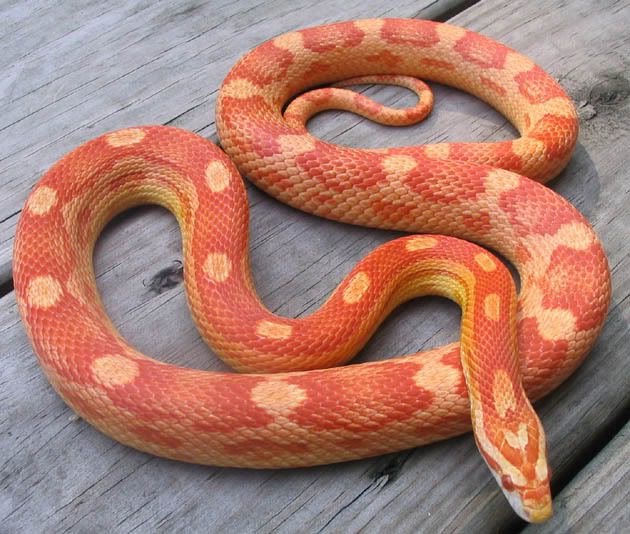
Thanks Tim. Thats just what I needed to know. I will buy me a Female Sunglow Motley when the Reptile Show hits town in 2 months. I figured out how to post pics. Here is one of my babies, they all look alike. Is this a normal corn? They have alot of orange in them. Motley maybe? Cant tell. By the way, the babies were not planned.. Just had my 2 pet snakes in the same 40 gal tank. Did not even know I had a male and a female. I hatched out all 13 eggs with my homemade incubator. Tube of water & a aquarium heater, worked perfect. BTW been keepin snakes for 25 years just never bred them...

actechwjw
Jul 24, 2010 02:22 PM
Pic of the whole clutch...

" alt="Image">
a153fish
Jul 24, 2010 03:09 PM
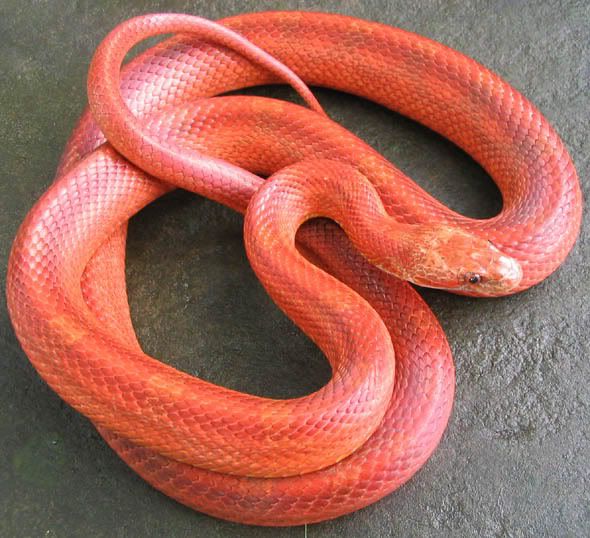
Sometimes some genes will effect the offspring even if they are just hets. Like for instance Bloodred bred to a normal will give normal babies all het for bloodred but many will show an influence from the bloodred gene. Now you may not need to buy a female sunglow motley(SM), unless you want to buy an adult? Since all your babies will be 100% het for sunglow motley all you need is to hold back a female or a pair. If you want quicker results or a total clutch of sunglow motley then you will need to buy a female. Your babies bred back to the Dad will result in about 50% SM, and a pair of babies bred together will give you I think 25% SM. Someone correct me if I got it wrong. I can never remember the numbers, lol. Here is a Normal corn showing the bloodred influence, but still considederd normal, het for Bloodred and hypo. Dad was bloodred mom was hypo. Now not all of them came out like this. Only a few had red bellies.

-----
King Snakes! Who can make a better mouse trap?
J Sierra
tspuckler
Jul 24, 2010 04:16 PM
Bloodred isn't a simple recessive genetic trait. It's a combination of diffused sided (which is recessive) and an abundance of red pigmentation (which is not recessive). The "abundance of red pigment" aspect of bloodreds works the same way as Miami Corns or Okeetee Corns would work if bred back to a normal corn - some of the offspring would look "Miamish" or "Okeeteeish" but they wouldn't be hets for anything. Nor would they be Miamis or Okeetees (although the definition of each is somewhat subjective).
If a bloodred were bred to a normal, some of the offspring might have increased red or reduced belly checkering, but none would be bloodred (though some would be "bloodredish" ). Because diffused sided is a recessive trait, none of the babies would be bloodreds.
There really is no such thing as "het bloodred" since the only thing the snake can be het for is diffused sided.
There might be a situation where an otherwise normal corn snake has an exceptional amount of red pigmenttaion and also happens to be het for diffused sided AND is being bred to a bloodred - but I still wouldn't call it a het in the conventional sense.
And in response to the OP - all those babies in the photos are normals.
Tim
Third Eye
actechwjw
Jul 24, 2010 05:21 PM
Thanks for the info guys. I will be keeping 1 baby for myself, just as a pet, cause my first clutch gotta keep 1 right. Im going to get a female sunglow motley from the reptile show to breed with my male sm. We have a small reptile show at Petco every last Friday of the month here in Memphis. Just bought some deli cups online to take my babies in to sell at the show. Wish me luck.
ajfreptiles
Jul 24, 2010 09:13 PM
I have a Plasma male and was told it was a Bloodred and Lavender combo...will that not pass on the bloodred gene? Will it only be Diffused sided? Thanks for the info!
Andy
-----

a153fish
Jul 25, 2010 09:04 AM
I'll let Tim answer this one.
-----
King Snakes! Who can make a better mouse trap?
J Sierra
Shiari
Jul 25, 2010 11:12 AM
Bloodred and Diffused are used interchangeably by a lot of people. Slowly, bloodred is being used to specifically refer to animals that are homozygous for only one trait (diffused) and line bred for deep reds with very little pattern. Thus, bloodred isn't "just" a simple recessive trait. It's like sunglows. Those are amels specifically bred to have little to no white, and vibrant colors. An animal cannot be het sunglow... but can be het amel from sunglow lines. The same with ROs.
a153fish
Jul 25, 2010 09:01 AM
Bloodred isn't a simple recessive genetic trait. It's a combination of diffused sided (which is recessive) and an abundance of red pigmentation (which is not recessive). The "abundance of red pigment" aspect of bloodreds works the same way as Miami Corns or Okeetee Corns would work if bred back to a normal corn - some of the offspring would look "Miamish" or "Okeeteeish" but they wouldn't be hets for anything. Nor would they be Miamis or Okeetees (although the definition of each is somewhat subjective)."
This is why I said they show an influence from the bloodred. So you don't think a corn snake can be het for bloodred? I think I understand what you are saying but it's kinda splitting hairs isn't it? Bloodred is almost synominous with diffused. Well let's say all bloodreds are diffused but not all diffused look like a true bloodred?
-----
King Snakes! Who can make a better mouse trap?
J Sierra
tspuckler
Jul 25, 2010 10:25 AM
How is it splitting hairs?
A snake cannot be het for Miami or Okeetee, right?
Excessive red pigmentation works the same way as those two phases of corns.
Hypererythrism (excessive red) is not a simple recessive genetic trait - it is inherited at varying levels (each individual offspring is different).
A simple recessive gentic trait is an "all or nothing" scenario - hypererythrism is not. Therefore a snake cannot be het for it (just like a snake cannot be het for Miami or Okeetee).
A snake can be het for diffused sided, but not hypererythrism. Even if it could, the snake would be a "double het" since two genes are at play.
Selling something as a het implies that it needs to match up its recessive gene with another snake carrying that gene in order to make more of the morph. This is not the case with bloodreds. Call it "splitting hairs" if you like, but to me it's a pretty big difference.
And to the person who posted the plasma questions. No, the red is not inheritable in a simple recessive genetic sort of way. Though the snake still could very well have been the result of a bloodred combo.
Tim
draybar
Jul 25, 2010 10:42 AM
>>How is it splitting hairs?
>>
>>A snake cannot be het for Miami or Okeetee, right?
>>
>>Excessive red pigmentation works the same way as those two phases of corns.
>>
>>Hypererythrism (excessive red) is not a simple recessive genetic trait - it is inherited at varying levels (each individual offspring is different).
>>
>>A simple recessive gentic trait is an "all or nothing" scenario - hypererythrism is not. Therefore a snake cannot be het for it (just like a snake cannot be het for Miami or Okeetee).
>>
>>A snake can be het for diffused sided, but not hypererythrism. Even if it could, the snake would be a "double het" since two genes are at play.
>>
>>Selling something as a het implies that it needs to match up its recessive gene with another snake carrying that gene in order to make more of the morph. This is not the case with bloodreds. Call it "splitting hairs" if you like, but to me it's a pretty big difference.
>>
>>And to the person who posted the plasma questions. No, the red is not inheritable in a simple recessive genetic sort of way. Though the snake still could very well have been the result of a bloodred combo.
>>
>>Tim
bloodred is a morph...two bloodreds give you bloodreds a bloodred and a normal gives you het bloodreds...otherwise how could people like Don S and others sell bloodreds and blood red anerys and so on....are they wrong? Or is it that not everyone has accepted the diffused name for what has been called bloodreds for many many years?
-----
Corn snakes and rat snakes...No one can have just one.
"Resistance is futile"
Jimmy Johnson
(Draybar)
Draybars Snakes
_____
tspuckler
Jul 25, 2010 11:01 AM
I think we all agree that diffused is a simple recessive genetic trait, right?
From the Corn Snake Manual, year 2000 edition, page 117, Bloodred section:
"The tendency for the ground color to match the blotch color may be a form of hypererythrism (an abnormally excessive amount of red pigment), although it is inherited variably from individual to individual, not like a simple recessive trait."
There are two traits at play. One simple recessive, one not. A normal corn snake cannot be het for bloodred.
Tim

Third Eye
draybar
Jul 25, 2010 11:07 AM
>>I think we all agree that diffused is a simple recessive genetic trait, right?
>>
>>From the Corn Snake Manual, year 2000 edition, page 117, Bloodred section:
>>
>>"The tendency for the ground color to match the blotch color may be a form of hypererythrism (an abnormally excessive amount of red pigment), although it is inherited variably from individual to individual, not like a simple recessive trait."
>>
>>There are two traits at play. One simple recessive, one not. A normal corn snake cannot be het for bloodred.
>>
>>Tim
>>
>>Third Eye
well I guess we better tell everyone that sells them they are all liars.
-----
Corn snakes and rat snakes...No one can have just one.
"Resistance is futile"
Jimmy Johnson
(Draybar)
Draybars Snakes
_____
Shiari
Jul 25, 2010 11:15 AM
It's not lying at all. Diffused is, frankly, the better term especially when not-red genes are added into the mix. I've seen people be confused that "anery bloodreds" aren't red. I've also seen animals carrying the diffused gene labeled as "bloodred" that are very poorly diffused... and not at all red. They look like slightly diffused normals.
So... bloodred is slowly turning into a term like sunglow, or RO.
draybar
Jul 25, 2010 11:42 AM
>>It's not lying at all. Diffused is, frankly, the better term especially when not-red genes are added into the mix. I've seen people be confused that "anery bloodreds" aren't red. I've also seen animals carrying the diffused gene labeled as "bloodred" that are very poorly diffused... and not at all red. They look like slightly diffused normals.
>>
>>So... bloodred is slowly turning into a term like sunglow, or RO.
but as long as diffused is not the accepted term accross the entire hobby/business then bloodred is still an acceptible term even if it is somewhat misleading.
As long as people like Don Soderberg can still have recessive bloodreds I will still say two bloodreds give you bloodreds and a normal with a bloodred gives you het bloodreds.
just a little snip-it from Don's site
Bloodred (anerythristic A)
Pantherophis guttatus
The combination of the anerythristic "A" and bloodred recessive genes results in this beautiful corn. Unlike the pewters, all the males in this bloodline develop an "overspray" affect of coral or pink throughout most of the dorsal and lateral markings. Some of the females do also. There are trace amounts of yellow on the throats of most adults too.
if he calls bloodred a recessive gene I will defer to him over most sorry
-----
Corn snakes and rat snakes...No one can have just one.
"Resistance is futile"
Jimmy Johnson
(Draybar)
Draybars Snakes
_____
tspuckler
Jul 25, 2010 12:04 PM
Jimmy,
I challenge to find someone who has bred a bloodred to a "het" bloodred and had the results be 50% bloodred offspring. Pics would be needed as proof.
Tim
draybar
Jul 25, 2010 12:12 PM
>>Jimmy,
>>
>>I challenge to find someone who has bred a bloodred to a "het" bloodred and had the results be 50% bloodred offspring. Pics would be needed as proof.
>>
>>Tim
ask Don and kathy and Tim (of T&J) and the many others who breed them and sell them every day as a simple recessive gene.
I don't work with them because I have always though of it as misleading...answer me this..can you breed a het diffused to a het diffused and get 50% diffused...if you can then you are talking the exact same thing. Diffused is the NEW term for Blood red. Not everyone as adopted this.
-----
Corn snakes and rat snakes...No one can have just one.
"Resistance is futile"
Jimmy Johnson
(Draybar)
Draybars Snakes
_____
tspuckler
Jul 25, 2010 04:55 PM
I've bred bloodreds for 10 years. I know how the gene works. I also explained how the gene works and used a reference from a well-known breeder. That's about as far as I'm going to go with this. If you don't believe me (or the reference I used) that's cool. But I have yet to see any proof that bloodred is a simple recessive genetic trait. It can't be (based on the information I provided).
I asked for proof that if a bloodred is bred to a "het" that 50% of the clutch be bloodred babies. I haven't seen that yet. Bloodreds have been around for quite some time. If it were a simple recessive genetic trait, someone should be able to prove it using the manner described above...I'm still waiting.
If bloodred is the combination of two traits, there's no way a normal looking snake can be het for it. At best, it would be a double het. This is the same for any normal-looking corn snake carrying two recessive traits. I don't see the reason why that's so difficult for you to understand.
Forget about what people are marketing their animals as and look at the genetics - it's pretty simple.
Tim
a153fish
Jul 25, 2010 04:50 PM
This kind of sprung from the picture I posted of what I called a Het for bloodred animal and said it showed influence. How do you explain the red belly on two out of the four babies I got from that pairing with a non diffused hypo female? It is showing some influence of the bloodred or diffused even though it is actually just a normal het for bloodred or diffused.
-----
King Snakes! Who can make a better mouse trap?
J Sierra
tspuckler
Jul 25, 2010 05:01 PM
There's a difference between a het - which implies an animal is carrying a simple recessive genetic trait and "showing influence" which is not a simple recessive genetic trait.
A corn snake can have Okeetee influence (not recessive) or even Yellow Rat Snake influence (not recessive). As stated in the quote I took from the CSM the hyererythristic characteristics are expressed in varying degrees in offspring - that's not the charcteristic of a simple recessive genetic trait.
Tim
Shiari
Jul 25, 2010 05:05 PM
To further this, my homozygous diffused bloodred.... has a mostly *white* belly. He only gets a red ventrum past his vent.
a153fish
Jul 25, 2010 04:46 PM
I think we are both in agreement it is just a matter of terms. I have a bloodred that was sold to me as a bloodred but it is really more of a bloodOrange, lol. I think it is like Drabar said, that the term diffused is not completely adopted and so people think of a diffused animal as a bloodred even if the animal is not red at all. I have seen many snakes sold as bloodred amber, or Bloodred whatever. Again technically you are right they should probably be called diffused Amber and what not.
-----
King Snakes! Who can make a better mouse trap?
J Sierra
tspuckler
Jul 25, 2010 05:09 PM
I think most of the diffused patterned animals have their own names (plasma, pewter, etc.). The point I've been repeatedly try to make here is that bloodred consists of two genes - it is not a simple recessive genetic trait.
And as I said before, diffused is a simple recessive genetic trait. Bloodred and diffused are not the same thing (despite some people using the terms interchangeably). To call a normal-looking snake het for bloodred is not correct.
I think I've been making the same point over and over again in this thread - what's so difficult to understand?
Do you agree that two traits are at play? If so, how can a normal-looking snake be het for bloodred? At best it could be a double het. That's how every other simple recessive morph works.
Tim
draybar
Jul 25, 2010 05:56 PM
>>I think most of the diffused patterned animals have their own names (plasma, pewter, etc.). The point I've been repeatedly try to make here is that bloodred consists of two genes - it is not a simple recessive genetic trait.
>>
>>And as I said before, diffused is a simple recessive genetic trait. Bloodred and diffused are not the same thing (despite some people using the terms interchangeably). To call a normal-looking snake het for bloodred is not correct.
>>
>>I think I've been making the same point over and over again in this thread - what's so difficult to understand?
>>
>>Do you agree that two traits are at play? If so, how can a normal-looking snake be het for bloodred? At best it could be a double het. That's how every other simple recessive morph works.
>>
>>Tim
what is the second gene...one is diffused right? what is the second one?
don't get pissed, I am asking to learn.
-----
Corn snakes and rat snakes...No one can have just one.
"Resistance is futile"
Jimmy Johnson
(Draybar)
Draybars Snakes
_____
draybar
Jul 25, 2010 06:30 PM
>>>>I think most of the diffused patterned animals have their own names (plasma, pewter, etc.). The point I've been repeatedly try to make here is that bloodred consists of two genes - it is not a simple recessive genetic trait.
>>>>
>>>>And as I said before, diffused is a simple recessive genetic trait. Bloodred and diffused are not the same thing (despite some people using the terms interchangeably). To call a normal-looking snake het for bloodred is not correct.
>>>>
>>>>I think I've been making the same point over and over again in this thread - what's so difficult to understand?
>>>>
>>>>Do you agree that two traits are at play? If so, how can a normal-looking snake be het for bloodred? At best it could be a double het. That's how every other simple recessive morph works.
>>>>
>>>>Tim
>>
>>
>>
>>what is the second gene...one is diffused right? what is the second one?
>>don't get pissed, I am asking to learn.
actually if you are saying diffused has nothing to do with bloodred then what are the TWO or genes
can't be het snow...it's het anery het amel
can't be het bloodred so what are the two genes that do make bloodred?
-----
Corn snakes and rat snakes...No one can have just one.
"Resistance is futile"
Jimmy Johnson
(Draybar)
Draybars Snakes
_____
tspuckler
Jul 25, 2010 07:03 PM
Bloodred is hypererythrism and diffused. Those are the two genes.
Diffused is a simple recessive genetic trait.
Hypererythrism is not.
Tim
KevinM
Jul 26, 2010 01:27 PM
I have to agree with Tims assessment of the genetics involved with Bloodred. It is a combination of the diffused gene, plus linebreeding for the ultra red coloration. Just like line breeding has been done for Okeetee and Miami phase animals. Outcrossed "blood reds" rarely show the uniform coloration and line breeding is required to refine the stocks look into the classic example of a blood red corn. If you breed a normal WC to a blood red, then bred the babies back to the bloodred parent, they will be diffused patterned (recessive gene), but probably not near as uniformly red colored as the parent pending its quality.
draybar
Jul 25, 2010 10:30 AM
>>This is why I said they show an influence from the bloodred. So you don't think a corn snake can be het for bloodred? I think I understand what you are saying but it's kinda splitting hairs isn't it? Bloodred is almost synominous with diffused. Well let's say all bloodreds are diffused but not all diffused look like a true bloodred?
I think you basically sumed it up with that paragraph.
there are still many many people who list animals as het bloodred. Not everyone has adopted diffused as the more correct name. The originals were slective bred diffused animals that had the true "blood-red" look but they were outcrossed and bred as much or more for the diffusion as the color and the name "blood-red" just doesn't fit.. at least not unless it has the true look.
-----
Corn snakes and rat snakes...No one can have just one.
"Resistance is futile"
Jimmy Johnson
(Draybar)
Draybars Snakes
_____
